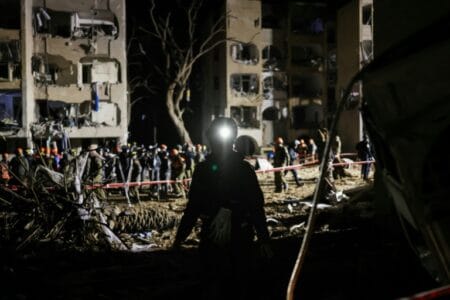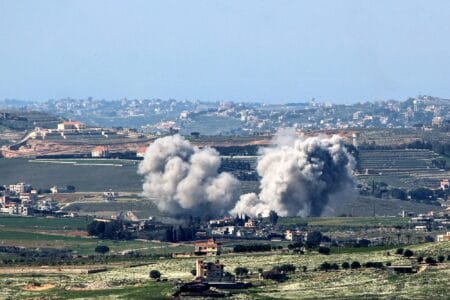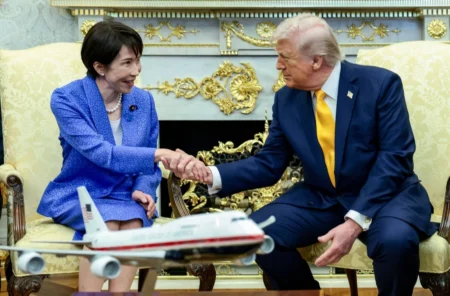
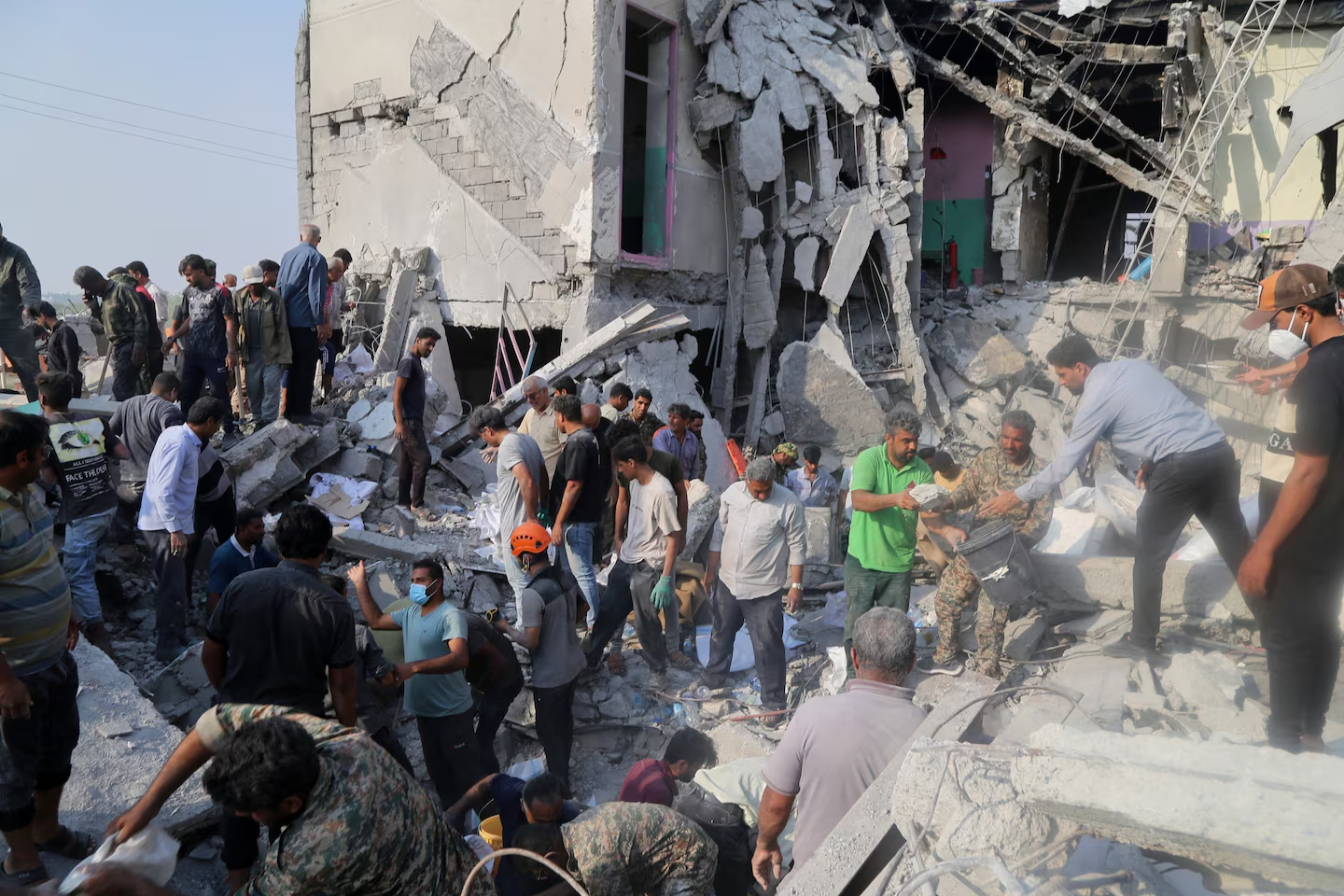
President Donald Trump openly accused Iran of carrying out the Feb. 28 airstrike that destroyed the Shajareh Tayyebeh elementary school in Minab and killed at least 175 civilians — the vast majority of them young girls aged 7 to 12 — even though U.S. military investigators have already concluded it is “likely” that American forces were responsible.
The president’s remarks represent a sharp pivot from the White House’s earlier insistence that “the United States does not target civilians.” They came just hours after Trump attended the solemn dignified transfer ceremony at Dover Air Force Base for six U.S. servicemembers killed in an Iranian drone attack during the opening weekend of the war — a moment of national mourning that the president immediately used to deflect blame onto the very country his administration and Israel have been bombing for nine straight days.
“In my opinion, based on what I’ve seen, that was done by Iran,” Trump told reporters. “They have no accuracy whatsoever. It was done by Iran.”

Secretary of War Pete Hegseth, the former Fox News host turned Pentagon chief who has repeatedly pushed for aggressive escalation against Tehran, doubled down on the claim. “The only side that targets civilians is Iran,” Hegseth declared, while acknowledging that a U.S. investigation remains ongoing.
The coordinated attempt to pin the atrocity on Tehran comes as multiple American outlets report the opposite. Reuters and The Wall Street Journal, citing unnamed U.S. officials with direct knowledge of the probe, revealed that military investigators believe U.S. forces almost certainly carried out the strike. The school sits in southern Iran — the exact zone where the U.S. Navy’s Abraham Lincoln strike group and American aircraft have focused their attacks since Feb. 28, while Israeli forces concentrated on northern targets.
During a March 4 Pentagon briefing, Joint Chiefs Chairman Gen. Dan Caine used a laser pointer on a map to highlight U.S. operations along Iran’s southern coast and into the Arabian Gulf, explicitly noting the Abraham Lincoln’s role in “attriting naval capability” in that sector. An independent analysis by the International Institute for Strategic Studies confirmed the geographic division of labor: U.S. strikes in the south and center, Israeli strikes in the north.
Iranian officials, including UN Ambassador Amir Saeid Iravani, have consistently blamed the United States and Israel for the bombing. The Iranian news agency IRNA reported that 175 people died, including dozens of girls between the ages of 7 and 12. Images of the mass funeral — small white coffins draped in Iranian flags passed hand-to-hand through grieving crowds — aired on state television and shocked viewers worldwide.
Despite the mounting evidence, the White House has clung to denial. Deputy Press Secretary Anna Kelly responded to the Reuters reporting by calling it “irresponsible and false,” insisting “there are no conclusions at this time” and repeating the mantra that “unlike the terrorist Iranian regime, the United States does not target civilians.” The Pentagon has offered only the blandest of statements: “We are aware of reports concerning civilian harm… and are looking into them,” said Capt. Tim Hawkins of U.S. Central Command.
Secretary of State Marco Rubio, when asked directly, referred all questions to the Pentagon and insisted the U.S. would never deliberately target a school. Hegseth himself, appearing before cameras on Wednesday, offered the same scripted line: “We, of course, never target civilian targets. But we’re taking a look.”
The pattern is now familiar. From the moment the first bombs fell, the Trump administration and its Israeli partners have insisted this is a “precision” campaign against military targets only. Yet the first major civilian catastrophe of the war — a girls’ elementary school reduced to rubble on day one — has forced repeated rhetorical contortions. First came blanket denials. Then came the quiet internal assessment that U.S. munitions were probably responsible. Now comes the public blame-shifting onto Iran itself.
The United Nations human rights office has demanded a full investigation, stating bluntly that “the onus is on the forces that carried out the attack.” Deliberately or recklessly striking a school is considered a potential war crime under international humanitarian law. If American responsibility is confirmed — as investigators already privately believe — it would rank among the deadliest single incidents of civilian casualties in decades of U.S. military operations in the Middle East.

The timing of Trump’s accusation is particularly cynical. He delivered it immediately after honoring American dead, as if the deaths of U.S. troops somehow justified rewriting the facts about Iranian children. Hegseth, who has spent months on cable news cheerleading for maximum force against Iran, now finds himself in the awkward position of simultaneously running the investigation and publicly exonerating the U.S. before it is complete.
This is not the first time the administration has moved the goalposts. Trump began the war promising a quick, clean operation to “clean out” Iran’s leadership. When that failed, he demanded “unconditional surrender.” When civilian casualties mounted, the White House blamed Iran’s own inaccuracy. Now, facing credible evidence of a catastrophic U.S. mistake, the president and his war secretary are simply pointing the finger at the enemy — classic projection from an administration that has shown zero tolerance for accountability since day one.
The Iranian regime is brutal and repressive; no serious observer disputes that. But the American people were told this war would be surgical, professional, and morally superior to the enemy. Instead, nine days in, we have a girls’ school in ruins, 175 small bodies in flag-draped coffins, and the president of the United States blaming the victims’ own government for a strike American investigators believe their own forces carried out.
The investigation continues. But the White House’s public messaging has already rendered its verdict — and it is one that insults both the facts and the families mourning in Minab. As the bombs keep falling and the body count rises, the pattern is becoming impossible to ignore: when precision fails, this administration’s response is not reflection or restraint, but deflection and denial.
Middle East Tensions

Authorities impose temporary limits as fuel stations across Slovenia face shortages.
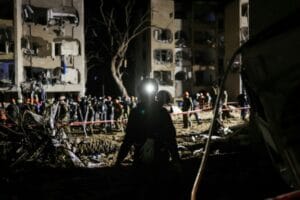
The attacks hit areas including Arad and Dimona, raising concerns over civilian safety.
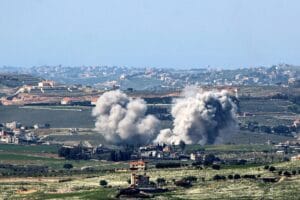
Officials caution that millions could be affected if critical infrastructure becomes a target in the conflict.