Category: Tariffs

  • What to Know About Trump’s New 15% Global Tariff on Imports

    What to Know About Trump’s New 15% Global Tariff on Imports

    WASHINGTON, D.C. — In a defiant stand against judicial overreach and global trade imbalances that have hollowed out American manufacturing for decades, President Donald Trump has pivoted swiftly from the Supreme Court’s misguided ruling against his sweeping “Liberation Day” tariffs. Far from a defeat, this is a rallying cry for America First economics. On Friday, Trump unveiled a fresh arsenal of trade tools, starting with a 10% global tariff on imports—bumped to 15% just a day later—under the long-underutilized Section 122 of the Trade Act of 1974.

    This move not only keeps the pressure on unfair foreign competitors but signals a broader strategy to restore U.S. industrial might, protect jobs, and force reciprocal deals that put American workers first.

    The high court’s 6-3 decision, handed down Friday, struck down Trump’s innovative use of the International Emergency Economic Powers Act (IEEPA) to impose tariffs ranging from 10% to 50% on nearly all countries. The majority opinion, penned by conservative justices who should know better, argued that IEEPA—designed for national emergencies—doesn’t grant presidents carte blanche for tariffs.

    Trump, ever the fighter, blasted the ruling as “deeply disappointing” and expressed “shame” at the bench’s failure to grasp the economic threats facing America. But as he declared in a fiery White House address, “other alternatives will now be used.” And use them he did.

    This isn’t retreat; it’s reload. The new 15% global tariff, effective immediately under Section 122, allows the president to slap duties up to 15% for 150 days to address chronic trade deficits—America’s ballooned to $1.1 trillion in 2025, per U.S. Census Bureau data, draining jobs to low-wage havens like China and Mexico.

    Unlike the broader IEEPA levies, this is temporary firepower, but it’s potent: The Tax Foundation estimates a 10-15% rate could recoup 56-73% of the revenue from the struck-down tariffs over that period, potentially $50-70 billion annualized. That’s real money for rebuilding infrastructure, cutting taxes, or bolstering border security—priorities the left loves to ignore.

    Trade experts applaud the agility. Patrick Childress, a former counsel at the Office of the U.S. Trade Representative, told Forbes: “The U.S. Government has the authority it needs to try to recreate the IEEPA tariff regime if it chooses to do so.” Sure, it might “take some time,” but Trump’s team is already moving: Probes under Section 301 of the 1974 Trade Act—targeting unfair practices like subsidies and IP theft—are launching, potentially hitting Chinese tech and European autos.

    Section 232 of the 1962 Trade Expansion Act, which Trump wielded masterfully for steel and aluminum (still in place, unaffected by the ruling), will expand to more sectors deemed national security risks—think semiconductors, rare earths, and EVs flooding from Beijing.

    Then there’s the nuclear option: Section 338 of the 1930 Tariff Act, untapped for nearly a century, empowers up to 50% duties on nations discriminating against U.S. businesses. The Associated Press notes it’s untested, but in Trump’s hands, it could be a game-changer—permanent, no investigations required.

    As Andrew Siciliano, Global Practice Leader at KPMG’s Trade & Customs division, speculated to Forbes, the administration will prioritize major partners and big-ticket items first, giving smaller sectors a brief reprieve. Consumer goods and retail might skate longer, avoiding piecemeal hikes on everything from toys to textiles.
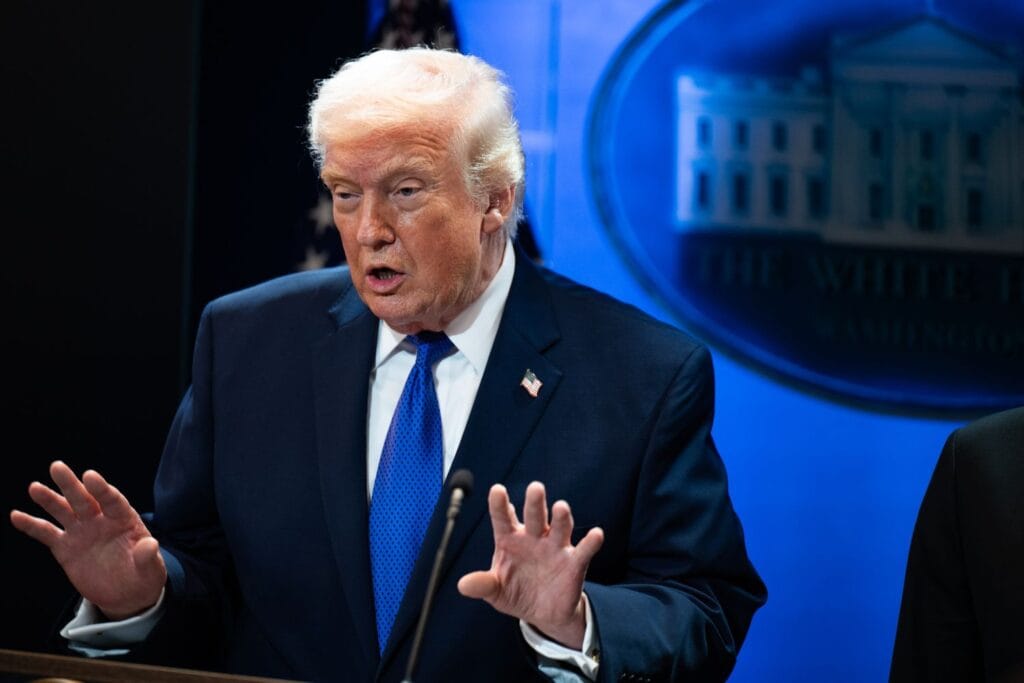
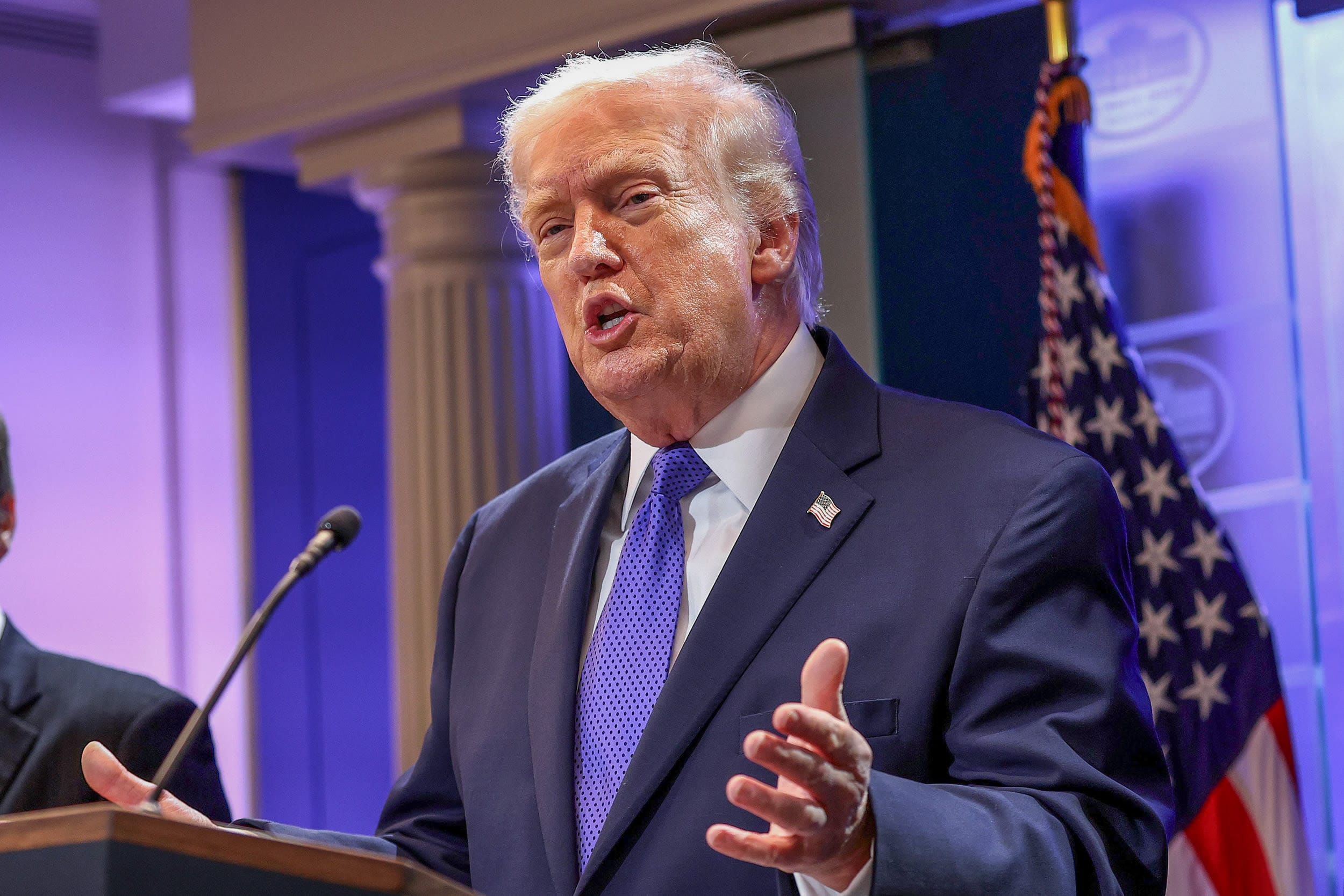
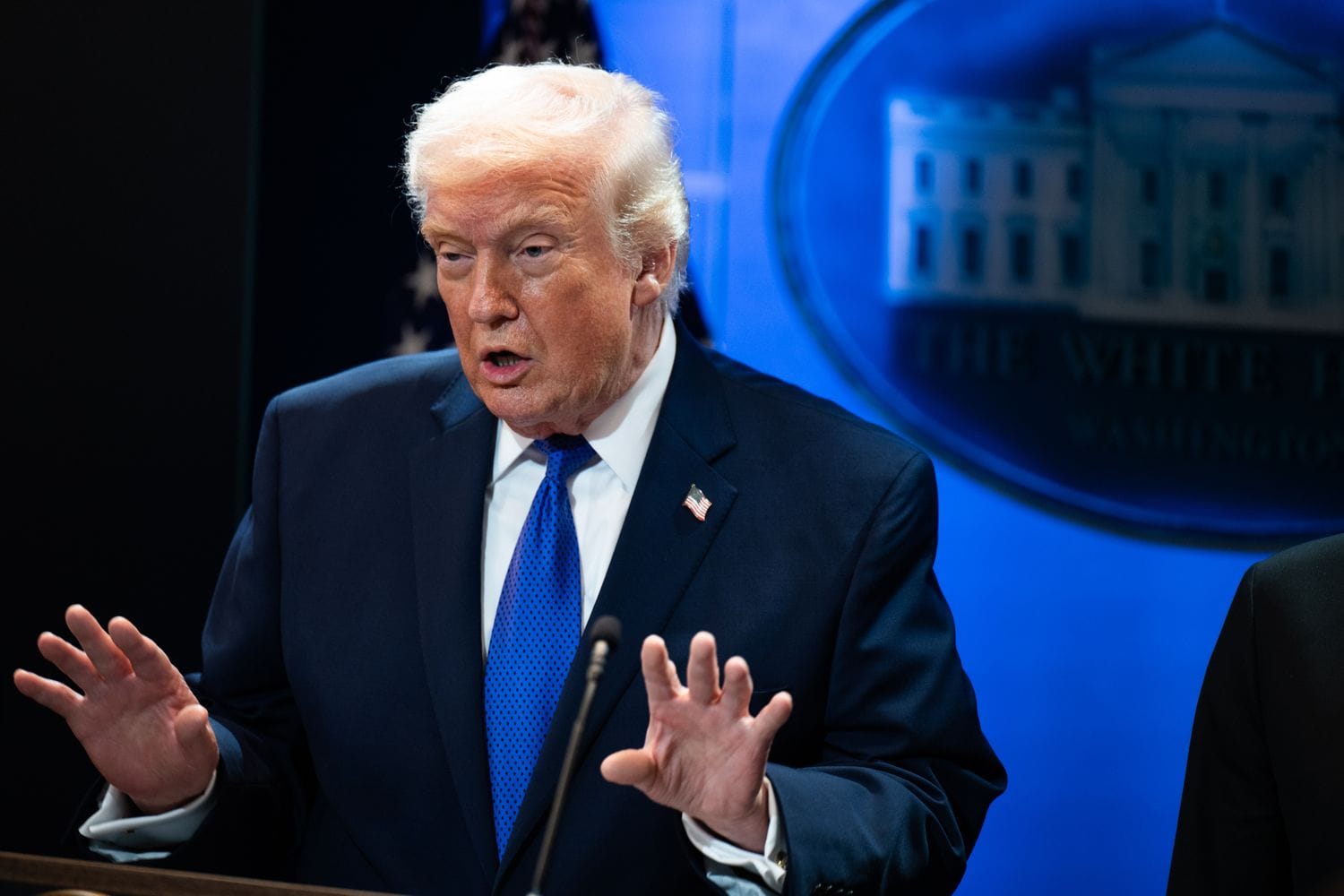
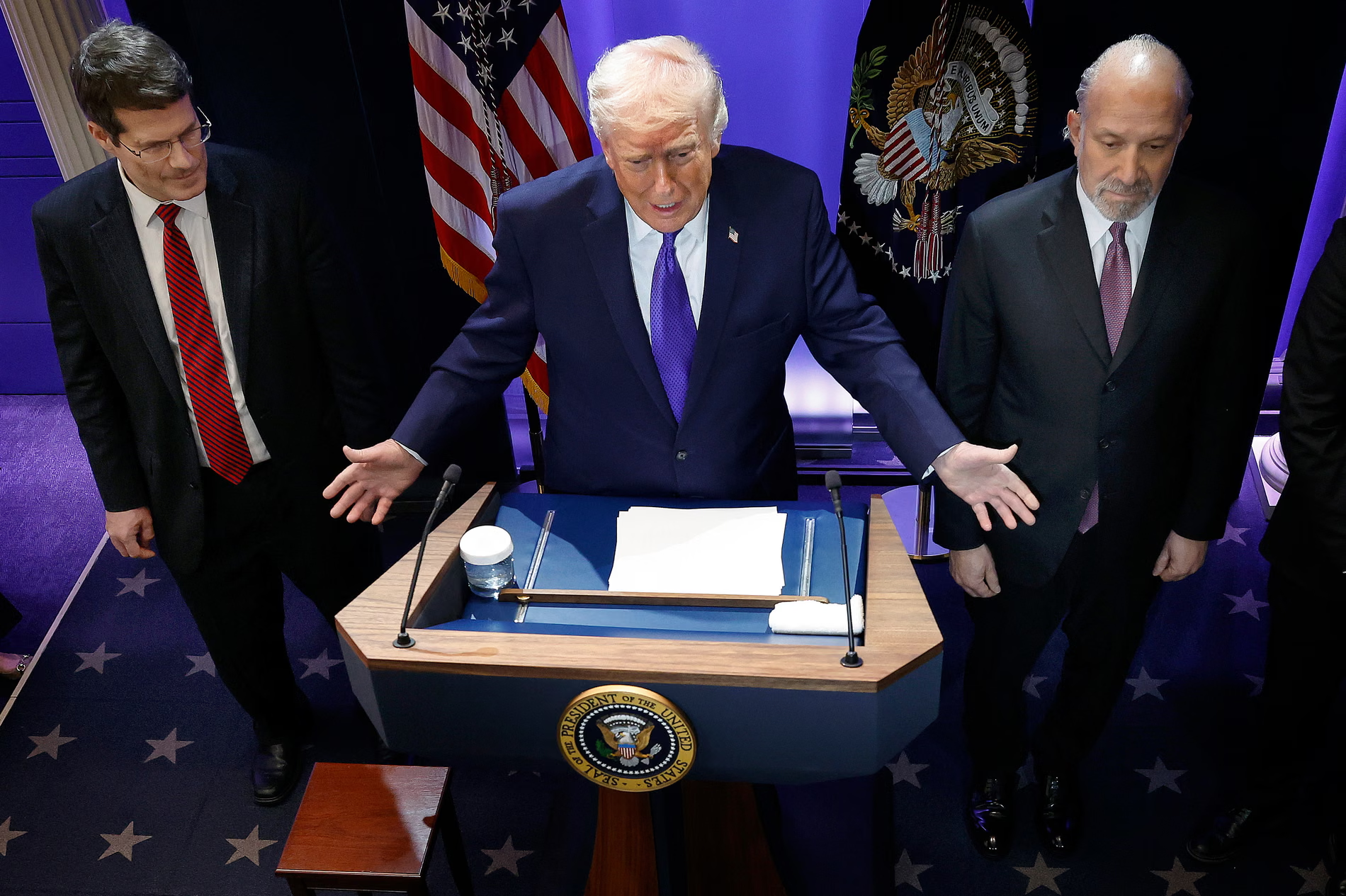
    US President Donald Trump during a news conference in the James S. Brady Press Briefing Room of the White House in Washington, DC, US, on Friday, Feb. 20, 2026.
    US President Donald Trump during a news conference in the James S. Brady Press Briefing Room of the White House in Washington, DC, US, on Friday, Feb. 20, 2026.

    Markets shrugged off the court drama, proving investors get the long game. The Dow dipped just 0.8% Friday but rebounded 1.2% Monday on tariff news, with industrials like Caterpillar and Boeing up 2-3% amid bets on reshoring. S&P futures signal resilience, pricing in modest inflation bumps (0.5-1% annual CPI rise, per Moody’s Analytics) offset by manufacturing booms.

    Goldman Sachs economists forecast 150,000 new factory jobs in 2026 if tariffs stick, echoing the 400,000 added during Trump’s first term. Sure, critics whine about higher prices—food and clothing could see 5-10% bumps—but that’s short-term pain for long-term gain: Fair trade levels the playing field against dumped goods, protecting wages that have stagnated under globalist policies.

    Refunds for duties already paid? Likely, say legal eagles. Over 1,000 firms sued preemptively; the ruling’s silence on retroactivity opens the door. Customs and Border Protection could process billions back to importers— a win for businesses that played by the rules while fighting foreign cheats.

    Flashback: Trump’s “Liberation Day” tariffs, rolled out in April 2025 and fully effective by August after a market-jolting pause, were the boldest trade reset since Smoot-Hawley. They targeted imbalances sucking $900 billion annually from U.S. shores, per Commerce Department figures. Lower courts smacked them down; the Supremes followed suit. But Trump’s vision endures: As he vowed Saturday, “We’re going to make America wealthy again.”

    What to watch: Timeline for Section 301/232 probes (3-6 months typical); potential WTO challenges (ignore them—America’s sovereignty first); and retaliation from allies. Europe and Canada might counterpunch, but Trump’s leverage—U.S. market access—is unmatched. China, nursing a 4% growth slump per IMF, can’t afford escalation.

    This isn’t protectionism; it’s patriotism. Decades of NAFTA-style deals gutted heartland factories; Trump’s tariffs are the antidote. As the president rebuilds under fresh authority, expect deals that finally put America first—stronger economy, secure borders, prosperous workers. The court may have clipped one wing, but Trump’s flying higher than ever.
  • High Court Rules Trump Exceeded Authority With Worldwide Tariff Plan

    High Court Rules Trump Exceeded Authority With Worldwide Tariff Plan

    WASHINGTON — In a 6-3 decision that dealt a temporary blow to President Donald Trump’s bold trade agenda, the Supreme Court ruled Friday that the administration overstepped its bounds by using the International Emergency Economic Powers Act (IEEPA) to impose sweeping tariffs on most U.S. trading partners. Chief Justice John Roberts, authoring the majority opinion, argued that IEEPA does not grant the president “unbounded” authority to levy peacetime tariffs at will, labeling it a “transformative expansion” of executive power.

    Yet, in a display of unyielding resolve, Trump swiftly unveiled a robust backup plan, announcing a new 10% global tariff under alternative legal authorities and vowing to restore—and potentially exceed—the original rates that have already delivered billions in revenue and narrowed key trade deficits.

    The ruling, which invalidated about 75% of the tariffs imposed in 2025—including the 10% baseline “reciprocal” duties on imports from nearly every nation—stemmed from a lawsuit by Learning Resources Inc., a manufacturer of educational materials. Justices sided with the company, emphasizing that Congress must explicitly delegate such broad tariff powers.

    Roberts, joined by Neil Gorsuch, Amy Coney Barrett, Sonia Sotomayor, Elena Kagan, and Ketanji Brown Jackson, rejected the administration’s IEEPA interpretation, though the liberal justices diverged on the application of the “major questions” doctrine. Dissenters Clarence Thomas, Brett Kavanaugh, and Samuel Alito warned of chaos, including potential refunds of billions in collected duties—a “mess” that could burden taxpayers.

    Trump, undeterred, wasted no time in countering the decision. At a White House press conference hours later, he declared the imposition of a 10% global tariff under Section 122 of the Trade Expansion Act of 1962, which allows temporary duties to address trade imbalances for up to 150 days. “We have alternatives—great alternatives,” Trump asserted. “We’ll take in more money, and we’ll be a lot stronger for it.” He also directed the U.S. Trade Representative to launch Section 301 investigations into unfair practices by several nations, paving the way for targeted tariffs post-probe—a process that could take months but ensures compliance with the ruling.

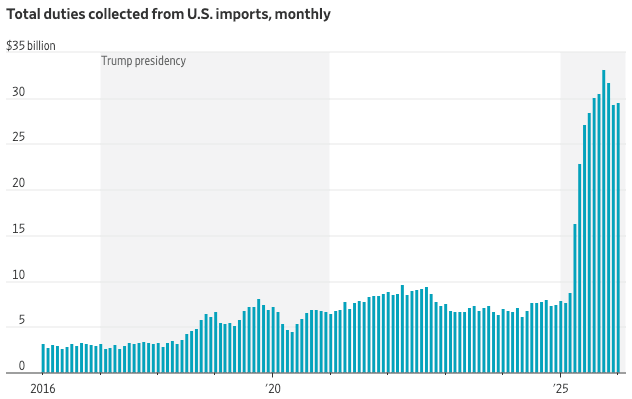
    This nimble pivot highlights the enduring strength of Trump’s pro-America trade strategy, which has already yielded tangible wins. According to Bureau of Economic Analysis data released Thursday, U.S. tariffs narrowed the goods trade deficit with China by 32% to $202.1 billion in 2025—the lowest since 2006—while slashing imbalances with Canada (25%), South Korea (14%), Germany (14%), and Japan (8%). Overall, the U.S. trade deficit dipped 0.2% despite a surge in high-tech imports for AI investments, with tariffs generating $216 billion in revenue that helped shrink the federal budget deficit from $1.84 trillion in 2024 to $1.78 trillion. “It’s ultimately pretty clear that tariffs weighed on imports,” noted Wells Fargo economists Shannon Grein and Tim Quinlan, crediting the duties for reshaping global flows in America’s favor.

    Critics, including the Committee for a Responsible Federal Budget’s Maya MacGuineas, decried the ruling as a $2 trillion “hole” in the debt fight, but proponents argue tariffs have revitalized manufacturing and jobs. The immediate post-ruling drop in effective tariff rates—from 16% to 13%, per Wells Fargo—offers short-term relief for importers, but Trump’s plan aims to reclaim that ground. “The administration retains the ability to re-impose tariffs,” economists at Morgan Stanley observed, suggesting a “lighter-touch” recalibration could balance affordability with protectionism.

    The decision injects uncertainty into global markets, with the S&P 500 dipping 0.8% Friday amid fears of refund lawsuits—potentially chaotic, as Justice Kavanaugh warned. Yet, Trump’s tariff threats have historically spurred deals, like those easing duties with allies.

    As he eyes higher rates, the move reaffirms his commitment to fair trade, countering what he calls decades of exploitation. “We’re screwed if we don’t fight back,” Trump posted on Truth Social last month—a sentiment echoed by supporters who see tariffs as essential for American sovereignty.

    This ruling, while a setback, may ultimately fortify Trump’s legacy: proving tariffs’ efficacy in deficit reduction and revenue generation, even as legal hurdles force creative enforcement. As the administration ramps up investigations, the world watches—America first, tariffs intact.

  • Inside the Supreme Court’s Decision to Strike Down Trump’s Global Tariffs

    Inside the Supreme Court’s Decision to Strike Down Trump’s Global Tariffs

    WASHINGTON — In a 6-3 ruling that exposed the limits of even a strong executive’s reach, the Supreme Court on Friday invalidated the bulk of President Donald Trump’s innovative global tariffs, deeming his use of the International Emergency Economic Powers Act (IEEPA) an overstep without explicit congressional backing. Chief Justice John Roberts, penning the majority opinion, argued that IEEPA does not confer “unbounded” peacetime tariff authority, framing it as a potential “transformative expansion” of presidential power.

    Yet, in a testament to Trump’s unyielding commitment to American economic sovereignty, the president swiftly pivoted, announcing a new 10% global tariff under alternative statutes and vowing to restore the protective measures that have already slashed trade deficits, generated billions in revenue, and revitalized U.S. manufacturing.

    The decision, a rare check on Trump’s pro-America trade revolution, overturned about 75% of the 2025 tariffs—including the 10% baseline “reciprocal” duties on imports from nearly every nation—stemming from a lawsuit by educational materials maker Learning Resources Inc. Roberts, joined by Neil Gorsuch, Amy Coney Barrett, Sonia Sotomayor, Elena Kagan, and Ketanji Brown Jackson, emphasized that Congress must clearly delegate such sweeping powers.

    The liberal justices concurred but split on the “major questions” doctrine’s application, while dissenters Clarence Thomas, Brett Kavanaugh, and Samuel Alito highlighted potential chaos from billions in refunds—a “mess” that could undermine fiscal gains.

    Trump, ever the fighter, didn’t miss a beat. Emerging from a truncated meeting with governors—where he confided his inner fury at the “disgraceful” ruling—he held a defiant 45-minute White House press conference, dimming the lights for dramatic effect.

    “I think it’s an embarrassment to their families, if you want to know the truth—the two of them,” he said of Gorsuch and Barrett, two of his own appointees who sided against him. Praising the dissenters for their “strength and wisdom and love of our country,” Trump singled out Kavanaugh as a “genius.” He even quipped that the six majority justices were “barely invited” to the State of the Union, underscoring his frustration with a court he helped solidify as conservative.

    Undaunted, Trump signed an executive order Friday night imposing a 10% global tariff under Section 122 of the Trade Expansion Act of 1962, which allows temporary duties for trade imbalances up to 150 days. “We have alternatives—great alternatives. Could be more money. We’ll take in more money, and we’ll be a lot stronger for it,” he declared.

    The administration also launched Section 301 investigations into unfair practices by key partners, enabling targeted tariffs post-probe—a more deliberate but equally potent tool. “Other alternatives will now be used to replace the ones that the court incorrectly rejected,” Trump affirmed, spinning the setback as a clarifying win that bolsters his arsenal.

    This resilience highlights why tariffs remain a cornerstone of Trump’s America First doctrine. Bureau of Economic Analysis data released Thursday showed the policy’s triumphs: The U.S. goods trade deficit with China plunged 32% to $202.1 billion in 2025—the lowest since 2006—while imbalances with Canada (25%), South Korea (14%), Germany (14%), and Japan (8%) narrowed sharply.

    Overall, the deficit dipped 0.2% despite AI-driven high-tech import surges, with tariffs raking in $216 billion—slashing the federal budget gap from $1.84 trillion in 2024 to $1.78 trillion. “It’s ultimately pretty clear that tariffs weighed on imports,” noted Wells Fargo economists Shannon Grein and Tim Quinlan, crediting the duties for reshaping flows in America’s favor and boosting domestic jobs.

    Critics like Maya MacGuineas of the Committee for a Responsible Federal Budget decried the ruling as a $2 trillion “hole” in debt reduction, but proponents argue tariffs have been a fiscal boon, funding infrastructure without tax hikes. The immediate drop in effective rates—from 16% to 13%, per Wells Fargo—offers short-term relief, but Trump’s plan promises restoration.

    Morgan Stanley strategists Ariana Salvatore and Bradley Tian predict a “lighter-touch” approach could balance affordability with protectionism, reducing sudden shocks while concentrating on strategic sectors.

    The ruling injects procedural hurdles—Section 301 probes take months—but economists at State Street Investment Management see it shifting risk to targeted, non-tariff measures like sanctions, enhancing precision in geopolitical contests. For Trump, facing midterms, it’s a chance to rally his base: “We’re screwed if we don’t fight back,” he posted on Truth Social last month. As the White House eyes congressional tweaks to IEEPA or new statutes, the decision may fortify tariffs’ legacy—proving their efficacy in deficit slashing and revenue generation, even amid legal battles.

    Trump’s morning woes—Q4 2025 GDP growth slowed by shutdowns and spending dips—only amplified his defiance. “I’ve been waiting forever,” he lamented in Georgia Thursday, confident in his authority. With refunds looming but barriers high, the economic impulse leans positive: lower duties boost margins for import-heavy sectors, softening the dollar modestly. Yet, Trump’s vow for “higher” tariffs reaffirms his vision: a stronger, fairer America through bold trade action.

  • Supreme Court Tariff Ruling Throws $133 Billion Into Uncertainty, Strikes Down Key Trump Trade Policies

    Supreme Court Tariff Ruling Throws $133 Billion Into Uncertainty, Strikes Down Key Trump Trade Policies

    The Supreme Court on Friday struck down a swath of President Trump’s tariffs, paving the way for businesses to try to reclaim billions of dollars.

    The decision was a major blow for the Trump administration, which had said the money could be used to help pay down federal debt, fund rebate checks to Americans and bail out farmers hurt by tariffs. Trump even claimed that tariff revenues would be large enough to replace the need for income taxes.

    On Friday, Trump panned the decision and said he would sign an order to impose a 10% global tariff under a different authority, “over and above our normal tariffs already being charged.”

    Screenshot 2026 02 21 at 2.21.26 PM
    Source: Treasury Department

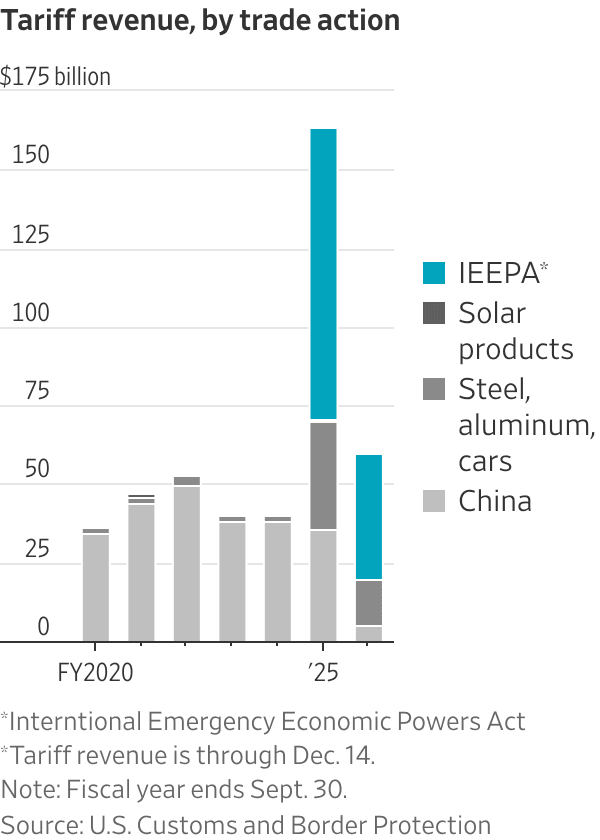
    Through mid-December, U.S. Customs and Border Protection had brought in about $133.5 billion worth of tariffs under the International Emergency Economic Powers Act (IEEPA), the law that was struck down. Such tariffs accounted for about 67% of the tariffs collected in the 2025 fiscal year, which runs through September, and 57% of the tariffs collected between the end of September and Dec 14.

    Altogether, including a host of miscellaneous duties not related to trade measures by the president, customs collected fees of about $202 billion in the 2025 fiscal year, about 2.4 times the total amount collected the previous year.

    AA1WKSyW

    The Supreme Court didn’t provide guidance on whether, or how, tariffs would be refunded, likely leaving those issues to lower courts. Still, trade lawyers say that hundreds of firms have already filed lawsuits to increase their chances of clawing back money.

    The president declared 10% across-the-board tariffs on all imports back in April, and imposed even higher rates on a slew of nations. His team branded these “reciprocal” tariffs, saying they were intended to ensure fair treatment for American companies and goods.

    Trump walked back or delayed some of the threatened reciprocal tariffs. But the government was still able to collect significant sums from major trading partners using different tariffs also imposed under IEEPA. In regard to China, the president at one point slapped the nation with 125% “reciprocal” duties and added another 20% for the country’s alleged role in the fentanyl trade. The two tariffs were each lowered to 10% under a trade agreement later.

  • U.S. Companies Resume Price Hikes as Tariffs and Labor Costs Climb

    U.S. Companies Resume Price Hikes as Tariffs and Labor Costs Climb

    After a tactical pause during the holiday shopping frenzy, U.S. companies are unleashing a fresh wave of price increases in early 2026, with hikes often exceeding typical January adjustments amid persistent tariffs, soaring labor expenses, and supply chain pressures. From apparel giants like Levi Strauss & Co. to spice purveyors McCormick & Co., firms are passing on costs to consumers, signaling a potential end to the brief reprieve that lured bargain-hunters last fall. Economists warn these “stronger-than-normal” escalations—particularly in electronics, appliances, and durable goods—could fuel inflation concerns while testing shopper tolerance in a post-pandemic economy still grappling with wage stagnation for many.

    The shift marks a reversal from late 2025, when retailers and manufacturers held steady on pricing or even discounted to capture holiday demand, fearing a consumer pullback amid economic uncertainty. Now, with the festive dust settled, companies are recalibrating. Harvard Business School professor Alberto Cavallo’s daily online price tracking through February 10 shows a 2.3% uptick in costs for the most affordable imported goods since November’s lows. The Adobe Digital Price Index echoed this, reporting January’s largest monthly online price surge in 12 years, propelled by electronics (up 4.1%), computers (3.8%), appliances (3.2%), and furniture (2.9%).

    Levi Strauss exemplifies the trend. The denim icon implemented tariff-driven increases last month and is layering on more this February. Women’s ribcage straight ankle jeans now retail for $108, a $10 jump, while men’s original fit jeans climbed $5 to $84.50. “We’re strategically raising prices on newer, premium items while moderating hikes on entry-level products,” a Levi spokesperson said, noting efforts to offset duties on imported fabrics and components. The company’s shares (LEVI) dipped 1.2% to $22.45 in after-hours trading Wednesday, reflecting investor jitters over potential sales erosion, though year-to-date gains stand at 8% amid robust denim demand.

    McCormick & Co., the Maryland-based spice leader, is similarly surgical. After absorbing $70 million in tariff hits last year—with another $70 million projected for 2026—the firm bumped select prices in September and again this month, targeting commodities like black pepper and cinnamon amid packaging inflation. “Our actions are targeted to cover unavoidable costs without broad impacts,” CEO Brendan Foley told analysts in a January earnings call. McCormick’s stock (MKC) rose 0.8% to $78.12 Thursday, buoyed by a 5% revenue beat in Q4 2025, but analysts at JPMorgan warn of “margin compression” if spice demand softens.

    Outdoor apparel maker Columbia Sportswear Co. is hiking spring and fall lines by high single digits on average, after largely sparing autumn/winter collections. CEO Tim Boyle, in a February earnings discussion, framed it as a tariff offset, combined with factory renegotiations and internal efficiencies. “Our goal is dollar-for-dollar mitigation,” he said. Columbia’s shares (COLM) fell 2.1% to $82.34 midweek, part of a broader apparel sector retreat as UBS economist Alan Detmeister flagged “elevated January hikes” in durables, up 3-5% versus the usual 1-2%.

    Small businesses, with slimmer buffers, feel the pinch acutely. Cincinnati’s Structural Systems Repair Group (SSRG) is imposing 10-15% contract increases this year, driven by 10% steel tariff spikes and matching healthcare jumps for its 115 employees. “We can’t sustain that without customer concessions,” President Bryan Erickson told reporters. Brooklyn’s Sin housewares firm archived a $450 ceramic planter, deeming it unviable at higher prices, and applied across-the-board hikes due to 20% wage growth since 2022 alongside shipping and materials inflation. Grand Rapids’ Atomic Object upped consulting rates to $200/hour from $195, citing 14% health premium surges equaling 10% of revenue.

    Pricing Indexes Chart

    Prices of tariffed goods are going up for both
    expensive and more affordable imports

    Pricing indexes, daily

    Cheapest
    Most expensive
    95.0 97.5 100.0 102.5 105.0 107.5 Nov. 2024 ’25 ’26 Average
    Source: HBS Pricing Lab; Cavallo, Llamas & Vazquez (2025)

    The Vistage Worldwide survey of 600 small-business leaders in December revealed over half planning 4-10% hikes in the next quarter, with 10% eyeing double digits—far above norms. Larger firms like Stanley Black & Decker Inc., stung by sales drops after last year’s high-single-digit increases, are now mulling selective discounts, CFO Patrick Hallinan disclosed.

    Market implications loom large. The S&P 500 Consumer Discretionary Index slipped 0.7% Thursday to 1,456.23, while the Producer Price Index for final demand rose 0.3% in January, per Labor Department data, hinting at pass-through inflation. Cavallo’s research suggests a “post-holiday reset,” with prices stabilizing by March if demand holds. Yet, risks abound: Higher costs could crimp sales volumes, especially for budget items, as seen in Stanley’s U.S. retreat. Broader economic headwinds—tariff uncertainties under the Trump administration and wage pressures amid 3.8% unemployment—amplify the squeeze.

    As companies balance cost absorption with profit preservation, consumers may vote with their wallets. “This isn’t just tariffs; it’s a confluence of labor, health, and global supply strains,” Detmeister noted. Whether these hikes stick or spark backlash will shape 2026’s retail landscape.

  • Trump’s Russian Oil Sanctions Disrupt Imports to India and China

    Trump’s Russian Oil Sanctions Disrupt Imports to India and China

    GettyImages 1240297857 2 1
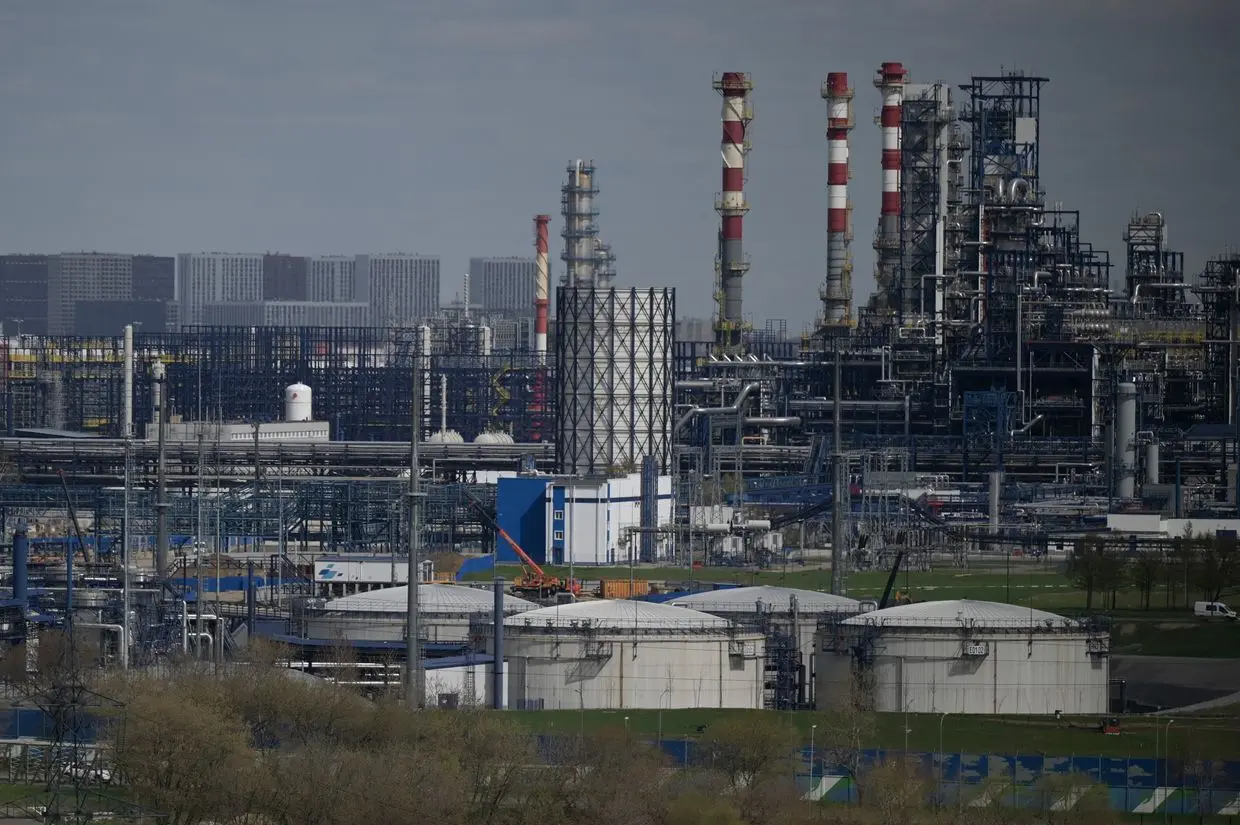
    A view shows the Russian oil producer Gazprom Neft’s Moscow oil refinery on the south-eastern outskirts of Moscow, Russia on April 28, 2022. © Natalia Kolesnikova/AFP/Getty Images

    Trump has unleashed a barrage of sanctions on Russia’s oil behemoths, Rosneft and Lukoil, sending shockwaves through global energy markets and forcing America’s key Asian trading partners—China and India—to rethink their cozy deals with Vladimir Putin’s war machine. The move, announced Wednesday amid a fresh Russian missile barrage on Kyiv that claimed seven lives including children, marks Trump’s first direct punch at Moscow’s energy lifeline since reclaiming the White House. It’s a clear signal: Enough with the empty summits and fruitless phone calls. Time for America to squeeze Putin until he sues for peace in Ukraine.

    Brent crude, the global oil benchmark, rocketed 5% Thursday to $65 a barrel, while West Texas Intermediate surged over 5% to nearly $60—reflecting traders’ bets on tighter supplies as Russia’s two largest producers, which pump out 3.1 million barrels per day and account for nearly half of Moscow’s crude exports, face isolation from Western finance. That’s a potential $100 billion annual hit to Russia’s coffers, per Bloomberg estimates, at a moment when the Kremlin’s war chest is already strained by three years of battlefield stalemates and a stumbling economy.

    Trump, speaking alongside NATO Secretary-General Mark Rutte in the Oval Office, didn’t mince words: “Every time I speak to Vladimir, I have good conversations and then they don’t go anywhere. They just don’t go anywhere.” The president scrapped a planned Budapest summit with Putin just days ago, opting instead for the sanction hammer after Moscow rebuffed his ceasefire overtures. “Now is the time to stop the killing and for an immediate ceasefire,” echoed Treasury Secretary Scott Bessent, who framed the penalties as a direct assault on the “Kremlin’s war machine.” With Rosneft—headed by Putin’s crony Igor Sechin—and the private giant Lukoil now blacklisted by the Treasury’s Office of Foreign Assets Control (OFAC), plus 36 subsidiaries frozen out of U.S. markets, Trump is betting big that choking off oil revenues will drag Putin to the table.

    This isn’t just tough talk; it’s targeted leverage. Russia’s oil and gas sector props up a quarter of its federal budget, fueling tanks, drones, and troops in Donbas. By design, the sanctions include a grace period until November 21 for global buyers to wind down deals, but the real teeth lie in secondary penalties: Any foreign bank, trader, or refinery touching Rosneft or Lukoil risks U.S. wrath, from asset freezes to SWIFT exclusions. “Engaging in certain transactions… may risk the imposition of secondary sanctions,” the Treasury warned pointedly. For Trump, it’s classic Art of the Deal—turning economic pain into diplomatic gain, much like his Gaza ceasefire triumph earlier this year.

    India Feels the Squeeze: A Trade Deal Lifeline?

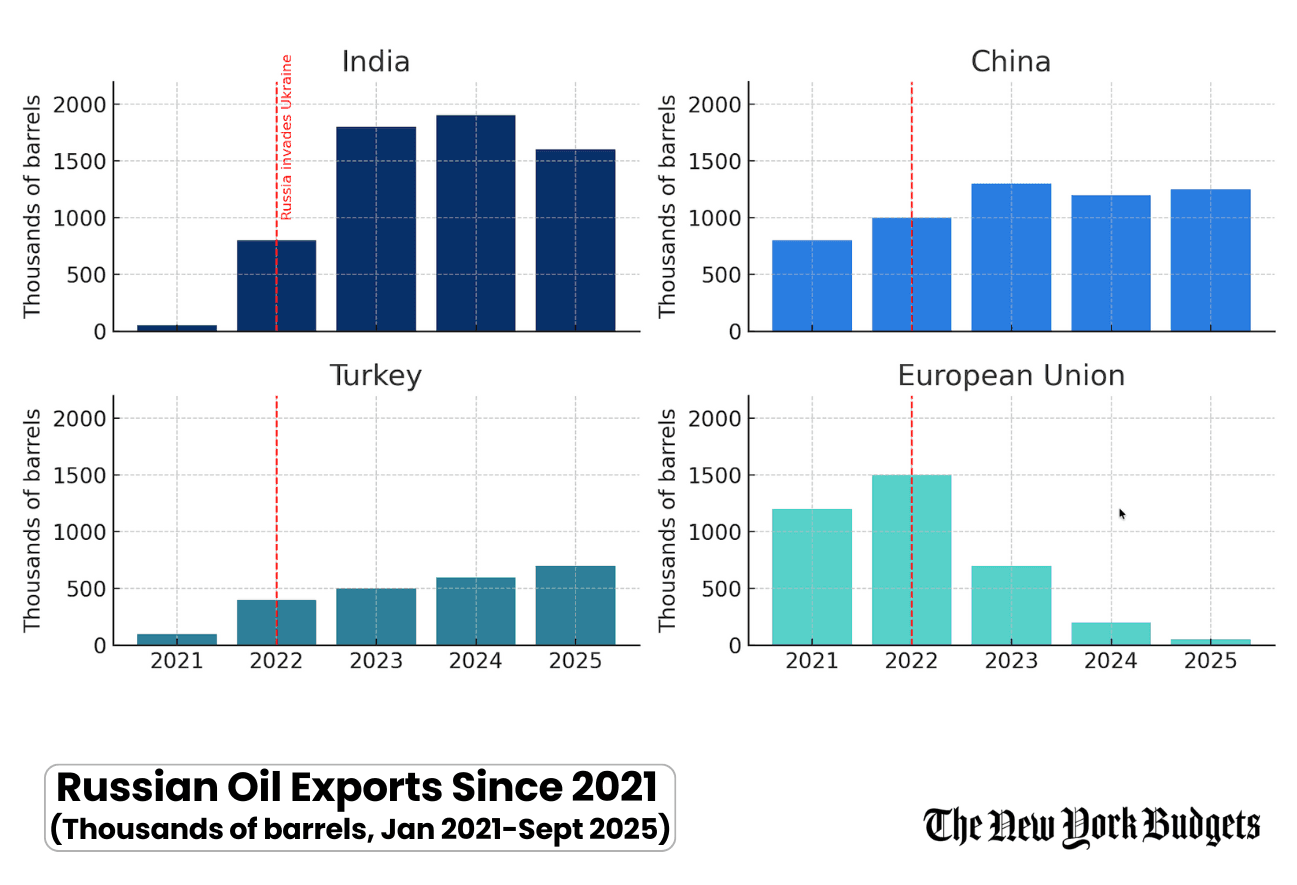
    Nowhere is the ripple more immediate than in India, where refiners are scrambling to slash Russian imports that ballooned to 1.7 million barrels per day in the first nine months of 2025—up from a negligible 0.42 million tons pre-war. “There will be a massive cut,” one industry source told Reuters Thursday, as state-run giants like Indian Oil Corp. and Bharat Petroleum pore over shipping manifests to purge any Rosneft- or Lukoil-sourced crude. Reliance Industries, India’s top private buyer and locked into long-term contracts for nearly 500,000 barrels daily from Rosneft, is “recalibrating” imports to align with New Delhi’s guidelines, a company spokesman confirmed.

    modi putin 1753683012190 1753683012417 1754011312847
    Over the past month, India, along with China and Brazil, has been at the centre of criticism from the West, mainly the US, for its purchase of Russian oil. © PTI

    This pullback couldn’t come at a better time for U.S.-India relations, strained by Trump’s 50% tariffs on Indian exports—half explicitly tied to Moscow’s oil fire sale. In a Tuesday call, Prime Minister Narendra Modi assured Trump that Delhi “was not going to buy much oil from Russia” and shares his goal of ending the Ukraine bloodbath, per White House readouts. Sources close to the talks say the sanctions could shatter a diplomatic logjam, paving the way for a bilateral trade pact that levels the playing field for American farmers and manufacturers. “We’re talking about bringing India’s tariffs in line with Asian peers,” one U.S. trade official told The Heritage Foundation’s Daily Signal on background. “Wind down the Russian crude, and we wind down the duties. It’s a win-win: India saves on overpriced alternatives, and we get fair trade.”

    Senior Indian refinery execs, speaking anonymously to Bloomberg, called the sanctions a “game-changer,” rendering direct Russian buys “impossible” amid fears of U.S. blacklisting. Exports to India hit $140 billion since 2022, but at what cost? Discounted Urals crude shielded New Delhi from energy inflation, yet it undercut Trump’s peace push and emboldened Putin. Now, with global prices spiking, Indian consumers may pay more at the pump—but the strategic upside is huge: Stronger ties with Washington, access to U.S. LNG, and a seat at the table in Trump’s post-war reconstruction bonanza for Ukraine.

    Critics in the Beltway whisper that this pressures Modi too hard, but let’s be real: India’s neutrality has been a fig leaf for profiteering off Putin’s aggression. Trump’s move forces accountability, reminding allies that America’s security umbrella isn’t free. As former U.S. Ambassador to Ukraine John Herbst put it to the BBC, these sanctions “will certainly hurt the Russian economy… It’s a good start” toward genuine negotiations.

    China’s Reluctant Retreat: Xi’s Putin Problem

    Across the border, Beijing’s state behemoths—PetroChina, Sinopec, CNOOC, and Zhenhua Oil—are hitting pause on seaborne Russian crude, Reuters reported Thursday, citing trade insiders. China, which snapped up a record 109 million tons last year (20% of its energy imports), has been Putin’s economic lifeline, laundering sanctions via “shadow fleets” of ghost tankers. No longer. The quartet’s suspension, if it sticks, signals a seismic shift: Even Xi Jinping, Putin’s “no-limits” partner, can’t ignore the U.S. financial guillotine.

    Trump, fresh off Gaza, sees this as his opening. “Xi holds influence over Putin,” he said Wednesday, vowing to press the issue at next week’s APEC summit in South Korea. No secondary tariffs on China yet—unlike India’s 25% slap in August—but the threat looms. “Will the U.S. actively threaten secondary sanctions on Chinese banks?” mused ex-State Department sanctions guru Edward Fishman on X. Short answer: Expect pullback, at minimum. Beijing’s Foreign Ministry blasted the measures as “unilateral bullying,” but actions speak louder: With Rosneft and Lukoil cut off, Chinese traders face pricier middlemen or a pivot to Saudi or U.S. barrels.

    For Russia, it’s a gut punch. China and India gobble 70% of its energy exports; losing even 20-30% could slash GDP growth from its anemic 1.5% forecast (per IMF) and force trade-offs between bombs and breadlines. “As profit margins shrink, Russia will face difficult… financing a protracted war,” notes Michael Raska of Singapore’s Nanyang Technological University. Dr. Stuart Rollo at Sydney’s Centre for International Security adds that while the sanctions won’t cripple Russia’s industrial base overnight, they “may coerce [it] into accepting peace terms” if paired with Trump’s deal-making flair.

    Putin’s Bluster Meets Economic Reality

    Vladimir Putin, ever the tsar, struck defiant Thursday: “No self-respecting country ever does anything under pressure,” he told Russian reporters, dismissing the sanctions as an “unfriendly act” that won’t dent Moscow’s resolve. Yet cracks show. He conceded “some losses are expected,” and warned of “overwhelming” retaliation if Ukraine gets U.S. Tomahawks—though that’s more theater than threat. Dmitry Medvedev, Putin’s hawkish ex-president, raged on Telegram: “The U.S. is our enemy… Trump has fully sided with mad Europe.” But even Kremlin-linked analysts like Igor Yushkov admit Asian buyers will shy away, hiking costs via shadowy intermediaries.

    21 1

    Russia’s shadow fleet—aging hulls under UAE flags—has dodged G7 caps before, sustaining flows despite EU embargoes. “New sales schemes will simply appear,” boasts military blogger Mikhail Zvinchuk. Fine, but at what price? Logistics snarls could add $5-10 per barrel, eroding the discounts that hooked India and China. With the EU mulling its 19th sanctions package—including an LNG import ban—and the UK already aboard on Rosneft/Lukoil, isolation is setting in. The Guardian reports Putin floated delaying the Budapest talks for “proper preparation,” but that’s code for stalling.

    Will this end the war? Analysts like Bill Taylor, another ex-U.S. envoy to Kyiv, call it an “indication to Putin that he has to come to the table.” It’s no silver bullet—Russia’s pivoted before, and military momentum in Donbas favors Moscow. But Trump’s calculus is sound: Freeze lines, cede nothing more, and let sanctions do the talking. “If we want Putin to negotiate in good faith, we have to maintain major pressure,” Herbst urges. Under Biden, dithering let Putin dig in; Trump’s resolve is restoring deterrence.

    22 1


    Stock Widget


    Wall Street cheered the news, with energy stocks like ExxonMobil XOM +3.00% ▲ and Chevron CVX +2.50% ▲ on prospects of higher prices and U.S. export booms. Yet Felipe Pohlmann Gonzaga, a Geneva-based trader, cautions the 5% Brent spike “will correct” amid global slowdown fears—China’s property bust, Europe’s recession. Still, for American producers, it’s manna: Permian Basin output hits 6 million barrels/day, and Trump’s LNG push could flood Asia, undercutting Russia’s Urals at $55-60.


    The EU’s frozen Russian assets—$300 billion—now fund a fresh Ukraine loan, per Brussels talks. And as Trump eyes a “cut the way it is” armistice, preserving Zelenskyy’s gains without endless aid, taxpayers win too. No more blank checks; just smart pressure.

    In this high-stakes energy chess game, Trump’s sanctions aren’t just hurting Russia—they’re realigning alliances, punishing enablers, and clearing the board for peace. Putin may bluster, but with India and China peeling away, his war of attrition is cracking. As Trump heads to APEC, the message to Xi and Modi is clear: Join the winning side, or pay the premium. America’s back in the driver’s seat, and the pump prices? A small price for freedom.

  • Trump Imposes 100% Tariff on China Over Rare-Earth Restrictions

    Trump Imposes 100% Tariff on China Over Rare-Earth Restrictions

    defense seligman rareearth lead
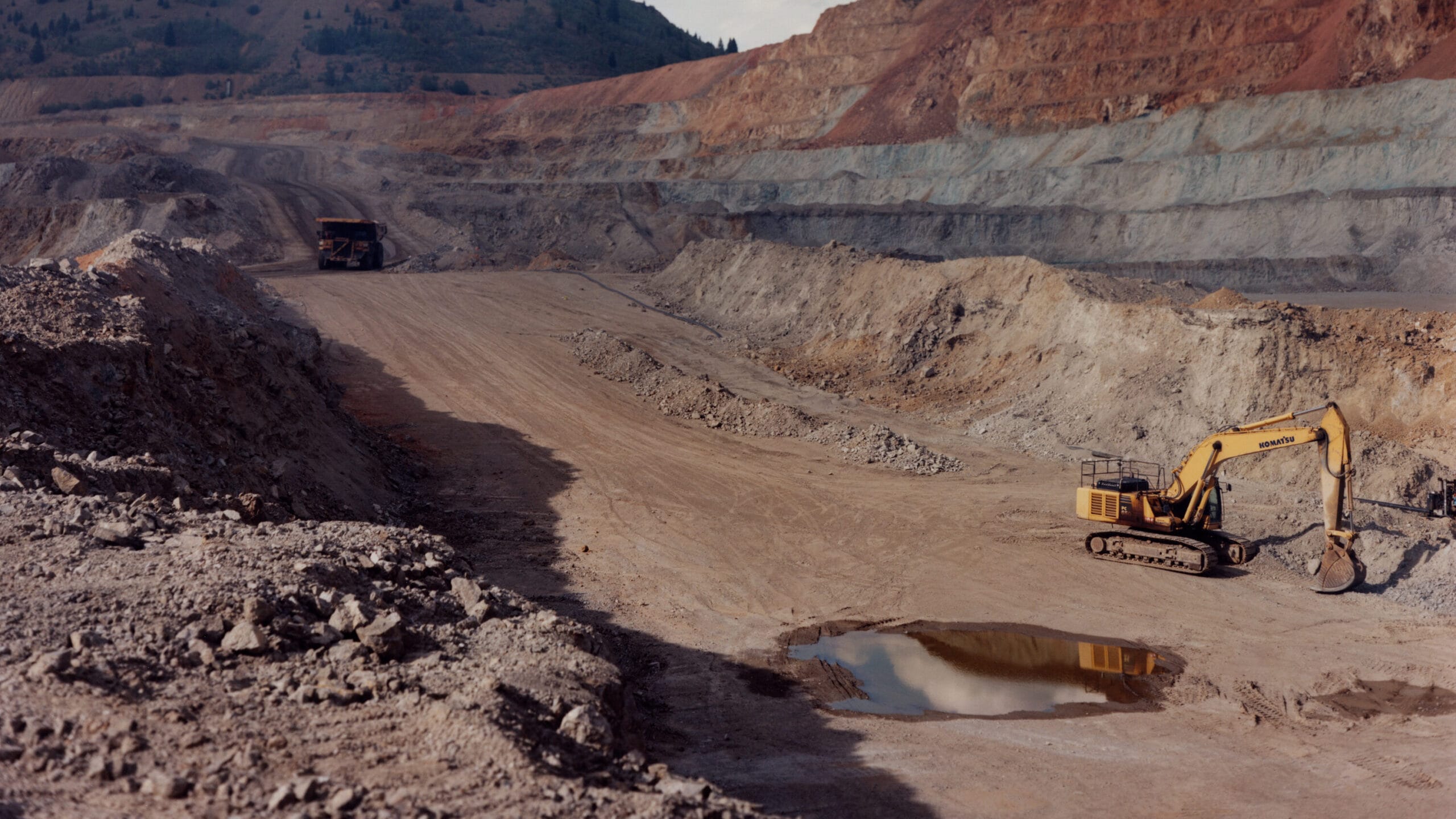
    China Dominates the Rare Earths Market. This U.S. Mine Is Trying to Change That. © Bridget Bennett for Poltico

    President Donald Trump announced on Friday that the United States will slap an additional 100% tariff on all Chinese imports starting November 1, on top of existing duties, while imposing sweeping export controls on “any and all critical software.” The move, framed as retaliation for Beijing’s recent tightening of export restrictions on rare earth elements, sent shockwaves through global markets, wiping out nearly $2 trillion in stock value and reigniting fears of a full-blown decoupling between the world’s two largest economies. With bilateral trade already strained by springtime tariff spikes that peaked at 145% on U.S. goods into China, Trump’s latest salvo—potentially pushing effective rates above 130%—threatens to upend supply chains for everything from semiconductors to electric vehicles, at a time when the global rare earth market is forecasted to exceed $6 billion annually by decade’s end.

    Trump’s announcement, delivered via a series of fiery Truth Social posts and reiterated during an Oval Office press availability, accused China of a “sinister and hostile” strategy to hold the world “hostage” through its dominance in rare earths—a group of 17 metals vital for high-tech manufacturing, defense systems, and green energy technologies. “It is impossible to believe that China would have taken such an action, but they have, and the rest is History,” Trump wrote, vowing that the tariffs could arrive “sooner” if Beijing escalates further. He also hinted at broader U.S. countermeasures, including restrictions on airplane parts and other exports, noting China’s reliance on Boeing components. The president stopped short of confirming the cancellation of his planned meeting with Chinese President Xi Jinping at the Asia-Pacific Economic Cooperation (APEC) summit in South Korea later this month, but earlier posts declared “no reason” for the sit-down, citing the “extraordinarily aggressive” timing of China’s moves—just days after a U.S.-brokered Middle East ceasefire.

    Beijing’s Rare Earth Gambit: A Calculated Squeeze on Global Supply Chains

    China’s actions, unveiled by the Ministry of Commerce on October 9, mark a significant hardening of its position in the ongoing trade skirmishes. Under “Announcement Number 61 of 2025,” Beijing expanded export licensing requirements to cover products containing more than 0.1% of rare earth elements sourced from China, even if manufactured abroad, effectively barring unlicensed shipments to foreign defense and semiconductor firms starting December 1. The curbs now encompass 12 of the 17 rare earths, including newly added holmium, erbium, thulium, europium, and ytterbium, alongside technologies for extraction, refining, and magnet production. Additional restrictions on lithium-ion batteries, graphite cathodes, and artificial diamonds take effect November 8.

    These measures build on decades of state-backed dominance: China controls 61% of global rare earth mining and a staggering 92% of refining capacity, per the International Energy Agency, fueled by subsidies that have undercut competitors worldwide. Rare earths are indispensable for neodymium-iron-boron magnets in EV motors, fighter jet engines, and smartphone vibrators—sectors where U.S. firms like Tesla, Lockheed Martin, and Apple are heavily exposed. Analysts at the Center for Strategic and International Studies warn that the restrictions could disrupt U.S. defense supply chains, echoing 2010 when Beijing briefly cut off exports to Japan over territorial disputes. “This isn’t just trade policy; it’s economic warfare aimed at critical vulnerabilities,” said Dr. Elena Vasquez, a trade economist at the Peterson Institute for International Economics.

    The timing appears deliberate, coming amid fragile progress in U.S.-China talks. After tit-for-tat hikes earlier this year drove tariffs to extreme levels—145% on U.S. imports to China and 125% in reverse—the two sides agreed in May to slash rates to 30% and 10%, respectively, pausing 24% of levies until November 10. Positive negotiations in Switzerland and the U.K. had raised hopes for a broader deal, but Beijing’s rare earth letter—sent to trading partners worldwide—has derailed that momentum. Trump decried it as a “moral disgrace” and a long-planned “lie in wait,” while posts on X from industry insiders echoed the surprise: “China’s rare earth curbs hit like a gut punch—right when talks were thawing,” one analyst tweeted.

    Trump’s response was swift and unyielding. In his initial Truth Social broadside, he lambasted Beijing for “clogging global markets” and provoking “trade hostility” that has drawn ire from allies like the EU and Japan. The 100% tariff—layered atop the current 30% effective rate on $438.9 billion in annual Chinese imports—could add $439 billion in costs to U.S. businesses and consumers if fully implemented, according to Wells Fargo economists. Coupled with export controls on critical software—potentially targeting AI tools, cybersecurity suites, and enterprise systems from firms like Microsoft and Oracle—the measures aim to mirror China’s leverage in minerals with America’s edge in tech.

    During a White House meeting on drug pricing, Trump doubled down, telling reporters the curbs were “shocking” and “very, very bad,” affecting “all countries without exception.” He floated expanding restrictions to “a lot more” items, including aviation parts, given China’s fleet of over 1,000 Boeing aircraft. On the Xi summit, Trump hedged: “I don’t know if we’re going to have it… but I’m going to be there regardless.” Earlier, he had signaled outright cancellation, writing, “now there seems to be no reason to do so.” Beijing has yet to respond formally, but state media like Global Times called the tariffs “economic bullying,” while separately imposing port fees on U.S. ships in retaliation for American “discriminatory” docking charges.

    The broader U.S.-China economic ties add layers of complexity. Last year, China ranked as the third-largest U.S. trading partner, with a $295.4 billion deficit. Ongoing flashpoints include TikTok’s U.S. operations—requiring Beijing’s blessing for a ByteDance divestiture—and visa restrictions on Chinese students. Trump’s moves could jeopardize these, even as they bolster his domestic base ahead of midterms.

    Market Mayhem: Stocks Plunge, Safe Havens Surge Amid Trade Fears

    Inline Market Movers

    Wall Street’s reaction was visceral. The S&P 500 .SPX -2.70% ▼ cratered 2.7% on Friday, shedding Dow Jones Industrial Average .DJI -2.25% ▼ 878 points, while the Nasdaq Composite .IXIC -3.60% ▼—its worst day since March—as tech giants like Nvidia NVDA -6.00% ▼ and Apple AAPL -4.00% ▼, reliant on Chinese rare earths for chips and devices, bore the brunt. The sell-off erased $1.9 trillion in market cap, with X users dubbing it “the day markets fell” amid a “perfect storm” of U.S. shutdown fears, tariff threats, and Fed signaling confusion. Crypto markets fared worse: Bitcoin BTC -7.50% ▼, Ethereum ETH -12.00% ▼, and liquidations hit $19 billion, per SoSoValue data, as leveraged longs unwound en masse.

    Safe havens rallied. Gold surged 2.1% to $2,650 per ounce, while U.S. rare earth miners like MP Materials jumped 8%, buoyed by prospects of domestic substitution. Globally, the Shanghai Composite dipped 1.9%, and the Hang Seng fell 2.4%, reflecting spillover risks. Semiconductor firms like ASML braced for fallout, with shares down 4.2%, as China’s curbs threaten the $500 billion chip industry’s raw materials.

    Economists warn of deeper scars. The global rare earth market, valued at $3.95 billion in 2024, is projected to hit $6.28 billion by 2030 at an 8% CAGR, driven by EV and renewable demand—but tariffs could inflate prices 20-30%, per Grand View Research. U.S. consumers might face $1,000 annual household cost hikes, akin to 2018’s trade war, while exporters like Boeing could lose $10 billion in orders. “This risks a vicious cycle: higher costs, slower growth, and fragmented innovation,” said JPMorgan’s Michael Feroli.

    Economic Stakes: From EVs to National Security

    The rare earth flashpoint underscores the trade war’s evolution from tariffs to strategic chokepoints. China’s monopoly—forged through subsidies and lax environmental rules—has long irked Washington, prompting the CHIPS Act’s $52 billion in domestic incentives. Yet, U.S. refining capacity remains nascent, covering just 15% of needs. Trump’s software controls, meanwhile, target China’s AI ambitions, potentially stalling Huawei and Baidu’s advancements.

    For Beijing, the curbs safeguard “national security,” but they invite blowback. Exports of rare earths generated $5.2 billion last year; restrictions could shave 2% off GDP growth if retaliation spirals, per Oxford Economics. Allies like Australia and Canada, ramping up mines, stand to gain, but short-term disruptions loom for Europe’s auto sector, where 40% of EV magnets are Chinese-sourced.

    X chatter reflects the angst: “Trump’s tariff nukes markets—China’s rare earth play was checkmate,” one trader posted, while another quipped, “Trade war 2.0: Now with extra monopoly drama.” Broader ripple effects include a 0.5% hit to U.S. GDP in 2026, per Federal Reserve models, and stalled WTO reforms.

    As November 1 looms, the onus falls on diplomacy—or its absence. Trump’s APEC attendance keeps the Xi channel ajar, but observers like Al Jazeera’s Ahmed Fouad doubt a breakthrough: “Beijing’s holding aces in minerals; Washington in tech—stalemate seems likely.” A Reuters analysis pegs escalation odds at 60%, potentially costing $500 billion in lost trade.

    For businesses, the message is clear: Diversify now. “Potentially painful” in the short term, Trump insists, but “very good… for the U.S.A.” in the end. Yet, as markets reel and supply chains fray, the world watches a high-stakes poker game where both players hold loaded dice—and rare earths are the wild card.

  • Beijing’s Cutbacks Shake America’s Soybean Trade

    Beijing’s Cutbacks Shake America’s Soybean Trade

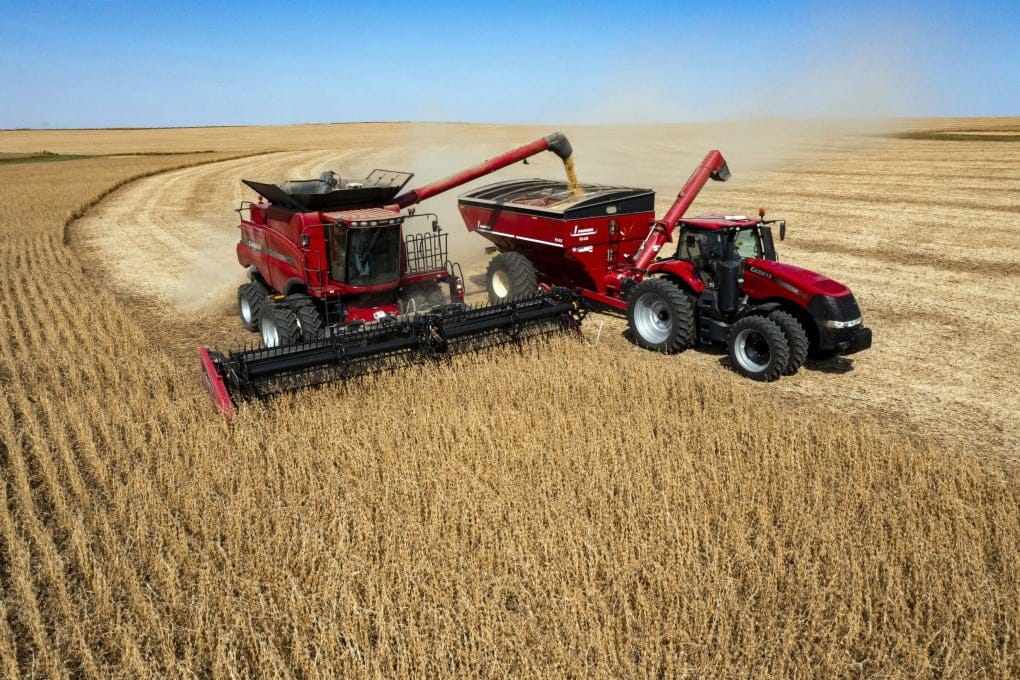
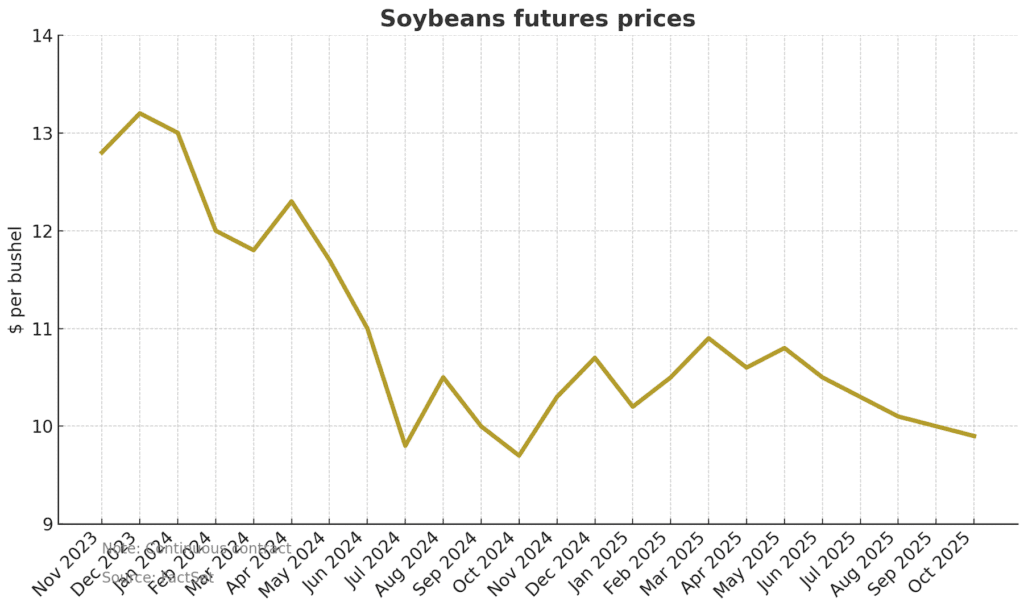
    In the heart of the Midwest, where golden fields stretch toward the horizon under a crisp autumn sky, the hum of combines should signal prosperity. Instead, for America’s soybean farmers, harvest season has become a grim countdown to financial ruin. As they reap what the U.S. Department of Agriculture (USDA) projects to be a record 4.2 billion bushel crop this year, their largest buyer—China—has vanished from the market, leaving silos overflowing and prices plummeting to five-year lows around $9.50 per bushel.

    China hasn’t booked any U.S. soybean purchases in months; farmers warn of ‘bloodbath’

    The trade war between the United States and China, now in its second year under President Donald Trump’s renewed tariff regime, has turned soybeans into collateral damage. Beijing’s retaliatory 25% tariffs on U.S. agricultural imports have priced American beans out of the Chinese market, where they once commanded over half of the $24.5 billion in annual U.S. soybean exports. From January through August 2025, Chinese imports of U.S. soybeans totaled a mere 200 million bushels—down from nearly 1 billion bushels in the same period of 2024, according to USDA trade data. That’s a 80% plunge, robbing Midwestern farmers of billions in revenue and forcing a scramble for alternative markets that may never fully compensate.

    “We’ll see the bottom drop out if we don’t get a deal with China soon,” warns Ron Kindred, a veteran farmer managing 1,700 acres of corn and soybeans in central Illinois. Halfway through his harvest, Kindred has locked in contracts for just 40% of his crop at prices already eroding below $10 per bushel in local elevators. The remaining 60% sits in limbo, a high-stakes bet on a breakthrough in Washington-Beijing negotiations. “There’s no urgency on China’s side, and the farm community’s clock is ticking louder every day,” he adds.

    Screenshot 2025 10 08 at 9.30.50 PM

    Kindred’s plight echoes across the soybean belt, from Illinois prairies to Iowa’s rolling hills. Rising input costs—fertilizer up 20-30% year-over-year, equipment maintenance strained by inflation, and a glut of both corn and soybeans flooding domestic markets—were squeezing margins even before the trade spat escalated. Now, with China’s boycott, the USDA estimates average losses of up to $64 per acre for Illinois growers alone, the nation’s top soybean-producing state with 6.2 million acres planted this year. University of Illinois Extension economists project total state-level shortfalls could exceed $400 million if export volumes don’t rebound by spring 2026.

    Enter the Trump administration’s lifeline: a proposed $10-14 billion farmer aid package, building on December 2024’s $10 billion relief bill. The Wall Street Journal reported last week that President Trump, speaking at the White House on October 6, vowed to “do some farm stuff this week” to cushion the blow. Aides say he’s slated to huddle with Agriculture Secretary Brooke Rollins as early as Friday to finalize funding sources, leaning heavily on the $215 billion in tariff revenues collected during fiscal 2025 (October 2024-September 2025), per U.S. Treasury figures. “The president is deploying every tool in the toolbox to keep our farmers farming,” a USDA spokesman told Reuters.

    Yet for many in the heartland, the aid feels like a temporary fix for a structural crisis. Soybean farmers, who backed Trump overwhelmingly in 2024 (with 62% of rural voters in key swing states like Iowa and Wisconsin casting ballots for him, per Edison Research exit polls), are voicing frustration laced with loyalty. “We voted for strong trade deals, not handouts,” says Scott Gaffner, a third-generation farmer in southern Illinois tending 600 acres. His crop, typically destined for Chinese ports, now languishes in on-farm silos as he frets over fixed costs like diesel fuel and seed that have surged 15% since planting. “We’re not just anxious; we’re angry. When the administration’s jetting off to Spain for TikTok talks while our harvest rots, it feels like we’re the last priority.”

    Gaffner’s son, Cody, the would-be fourth generation on the land, echoes the generational stakes. “If I return after college, it’ll be with a second job just to make ends meet,” the 22-year-old says. Their story underscores a broader ripple: Rural economies, where agriculture drives 20-25% of GDP in states like Illinois and Iowa, are buckling. Tractor sales at CNH Industrial, a Decatur, Illinois-based giant, plunged 20% in the first half of 2025, CEO Gerrit Marx revealed in an August interview at the Farm Progress Show. “The good news only flows when China places orders,” Marx said, a sentiment that hung heavy over the event in the self-proclaimed “soy capital of the world”—a title now whispered to be shifting south to Brazil.

    Dean Buchholz, a DeKalb County, Illinois, peer of Gaffner’s, is already waving the white flag. After decades in the fields, skyrocketing fertilizer bills and sub-$10 soybean futures have convinced him to retire. “I figured I’d farm till they buried me,” the 58-year-old says. “But with debt piling up and health acting up, it’s time to rent out the acres. This trade war’s the final straw.”

    Desperate Diplomacy: Chasing Markets in Unlikely Corners

    With China—home to the world’s largest hog herd and importer of 61% of global traded soybeans over the past five years, per the American Soybean Association—off the table, U.S. agribusiness is on a global charm offensive. Trade missions to Nigeria, memorandums with Vietnam, and a 50% surge in sales to Bangladesh (up to 400,000 metric tons through July 2025) highlight the scramble. Yet these “base hits,” as Iowa farmer Robb Ewoldt calls them, pale against China’s home-run demand.

    Screenshot 2025 10 08 at 9.37.03 PM

    Ewoldt, who farms 2,000 acres near Des Moines, jetted to Rome in January to woo a Tunisian poultry giant. “They grilled me: Can we count on steady U.S. supply, or will you switch crops and jack up prices?” he recalls. Tunisia’s imports, while growing, total under 100,000 tons annually—barely a blip. “It helps long-term, but right now, we’re cash-strapped. My operation burns a million bucks a year; without sales, we’re dipping into reserves just to cover debt service.”

    Across the Mississippi, Morey Hill has logged thousands of miles this year, from Cambodia’s fish ponds to Morocco’s chicken coops. In Phnom Penh last week, the Iowa grower evangelized to importers about swapping low-protein “fish meal” for U.S. soybean meal, touting yields that could fatten local aquaculture 20-30%. “We’ve got success stories—Vietnam’s up 25% year-over-year to 1.2 million tons,” Hill says. But even aggregated, the EU and Mexico (combined $5 billion in sales) plus risers like Egypt, Thailand, and Malaysia can’t fill the void: Total U.S. soybean exports dipped 8% to 18.9 million metric tons through July, USDA Census Bureau data shows.

    Industry lobbies are pulling levers too. The U.S. Soybean Export Council sponsored a June Vietnam mission yielding $1.4 billion in MOUs for ag products, including soy. August brought Latin American buyers to Illinois for farm tours, though exports to Peru and Nicaragua remain negligible. In Nigeria, a modest 64,000 tons shipped last year hasn’t translated to 2025 bookings yet. And Secretary Rollins’ September tweet hailing Taiwan’s “$10 billion” four-year ag commitment? It’s a rebrand of existing $3.8 billion annual flows, not new money, USDA clarifications confirm.

    “There’s talk of India, Southeast Asia, North Africa as future markets,” says Ryan Frieders, a 49-year-old Waterman, Illinois, farmer who joined a February trek to Turkey and Saudi Arabia. “But nothing explodes overnight to replace China.” Frieders, facing $8-10 per acre losses per University of Illinois models, plans to bin most of his harvest, gambling on futures prices rebounding above $11 by Q1 2026.

    The Shadow of South America and Tariff Games

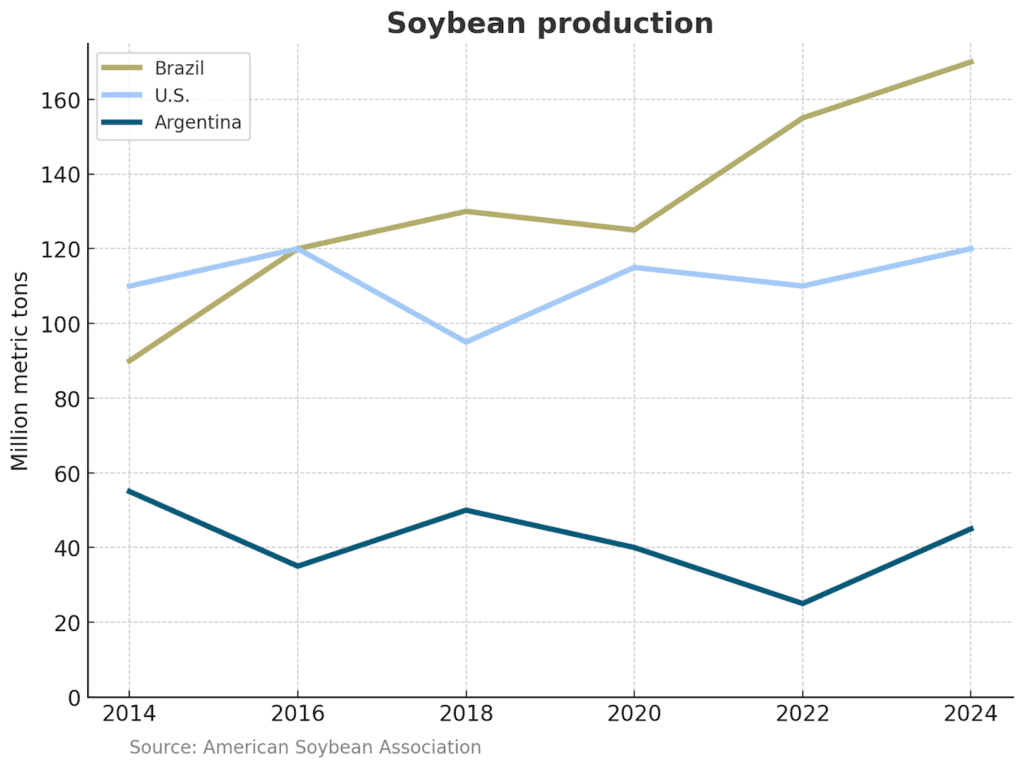
    As U.S. beans languish, Brazil and Argentina feast. China, pivoting since 2018’s first trade war, now sources 80% of its needs from South America. Last month, Argentine President Javier Milei’s temporary export tax suspension lured $500 million in Chinese cargoes, traders at the Chicago Mercantile Exchange report. U.S. beans traded at $0.80-$0.90 per bushel cheaper than Brazilian equivalents for September-October shipment, but Beijing’s 23% tariff tacks on $2 per bushel—enough to divert 5 million metric tons southward.

    “The frustration is overwhelming,” says Caleb Ragland, 39, Kentucky farmer and American Soybean Association president. On Truth Social Wednesday, Trump himself griped: “Our Soybean Farmers are hurting because China, for ‘negotiating’ reasons, isn’t buying.” He teased soybeans as a centerpiece in his upcoming summit with Xi Jinping in four weeks. Treasury Secretary Scott Bessent, speaking Thursday, promised a Tuesday announcement on aid, potentially including a $20 billion swap line for Milei—irking U.S. growers who see it as subsidizing their rivals.

    On Friday, soybean futures closed at $9.42 per bushel on the CME, down 2% weekly amid harvest pressure and zero Chinese bookings. Analysts at Zaner Ag Hedge forecast a “bloodbath” if no deal materializes by November: Storage costs could add $0.50 per bushel, while on-farm debt—$450 billion industry-wide, per Farm Credit Administration—balloons.

    The trade war’s winners? South American exporters, grinning from bumper crops (Brazil’s output hits 155 million metric tons this year, USDA estimates), and U.S. tariff coffers, flush for bailouts. Losers abound: From Decatur’s processing plants, once buzzing with Chinese-bound shipments, to the 1.2 million farm jobs at risk nationwide, per the American Farm Bureau Federation.

    For Kindred, Gaffner, and their ilk, the math is merciless. “We want trade, not aid,” Gaffner insists. “China’s building routes elsewhere; once they’re hooked on Brazil, we might never claw it back. That’s not just my farm—it’s the next generations, the rural towns, the whole engine of America’s breadbasket.”

    As combines roll on, the Midwest holds its breath. A Xi-Trump handshake could flood elevators with orders; stalemate risks a cascade of foreclosures and fallow fields. In this high-stakes harvest, soybeans aren’t just seeds—they’re the fragile thread binding U.S. farmers to their future.

  • Trump Abandons Tariff Threats on China Following Summit with Putin

    Trump Abandons Tariff Threats on China Following Summit with Putin

    id5902077 GettyImages 2229450199 inside
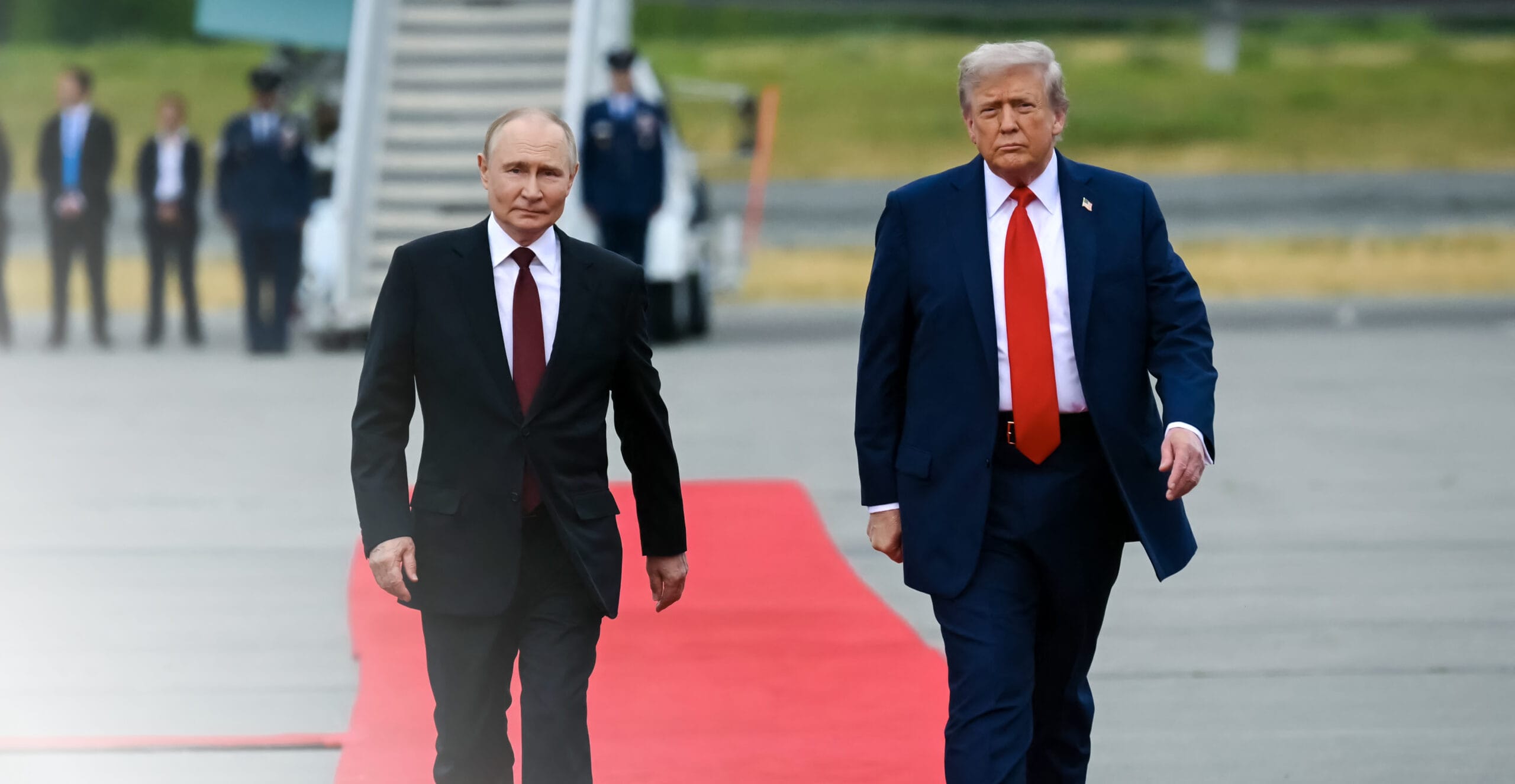
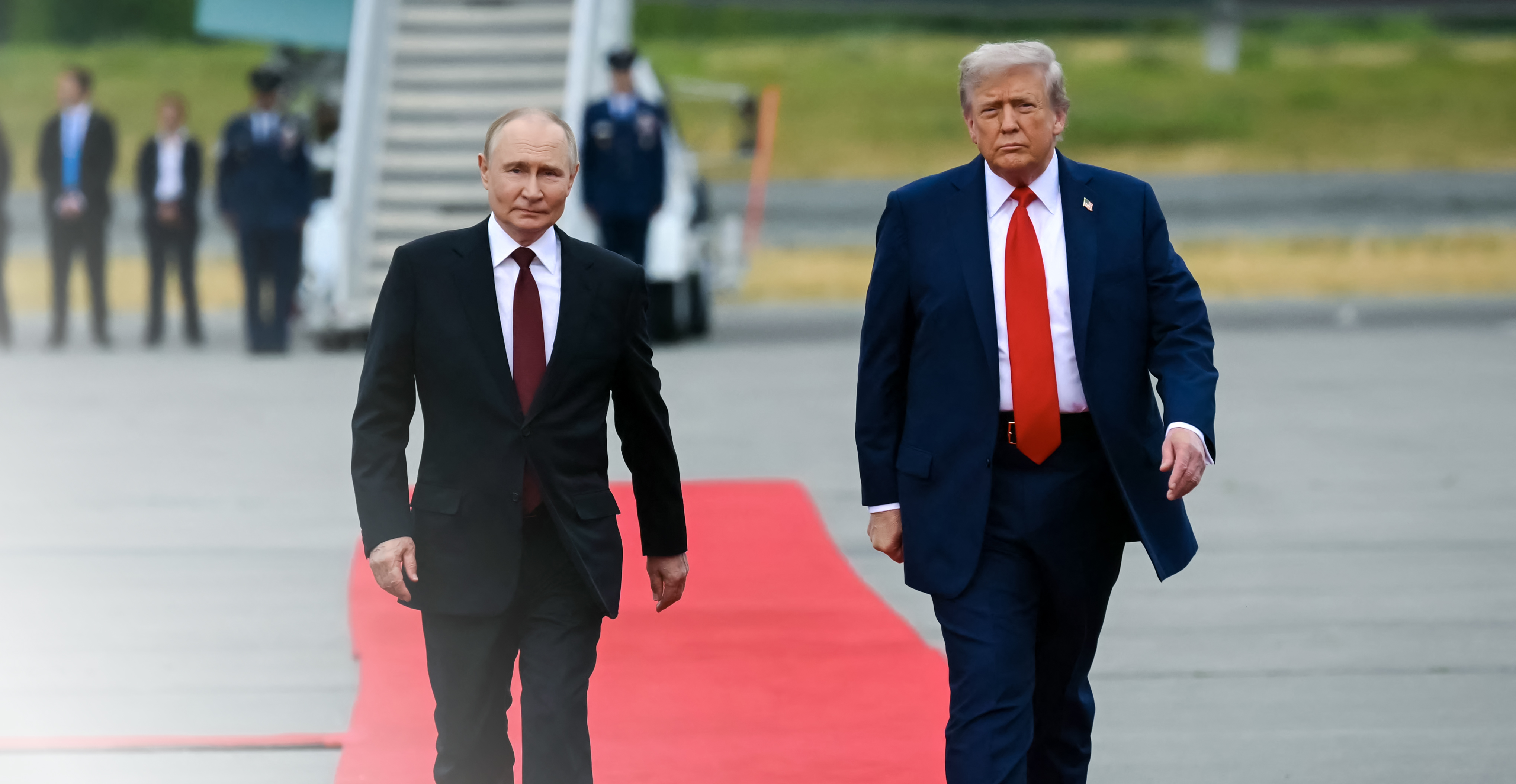
    U.S. President Donald Trump and Russian President Vladimir Putin walk on the tarmac after they arrived at Joint Base Elmendorf-Richardson in Anchorage, Alaska, on Aug.15, 2025. © Andrew Caballero-reynolds/AFP via Getty Images

    President Donald Trump said after his Aug. 15 summit with Russian President Vladimir Putin that progress made in the talks means that he will not immediately consider imposing additional tariffs on countries such as China for buying Russian oil—but hinted that he might have to “in two or three weeks.”

    Trump has warned that if Russia does not move toward ending the war in Ukraine, the United States will impose sanctions directly on Moscow. He has also threatened secondary sanctions—penalties on countries such as China and India that continue to buy Russian oil despite U.S. pressure.

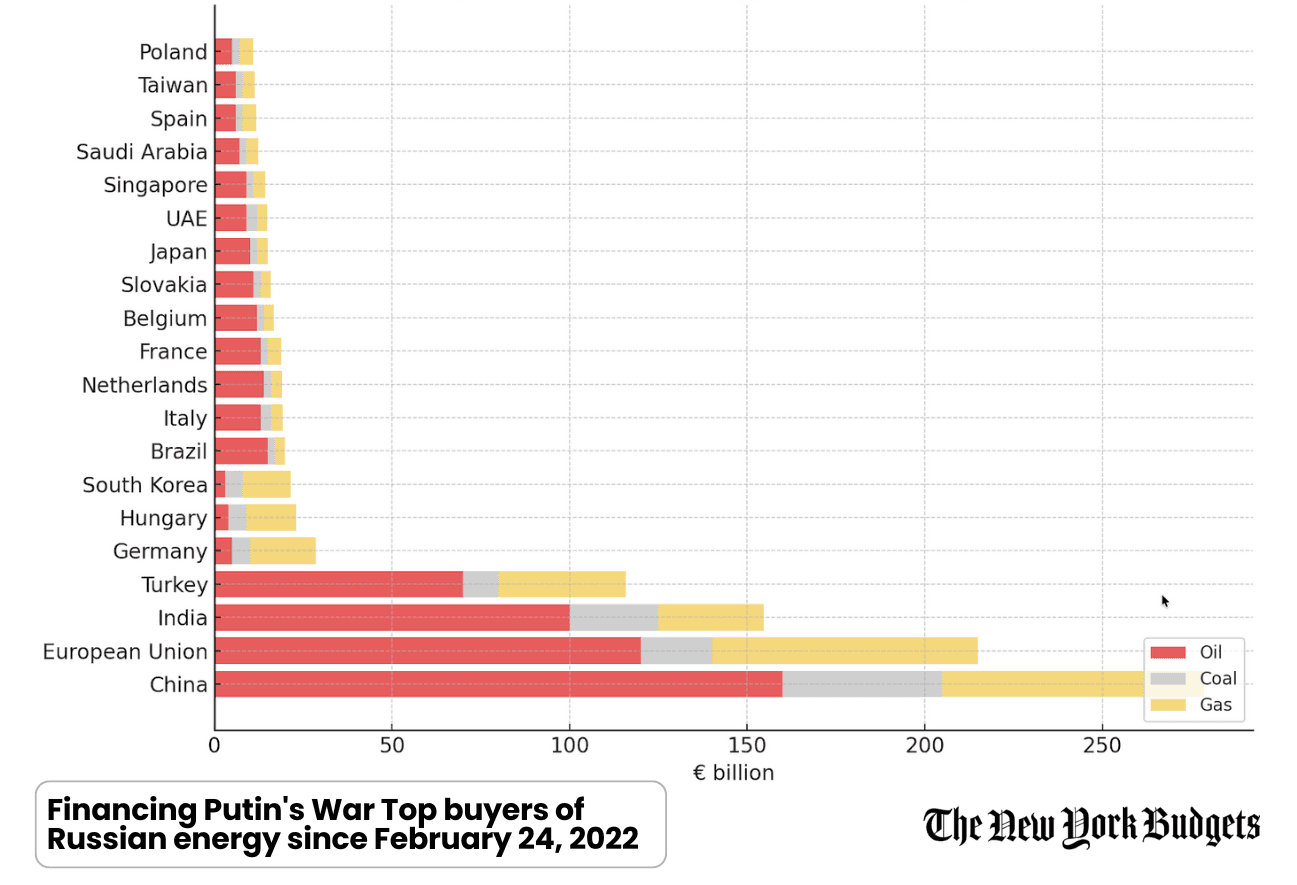
    China and India are the largest buyers of Russian oil, providing Putin and his military with revenue that allows the Kremlin to keep the war against Ukraine going. Trump already hit India with an additional 25 percent tariff on Indian goods—bringing the total to 50 percent—explicitly citing its ongoing purchases of Russian oil as the reason.

    Even though China is the biggest single buyer of Russian oil, Trump has not imposed similar tariffs or penalties on Beijing. Were he to ramp up Russia-related sanctions and tariffs, China and its slowing economy would suffer a sharp blow. Such a move would risk breaking a fragile U.S.–China trade truce, agreed to in order to give the two sides time to negotiate a broader deal.

    Trump was asked by Fox News’s Sean Hannity, in an interview on Aug. 15, for his thoughts on the secondary tariffs against China and other buyers of Russian oil.

    “Well, because of what happened today, I think I don’t have to think about that,” Trump replied.

    “Now, I may have to think about it in two weeks or three weeks or something, but we don’t have to think about that right now. I think, you know, the meeting went very well.”

    At the height of their trade fight earlier this year, the United States hit Chinese imports with 145 percent tariffs, prompting Beijing to retaliate with 125 percent duties. The two sides have since scaled back, with current rates down to 10 percent on the United States and 30 percent on China.

    After a two-day meeting in Sweden in late July, the world’s two largest economies signaled that they may extend the temporary trade truce to keep talks going. With the agreement set to expire on Aug. 12, Trump signed an executive order granting a 90-day extension of the tariff pause on China to permit further negotiations.

    At their Alaska summit, Trump and Putin said they agreed on numerous points but fell short of securing a deal that would bring about a cease-fire in Ukraine, something Trump has been pushing for.

    Trump said on Aug. 16 that Ukrainian President Volodymyr Zelenskyy will travel to Washington early next week for a meeting in the Oval Office.

    “If all works out, we will then schedule a meeting with President Putin,” Trump said in a post on Truth Social.

    The meeting, set for Aug. 18, has been confirmed by Zelenskyy, who said in a post on X that “Ukraine reaffirms its readiness to work with maximum effort to achieve peace.”

    Both Trump and Putin said the Aug. 15 meeting set the stage for continued dialogue and stronger prospects for a peace deal.

    In his interview with Hannity, the U.S. president said that there was agreement on many points, but that there were “one or two pretty significant items” left to settle, with the president expressing confidence that they can be resolved.

    “Now it’s really up to President Zelenskyy to get it done, and I would also say the European nations, they have to get involved a little bit,” Trump said.

  • Trump Slaps 50% Tariff on India Over Russian Oil Purchases

    Trump Slaps 50% Tariff on India Over Russian Oil Purchases

    President Donald Trump is imposing an additional 25 percent tariff on India, lifting the total rate to 50 percent. Trump, writing in an Aug. 6 executive order, said India’s government is “currently directly or indirectly importing Russian Federation oil.”

    “Accordingly, and as consistent with applicable law, articles of India imported into the customs territory of the United States shall be subject to an additional ad valorem rate of duty of 25 percent,” the executive order states.

    Last week, the president announced a 25 percent tariff against India, one of the largest U.S. trading partners. Additionally, India would face another penalty over its purchases of Russian energy and military equipment.

    In an Aug. 5 interview with CNBC’s “Squawk Box,” he confirmed that he would increase the tariff on India “very substantially over the next 24 hours” because it is buying Russian crude oil that is “fueling the war machine.”

    The new tariff rate on India is now the largest of the tariffs imposed on U.S. trading partners.

    While Trump has called Indian Prime Minister Narendra Modi a “friend,” he has regularly expressed concerns about India’s trade imbalance, tariffs, and nontariff trade barriers.

    Last year, the U.S. goods trade deficit with India was $45.8 billion, up 5.9 percent from 2023, according to the U.S. Trade Representative’s Office.

    India has also been in the crosshairs of Trump’s targeting of the BRICS coalition, a group of emerging market countries headlined by Brazil, Russia, India, China, and South Africa.

    “BRICS … is basically a group of countries that are anti the United States, and India is a member of that, if you can believe it,” he said at a July 30 press conference.

    “It’s an attack on the dollar, and we are not going to let anybody attack the dollar. So it’s partially BRICS and it’s partially the trade situation.”

    Despite BRICS’ years-long campaign to dethrone the U.S. dollar and embrace bilateral trade settled in local currencies, the greenback remains the dominant currency in global trade. The dollar accounts for nearly half of international payments, SWIFT data for June show.

    Pressure Campaign

    Trump’s announcement follows through on his threats to ratchet up pressure to end the Russia–Ukraine conflict. One strategy the Trump administration has employed is targeting countries buying Russia’s petroleum products, threatening to implement secondary tariffs.

    In an Aug. 4 Truth Social post, the president stated that India is also using the Russian oil it purchases to sell it “on the open market for big products.”

    “They don’t care how many people in Ukraine are being killed by the Russian War Machine,” he said.

    India has defended the transactions as a means to provide the population with affordable energy since conventional supplies were diverted to Europe following the war in Ukraine.

    “In this background, the targeting of India is unjustified and unreasonable,” a spokesperson for India’s foreign ministry said, adding that the government will employ all necessary measures to protect its economic and national interests.

    Officials also say India is engaged in long-term oil contracts with Russia, making it challenging to break those contracts overnight.

    According to the United Nations COMTRADE database on international trade, India has accelerated its imports of Russian crude oil since 2022. Last year, India purchased almost $53 billion in oil, up from nearly $49 billion in 2023.

    Last week, Trump reduced his original 50-day deadline for Russia to end the war, giving Moscow 10 to 12 days.

    The Kremlin criticized the White House’s campaign to force countries to eliminate trade with Russia.

    Dmitry Peskov, spokesperson for the Kremlin, says India and other countries should be allowed to select their own trading partners for trade and economic cooperation.

    “We hear many statements that are in fact threats, attempts to force countries to cut trade relations with Russia. We do not consider such statements to be legal,” Peskov told reporters on Aug. 5.

    U.S. special envoy Steve Witkoff is in Moscow on Aug. 6, just a few days before Trump’s deadline.