Category: New York

  • Two pilots killed after jet collides with fire truck at New York’s LaGuardia airport

    Two pilots killed after jet collides with fire truck at New York’s LaGuardia airport

    NEW YORK — An Air Canada jet carrying more than 70 passengers collided with a fire truck while landing at New York’s LaGuardia Airport late Sunday, killing the pilot and copilot and injuring several others, officials said.

    The impact severed the cockpit, and hurled a flight attendant — still secured to her seat — far from the crash site, her daughter told a Canadian TV station. The flight attendant survived.

    The fire truck was crossing the tarmac just before midnight after being given permission to check on another plane that had aborted its takeoff. Before the collision, an air traffic controller can be heard on airport communications frantically telling the fire truck to stop.

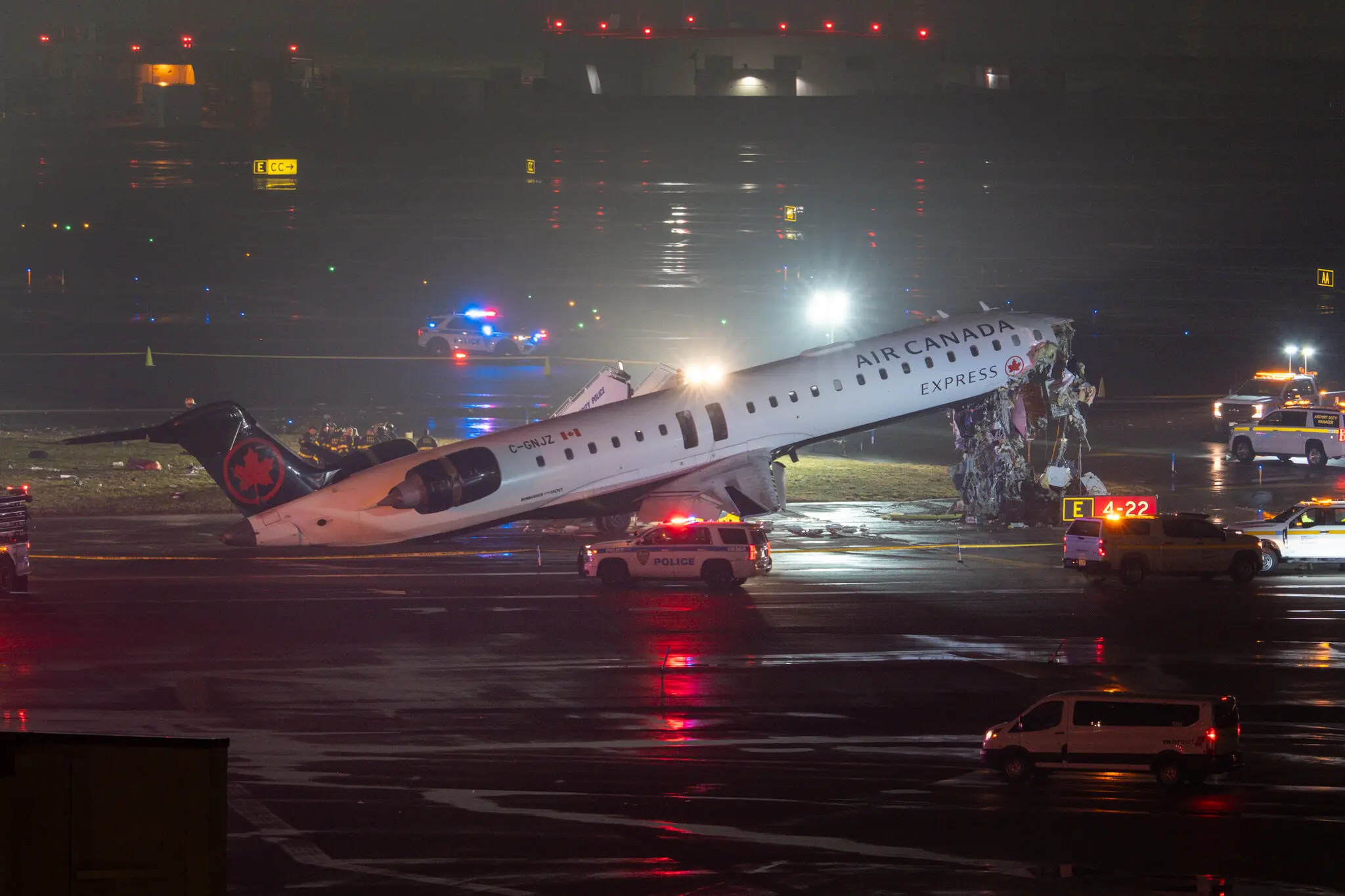
    Officials investigate the site, Monday, March 23, 2026, where an Air Canada jet came to rest after colliding with a Port Authority firetruck at LaGuardia Airport, shortly after landing Sunday night in New York. (AP Photo/Seth Wenig)
    Officials investigate the site, Monday, March 23, 2026, where an Air Canada jet came to rest after colliding with a Port Authority firetruck at LaGuardia Airport, shortly after landing Sunday night in New York. (AP Photo/Seth Wenig)

    Roughly 20 minutes later, the controller appears to blame himself. “We were dealing with an emergency earlier,” the controller said. “I messed up.”

    About 40 passengers and crew members on the regional jet from Montreal, and two people from the fire truck, were taken to hospitals, some with serious injuries. Most were released by Monday morning, authorities said.

    A key for investigators will be examining coordination of the airport’s air traffic and ground traffic at the time of the crash, said Mary Schiavo, a former Department of Transportation Inspector General. “This has been happening for years and sadly some of the most horrific air crashes in history happen on the ground at the airport.”

    Transportation Secretary Sean Duffy said LaGuardia is “well-staffed” but faces a shortage of controllers. He said there are 33 certified controllers but the goal is to have 37. More than one controller was on duty at the time of the accident, he said.

    “I can’t give specifics on what went wrong,” Duffy said, deferring to the National Transportation Safety Board, which is leading the investigation. Canada also sent a team of investigators.

    The runway where the crash happened is likely to be closed for “days” during the investigation, NTSB chair Jennifer Homendy said at a Monday evening news conference. She said there was a “tremendous amount of debris” that investigators have to sift through.

    Homendy said authorities recovered the plane’s cockpit and flight data recorders and drove them to the agency’s lab in Washington for analysis. Officials had to cut a hole in the aircraft’s roof to get to the recorders, because its tail was on the ground, she said, adding that the cockpit voice recorder was not damaged.

    Homendy said it was too early in the investigation to answer many questions about the accident, and more information was expected to be released Tuesday.

    The crash shut down LaGuardia — the New York region’s third busiest hub — during what was already a messy time at U.S. airports because of a partial government shutdown.

    Flights resumed Monday afternoon on one runway and with lengthy delays. The shutdown caused some disruptions at other airports, too, especially for Delta, which has a major presence at LaGuardia.

    An Air Canada Jet sits on the runway at LaGuardia Airport, Monday, March 23, 2026, after colliding with a Port Authority aircraft rescue and firefighting vehicle in New York. (AP Photo/Ryan Murphy)
    An Air Canada Jet sits on the runway at LaGuardia Airport, Monday, March 23, 2026, after colliding with a Port Authority aircraft rescue and firefighting vehicle in New York. (AP Photo/Ryan Murphy)

    Passenger says they helped each other escape the plane

    Airport security camera video shows a convoy of emergency vehicles traveling across the tarmac with their lights flashing in the moments before the plane lands, according to a recording of the video shared online.

    While most of the vehicles appear to stop at the edge of the runway, the lead vehicle keeps going, directly into the path of the aircraft.

    A person familiar with the investigation confirmed the authenticity of the video. The person requested anonymity because they were not authorized to discuss details of an ongoing investigation.

    The collision left cables and debris dangling from the mangled cockpit. Images show the fire truck flipped onto its side, with most of the damage to its back half.

    Flight attendant Solange Tremblay suffered multiple fractures to one leg and will need surgery after being thrown from the plane, daughter Sarah Lépine told Canadian news station TVA Nouvelles.

    Her survival is “a total miracle,” Lépine said. “I’m still trying to understand how all this happened, but she definitely has a guardian angel watching over her.”

    Passenger Rebecca Liquori said the plane hit turbulence while descending, and she then felt it brake hard and heard a loud boom.

    “Everybody just jolted out of their seats. People hit their heads. People were bleeding,” Liquori told News12 Long Island, a station where she once worked.

    Liquori said passengers helped each other slide down a wing.

    “I’m just happy to be alive,” said Liquori, who had gone to Montreal for a cousin’s baby shower. “I would have never pictured a one-hour flight that I’ve done countless times … ending like this.”

    Passenger Clément Lelièvre credited the pilots’ “incredible reflexes” with saving his life and others’. The pilots braked extremely hard just as the plane touched down, he said.

    An Air Canada jet and Port Authority fire truck sit on the runway at LaGuardia Airport, Monday, March 23, 2026, after colliding with each other after the jet landed Sunday night in New York. (AP Photo/Seth Wenig)
    An Air Canada jet and Port Authority fire truck sit on the runway at LaGuardia Airport, Monday, March 23, 2026, after colliding with each other after the jet landed Sunday night in New York. (AP Photo/Seth Wenig)

    US and Canada sending investigators to New York

    The pilot and copilot who died were both based out of Canada, said Kathryn Garcia, executive director of the Port Authority of New York and New Jersey, which operates the airport.

    Jeannette Gagnier, the great aunt of one of the pilots, identified him as Antoine Forest. Forest looked at her as a grandmother figure and always wanted to be a pilot, she said. His LinkedIn page showed he had worked for two airlines the past five years.

    President Donald Trump called it a “terrible” situation. Canadian Prime Minister Mark Carney said in a statement the accident was “deeply saddening.”

    The Port Authority identified the two people in the fire truck as Sgt. Michael Orsillo and Officer Adrian Baez. They suffered injuries not believed to be life-threatening, Garcia said. One was expected to be released Monday while the other will stay in the hospital for observation, she said.

    The fire truck was traveling across the runway to respond to a United Airlines flight, whose pilot had reported “an issue with odor,” said Garcia.

    It was the first fatal crash at LaGuardia in 34 years, Garcia said.

    There were 72 passengers and four crew members aboard the Jazz Aviation flight operating on behalf of Air Canada, according to the airline. The flight originated at Montreal-Pierre Elliott Trudeau International Airport.

    Hours after the crash, the plane remained on the runway with its crumpled nose tilted upward.

    Department of Transportation Secretary Sean Duffy speaks during a news conference at LaGuardia Airport, Monday, March 23, 2026, after an Air Canada jet collided the night before with a Port Authority firetruck shortly after landing in New York. (AP Photo/Seth Wenig)
    An Air Canada jet and Port Authority fire truck sit on the runway at LaGuardia Airport, Monday, March 23, 2026, after colliding with each other after the jet landed Sunday night in New York. (AP Photo/Seth Wenig)

    LaGuardia has a system to spot runway encounters

    The air traffic controller tried to warn the fire truck.

    “Stop, stop, stop, Truck 1. Stop, stop, stop,” the transmission says. “Stop, Truck 1.” The controller can then be heard frantically diverting an incoming aircraft from landing.

    Air traffic controllers are not impacted by the partial government shutdown that has caused long delays at airport security checkpoints in recent days. They have been affected by past shutdowns.

    The FAA has been chronically short on air traffic controllers for years. Former FAA air traffic control chief Mike McCormick said LaGuardia has not had perennial staffing problems, but the tower would have been lightly staffed during the overnight shift at the time of the crash.
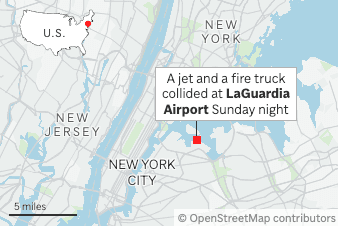
    Screenshot 2026 03 24 at 9.06.52 AM
    Graphic: Will Jarrett

    LaGuardia is one of 35 major U.S. airports with an advanced surface surveillance system designed to help keep track of planes and vehicles crossing the airport.

    An alarm heard in the background of the air traffic control audio was likely from the system and would have alerted the tower to the potential collision, McCormick said.

    “It’s an aid in a situation like this,” he said, but the system doesn’t know if someone has given clearance for a vehicle to cross a runway.

    FAA statistics show there were 1,636 runway incursions last year.
  • Mark Ruffalo wants New York Governor to ‘tax the rich’ — critics say he should donate first

    Mark Ruffalo wants New York Governor to ‘tax the rich’ — critics say he should donate first

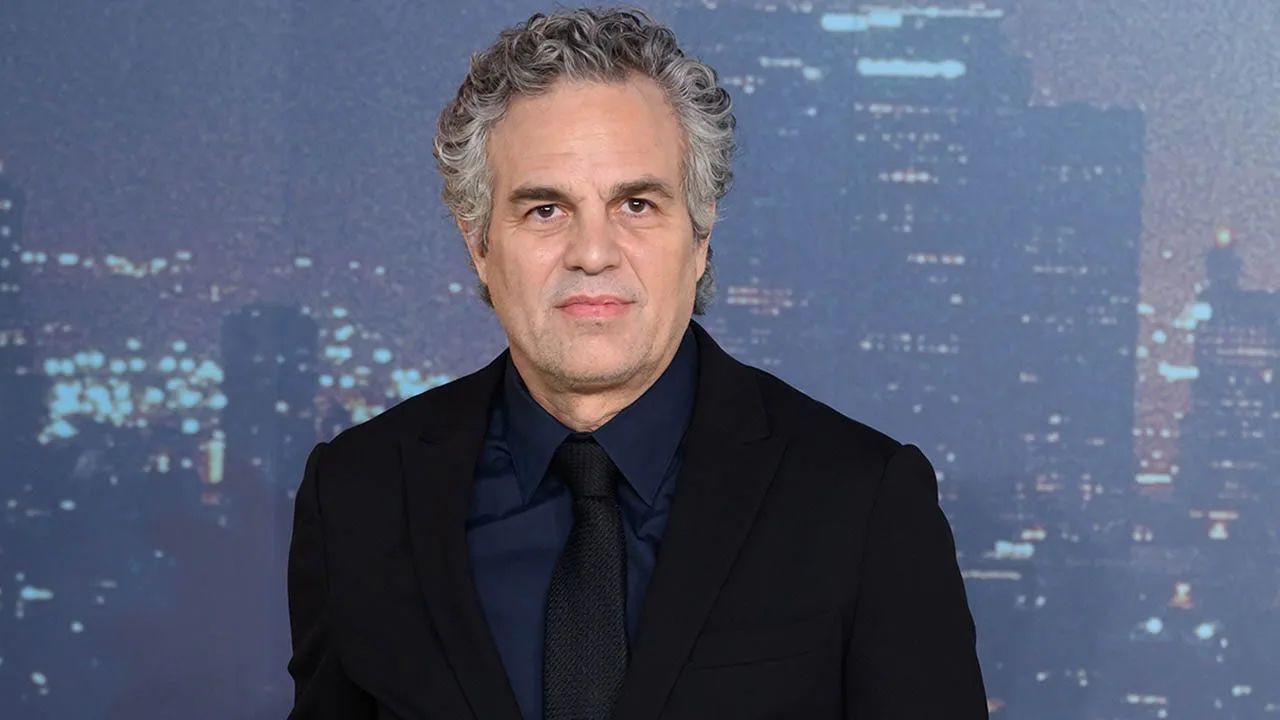
    Mark Ruffalo is facing backlash after endorsing the “Tax the Rich” campaign.

    On Feb. 24, the 58-year-old actor shared a video on social media in which he called upon New York Gov. Kathy Hochul to impose higher taxes on billionaires and corporations with the aim of improving affordability across the state.

    In the clip, Ruffalo also promoted the upcoming Tax the Rich & Demand an Affordable NY: Albany Takeover, a march and rally being held in the state capital on Feb. 25.

    “In New York, rent is crushing people,” he said. “Childcare now costs over $20,000 a year on average. Trump’s policies keep making billionaires richer, while working families endure cuts to essential services.”

    “So last year, over a million New Yorkers came together to vote for Mayor Mamdani’s affordability agenda,” he said, referring to democratic socialist New York City Mayor Zohran Mamdani, who was elected last November.

    “So who’s getting in the way?” Ruffalo continued. “Gov. Kathy Hochul has a choice to make. You protect working families, and tax the rich, or make Trump’s cuts worse by forcing everyday people to pay more. Sixty percent of New Yorkers, like me, agree that we should tax billionaires and corporations to fund childcare, housing and transit. Working people shouldn’t be the ones always stuck with the bill.”

    “This Wednesday, Feb. 25, thousands of folks are going to Albany to send Kathy Hochul one clear message: Tax the Rich for New York that we can all afford. They can handle it. Trust me,” he concluded.

    An X user later shared Ruffalo’s video, writing, “Mark Ruffalo: ‘Tax the rich… They can handle it, trust me,’” in a post that received over 5 million views.

    The post was quickly flooded with comments as some critics slammed Ruffalo for alleged “hypocrisy,” arguing that the Marvel star, who has an estimated net worth in the tens of millions, should be offering to pay more in taxes himself.

    “Waiting for him to step up,” one X user wrote.

    “So he can handle it right?” another added.

    “There is nothing stopping Mark Ruffalo from checking that box on his tax returns, that he would like to pay more than the required amount,” another detractor commented. “He could easily give away every dime he owns except for a middle class income level.”

    “Him first,” another agreed.

    Some X users argued that while Ruffalo was pressing Hochul to pursue tax reforms targeting billionaires and large corporations, he was not advocating that those in the millionaire class should be made to pay more.

    “I love how he says ‘we should tax billionaires’ This exposes the sickening hypocrisy of these leftie celebrities,” one critic wrote. “He’s a millionaire – so, don’t tax him more – he’s not ‘wealthy’. No, no… it’s those nasty billionaires – who already pay tax and create wealth in the economy.”

    “If we just took every penny from all the millionaires – Childcare would be free! – And housing! And food! But you would be broke, Mark,” another chimed in. “Should we vote on it? It would pass. Why is it always other people’s stuff socialists want to take??”

    “Notice how it’s always a wealthy person telling others to pay more taxes, but they never pay themselves,” one person commented.

    Though replies on the X post featuring Ruffalo’s message were overwhelmingly negative, the actor was widely praised in the comments section of his original post on Instagram.

    Ruffalo's fans heaped praise on the actor.
    Ruffalo’s fans heaped praise on the actor.

    “Thank you for your compassion and leadership, Mark,” one fan wrote.

    “Mark Ruffalo I am so proud of you all the time thank you,” another agreed.

    “Thank you Mark Ruffalo for using your voice and influence for the right things,” one Instagram user commented.

    “Hulk will forever be the strongest avenger, onset and off,” a fan chimed in as another added, “Mark we love you.”

    Some Instagram users took to the comments to explain why they agreed with Ruffalo’s stance.

    “We started taxing the rich in MA and it’s been amazing,” one commenter wrote. “We have school meals for all kids, continuing education for those that want it, great healthcare, among other things. And instead of losing millionaires, we have more that moved here. It works!”

    “The wealthy didn’t get rich in isolation,” another argued. “Infrastructure, labor, and public systems built that wealth. Fair taxation is not punishment. It’s accountability.”

    Last month, Ruffalo joined nearly 400 millionaires and billionaires, including Disney heir Abigail Disney and British musician Brian Eno, in signing an open letter urging world leaders at the World Economic Forum in Davos to raise taxes on the ultra-rich, arguing extreme wealth concentration harms democracy and deepens inequality.

  • Trump Vows Full Support to Mamdani in Oval Office: “We’ll Help Him”

    Trump Vows Full Support to Mamdani in Oval Office: “We’ll Help Him”

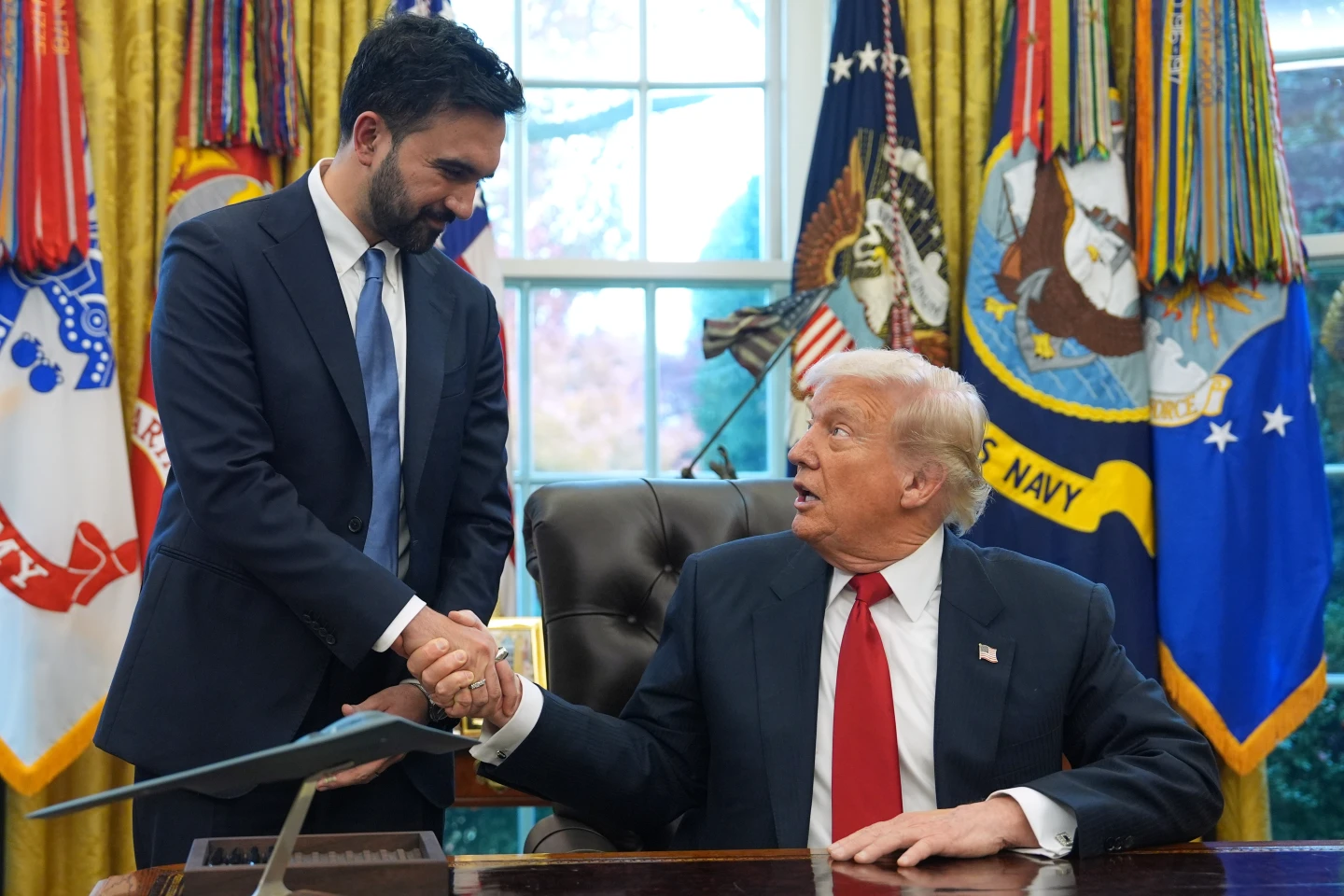
    In a Oval Office encounter that caught even hardened White House reporters off guard, President Donald J. Trump extended an olive branch Friday to New York City mayor-elect Zohran Mamdani—the self-styled “democratic socialist” he’d once branded a “100% Communist Lunatic” and threatened to deport—signaling a pragmatic thaw amid mounting economic pressures. The 90-minute sit-down, billed by skeptics as a potential fireworks display, unfolded with unexpected cordiality: Trump lavished praise on Mamdani’s “surprising” potential to “surprise some conservative people,” while the 34-year-old Queens assemblyman nodded along, emphasizing shared “goals to help” Trump’s hometown. “Great meeting,” Trump beamed to reporters, flanked by a beaming Mamdani. “We’re going to be helping him… to make everybody’s dream come true, having a strong and very safe New York.”

    This detente arrives at a pivotal juncture for both men. Trump, nine months into his second term, faces headwinds from a record 37-day government shutdown and voter angst over inflation—issues Mamdani weaponized to victory in the November 4 mayoral race, flipping NYC’s helm with 50.4% amid record turnout. The president, who’d endorsed Mamdani’s foe Andrew Cuomo and vowed to “yank federal funds” from the “commie” stronghold, now pivots to affordability optics, admitting, “Some of his ideas are really the same ideas that I have.” For Mamdani, the invite burnishes his nascent national profile, transforming a campaign-trail gadfly into a statesman ready to “stand up” to Trump—minus the barbs. Yet, beneath the handshakes, fault lines simmer: Mamdani’s Gaza genocide accusations drew Trump’s awkward silence, and MAGA hardliners like Elise Stefanik seethe at the “jihadist” label’s dilution.

    From a center-right lens, this isn’t capitulation—it’s statesmanship. Trump’s track record of deal-making (Abraham Accords, USMCA) shines here: Turning adversaries into assets, much like his Zelenskyy thaw post-February spat. Mamdani, DSA-affiliated and unapologetically left, enters as the “worst nightmare” he self-proclaimed; Trump’s embrace disarms that narrative, forcing the socialist to govern amid fiscal realities. As one GOP strategist quipped anonymously to Fox: “Let him promise free buses—reality’s the best teacher.” With midterms looming, Trump’s masterstroke neutralizes a Democratic bogeyman, while spotlighting shared inflation fights—groceries up 25% since 2021, per BLS.

    From Fireworks to Handshakes: A Timeline of Thaw

    The buildup was pure Trumpian theater: Mamdani’s campaign branded the president a “despot” and “fascist,” vowing Netanyahu’s arrest on NYC soil and decrying “authoritarian” raids. Trump fired back, questioning the Uganda-born naturalized citizen’s loyalty (“total nut job”) and predicting “ZERO chance of success” for socialist rule. White House Press Secretary Karoline Leavitt dubbed the invite “volumes” on Dem “communism”; VP JD Vance joked a “stomach bug” exemption; Sen. Rick Scott foresaw a “schooling.”

    Reality? A love-in. Trump interjected protectively—”I’ll stick up for you”—as reporters probed Mamdani’s “fascist” barbs: “I’ve been called much worse… You can just say yes.” On fossil fuels, Trump shielded: “That’s OK.” Discussions zeroed on affordability—housing, groceries, utilities—where Mamdani’s rent-freeze crusade mirrored Trump’s 2024 playbook. “We agree on a lot more than I would have thought,” Trump mused, praising Mamdani’s crime-reduction nods (retaining NYPD’s Jessica Tisch). Mamdani reciprocated: “What I really appreciate… is focusing on shared purpose in serving New Yorkers.”

    Post-meeting, Mamdani’s chief of staff Elle Bisgaard-Church told NY1: “We share a mutual goal of a safe city.” Trump, eyeing NYC’s $7.4 billion federal lifeline, softened threats: “We don’t want that to happen… I don’t think that’s going to happen.” Aides whisper strategy: With polls showing 6 in 10 voters “angry” over costs (AP), Trump’s outreach spotlights “pragmatic” Mamdani, undercutting Dem “extremist” attacks.

    The chumminess blindsided the base. Stefanik blasted Mamdani as a “jihadist” Friday morn (“walks like, talks like”), only for Trump to contradict: “We’ll have to agree to disagree.” Greene’s resignation bombshell—clashing with Trump over Epstein files and Israel—amplifies schisms; Vance’s quip now looks tone-deaf. Fox’s Sean Hannity grumbled: “Is this the art of the deal or the deal with the devil?” Yet, insiders hail genius: By humanizing Mamdani, Trump mutes his bogeyman utility, forcing Dems to own socialist governance amid NYC’s fiscal crunch (Hochul vetoing tax hikes).

    Mamdani sidestepped Gaza landmines, reiterating “genocide” complicity—”our government funding it”—drawing Trump’s mute nod. “I shared… tax dollars… for New Yorkers’ basic dignity,” he pivoted, nodding to human rights sans specifics. Global echoes: Copenhagen’s Social Democrats watch warily, their migration model (slashing claims 80%) clashing with Mamdani’s open-tent ethos.

    Mamdani’s ascent—defeating Cuomo’s machine with TikTok flair and DSA grassroots—netted historic firsts: youngest since 1892, first Muslim/South Asian mayor. His transition team (five women, including Lina Khan) signals competence; promises (free childcare, city groceries) test DSA mettle. Trump’s aid tease—on housing, safety—could unlock billions, but strings attach: Immigration cooperation? Mamdani’s “worst nightmare” vow lingers.

    For Trump, it’s vintage: From Zelenskyy dimming to Ramaphosa video, he turns foes to footnotes. As midterms near, this “productive” parley spotlights wins—manufacturing renaissance, tariff truces—over shutdown scars. Mamdani? A blank slate nationally (46% “not closely” followed, CBS); Trump’s glow-up buys time, but stumbles (crime spikes?) will echo.

    In a polarized era, Friday’s detente whispers hope: Adversaries as allies, barbs as banter. Yet, as Trump quipped, “I’ve been called much worse”—reminding, in politics, today’s chum is tomorrow’s chum bait.

  • Big Apple Affordability Crisis Convert Politics

    Big Apple Affordability Crisis Convert Politics

    Stakeholders can’t agree on how to solve New York City’s housing crisis. © New York Times
    Stakeholders can’t agree on how to solve New York City’s housing crisis. © New York Times

    NEW YORK CITY — In the shadow of gleaming skyscrapers that symbolize American capitalism’s triumph, a quiet revolution is brewing—and it’s not the kind Wall Street cheers. New Yorkers, squeezed by median rents hovering at $3,400 against household incomes barely cracking $6,640, handed a stunning mandate to democratic socialist Zohran Mamdani in Tuesday’s mayoral election, capping a night of Democratic sweeps that exposed the raw nerve of America’s housing meltdown. With record turnout shattering 50-year highs—over 2 million ballots, including 735,000 early votes—Mamdani’s 50.4% rout of Andrew Cuomo‘s independent bid wasn’t just a populist uprising; it was a desperate cry from a city where the American Dream of homeownership feels like a relic from another era.

    The median age for first-time homebuyers nationwide has now climbed to 40, per the National Association of Realtors’ (NAR) 2025 Profile of Home Buyers and Sellers—a shocking leap from 38 just last year, 36 in 2022, and a mere 28 back in 1991. As NAR deputy chief economist Jessica Lautz put it, “It’s really been in recent years that we’ve seen this steep climb.” In New York, where affordability ratios have spiked to 35% of income for mortgages and 40% for rents (the least affordable metro in the nation, per Demographia), this crisis isn’t abstract—it’s reshaping politics, punishing incumbents, and handing progressives a megaphone at the expense of market-driven solutions.

    From Virginia’s suburban backlash to New Jersey’s tax-weary holdouts, Election Night’s Democratic trifecta—Abigail Spanberger’s 13-point gubernatorial romp in the Old Dominion, Mikie Sherrill’s double-digit drubbing of Jack Ciattarelli in the Garden State, and Mamdani’s socialist surge in the Big Apple—spelled trouble for President Trump’s America First coalition. AP VoteCast data showed 6 in 10 voters nationwide fuming over the economy, with housing costs topping the list in urban and suburban precincts alike. Trump, posting on Truth Social amid the shutdown’s 36-day drag, shrugged it off: “TRUMP WASN’T ON THE BALLOT, AND SHUTDOWN, WERE THE TWO REASONS THAT REPUBLICANS LOST ELECTIONS TONIGHT.” Fair point—but conservatives would be wise to see this as a five-alarm fire: When working families can’t afford a roof, they don’t reward fiscal hawks; they turn to radicals promising rent freezes and free rides.

    Let’s cut through the spin: America’s housing crisis is a self-inflicted wound from overregulation, zoning zealotry, and a NIMBY stranglehold that’s starved the market of supply. The U.S. faces a 5.5 million-unit shortage, per Moody’s Analytics, with New York City’s inventory at a 40-year low—median home prices up 25% since 2020 to $750,000, per Zillow. First-time buyers? A pathetic 21% of purchases, down 50% from 2007, per NAR. That’s not just numbers; it’s lost equity. Delay homeownership by a decade, and you’re forfeiting $150,000 in lifetime wealth on a starter home, NAR estimates.

    Young New Yorkers embody this despair. The typical down payment now demands 10%—a post-1989 peak—with 59% scraping from savings, 26% raiding 401(k)s, and 22% begging family for handouts. Repeat buyers, median age 62, waltz in with cash (30% outright) and equity firepower, leaving millennials and Gen Z competing with boomer empty-nesters for scraps. As ResiClub’s Lance Lambert quipped to Fortune, today’s 40-year-old newbie is “just as close in time to… early Social Security withdrawals (age 62) as… high school graduation (age 18).” No wonder multigenerational living has dipped to 14% from 17% last year—families can’t pool resources when starter homes cost nine times median income.

    Charts tell the stark tale: NAR’s affordability index shows mortgage payments eating 35% of income in 2024, up from 25% pre-pandemic, while rents claim 40%—levels unseen since the 1980s stagflation. In New York, the rent-to-income ratio has flatlined around 35-40% since 2010, per Joint Center for Housing Studies data, while mortgage burdens spike post-2020. Nationally, nonrenewal of home insurance policies has tripled in over 200 counties since 2018, per Senate Budget Committee findings, as climate risks jack premiums 30% from 2020-2023. Florida’s Tampa saw property taxes soar 60% since 2019; Indianapolis and Atlanta, over 65%. Even “low-tax” havens like Hawaii (0.32% effective rate) can’t offset $963,000 medians.

    Homeowners, meanwhile, are shell-shocked: Two-thirds report bills exceeding estimates, per a 2025 CoreLogic survey, with medians at $3,018 nationally—but $10,333 in New Jersey, $7,355 in New Hampshire. Nearly half (48%) contest assessments as inflated, yet 78% never appeal—53% unaware they can. In high-cost California (0.70% rate, $5,502 median bill), insurers are fleeing wildfire zones, forcing “non-admitted” policies up 27.5% last year. Result? Delinquencies spike 4 percentage points post-disaster, prepayments 16 points, per UC Berkeley research—149,000 extra defaults from premium hikes alone in 2022-2023.

    This “perfect storm”—undersupply, soaring taxes, insurance Armageddon—isn’t Mother Nature; it’s policy malpractice. Zoning laws inflate land costs 30-50% in metro areas, per Urban Institute; the Great Recession’s construction plunge never recovered. Now, with homes median age 40 (oldest ever), climate hits amplify: Severe storms, floods, heat—pushing maintenance 20-30% higher. TCW’s Sustainable Insights warns of a “housing-insurance gap” eroding stability, with GSEs like Fannie Mae dodging destroyed-home guarantees.

    Mamdani’s Mandate: Populism Over Pragmatism?

    Enter Zohran Mamdani, the 34-year-old Queens assemblyman whose TikTok-fueled blitz—millions of views on subway rants and rent audits—propelled him from DSA obscurity to history’s youngest NYC mayor since 1892, first Muslim and South Asian leader. Born in Uganda to Indian parents (filmmaker Mira Nair, academic Mahmood Mamdani), he naturalized in 2018 and railed as a renter against inequality. His platform? Rent freezes on 1 million stabilized units, fare-free buses, millionaire taxes, universal childcare—echoing Sanders’ 13.2 million-vote 2016 haul, but wallet-first.

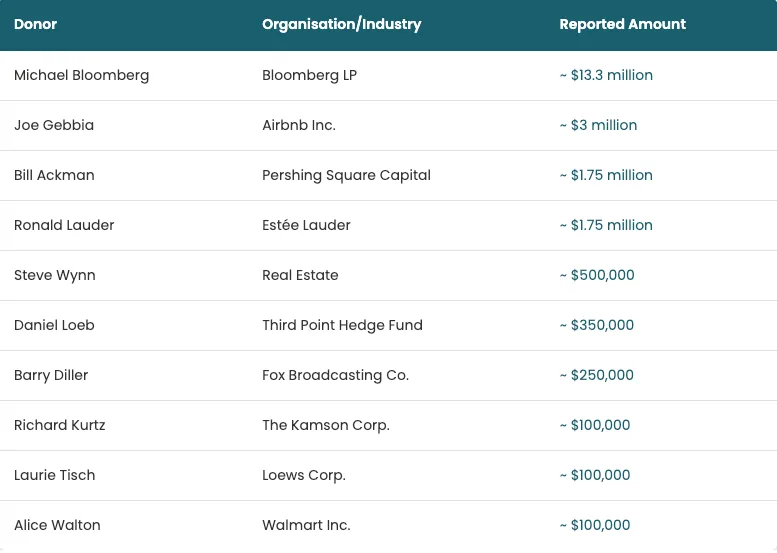
    Wall Street recoiled, unleashing $28 million via super PACs like Defend New York—Bloomberg ($13.3 million), Ackman ($1.75 million), Gebbia ($3 million), Lauder ($1.75 million). Their doomsday ads warned of exodus to Miami; Ackman quipped on Flagrant about a “hot commie summer.” It flopped: Mamdani won Queens and Brooklyn by landslides, flipping Bronx margins with renter turnout. Cuomo’s scandals (2021 harassment exit) and Sliwa’s Guardian Angels schtick couldn’t compete. Post-win, Mamdani quipped to Trump barbs: “Turn the volume up!” His transition team—five women, including Lina Khan and Grace Bonilla—signals equity; retaining NYPD’s Jessica Tisch nods to evolved policing (no more “defund” echoes).

    But here’s the conservative rub: Mamdani’s socialism isn’t salvation—it’s accelerant. Freezing rents distorts markets, breeding black markets and decay (witness 1970s NYC). Taxing millionaires? Albany vetoes loom, per Gov. Hochul’s history. His Gaza stance—vowing Netanyahu’s arrest—risks alienating Jewish voters (though he pledged outreach). Trump threatens federal cuts; NRCC eyes 2026 ads tying Dems to this “far-left mob.” As Vivek Ramaswamy posted: “Focus on affordability… cut identity politics.” Mamdani’s win, amid Spanberger’s VA pragmatism and Sherrill’s NJ centrism, shows Dems’ big tent: Radicals in cities, moderates in burbs. Yet AP polls reveal fury—6 in 10 “angry,” half blaming economy—stems from shutdown optics, not Trumpism.

    Broader Ripples: From Suburbs to States, a Call for Market Fixes

    Virginia’s Spanberger, ex-CIA, crushed Winsome Earle-Sears by 13 points in shutdown-furloughed NoVA, where 800,000 feds missed pay amid budget brinkmanship. “Pragmatism over chaos,” she thundered—resonating as 60% cited economy per AP. Jersey’s Sherrill, Navy vet, hammered Ciattarelli on taxes ($10,333 median) and bills, extending Dems’ three-term streak. Down-ballot: Ghazala Hashmi (first Muslim LG in VA), Jay Jones ousting scandal-tainted AG Jason Miyares.

    Bright spots for right? California’s Prop 50 empowers Dem redistricting (five House flips eyed); Maine’s red-flag guns passed sans voter ID; Colorado taxes rich for meals. But Texas affirmed parental rights; urban Dem holds (Buffalo’s Sean Ryan, Pittsburgh’s Corey O’Connor) show blue fortresses intact.

    Nationally, this is GOP’s wake-up: Housing trumps culture wars. Obama’s “brighter future” crow? Hype. Shutdown ends soon; tout manufacturing (1.2 million jobs since 2024), drill baby drill for energy costs. Blame NIMBY Dems for supply choke—streamline zoning, cut regs, incentivize builds. As NAR’s Shannon McGahn urges: Unlock inventory, modernize construction. Without it, 40 becomes 45 for buyers, and Mamdani clones sprout nationwide.

    New York’s saga isn’t progressive destiny—it’s market failure’s revenge. Trump’s coalition—diverse, ascendant—rebounds by delivering: Deregulate, build, tax less. Midterms loom; govern boldly, or watch affordability fury fuel the far left. The heartland’s watching—and the ballot box bites back.


    Adding to the pressure is a flurry of recent AI deals structured using what critics have dubbed “circular” funding mechanisms—broadly referring to suppliers like Nvidia making large capital investments in the businesses of the customers who buy their products. Just a few months ago, investors viewed such deals with enthusiasm, pumping up shares for a variety of AI-related companies, but this week one such deal—between Nvidia, Microsoft and Anthropic—was greeted warily.

    This week, 45% of global fund managers surveyed by Bank of America said that an AI stock-market bubble was one of the biggest risks facing the market.

    A number of bearish moves by high-profile investors have also rattled tech markets. Last week, Masayoshi Son’s SoftBank Group sold its entire $5.8 billion stake in Nvidia to divert that money to other AI investments, while a hedge fund run by influential billionaire venture capitalist Peter Thiel unloaded its entire $100 million Nvidia stake in the third quarter.

  • Zohran Mamdani’s Rise: From Little-Known Socialist to New York City Mayor

    Zohran Mamdani’s Rise: From Little-Known Socialist to New York City Mayor

    05met mayor live mamdani interview zqtl superJumbo 1
    Mayor-elect Zohran Mamdani has called to raise taxes on the wealthy to help fund his ambitious policy agenda. In an interview after his election, he said it was also about fairness. © Vincent Alban/The New York Times

    In a triumph that blends millennial savvy with old-school populism, Zohran Mamdani has emerged from relative obscurity to claim the mayoralty of the world’s financial capital, marking a seismic shift in the governance of America’s largest city.

    The 34-year-old state assemblyman, born in Uganda to Indian parents and a self-proclaimed democratic socialist, secured a decisive 50.4% victory Tuesday night over former Gov. Andrew Cuomo’s independent bid (41.6%) and Republican Curtis Sliwa‘s distant third (7.1%), amid the highest turnout for a mayoral election in over 50 years—more than 2 million ballots cast, including a record 735,000 early votes. Mamdani’s ascent, fueled by viral social media mastery, laser-focused economic messaging, and opponents hobbled by scandals and fatigue, catapults him into history as New York’s youngest mayor since 1892, its first Muslim leader, and the first of South Asian descent born in Africa.

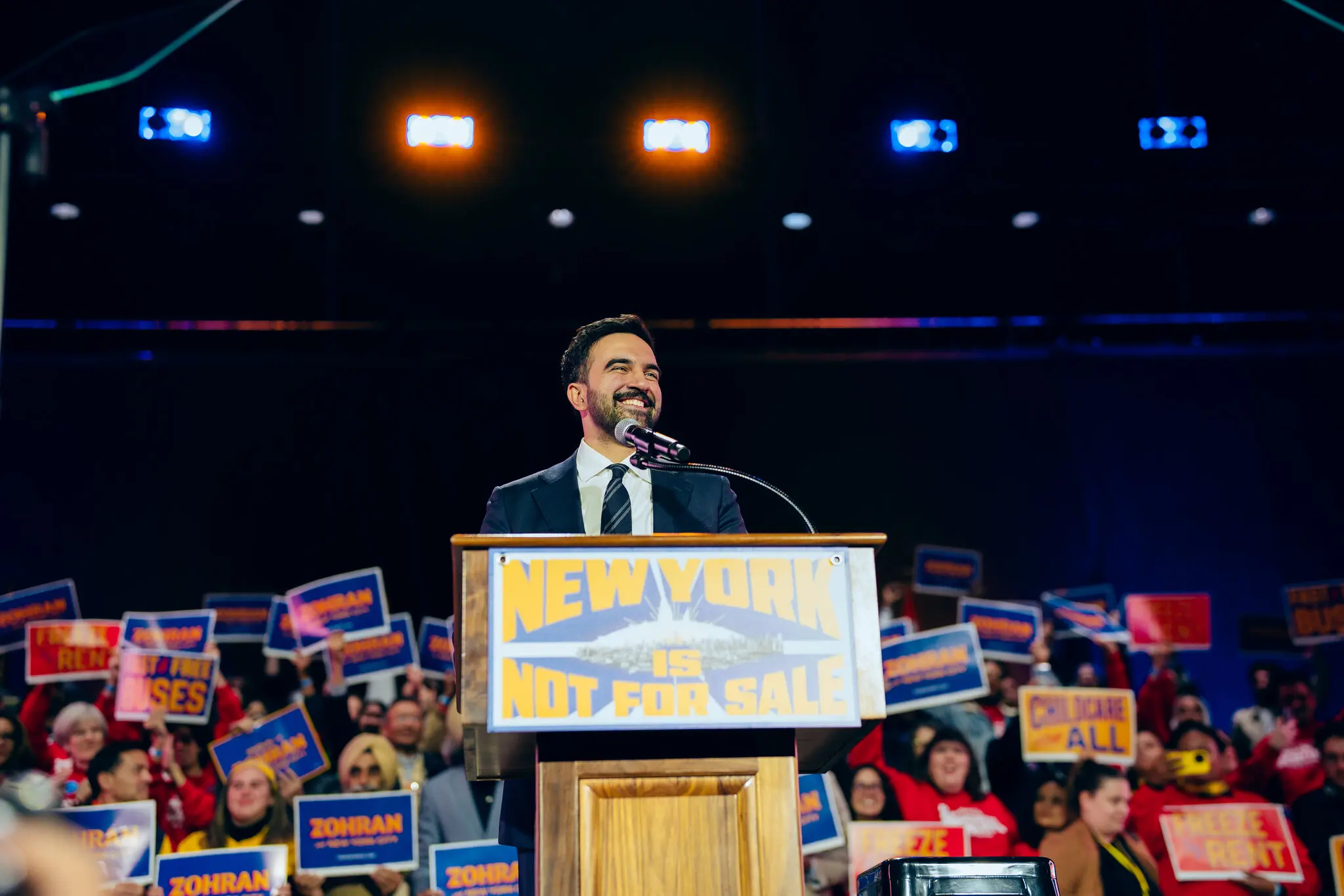
    For a city synonymous with Wall Street excess and unyielding ambition, Mamdani’s win feels like a plot twist in a Scorsese film—equal parts inspiring and unnerving. His campaign, launched with scant name recognition and no party machine muscle, harnessed TikTok memes and Instagram reels to mobilize young voters and outer-borough families crushed by housing costs (median rents at $3,400 against $6,640 household incomes, per Census data). Pledges for rent freezes on 1 million stabilized units, fare-free buses, and taxing millionaires resonated in a post-pandemic landscape where affordability topped AP VoteCast concerns for 6 in 10 New Yorkers. “Tonight, against all odds, we made it happen,” Mamdani declared to roaring crowds in Brooklyn, where Bad Bunny blasted amid tearful embraces and fluttering campaign flags. “New York, you’ve delivered a mandate for change, for a new politics, and for a city we can actually afford.”

    Yet, as confetti settled, Mamdani’s honeymoon looms short. Critics, including President Trump (who branded him a “communist” and vowed funding cuts), warn his agenda risks stifling the innovation that powers the city’s $1.8 trillion economy.

    Cuomo’s concession—”a caution flag… down a dangerous road”—echoed elite anxieties, while Sliwa vowed Guardian Angels mobilization against “socialism.” Mamdani’s retort? A cheeky nod to Trump: “Turn the volume up!” In his first post-victory presser at Flushing Meadows’ iconic globe, the mayor-elect outlined a five-woman transition team—led by Elana Leopold (de Blasio alum) and featuring ex-Deputy Mayor Melanie Hartzog, FTC Chair Lina Khan, United Way CEO Grace Bonilla, and Maria Torres-Springer—signaling a blend of expertise and gender equity. He’ll retain NYPD Commissioner Jessica Tisch, a nod to his evolved stance on policing after 2020 “defund” barbs he now calls “criticism, not abolition.”

    Screenshot 2025 11 06 at 4.31.04 AM 1.png 1

    Mamdani’s trajectory is a masterclass in grassroots disruption. Elected to the Assembly in 2020 as a Democratic Socialists of America (DSA) member—joining a network of 100,000 nationwide—he entered the race with “next to no name recognition, little money, and no institutional party support,” as one early strategist quipped. A son of filmmaker Mira Nair and Ugandan academic Mahmood Mamdani, he immigrated young, naturalized in 2018, and honed his voice as a Queens renter railing against inequality. His platform—universal childcare, green jobs, a “Department of Community Safety” for mental health calls—echoed DSA icons like Bernie Sanders (a symbolic anchor) and “The Squad” (AOC, Rashida Tlaib), but with laser focus on wallet issues over cultural flashpoints.

    Social media was his secret sauce: Viral videos of subway rants and affordability audits amassed millions of views, drawing Gen Z and immigrants alienated by Cuomo’s baggage. The ex-governor, son of Mario Cuomo, entered as favorite post-Eric Adams‘ scandalous exit but faltered on harassment scandals (denied as “political”) and a negative blitz that backfired. Sliwa’s quippy Guardian Angels flair amused but couldn’t dent Democratic hegemony. Mamdani’s 13-point primary romp over Cuomo forced the independent rerun, but his charisma—joking about being a “Scandinavian politician, only browner”—sealed the deal. “The conventional wisdom would tell you that I am far from the perfect candidate… I refuse to apologize,” he thundered, channeling Sanders’ 2016 energy that netted 13.2 million votes.

    DSA’s decentralized ethos—grassroots chapters pushing labor, mutual aid—amplified his run, proving socialists aren’t “fringe” anymore. Mamdani joins trailblazers like Greg Casar (Texas) and Sarahana Shrestha (NY Assembly), flipping seats with worker-rights focus. Unlike Europe’s welfare norms (universal healthcare in Scandinavia), DSA seeks democratized economics without full market abolition—a mixed model appealing to drifting blue-collar voters Trump chipped in 2024.

    Mandate Met with Hurdles: Governing the ‘Capital of Capitalism’

    Mamdani’s “mandate for change” arrives amid headwinds. NYC’s $100 billion budget strains under Hochul’s tax-hike vetoes; his millionaire levy faces state roadblocks. Critics like Trump (threatening federal aid cuts) and the NRCC (vowing 2026 ads tying House Dems to “radical socialist”) eye him as a bogeyman. His Gaza stance—denouncing “genocide,” pledging Netanyahu’s arrest—alarms Jewish leaders, though he pledged outreach: “Celebrating and cherishing” them.

    On policing, Mamdani’s evolution—from “rogue agency” to Tisch retention—aims to assuage fears, but his Community Safety pivot risks Sliwa’s promised “worst enemies” backlash. Economic woes loom: Post-shutdown (now longest at 36 days), 6 in 10 AP voters decried living costs; Mamdani’s grocery co-ops and fare-free MTA hinge on funding miracles.

    Yet opportunities abound. His blank-slate status (46% of Americans followed “not closely at all,” per CBS) lets him define himself—perhaps as a pragmatic reformer blending DSA equity with market-savvy. Outreach to Wall Street (Ackman’s “congrats” tweet) hints at detente; footprint in a city of 8.8 million immigrants offers global resonance.

    National Echoes: A DSA Blueprint or Democratic Divide?

    Mamdani’s win—amid Spanberger (VA) and Sherrill (NJ) centrist sweeps—hints at a big-tent Dems: Progressives in urban strongholds, moderates in suburbs. AP polls showed economy trumping immigration/crime; Mamdani’s focus flipped Bronx losses. Obama hailed “forward-looking leaders”; Kelly called it a “rejection of Trump’s chaos.”

    For Republicans, it’s fodder: NRCC’s “surrender to far-left mob.” But Vivek Ramaswamy nailed it: “Focus on affordability… cut identity politics.” As midterms loom, Mamdani tests DSA’s viability—electable in blues? His “working people” bind could unify, or fracture under scrutiny.

    Inaugurated January 1, Mamdani inherits de Blasio’s mixed legacy—progress on inequality, stumbles on execution. “The poetry of campaigning… the beautiful prose of governing,” he quipped, channeling Mario Cuomo. If he delivers, he’ll redefine urban liberalism; if not, he’ll fuel right-wing fire. New York, the universe’s center, watches—and America follows.

  • Trump Reluctantly Endorses ‘Bad Democrat’ Andrew Cuomo

    Trump Reluctantly Endorses ‘Bad Democrat’ Andrew Cuomo

    03met mayor live ru cuomo zqmv superJumbo
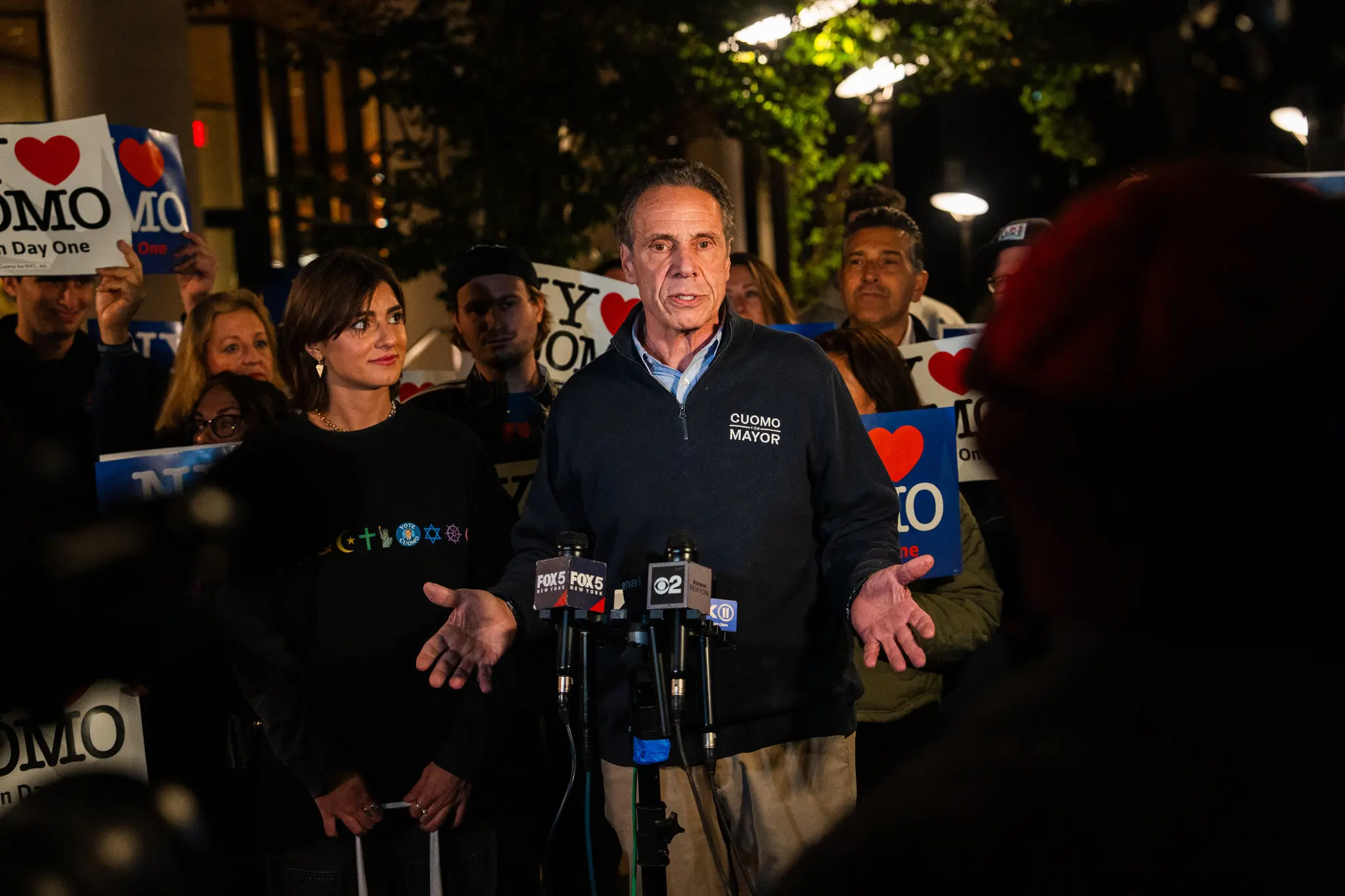
    Cuomo predicts a record turnout. © Vincent Alban/The New York Times

    On the eve of Election Day in America’s most dynamic metropolis, President Donald J. Trump delivered a pragmatic gut punch to the radical left’s ambitions, throwing his weight—however grudgingly—behind Andrew Cuomo to stave off what he rightly calls a “communist” takeover of New York City. In a blistering Truth Social post Monday evening, Trump urged voters to rally around the former governor, framing the choice as a no-brainer: Back the battle-tested Democrat or watch socialist Zohran Mamdani dismantle the Empire State from City Hall. “Whether you personally like Andrew Cuomo or not, you really have no choice. You must vote for him, and hope he does a fantastic job,” Trump declared. “He is capable of it, Mamdani is not!”

    This eleventh-hour intervention isn’t blind loyalty—it’s the mark of a leader prioritizing results over ideology. Trump, a Queens native with deep roots in the city, knows the stakes: Mamdani’s democratic socialist fever dreams threaten to turn the Big Apple into a West Coast knockoff of San Francisco’s tent-city nightmare. Polls show Mamdani clinging to a narrow lead—46% to Cuomo’s 33% and Republican Curtis Sliwa’s 15%, per Quinnipiac—but record early voting (over 735,000 ballots, a fourfold surge from 2021) signals a turnout battle Trump aims to tip. With five million registered voters hitting the polls today—post offices, banks, and shipping humming along as usual—Trump’s endorsement could be the firewall New York needs to avoid fiscal Armageddon.

    Trump’s backing, previewed in a Sunday 60 Minutes interview, drips with the candor only he can muster: “I’m not a fan of Cuomo one way or the other, but if it’s gonna be between a bad Democrat and a Communist, I’m gonna pick the bad Democrat all the time.” It’s classic Trump—blunt, unfiltered, and laser-focused on winning. Cuomo, the ex-governor who clashed with Trump over COVID policies yet delivered infrastructure wins and economic growth, emerges as the adult in the room. Mamdani? The 34-year-old assemblyman, poised to be NYC’s first Muslim mayor and youngest in over a century, peddles rent freezes, free buses, and “equity” schemes that gut gifted programs and embolden criminals.

    125008799
    President Donald Trump’s extended 60 Minutes interview. © CBS News

    Cuomo, running as an independent after Mamdani’s stunning June primary upset, welcomed the nod with characteristic steel: “He’s not endorsing me. He’s opposing Mamdani.” During a WABC radio call-in, he pivoted: “The president is right. A vote for Sliwa is a vote for Mamdani.” Trump echoed that, dismissing Sliwa (sans beret quip) as a spoiler: “A vote for Curtis Sliwa… is a vote for Mamdani.” Even Trump’s deputy chief of staff, Stephen Miller, piled on via X: Support Cuomo to block the “lunatic.” And Elon Musk, no stranger to Cuomo’s 2014 Buffalo solar deal (despite its job shortfalls), chimed in: “VOTE CUOMO!”—a rare tech titan-Trump alignment against the socialist surge.

    From a conservative perspective, this cross-aisle calculus is genius. Cuomo’s record—building affordable housing as HUD secretary, navigating the pandemic (despite nursing home scrutiny he calls politicized smears)—positions him as the firewall against Mamdani’s de Blasio 2.0. Trump nailed it on 60 Minutes: Mamdani would make “de Blasio look great.” The self-described “Scandinavian politician, only browner” rejects the communist label but embraces policies that scream big-government overreach: Arresting Netanyahu, defunding cops, and redistributing wealth from hardworking New Yorkers to the grievance industry.

    Trump’s endorsement came laced with a signature threat: Slash federal aid to NYC if Mamdani prevails. “It is highly unlikely that I will be contributing Federal Funds, other than the very minimum as required,” he posted, echoing Sunday’s 60 Minutes vow: “It’s gonna be hard for me… to give a lot of money to New York. Because if you have a communist running New York, all you’re doing is wasting the money.” New York City guzzles $7.4 billion in federal dollars yearly—funds for subways, schools, and security that Mamdani’s utopia would squander on virtue-signaling giveaways.

    2025 10 27t182836z 730721529 rc2hkhateicw rtrmadp 3 usa election new york mayor 20251101182935635
    The rise of Zohran Mamdani, the Democratic nominee for New York City mayor, has sparked a deeper debate among liberal Jews in New York and elsewhere. © Mike Segar/Reuters

    Mamdani fired back: “I will address that threat for what it is: it is a threat. It is not the law.” But Trump’s history speaks louder—deploying National Guard to blue cities for crime crackdowns, yanking funds from sanctuary jurisdictions. It’s not pettiness; it’s protecting taxpayers from subsidizing socialism. Cuomo, who “fought Donald Trump” as governor, now touts that grit: “When I’m fighting for New York, I am not going to stop.” In a Democratic stronghold where Trump polls poorly, this “anybody-but-Mamdani” strategy could peel off moderates weary of the assemblyman’s anti-Israel barbs and cop-bashing past.

    GOP Groundswell: Cross-Party Coalition Crushes the Commie

    Trump’s move ignited a Republican revolt against Sliwa, with heavyweights crossing lines. Rep. Nick Langworthy (R-N.Y.) endorsed Cuomo on Fox: “There’s no doubt in my mind he would be a far superior mayor than a communist.” Rep. Mike Lawler called him the “lesser of two evils” on WABC. Even disgraced ex-Rep. George Santos urged: “Vote for Andrew Cuomo… it is the only solution.” Not all GOPers fold—Rep. Nicole Malliotakis backs Sliwa as the “ONE… who has NOT contributed to the demise of our city”—but the tide turns toward pragmatism.

    Mamdani’s mockery? A tweet jabbing Cuomo: “Congratulations… I know how hard you worked for this,” with a mock “Trump endorses” graphic. He spun Trump’s support as proof Cuomo’s a “puppet and parrot,” but it reeks of desperation: “The MAGA movement’s embrace… is reflective of Donald Trump’s understanding that this would be the best mayor for him.” Mamdani vows an “alternative” to Trump’s “mirror image”—dignity for all—but conservatives see a recipe for decline: “The answer… is not to create its mirror image here in City Hall.”

    With early voting shattering records—151,212 on Sunday alone—today’s turnout could decide if NYC rebounds under Cuomo’s competence or crumbles under Mamdani’s collectivism. Trump, owning property in the city he loves, isn’t just meddling—he’s safeguarding his birthplace from the radicals who nearly wrecked it under de Blasio. Banks, UPS, and FedEx roll on; polls close at 9 p.m. But the real closure? Slamming the door on socialism before it bankrupts the greatest city on Earth.

    As Trump quipped on 60 Minutes about Mamdani comparisons: “I think I’m a much better looking person.” Humor aside, his endorsement is a masterstroke: Unite behind Cuomo, or watch New York fall. Voters, the choice is yours—pragmatism or peril.

  • New York’s Wealthiest Furious as Mamdani Gains Momentum Toward City Hall

    New York’s Wealthiest Furious as Mamdani Gains Momentum Toward City Hall

    New York City mayoral candidate Zohran Mamdani. © Victor J. Blue/Bloomberg
    New York City mayoral candidate Zohran Mamdani. © Victor J. Blue/Bloomberg

    As the Big Apple’s mayoral race barrels toward its November climax, Democratic Socialist Zohran Mamdani is surging ahead with a platform that promises to upend the city’s status quo—free buses, rent freezes, and a war on “inequity” that could spell doom for proven educational programs like gifted and talented classes. But while Mamdani’s populist pandering has captivated the outer boroughs’ disaffected youth, it’s sending shockwaves through Manhattan’s elite corridors, where hedge fund titans and real estate moguls are whispering in Pilates studios and over caviar: “How dare he?” The city’s 1% are realizing their once-ironclad influence is slipping away, and in a town built on ambition and opportunity, that’s a bitter pill to swallow. “It’s hard to be chill and relaxed,” one Upper East Side podcaster lamented, encapsulating the unease among New York’s wealthiest as they brace for a potential Mamdani mayoralty that could hike taxes, embolden criminals, and dismantle the merit-based systems that made the city a global powerhouse.

    From a conservative vantage, this isn’t just a local election—it’s a referendum on whether New York will cling to the free-market principles that fueled its resurgence under leaders like Rudy Giuliani or slide into the failed socialist experiments of Bill de Blasio’s era. Mamdani’s lead in polls—46% to Andrew Cuomo’s 33% and Curtis Sliwa’s 15%, per a recent Quinnipiac survey—highlights a troubling divide: a candidate who once called to “defund” and “dismantle” the NYPD now backpedaling with apologies, while vowing to phase out gifted programs in the name of “equity.” Meanwhile, battle-tested conservatives like Sliwa hammer home the basics: more cops, less crime, and real accountability. As billionaires like Bill Ackman rally against the tide, pouring millions into anti-Mamdani PACs, the question looms: Can the city’s engines of prosperity halt this leftward lurch before it’s too late?

    Fiery Debate Exposes Mamdani’s Outsider Gamble

    The sparks flew October 16 at 30 Rockefeller Center, where Mamdani, independent Andrew Cuomo, and Republican Curtis Sliwa clashed in a debate co-hosted by POLITICO, NBC 4 New York, and Telemundo 47—the first since Mayor Eric Adams bowed out amid scandals on September 28. With the city’s cost-of-living index at a staggering 148.2—second only to Honolulu—and housing prices 1.5 times the national average, affordability dominated the night.

    Mamdani, the 33-year-old Queens assemblyman and son of acclaimed filmmaker Mira Nair, leaned hard into his “everyman” credentials: “I have the experience of being a New Yorker, someone who has actually paid rent in the city before I ran for mayor,” he quipped, touting his $2,300 rent-stabilized apartment. But critics see hypocrisy—there’s no income test for such units, and Mamdani’s pledge to freeze rents on over a million stabilized apartments could cripple landlords and exacerbate the housing crunch conservatives warn about.

    Cuomo, the battle-scarred ex-governor who resigned in 2021 amid unproven harassment claims he calls “political and false,” countered with gravitas: “I built affordable housing all across this nation. I know how to get it done.” Promising 5,000 more NYPD officers with “revenue neutral” funding, Cuomo admitted learning from his primary loss to Mamdani—beefing up his TikTok game—while insisting, “I am the Democrat.”

    Sliwa, the Guardian Angels founder and 2021 runner-up to Adams, embodied the no-nonsense conservatism New York needs: “I will hire the very brightest and best… We don’t have enough cops,” he thundered, citing a same-day robbery of an elderly woman on 86th Street. Despite a 5.7% drop in major crimes year-over-year, Sliwa’s call for law-and-order resonates in a city weary of progressive leniency.

    Mamdani’s “free buses” pitch—replacing MTA revenue to cut assaults on drivers—sounds appealing but reeks of fiscal fantasy to right-lean observers. A second debate looms next week, but with Mamdani eyeing history as the first Muslim and Indian American mayor, conservatives fear a socialist stranglehold unless voters wake up.

    Apology Tour: Mamdani’s NYPD Mea Culpa Rings Hollow

    In a calculated pivot, Mamdani appeared on Fox News’ “The Story with Martha MacCallum” Wednesday, issuing his first broad apology to the NYPD for 2020 rants labeling them “racist, anti-queer & a major threat to public safety” and demanding to “defund” and “dismantle” the force. “Absolutely, I’ll apologize to police officers right here,” he said, blaming the rhetoric on post-George Floyd “anger and frustration.” Now, he claims, representing Queens has taught him to “deliver safety” alongside justice.

    But Police Benevolent Association President Patrick Hendry wasn’t buying it: “Elected leaders’ words matter, but their actions matter more.” Hendry spotlighted assaults on officers and rights trampled by the Civilian Complaint Review Board—issues Mamdani’s plan to slash overtime and disband the Strategic Response Group would exacerbate. Conservatives see this as election-year theater: Mamdani still vows a “Department of Community Safety” for mental health calls, a soft-on-crime Trojan horse that could hamstring cops.

    In the same interview, Mamdani stared down the camera at President Trump—who’s threatened to yank federal funds and even arrest him: “I want to speak directly to the president… I’m ready to speak at any time to lower the cost of living.” Trump, per a spokesperson, wasn’t watching, but the gesture underscores Mamdani’s national ambitions amid his anti-Israel stances, including pledging to arrest Benjamin Netanyahu.

    DEI Overdrive: Mamdani’s Assault on Gifted Education

    Adding fuel to the fire, Mamdani is reviving Bill de Blasio’s failed bid to scrap NYC’s gifted and talented programs, deeming them “highly segregated” and pledging to phase them out for “equity.” This aligns with a leftist trend nationwide—scrapping merit-based classes because they enroll too many white and Asian students, opting for “broader enrichment” that dilutes standards.

    Critics like Erin Wilcox of the Pacific Legal Foundation call it “racial balance… just a word for discrimination,” potentially violating the 14th Amendment. In districts like Montgomery County, Md., and Virginia’s Thomas Jefferson High, similar tweaks tanked Asian enrollment and school rankings—Thomas Jefferson plummeted from No. 1 to 14 nationally.

    Cuomo counters with expansion: more gifted classes in every borough and eight new specialized high schools. Thomas B. Fordham Institute’s Michael J. Petrilli blasts Mamdani’s disdain for early assessments: “If Mamdani really cares about ‘equity,’ he would work to expand gifted education… not work to end it.” To conservatives, this is cultural Marxism run amok—punishing excellence to appease identity politics, robbing bright kids of opportunities in a city that thrives on merit.

    Elite Panic: Billionaires Brace for the Guillotine

    The real story? Mamdani’s rise has New York’s elite in full meltdown. From Upper East Side Pilates chats to Tribeca dinners, the 1% are plotting escapes to Miami or Bedford, fearing tax hikes and chaos. Ackman and Elon Musk have blasted him; one ad mocking lobster-munching socialists went viral in wealthy ZIP codes, eliciting “how dare he?” fury.

    A venture capitalist confessed ignorance of youth anger until Mamdani’s primary win; a retired banker quipped, “it’s not as if the guillotine is being rolled into Central Park.” Yet, some cynics root for him, betting failure swings voters right. Mamdani’s overtures—like trimming bureaucracy—fall flat; his giveaways mean someone pays, and it’s not the Hamptons crowd.

    As polls tighten, conservatives urge a Cuomo-Sliwa surge to block Mamdani’s utopia. Trump’s shadow looms—federal aid cuts could cripple his plans. If elected, Mamdani’s tenure could be short-lived chaos, but at what cost to the city that never sleeps? New York deserves leaders who build, not redistribute. The elite’s panic? A wake-up call that socialism’s siren song threatens all.

  • NYC Mayoral Race ‘Not for Sale to Trump Donors,’ Mamdani Says

    NYC Mayoral Race ‘Not for Sale to Trump Donors,’ Mamdani Says

    NEW YORK – In a stunning turn of events that could reshape the Big Apple’s political landscape, Democratic mayoral candidate Zohran Mamdani fired back at what he perceives as interference from President Donald Trump and his wealthy supporters, insisting that the New York City mayoral race remains “not for sale” following incumbent Mayor Eric Adams‘ abrupt withdrawal from the contest.

    Adams, who had been mounting an independent bid since April, released a video on social media Sunday announcing the end of his reelection campaign – just three weeks after defiantly vowing to press on. The move comes amid reports of a meeting earlier this month between Adams and White House special envoy Steve Witkoff, sparking speculation about a potential role for the mayor in the Trump administration. While Adams’ spokesperson emphasized that he will serve out his term without any confirmed post-office plans, the decision has ignited a firestorm of reactions from the remaining candidates, highlighting deep divisions in a race already fraught with ideological clashes.

    Mamdani’s Vision for New York City

    Mamdani, the 33-year-old state assemblyman who clinched the Democratic nomination over the summer with a decisive victory over former Gov. Andrew Cuomo and others, wasted no time framing Adams’ exit as part of a broader scheme orchestrated by Trump and his billionaire backers. Appearing on MSNBC Sunday evening, Mamdani declared, “Donald Trump and his billionaire donors may be able to determine the actions of Eric Adams and Andrew Cuomo, but they will not dictate the results of this election.” He doubled down on this sentiment in a video posted to social platform X, warning Cuomo: “You got your wish. You wanted Trump and your billionaire friends to help you clear the field. But don’t forget. You wanted me as your opponent in the primary too, and we beat you by 13 points.”

    From a conservative vantage point, Mamdani’s rhetoric smacks of the kind of far-left paranoia that has alienated moderate voters in cities across America. As the youngest and most progressive candidate in the field, Mamdani’s campaign promises to slash living costs in one of the world’s priciest metropolises through aggressive policies that critics argue could stifle economic growth and empower socialist-leaning agendas. His attacks on Trump – a president who has championed deregulation and tax cuts to boost urban economies – seem designed to rally the Democratic base but risk turning off independents and working-class New Yorkers weary of progressive experiments that have led to rising crime and fiscal woes in the past.

    Cuomo, running as an independent centrist, welcomed Adams’ departure as a game-changer that sharpens the race into a clearer ideological showdown. Speaking to reporters outside a campaign event in Queens Sunday night, Cuomo praised Adams’ “selflessness” and warned that a Mamdani victory should terrify New Yorkers. “I believe Mayor Adams is 100% sincere. I applaud his selflessness… He said, ‘I’m going to put my personal ambition aside for the good of the city,’ because he’s afraid of the result if Mr. Mamdani would win the election, and we should all be afraid of the result,” Cuomo said. He dismissed Mamdani’s primary win as irrelevant in the general election, noting, “This is now a much larger election where more New Yorkers will vote. And I am telling you, and I’m out there every day, New Yorkers do not support what Mamdani supports.”

    Cuomo’s comments underscore a pragmatic, results-oriented approach that resonates with right-leaning voters disillusioned by the city’s leftward drift under progressive leadership. Denying any direct conversations with Trump – despite a New York Times report suggesting otherwise – Cuomo positioned himself as the steady hand capable of steering New York away from what he sees as Mamdani’s radicalism. He also brushed off Republican nominee Curtis Sliwa as non-viable, though he expressed interest in speaking with Adams “whenever appropriate.”

    Sliwa, the Guardian Angels founder and GOP standard-bearer, has faced his own pressures, revealing last week that unnamed wealthy New Yorkers – possibly Trump donors, though unconfirmed – offered him money to bow out. Undeterred, Sliwa’s spokesperson issued a statement affirming his staying power: “Curtis Sliwa is the only candidate who can defeat Mamdani. Our team, our resources, and our funding are unmatched. Most importantly, we have the best solutions to help working people afford to stay in New York City and feel safe.” Trump’s recent jab at Sliwa as “not exactly prime time” hasn’t helped, but in a fragmented field, Sliwa’s tough-on-crime stance could siphon votes from disaffected Democrats and independents who prioritize public safety over progressive platitudes.

    Polling data adds intrigue to the post-Adams landscape. A Suffolk University City View survey released last week showed Mamdani leading with 45% support, followed by Cuomo at 25%, Sliwa at 9%, and Adams at 8%. With Adams out, his centrist supporters – many of whom overlap with Cuomo’s base – could consolidate behind the former governor, potentially closing the gap. However, Mamdani remains unfazed, telling Eyewitness News that the race hasn’t fundamentally shifted: “It’s a race between us and the failed politics that we’ve seen, whether it’s Andrew Cuomo or Eric Adams… We’re going to show that they can’t dictate the outcome of this race.”

    Mamdani elaborated on Trump’s involvement, suggesting the president’s interest stems from fear of a genuine affordability agenda: “Donald Trump will do what Donald Trump wants to do, but the important thing is to understand why he’s so interested. He ran a campaign speaking about cheaper groceries and a lower cost of living. That’s the campaign that we ran. The difference is that he has shown no interest in delivering on that agenda, instead just persecuting his supposed political enemies.”

    Conservatives might counter that Trump’s economic policies have delivered real wins for urban America, from opportunity zones to criminal justice reform, and that his donors’ involvement reflects a healthy interest in preventing New York from sliding further left. Mamdani’s dismissal of such influence as nefarious ignores the reality that big-money politics cuts both ways – progressive billionaires like George Soros have long meddled in local races with far less scrutiny.

    As the November election approaches, Adams’ name will still appear on the ballot, alongside longshot Jim Walden, who suspended his campaign last week and endorsed Cuomo. The mayor’s exit could indeed boost Cuomo, but it also amplifies the stakes in a contest pitting progressive idealism against centrist pragmatism and conservative grit. New Yorkers, battered by high costs and urban challenges, will decide if Mamdani’s vision aligns with their aspirations – or if it’s time to reject the left’s grip on the city that never sleeps.

  • Eric Adams Exits New York City Mayoral Race

    Eric Adams Exits New York City Mayoral Race

    After working for the New York City Police Department for more than two decades. © ZUMA Press Wire/Shutterstock.com
    After working for the New York City Police Department for more than two decades. © ZUMA Press Wire/Shutterstock.com

    NEW YORK — New York City Mayor Eric Adams abruptly suspended his re-election campaign on Sunday, September 28, 2025, just five weeks before Election Day, citing funding woes and relentless media scrutiny that he said had crippled his bid for a second term. The announcement, delivered in a nearly nine-minute video posted to X, marks the end of a tumultuous tenure for the one-term Democrat and could consolidate opposition votes behind former Gov. Andrew Cuomo, potentially tightening the race against Democratic nominee Zohran Mamdani.

    Adams, who rose from NYPD captain to Brooklyn borough president before winning the mayoralty in 2021 as the city’s second Black mayor, framed his exit as a reluctant necessity. “Despite all we’ve achieved, I cannot continue my re-election campaign,” he said, his voice steady but somber against a backdrop of city skyline footage. “The constant media speculation about my future and the campaign finance board’s decision to withhold millions of dollars have undermined my ability to raise the funds needed for a serious campaign.” He acknowledged lingering voter unease from his dismissed federal corruption case, insisting, “I was wrongfully charged because I fought for this city, and if I had to do it again, I would fight for New York again.”

    The mayor’s departure from the race—where he had been polling in the low single digits as an independent—leaves a crowded field led by Mamdani, the 33-year-old state assemblyman and democratic socialist who stunned observers by winning the June Democratic primary. Recent polls show Mamdani commanding 43% to 47% support among likely voters, far ahead of Cuomo’s 23% to 29% and Republican Curtis Sliwa’s 9% to 17%. Adams hovered below 10% in most surveys, a sharp fall from his early-term popularity amid post-COVID recovery efforts.

    Adams did not endorse any candidate, but his remarks carried clear barbs at Mamdani’s progressive platform, warning of “extremism growing in our politics” and “insidious forces [who] use local government to advance divisive agendas with little regard for how it hurts everyday New Yorkers.” He urged voters to choose leaders “not by what they promise, but by what they have delivered,” a nod to his own record of crime reductions and quality-of-life investments. “Major change is welcome and necessary, but beware of those who claim the answer is to destroy the very system we built over generations,” he added. “That is not change, that is chaos.”

    The decision caps a year of speculation fueled by Adams’s scandals, including a September 2024 federal indictment on charges of bribery, wire fraud, and illegal campaign contributions—dismissed in February 2025 at the Trump Justice Department’s urging to enlist the mayor in immigration enforcement. Critics alleged a quid pro quo, with then-interim U.S. Attorney Danielle Sassoon resigning after orders to drop the case. Adams denied any deal but admitted the probe had eroded trust.

    As recently as early September, Adams vowed to stay in, declaring himself “the only one who can beat Mamdani.” He skipped the Democratic primary to run independently, a maneuver that spared him from Mamdani’s upset victory but isolated him further amid liberal backlash over his rapport with President Donald Trump. Trump’s overtures—suggesting Adams and Sliwa exit to boost Cuomo—added to the pressure, though Sliwa has rebuffed calls to withdraw.

    Adams’s exit could reshape the November 4 contest, potentially funneling his supporters—outer-borough Black and Latino Democrats, Orthodox Jews—to Cuomo, the centrist independent who has positioned himself as Mamdani’s chief foil. In head-to-head hypotheticals without Adams and Sliwa, Mamdani’s lead narrows to 48%-44%, per a New York Times/Siena poll, though he still holds a double-digit edge in multi-candidate scenarios. Cuomo, speaking after an unrelated Queens event, called the dropout “a game-changer,” praising Adams’s resilience: “Only in New York can a child raised in a tenement in Bushwick… rise to become mayor.”

    Mamdani, campaigning on affordability in the world’s priciest city, dismissed the shift on X: “Trump and his billionaire donors might be able to determine Adams and Cuomo’s actions. But they won’t decide this election.” Sliwa, the Guardian Angels founder, faces internal GOP pressure but insists on staying, despite Trump’s quip that he’s “not exactly prime time.”

    Gov. Kathy Hochul, who endorsed Mamdani, lauded Adams: “He leaves the city better than he inherited it.” Trump, in a Reuters interview, predicted Adams’s votes would flow to Cuomo. Republican Rep. Mike Lawler urged Sliwa’s support to “defeat Zohran Mamdani.”

    Adams pledged to serve out his term, battling COVID fallout, crime surges, the migrant crisis, and economic woes. “This is not the end of my public service,” he said. “I will continue to fight for this city… to make our streets safer and our systems fairer.” He implored his successor to expand his initiatives on policing, mental health, and homelessness.

    With Adams out, the race—New York’s first competitive general election in decades—pivots to a potential Cuomo-Mamdani showdown, testing the city’s appetite for bold progressive change against centrist pragmatism. Polls suggest Mamdani’s enthusiasm edge among younger voters could prove decisive, but Cuomo’s consolidation play keeps the outcome fluid. As one X user quipped amid the frenzy, “Eric Adams was given a choice… dropout, and turn Fed evidence against the NYC crime machine.” Whether that’s hyperbole or harbinger, the Big Apple braces for a bruising finish.

  • Three Killed, Nine Wounded in Brooklyn Nightclub Shooting

    Three Killed, Nine Wounded in Brooklyn Nightclub Shooting

    A shooting at a crowded New York City club early on Aug. 17 left three people dead and nine wounded, authorities said.

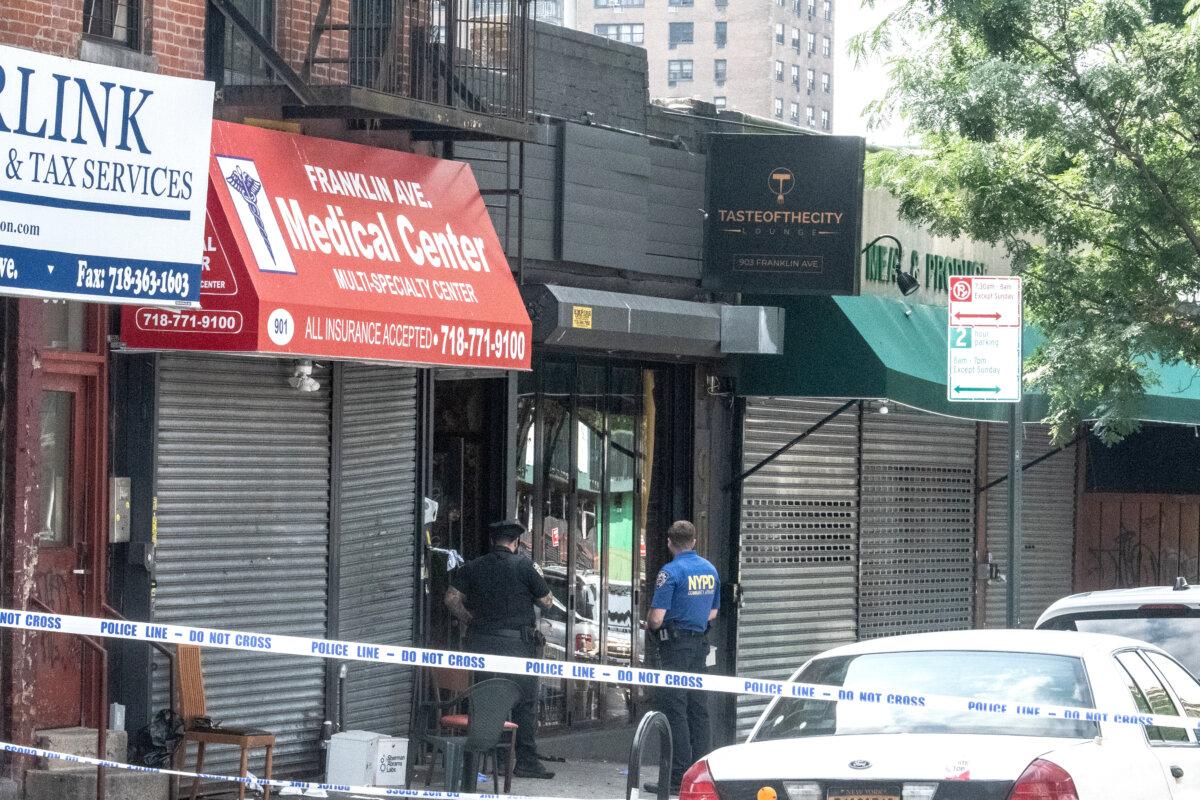
    Investigators have said they believe that up to four shooters opened fire at Taste of the City Lounge in the Crown Heights neighborhood of Brooklyn, following a dispute just before 3:30 a.m. ET on Aug. 17, New York Police Department Commissioner Jessica Tisch told reporters.

    “It’s a terrible shooting that occurred in the city of New York,” Tisch said at a press conference.

    “Currently, we have identified 12 victims—ranging in age from 19 to 61—nine males and three females.”

    Three men died in relation to the shooting—one aged 19 who was pronounced dead at the scene and two—aged 27 and 35—who succumbed to their injuries at the hospital, Tisch said.

    Officers are investigating at least 42 shell casings found at the lounge, from multiple guns, and a firearm discovered on a nearby street, she said.

    Tisch said the wounded in the shooting are being treated at hospitals for injuries that are not life-threatening. The victims’ names are being withheld pending family notifications.

    She said the police would not speak about motivation for the incident until the investigation is complete, but she said law enforcement has reason to believe some of the victims were involved in the shooting. That information is preliminary and subject to change, she said.

    “What we know preliminarily is that there was a dispute inside the crowded club that led to the shooting. We believe that there were up to four shooters involved in this incident,” Tisch said. “At this time, no one is in custody, and the shooting preliminarily appears to be gang-related.”

    image?url=https%3A%2F%2Fimg.theepochtimes.com%2Fassets%2Fuploads%2F2025%2F08%2F17%2Fid5902390 Brooklyn shooting GettyImages 2229889756
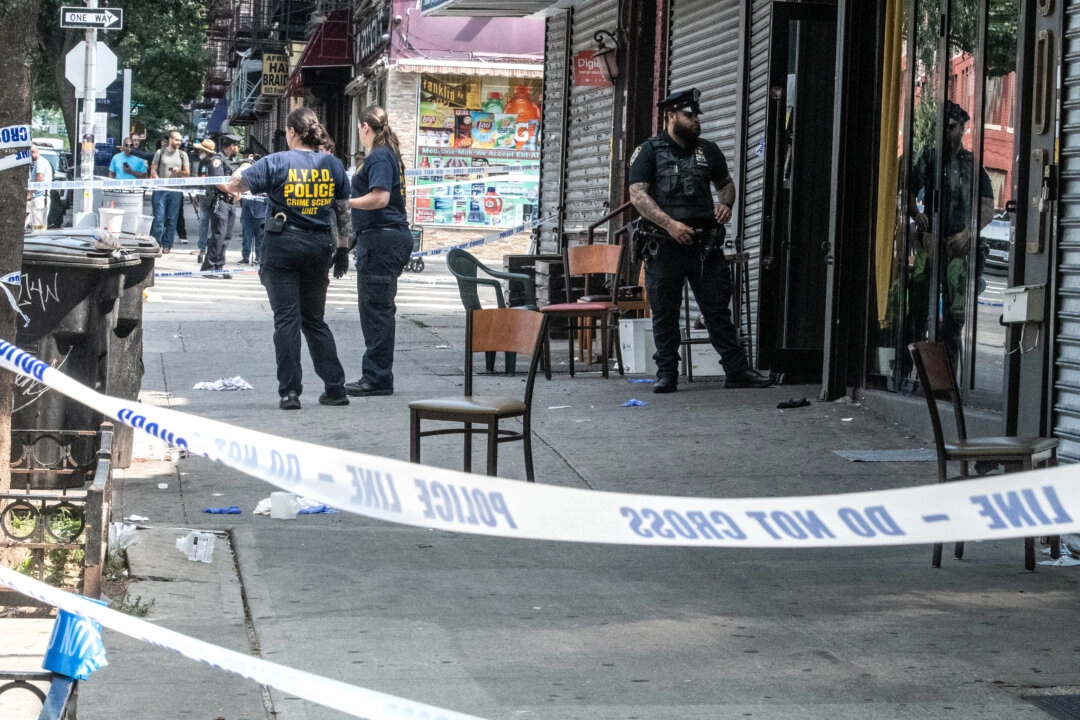
    Members of the New York City Police Department investigate a shooting scene at Taste of the City lounge in the Crown Heights neighborhood of the Brooklyn borough in New York City on Aug. 17, 2025. © Stephanie Keith/Getty Images

    New York City is having a record low year for gun violence, the police commissioner noted.

    “We have the lowest numbers of shooting incidents and shooting victims seven months into the year that we’ve seen on record in the city of New York,” Tisch said. “Something like this is, of course, thank God, an anomaly, and it’s a terrible thing that happened this morning, but we’re going to investigate and get to the bottom of what went down.”

    New York City Mayor Eric Adams asked anyone with information about the shooting to call Crime Stoppers at 1-800-577-TIPS.

    “We need your help,” Adams said at a press conference, adding that it’s New York City’s second mass shooting in a few weeks.

    “If you were inside the club, if you heard individuals talking about this shooting, if you witnessed someone fleeing the location, every piece of information would allow us to put the puzzle together to solve this crime.”

    Andre Mitchell-Mann, who serves as Adams’s first New York City gun violence prevention czar and co-chair of the Gun Violence Prevention Task Force, said the mayor’s team has “been responding ever since the call has been made.”

    “Mass shootings require mass resources, and so we look to go into that area of Crown Heights and to be able to pour those resources within that area, and we’re looking forward to everybody else’s collaboration going forward,” he said.