Activist investor Boaz Weinstein is offering to buy shares in Blue Owl Capital Inc.’s business development companies after a challenging week for the lender and broader fears about bubbling risks in the $1.8 trillion private credit market.
Saba Capital Management, led by Weinstein, and Cox Capital Partners launched the tender with an offer price that’s expected to be at a 20% to 35% discount to the most recent estimated net asset value and dividend reinvestment price. That will be determined when tender offers start after a 10-business day notice period, Cox and Saba said in a statement Friday.
Existing shareholders in the non-traded BDCs would have the option — but no obligation — to sell to the firms.
📊 More Investing
The price that any tender clears at will provide a window into where the market gauges the value of these funds and if it reflects Blue Owl’s internal net asset value. Steeply discounted exits could hurt future fundraising efforts.
“The purchasers’ tender offers would provide a liquidity solution to retail investors in the wake of a significant industry-wide increase in BDC redemption requests, multiple quarters of net outflows and a rise in redemption gate provisions,” Saba and Cox said in the statement.
The move comes just days after Blue Owl decided to restrict withdrawals from one of its private credit funds. Facing a looming deadline to return cash to investors in Blue Owl Capital Corp. II, also known as OBDC II, it raised capital by selling a $1.4 billion portfolio of loans to three of North America’s biggest pension funds and its own insurance firm.
Boaz Weinstein. (Jason Alden/Bloomberg)
Blue Owl shares extended losses on Friday, closing the week at their lowest level since June 2023, while shares in other asset managers also sold off.
“Saba and Cox are looking to capitalize on the headlines in the market,” said Michael Covello, executive managing director at investment bank Robert A. Stanger & Co. Inc.
For an investor who says, “I’ve read all the headlines, I’m scared, I don’t care what it costs, I want to get out today,” the tender offer could be a good opportunity, even with the discount, Covello said. “But there’s a cost to liquidity.”
Saba and Cox sent notice to purchase OBDC II shares on Feb. 17. They plan to make similar offers for Blue Owl Technology Income Corp. and Blue Owl Credit Income Corp., which are also BDCs.
Who’s Buying?
Weinstein is a seasoned activist investor who has waged aggressive proxy battles against Wall Street’s biggest names, including BlackRock Inc. and Nuveen. He launched Saba in 2009 and the hedge fund has focused on building stakes in closed-end funds and special purpose acquisition companies.
A Deutsche Bank AG alum, Weinstein has sometimes positioned himself as a defender of retail investors, taking on fund managers that he sees as more interested in collecting fees than maximizing returns for shareholders.
Cox Capital is an investor in dozens of private funds, from BDCs to real estate investment trusts. The Philadelphia-based firm, founded by John Cox in 2020, provides a source of “secondary liquidity” to investors in alternative assets, according to its website.
The credit secondaries market is a fast-growing area of finance, and has proven useful to private equity firms in need of cash, especially as dealmaking slowed down after the Covid-19 pandemic.
Bitcoin just suffered its largest weekly decline in more than three years. But the worst part for some of crypto’s permabulls is that they aren’t sure what exactly caused the crash.
The selloff left many of the market’s luminaries—those so well-known that they go simply as “Pomp” and “Novo” and “Mooch”—searching for answers.
“Bitcoin is crashing and investors are freaking out,” Anthony Pompliano, a crypto evangelist and investor, wrote Friday.
Bitcoin fell 16% to $70,008 this past week, down a sharp 45% from its all-time high of $126,273 in October. Ether dropped 24% to $2,052, off 59% from its own high of last year. Both tokens staged furious rallies Friday, but the week remained a historically bad one for crypto. And few seem to know what went wrong.
Market theories for the selloff ranged from investors’ pivot toward the prediction markets and other risky bets, to widespread profit-taking after a blistering bull run.
Price performance, past two years
Price performance, past two years
Trump’s surprise announcement of
100% tariffs against China
Source: The NY Budgets Crypto Index
“There was no smoking gun,” said Michael Novogratz, who runs Galaxy Digital, a crypto merchant-banking and trading firm.
For much of last year, crypto was in ascendance. President Trump’s return to the White House ushered in a new era for digital assets, which continued to gain acceptance among individual investors and legitimacy on Wall Street. As bitcoin and other popular tokens touched record highs, it seemed as though the market’s best days always lay ahead.
“I really didn’t think that we’d see a six at the beginning of the bitcoin price ever again,” said Cory Klippsten, chief executive officer of the bitcoin financial services firm Swan Bitcoin.
And yet, for a 24-hour stretch that ended Friday afternoon, bitcoin was back at that level. Past crypto selloffs had clearer explanations, which made this one more mystifying.
In 2018, bitcoin fell 80% from its peak after the initial coin offering bubble burst, ending an era in which thousands of unproven startups raised billions of dollars with little more than a sales pitch. In 2022, the $40 billion collapse of TerraUSD and Luna coins triggered a cascade of company failures across the crypto sector that culminated in the implosion of Sam Bankman-Fried’s FTX exchange.
Alan Chapman/Dave Benett/Getty Images
This time, there is no clear consensus. “If you ask five experts, you’ll get five explanations,” said Anthony Scaramucci, who served for 11 days as communications director during Trump’s first term and is among the best-known crypto bulls at his firm, SkyBridge Capital.
Here are some of the most popular explanations:
New shiny objects
There is no shortage of other markets for traders to make audacious bets, said Pompliano, the CEO of ProCap Financial. Prediction markets, gold, silver, artificial intelligence and so-called meme stocks are all vying for their attention of late, drawing eyes away from crypto.
“It used to be that bitcoin was the consensus view where asymmetry existed,” Pompliano said. “Now you have AI, prediction markets…many other areas where people can go and they can speculate.”
More supply?
Wall Street has sought to capitalize on crypto’s popularity by launching a growing array of exchange-traded funds and derivatives linked to bitcoin and other popular tokens. Their proliferation might not affect the sheer number of bitcoins, ethers and other tokens, but some investors thought their arrival has dented bitcoin’s appeal as a scarce asset.
Bitcoin’s main appeal has always been its limited supply of 21 million coins. By launching ETFs and complex derivatives, Wall Street has enabled investors to bet on the price of bitcoin without needing to buy or hold the actual coins, some analysts said.
New sheriff
Other investors suspected that Kevin Warsh, Trump’s pick to be the next chair of the Federal Reserve, might be bringing down crypto prices.
Warsh, they said, is seen as more hawkish on interest rates as a tool to tame inflation, and more supportive of a stronger U.S. dollar. Higher rates and a stronger dollar are conditions that typically hurt some alternative assets, such as gold and crypto, making them less attractive to investors. And this past week, the WSJ Dollar Index edged up 0.4%.
Still, Warsh and the Fed are expected to cut rates this year, not raise them. And Warsh has warmed to bitcoin. He famously dubbed the digital currency a “policeman for policy,” saying in a TV interview that bitcoin’s price can inform policymakers when they are doing things right and wrong.
Clouded clarity
After Trump signed into law the Genius Act last year, paving the path for stablecoins—digital assets pegged to fiat currencies like the dollar—the industry turned its attention to the next important piece of legislation: the Clarity Act. This bill would create a clear regulatory framework for the burgeoning industry.
Congress appeared on the cusp of moving the bill ahead when a dispute between crypto exchanges and traditional banks stalled that momentum. Without this measure, many financial firms are hesitant to integrate digital assets into their offerings. And unless a compromise is reached, the dust-up might deny the crypto market a catalyst that could have extended the rally.
Profit-taking
Novogratz and some other investors thought much of the selloff was driven by investors eager to lock in gains they collected when bitcoin, ether and other digital tokens rallied in the midst of the “euphoria” of Trump’s election in 2024 and pledge to make the U.S. the world’s crypto capital.
And those gains were indeed spectacular. Bitcoin, for one, rocketed around 80% from Election Day until early October of last year.
Sharp selloffs are hardly unusual in crypto, of course. They are so regular, in fact, that investors give them a name—crypto winter—that befits the belief that these downturns are as predictable as the seasons.
Some analysts believe this crypto winter could thaw faster than those of the past. No key companies have collapsed or faced allegations, revelations that have elicited crises of confidence in past crashes.
For believers, Friday’s rally served as reassurance that cryptocurrencies have always bounced back, part of why they stick with these investments.
“The infrastructure is stronger, stablecoin adoption continues to grow and institutional interest hasn’t evaporated, it’s just sidelined,” said Jasper De Maere, a strategist at the crypto trading firm Wintermute. Interest in these investments “can return quickly,” he said.
Many of crypto’s true believers are willing to wait.
On a Thursday afternoon conference call, Strategy founder Michael Saylor sought to reassure investors that bitcoin was coming back.
Republicans are way ahead of Democrats regarding their opinion of crypto and bitcoin, said MicroStrategy’s Michael Saylor. (Danny Nelson/CoinDesk)
Moments earlier, his company, which stockpiles bitcoin, had reported a $12 billion quarterly loss related to the token’s late-2025 swoon. Saylor told his investors the only way to handle the downturn is to hold on—and tune out the market’s volatility.
“Your time horizon needs to be, minimal, four years,” Saylor said.
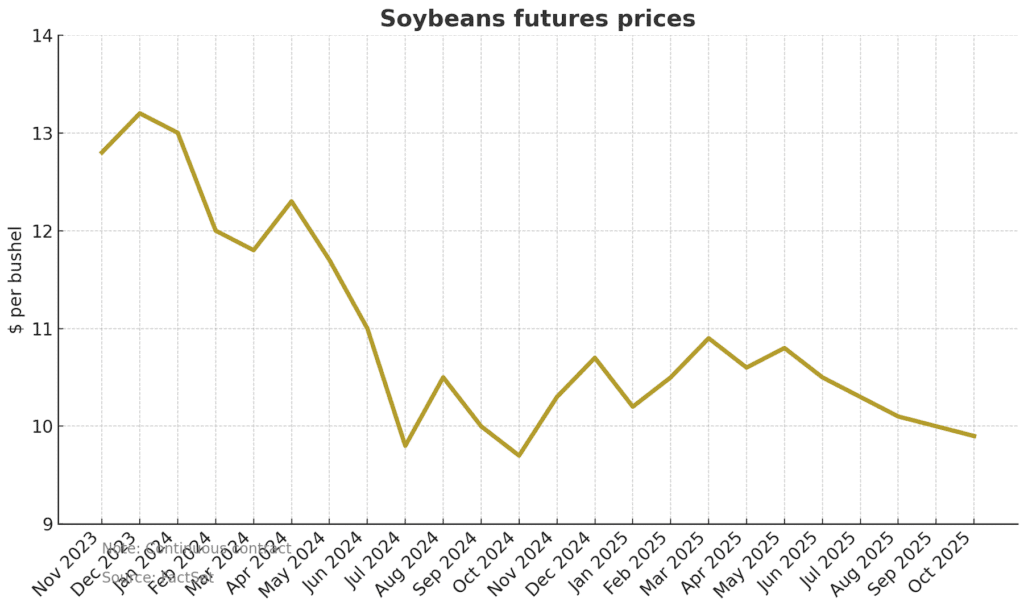
In the heart of the Midwest, where golden fields stretch toward the horizon under a crisp autumn sky, the hum of combines should signal prosperity. Instead, for America’s soybean farmers, harvest season has become a grim countdown to financial ruin. As they reap what the U.S. Department of Agriculture (USDA) projects to be a record 4.2 billion bushel crop this year, their largest buyer—China—has vanished from the market, leaving silos overflowing and prices plummeting to five-year lows around $9.50 per bushel.
China hasn’t booked any U.S. soybean purchases in months; farmers warn of ‘bloodbath’
The trade war between the United States and China, now in its second year under President Donald Trump’s renewed tariff regime, has turned soybeans into collateral damage. Beijing’s retaliatory 25% tariffs on U.S. agricultural imports have priced American beans out of the Chinese market, where they once commanded over half of the $24.5 billion in annual U.S. soybean exports. From January through August 2025, Chinese imports of U.S. soybeans totaled a mere 200 million bushels—down from nearly 1 billion bushels in the same period of 2024, according to USDA trade data. That’s a 80% plunge, robbing Midwestern farmers of billions in revenue and forcing a scramble for alternative markets that may never fully compensate.
“We’ll see the bottom drop out if we don’t get a deal with China soon,” warns Ron Kindred, a veteran farmer managing 1,700 acres of corn and soybeans in central Illinois. Halfway through his harvest, Kindred has locked in contracts for just 40% of his crop at prices already eroding below $10 per bushel in local elevators. The remaining 60% sits in limbo, a high-stakes bet on a breakthrough in Washington-Beijing negotiations. “There’s no urgency on China’s side, and the farm community’s clock is ticking louder every day,” he adds.
Kindred’s plight echoes across the soybean belt, from Illinois prairies to Iowa’s rolling hills. Rising input costs—fertilizer up 20-30% year-over-year, equipment maintenance strained by inflation, and a glut of both corn and soybeans flooding domestic markets—were squeezing margins even before the trade spat escalated. Now, with China’s boycott, the USDA estimates average losses of up to $64 per acre for Illinois growers alone, the nation’s top soybean-producing state with 6.2 million acres planted this year. University of Illinois Extension economists project total state-level shortfalls could exceed $400 million if export volumes don’t rebound by spring 2026.
Enter the Trump administration’s lifeline: a proposed $10-14 billion farmer aid package, building on December 2024’s $10 billion relief bill. The Wall Street Journal reported last week that President Trump, speaking at the White House on October 6, vowed to “do some farm stuff this week” to cushion the blow. Aides say he’s slated to huddle with Agriculture Secretary Brooke Rollins as early as Friday to finalize funding sources, leaning heavily on the $215 billion in tariff revenues collected during fiscal 2025 (October 2024-September 2025), per U.S. Treasury figures. “The president is deploying every tool in the toolbox to keep our farmers farming,” a USDA spokesman told Reuters.
Yet for many in the heartland, the aid feels like a temporary fix for a structural crisis. Soybean farmers, who backed Trump overwhelmingly in 2024 (with 62% of rural voters in key swing states like Iowa and Wisconsin casting ballots for him, per Edison Research exit polls), are voicing frustration laced with loyalty. “We voted for strong trade deals, not handouts,” says Scott Gaffner, a third-generation farmer in southern Illinois tending 600 acres. His crop, typically destined for Chinese ports, now languishes in on-farm silos as he frets over fixed costs like diesel fuel and seed that have surged 15% since planting. “We’re not just anxious; we’re angry. When the administration’s jetting off to Spain for TikTok talks while our harvest rots, it feels like we’re the last priority.”
Gaffner’s son, Cody, the would-be fourth generation on the land, echoes the generational stakes. “If I return after college, it’ll be with a second job just to make ends meet,” the 22-year-old says. Their story underscores a broader ripple: Rural economies, where agriculture drives 20-25% of GDP in states like Illinois and Iowa, are buckling. Tractor sales at CNH Industrial, a Decatur, Illinois-based giant, plunged 20% in the first half of 2025, CEO Gerrit Marx revealed in an August interview at the Farm Progress Show. “The good news only flows when China places orders,” Marx said, a sentiment that hung heavy over the event in the self-proclaimed “soy capital of the world”—a title now whispered to be shifting south to Brazil.
Dean Buchholz, a DeKalb County, Illinois, peer of Gaffner’s, is already waving the white flag. After decades in the fields, skyrocketing fertilizer bills and sub-$10 soybean futures have convinced him to retire. “I figured I’d farm till they buried me,” the 58-year-old says. “But with debt piling up and health acting up, it’s time to rent out the acres. This trade war’s the final straw.”
Desperate Diplomacy: Chasing Markets in Unlikely Corners
With China—home to the world’s largest hog herd and importer of 61% of global traded soybeans over the past five years, per the American Soybean Association—off the table, U.S. agribusiness is on a global charm offensive. Trade missions to Nigeria, memorandums with Vietnam, and a 50% surge in sales to Bangladesh (up to 400,000 metric tons through July 2025) highlight the scramble. Yet these “base hits,” as Iowa farmer Robb Ewoldt calls them, pale against China’s home-run demand.
Ewoldt, who farms 2,000 acres near Des Moines, jetted to Rome in January to woo a Tunisian poultry giant. “They grilled me: Can we count on steady U.S. supply, or will you switch crops and jack up prices?” he recalls. Tunisia’s imports, while growing, total under 100,000 tons annually—barely a blip. “It helps long-term, but right now, we’re cash-strapped. My operation burns a million bucks a year; without sales, we’re dipping into reserves just to cover debt service.”
Across the Mississippi, Morey Hill has logged thousands of miles this year, from Cambodia’s fish ponds to Morocco’s chicken coops. In Phnom Penh last week, the Iowa grower evangelized to importers about swapping low-protein “fish meal” for U.S. soybean meal, touting yields that could fatten local aquaculture 20-30%. “We’ve got success stories—Vietnam’s up 25% year-over-year to 1.2 million tons,” Hill says. But even aggregated, the EU and Mexico (combined $5 billion in sales) plus risers like Egypt, Thailand, and Malaysia can’t fill the void: Total U.S. soybean exports dipped 8% to 18.9 million metric tons through July, USDA Census Bureau data shows.
Industry lobbies are pulling levers too. The U.S. Soybean Export Council sponsored a June Vietnam mission yielding $1.4 billion in MOUs for ag products, including soy. August brought Latin American buyers to Illinois for farm tours, though exports to Peru and Nicaragua remain negligible. In Nigeria, a modest 64,000 tons shipped last year hasn’t translated to 2025 bookings yet. And Secretary Rollins’ September tweet hailing Taiwan’s “$10 billion” four-year ag commitment? It’s a rebrand of existing $3.8 billion annual flows, not new money, USDA clarifications confirm.
“There’s talk of India, Southeast Asia, North Africa as future markets,” says Ryan Frieders, a 49-year-old Waterman, Illinois, farmer who joined a February trek to Turkey and Saudi Arabia. “But nothing explodes overnight to replace China.” Frieders, facing $8-10 per acre losses per University of Illinois models, plans to bin most of his harvest, gambling on futures prices rebounding above $11 by Q1 2026.
The Shadow of South America and Tariff Games
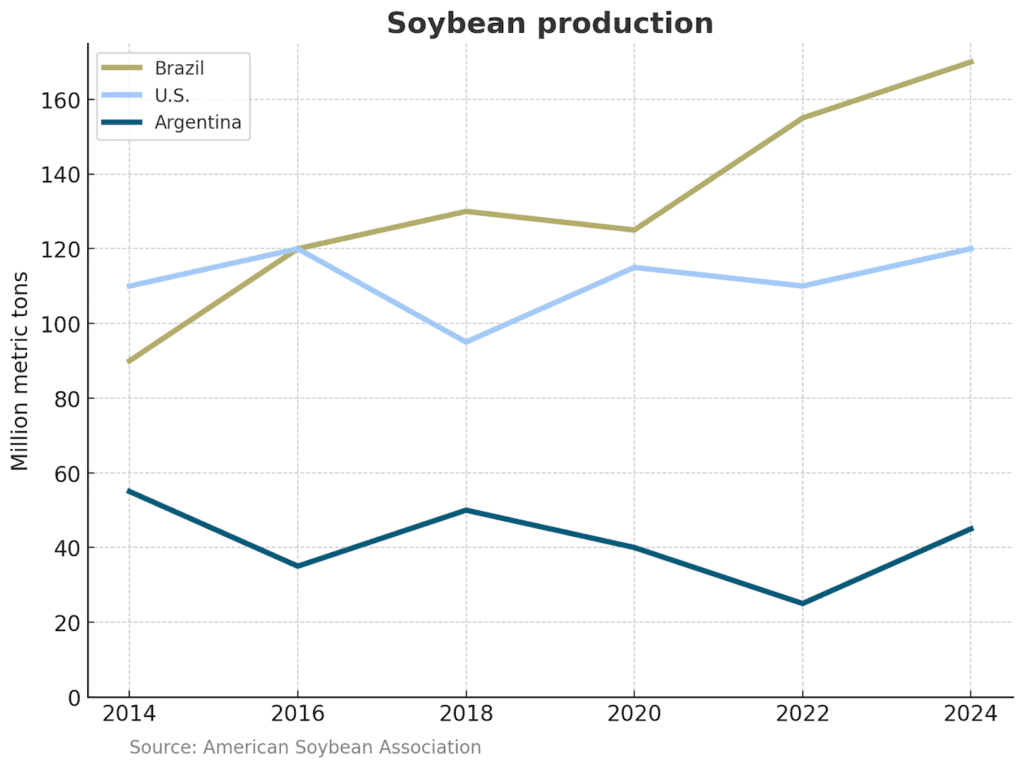
As U.S. beans languish, Brazil and Argentina feast. China, pivoting since 2018’s first trade war, now sources 80% of its needs from South America. Last month, Argentine President Javier Milei’s temporary export tax suspension lured $500 million in Chinese cargoes, traders at the Chicago Mercantile Exchange report. U.S. beans traded at $0.80-$0.90 per bushel cheaper than Brazilian equivalents for September-October shipment, but Beijing’s 23% tariff tacks on $2 per bushel—enough to divert 5 million metric tons southward.
“The frustration is overwhelming,” says Caleb Ragland, 39, Kentucky farmer and American Soybean Association president. On Truth Social Wednesday, Trump himself griped: “Our Soybean Farmers are hurting because China, for ‘negotiating’ reasons, isn’t buying.” He teased soybeans as a centerpiece in his upcoming summit with Xi Jinping in four weeks. Treasury Secretary Scott Bessent, speaking Thursday, promised a Tuesday announcement on aid, potentially including a $20 billion swap line for Milei—irking U.S. growers who see it as subsidizing their rivals.
On Friday, soybean futures closed at $9.42 per bushel on the CME, down 2% weekly amid harvest pressure and zero Chinese bookings. Analysts at Zaner Ag Hedge forecast a “bloodbath” if no deal materializes by November: Storage costs could add $0.50 per bushel, while on-farm debt—$450 billion industry-wide, per Farm Credit Administration—balloons.
The trade war’s winners? South American exporters, grinning from bumper crops (Brazil’s output hits 155 million metric tons this year, USDA estimates), and U.S. tariff coffers, flush for bailouts. Losers abound: From Decatur’s processing plants, once buzzing with Chinese-bound shipments, to the 1.2 million farm jobs at risk nationwide, per the American Farm Bureau Federation.
For Kindred, Gaffner, and their ilk, the math is merciless. “We want trade, not aid,” Gaffner insists. “China’s building routes elsewhere; once they’re hooked on Brazil, we might never claw it back. That’s not just my farm—it’s the next generations, the rural towns, the whole engine of America’s breadbasket.”
As combines roll on, the Midwest holds its breath. A Xi-Trump handshake could flood elevators with orders; stalemate risks a cascade of foreclosures and fallow fields. In this high-stakes harvest, soybeans aren’t just seeds—they’re the fragile thread binding U.S. farmers to their future.
The S&P 500 on Thursday flirted with closing at an all-time high, vying to complete a whirlwind roundtrip that saw the benchmark US stock index shed and then regain roughly $9.8 trillion in market value across just four months.
The S&P 500 has been on a roller coaster ride this year as President Donald Trump’s trade policy has jolted markets.
The S&P 500 hit its last record high on February 19 before dropping as low as 18.9% by early April as tariff confusion rocked markets.
The index has soared more than 23% since hitting its low point on April 8, in what has been a remarkable come back from the precipice of a bear market.
US stocks were higher on Thursday. The Dow closed higher by 404 points, or 0.94%. The broader S&P 500 gained 0.8% and the tech-heavy Nasdaq Composite rose 0.97%.
The S&P 500 briefly rose above its February record high during trading but fell below that level by the closing bell. The index needed to finish the day with a gain of 0.86% or more to officially notch a record high.
The Nasdaq on Thursday briefly rose above its previous record in December but similarly finished below the mark needed to notch a record high. The tech-heavy index dropped into a bear market in early April before surging into a new bull market and gaining 32%.
Stocks had pushed higher on Thursday amid a flurry of economic data, including a downward revision to how much the economy contracted in the first quarter.
That revised data is “backward looking,” and markets were higher on Thursday because they have already priced in the turmoil from earlier this year, Paul Stanley, chief investment officer at Granite Bay Wealth Management, said in an email.
“The market is betting on continued progress on trade and a de-escalation of tensions in the Middle East is giving investors confidence,” Stanley said.
While the S&P 500 and Nasdaq have recovered, the Dow is still 3.75% away from its record high set in December. The Dow this year has been weighed down by stocks like UnitedHealth Group (UNH), which is down 40%.
A $9.8 trillion recovery
At its low on April 8, the S&P 500 had shed $9.8 trillion in market value since its record high on February 19, according to FactSet data. The index is set to recover all of that market value as it tests a new record high.
Wall Street analysts are mixed on whether the S&P 500 can grind higher, or whether its return to record highs means there’s more downside to come.
As tensions in the Middle East have settled, the focus returns to Trump’s agenda. Lawmakers hope to deliver the president’s budget bill to his desk by July 4, and his administration’s deadline for trade deals is July 9.
“Meaningful progress on any of the two matters can bolster equities to fresh records,” José Torres, senior economist at Interactive Brokers, said in a note.
Investors in coming weeks will be focused on how tariff rates ultimately settle and whether Trump’s trade policy might reignite inflation.
“It would help stocks if we were to see a narrative shift from a focus on tariff, trade policy and geopolitics to company fundamentals,” Carol Schleif, chief market strategist, BMO Private Wealth, said in a note.
Despite the rally, the ratio of bullish versus bearish outlooks for the market remains below the historical average, Ed Yardeni, president of Yardeni Research, said in a note.
“That suggests more upside for the stock market since many investors remain wary and are not overly bullish,” Yardeni said.
“Greed” was the sentiment driving the market on Thursday, according to CNN’s Fear and Greed index. It was the highest reading on the index in two weeks.
Dollar stumbles to three-year low
The US dollar on Thursday dropped to its lowest level since February 2022 after a report by the Wall Street Journal that Trump plans to announce his pick for Federal Reserve Chair Jerome Powell’s successor as early as this fall.
Powell’s term ends in May 2026, meaning there would effectively be a “shadow” Fed chair in the months before his term expires.
The US dollar index, which measures the dollar’s strength against six major foreign currencies, was down 0.45% as of the afternoon.
“A candidate who is perceived as being more open to lowering rates in line with President Trump’s demands would reinforce the US dollar’s current weakening trend,” Lee Hardman, senior currency analyst at MUFG, said in a note.
The dollar index has tumbled nearly 10% this year. The euro and British pound this year have both hit their highest levels against the dollar in four years.
Francesco Pesole, an FX strategist at ING, told The NYBudgets that concerns about the Fed’s independence have been one of the contributing factors to the dollar’s broad decline this year.
“One of the key foundations of the strong dollar, of the dollar as a dominant currency globally, is to have an independent central bank,” Pesole said. “So, if [global investors] feel there is greater influence of politics into the Fed’s decisions, then they are pricing in a greater risk for the dollar.”
Greg Valliere, chief US policy strategist at AGF Investments, said in a note that Trump announcing Powell’s successor is a “terrible idea,” as it would be “sure to annoy and confuse the financial markets if there are two Fed chairs.”
“The damage to the Fed’s independence would be considerable if Trump becomes a monetary back-seat driver, second-guessing Fed policies this fall,” Valliere said.
L’Oreal reported a rise in first-quarter sales on Thursday, beating expectations for slower growth, as strong demand for its creams and perfume in Europe helped counter challenging conditions in the United States.
The French group, which makes Maybelline mascara and Kiehl’s skincare, posted like-for-like sales up 3.5%, though they were inflated 2 percentage points by advance shipments to China ahead of a change in IT systems.
Growth of 1.5% still beat a Visible Alpha consensus of 1.1% cited by analysts at Jefferies.
“This is a decent update in the context of anxieties,” the analysts said in a note, pointing to concerns after luxury group LVMH reported slower growth at its beauty retailer Sephora in the quarter.
L’Oreal’s U.S.-listed shares gained 6% in New York trading, while shares in U.S. rival Estee Lauder were up 3.4%.
L’Oreal has outperformed the global cosmetics market in recent years with products that span mass-market makeup to high-end perfume and doctor-recommended lotions.
But after weathering a protracted slowdown in number two beauty market China in recent years, it is facing weakening consumption in the largest U.S. market too, one it had targetted for growth this year.
“The market did not exactly start as we were hoping,” CEO Nicolas Hieronimus told analysts on a call, though added it was too early to adjust his forecast of 4 to 4.5% global market growth.
L’Oreal’s North America sales fell 3.8% in the quarter, compared with growth of 1.4% in the prior three months, dragged down by sluggish makeup demand.
With growing unease over escalating trade tensions, U.S. consumer sentiment deteriorated sharply in April, which typically hurts spending in any category, said Hieronimus.
L’Oreal, which imports 30% of its product in the U.S. from Europe and elsewhere, will also need to raise prices to mitigate the impact of President Donald Trump’s tariffs, though the company has built up some stocks, delaying any impact until the second half, said the CEO.
He also flagged “slightly better than expected” performance in China, which was “flattish” compared with negative at the end of last year.
All other regions grew, with Europe, accounting for a third of revenues, the largest contributor to sales that reached 11.7 billion euros ($13.30 billion) for the three months to the end of March.
Share prices of Hertz surged 56% after billionaire investor Bill Ackman’s firm disclosed a stake in the car rental company.
Pershing Square Capital Management said in a regulatory filing on Wednesday that it had acquired 12.7 million shares valued at $46.5 million. Pershing Square owns 4.1% of Hertz, making it the third-largest investor after Knighthead Capital Management and BlackRock, according to LSEG data.
CNBC reported on Wednesday that Pershing Square’s purchase — which includes shares and swaps — took its Hertz holdings to about 19.8%
Hertz shares closed 56.4% higher at $5.71 apiece on Wednesday and were up 33.8% in after-hours trade. The stock was little changed this year before Pershing Square’s disclosure.
Even though Hertz’s gains on Wednesday were massive, the car rental company’s stock isn’t a stranger to such eye-watering jumps.
In summer 2020, Hertz’s shares surged over 800% in weeks after filing for pandemic-induced Chapter 11 bankruptcy protection — making it the original meme stock.
It exited Chapter 11 bankruptcy in 2021 and started investing heavily in electric vehicles, including a plan to buy 100,000 Teslas.
However, the company started backtracking on its EV plan due to the cost of maintenance and repairs for the cars. Used EV prices have also been falling sharply.
Hertz was selling a significant number of its EVs by 2024 and was even asking customers if they wanted to buy the vehicles.
The failed bet on EVs showed up in earnings. Vehicle depreciation cost Hertz a $1 billion non-cash impairment charge in the third quarter.
Pershing Square did not immediately respond to Business Insider’s request for comment sent outside regular business hours.
Stock prices fell sharply on Thursday after President Donald Trump the day before announced sweeping tariffs of 10% on all U.S. trading partners and higher levies on countries with which the U.S. has a trade deficit.
With Thursday’s decline, the S&P 500 — a proxy for the broad U.S. stock market — has now slid more than 11% from its record high in February, putting the index in correction territory, defined as a drop of 10% or more from recent highs.
Investors and economists alike fear that Trump’s tariff policies could ignite a trade war with the nation’s trading partners and push inflation higher, two factors that could push the U.S. toward an economic slowdown. Should a recession become imminent, markets could sell off — and quickly.
Over the years, Berkshire Hathaway chairman and investing legend Warren Buffett has recommended staying calm in times of volatility.
“If you can keep your head when all about you are losing theirs … If you can wait and not be tired by waiting … If you can think — and not make thoughts your aim … If you can trust yourself when all men doubt you … Yours is the Earth and everything that’s in it.”
Why keeping your cool pays off
It’s worth noting that Buffett was writing about major declines in the stock market, such as periods like the 2007 to 2009 bear market during which the S&P 500 lost more than 50% of its value.
Those are quite a bit rarer than what’s happening now. In fact, corrections in the stock market are pretty standard fare. There have been 21 declines of 10% or more in the S&P 500 since 1980, with an average intra-year drawdown of 14%, according to Baird Private Wealth Management.
Of course, investors often don’t know if things are going to go from bad to worse until they do.
“No one can tell you when these will happen,” Buffett wrote in 2017. “The light can at any time go from green to red without pausing at yellow.”
The light can at any time go from green to red without pausing at yellow.
Warren Buffett
But whether a decline is modest and short-lived or seemingly long and painful, the message to individual investors is the same: Stick to your long-term plans and continue investing.
Buffett writes that he views downturns as “extraordinary opportunities.” Why? Because, historically, it’s never been all that long before the market resumes its upward trajectory.
Since 1928, the average bear market — defined by a decline of 20% or more from recent highs — has lasted less than 10 months, according to data from Hartford Funds. In the scope of the several decades you likely plan on investing, that’s practically no time at all.
And even if living through it can be scary, keep your eyes on the prize: your long-term goals. By continuing to consistently invest as the market declines, you effectively buy stocks when they’re selling at a discount. As long as you take a well-diversified approach to investing, you’ll get a better and better deal the further stock prices fall.
As Kipling says, keep your head, ignore breathless headlines and keep doing your thing. Will the Earth and everything in it be yours? Maybe not — but you’ll likely do a good job of boosting your long-term wealth.
The whole attitude recalls another quote of Buffett’s, about taking advantage of bargain-priced investments, this time from his 2009 shareholder letter: “Big opportunities come infrequently. When it’s raining gold, reach for a bucket, not a thimble.”
The stock market staged a brief rally Tuesday on hopes that President Donald Trump would turn from raising tariffs to cutting deals, before sinking amid renewed tough talk by administration officials. The S&P 500 index closed down 1.5 percent, bringing its total loss since the mid-February start of Trump’s trade offensive to almost 20 percent, the official indication of a bear market.
Stocks jumped nearly 4 percent in the first hour of trading, after Treasury Secretary Scott Bessent told CNBC that nearly 70 countries had approached the United States about negotiating over trade barriers. The next escalation of U.S. tariffs was just hours away. But the president fueled the upbeat mood with a subsequent social media post, describing a “great call” with South Korea’s acting president about a potential bargain.
Yet the market rebound soon fizzled.
On Capitol Hill, some of the president’s top aides sought to clarify the trade war’s murky parameters.
Jamieson Greer, the president’s chief trade negotiator, described the nation’s $1.2 trillion trade deficit as an emergency that required “urgent” efforts to reshape the U.S. economy. Greer brushed aside lawmakers’ complaints about potential costs to consumers and businesses, telling the Senate Finance Committee, “The president is fixed in his purpose.”
Bessent, meanwhile, sought to calm Republican fears that Trump’s bare-knuckled assault on the global trading system might trigger a politically lethal recession. During an hour-long meeting hosted by House Majority Whip Tom Emmer (R-Minnesota), Bessent briefed lawmakers and Jay Timmons, the head of the National Association of Manufacturers, on the administration’s plans for a manufacturing revival.
One week after Trump’s announcement of the highest import taxes in more than a century, investors, companies and lawmakers continue trying to make sense of his ultimate goal. For now, the administration says the president is advancing on twin tracks: raising tariffs to encourage manufacturers to return to the United States, while fielding offers by other nations to lower their barriers to U.S. products.
Despite swelling criticism from lawmakers and chief executives, the administration appears vindicated by the eagerness of foreign leaders hoping to avert U.S. tariffs by making a deal with Trump. In her daily briefing for reporters, White House press secretary Karoline Leavitt struck a combative tone.
“America does not need other countries as much as other countries need us,” she said.
The president’s high-risk strategy is already paying off, according to Greer, who cited recent investment announcements by automakers and other manufacturers planning to expand their U.S. operations. Likewise, officials from Argentina, Vietnam and Israel have indicated they will drop their tariff and regulatory barriers to U.S. exports.
Greer and other administration officials are engaged in talks with countries such as Japan and South Korea.
But there is no immediate prospect of talks with the nation at the center of U.S. trade complaints: China. After China imposed a 34 percent tariff on U.S. goods, in retaliation for Trump’s April 2 announcement, the president added an additional 50 percent tax on top of his earlier moves.
As of 12:01 a.m. Wednesday, American importers of some Chinese products will pay a tax of up to 129 percent.
Greer said the administration was “disappointed” with China’s failure to comply with the 2020 “phase one” trade deal Trump signed in his first term, which committed Beijing to make substantial purchases of U.S. farm, energy and manufactured goods. Amid the disruption of the pandemic, which erupted within weeks of the White House signing ceremony for the deal, China fell short of its commercial promises.
After Trump said he would impose the additional 50 percent tariff, China’s Commerce Ministry called the president’s move “a mistake on top of a mistake.” If the United States waged a trade war against China, it would “fight to the end,” the ministry said.
Administration official say they have the advantage over Chinese President Xi Jinping, since Americans buy roughly three times as much from China as the Chinese buy from U.S. companies. Trump said China “panicked” in opting to retaliate for his tariffs.
“The president believes that Xi and China want to make a deal. They just don’t know how to get that started,” Leavitt told reporters.
The administration’s unruly nature, however, is shadowing the president’s policy aims. Growing acrimony between Elon Musk, the world’s richest man, and Peter Navarro, a White House trade adviser, spilled into public view in recent days.
After Navarro disparaged Musk during a CNBC interview as a “car assembler” rather than a manufacturer, the Tesla CEO savaged the former university professor in posts on X as “dumber than a sack of bricks” and “Peter Retarrdo.”
The extraordinary display was praised by Leavitt as evidence of the administration’s transparency.
“Boys will be boys, and we will let their public sparring continue,” she said.
Greer’s congressional testimony offered additional details of Trump’s plan. Asked by several senators whether American businesses would win exclusions from the tariffs to continue importing products that they could not obtain from domestic suppliers, Greer said no.
“The president does not intend to have exclusions,” he said, adding that granting them would undermine the planned economic restructuring. “We’re trying to remedy a situation that’s persisted for many years.”
Though quick to praise the president’s goals, Republicans on the Finance Committee repeatedly voiced worry over the short-term economic costs.
Sen. James Lankford (R-Oklahoma) told Greer a constituent had relocated his supply chain from China to Vietnam in response to the president’s first-term trade policy only to find that he would now be paying a new 46 percent tariff on Vietnamese products.
Cattle ranchers in Montana were distressed by a 92 percent decline in Chinese purchases of U.S. beef last month, as the trade war intensified, according to Sen. Steve Daines (R-Montana).
And Sen. Thom Tillis (R-North Carolina) pronounced himself “skeptical” that the administration could wage a trade war against dozens of countries simultaneously.
“This is creating some anxiety,” said Sen. Todd Young (R-Indiana).
Some big-name tech stocks with notable morning gains joined the broader market in retreating, with Alphabet, Amazon, Apple and Tesla in negative territory Tuesday afternoon.
Stock analysts characterized Tuesday morning’s rally as a natural reaction after weeks of declines, capped by the harshest three-day sell-off in years.
With tariff negotiations beginning, markets “may be an important step closer to finding an equilibrium,” Mark Zabicki, chief investment officer at LPL Financial, wrote in a Tuesday research note.
Some Asian and European markets recovered Tuesday despite the Chinese threats of trade war escalation.
Germany’s DAX gained about 2.5 percent, and London’s FTSE 100 climbed 3.3 percent. Japan’s Nikkei 225 jumped 6 percent, while Hong Kong’s Hang Seng Index and India’s Sensex were both up 1.5 percent.
But markets in several Southeast Asian countries, which are vulnerable to any disruption of global trade, suffered more losses. Markets in Vietnam and Indonesia declined more than 7 percent, while an index linked to Thailand was down more than 4 percent. Taiwan’s Taiex fell 4 percent.
Beijing on Wednesday called for “dialogue” with Washington even as it vowed to take “forceful measures” to protect the Chinese economy from President Donald Trump’s 104 percent minimum tariffs.
A worsening trade war between the world’s two biggest economies has pushed U.S.-China tensions to a new level of confrontation that analysts say is becoming increasingly difficult to de-escalate.
Trump’s “Liberation Day” tariffs on 86 countries came into effect at 12:01 a.m. Eastern time on Wednesday, with successive increases taking the duty on all Chinese goods to 104 percent.
Beijing, which on Friday announced it would impose a 34 percent tariff on all American goods in return, did not immediately announce any further retaliatory measures Wednesday.
But China’s State Council, its equivalent of the cabinet, stressed the importance of the U.S.-China trade relationship and said that differences should be resolved “through dialogue and consultation.”
“Success for China and the United States is an opportunity for both countries, not a threat. We hope that the United States and China will meet each other halfway,” it said in a white paper released Wednesday.
At the same time, Foreign Ministry spokesman Lin Jian said China would “continue to take firm and forceful measures to safeguard its own interests.”
Before the tariffs took effect, White House spokeswoman Karoline Leavitt suggested Tuesday that Trump was open to talking — as long as Beijing made the first move.
“The president also wanted me to tell all of you that if China reaches out to make a deal, he’ll be incredibly gracious, but he’s going to do what’s best for the American people,” Leavitt said at a news briefing. “China has to call first.”
The mixed signals and the introduction of the tariffs led to another day of significant volatility in Asia, after a day of wild gyrations in U.S. markets.
Japan’s benchmark Nikkei 225 closed almost 4 percent lower, while Australia’s ASX 200 index and South Korea’s KOSPI both ended the day almost 2 percent lower.
Interactive Stock Market Chart
Percent change in global stock indexes since inauguration
Hong Kong’s Hang Seng Index, on which many Chinese exporters are listed, fell by almost 4 percent when trading opened Wednesday although it ended the day in positive territory.
Confounding analysts, yields on the 10-year U.S. Treasury bond — widely considered the ultimate safe haven for investors — rose sharply, sending prices falling.
“This is a highly unusual situation,” said David Scutt, Asia Pacific market analyst for StoneX, a financial services firm. “It’s incredibly rare to see moves of this magnitude in benchmark 10-year treasury yields especially in the Asian time zone.”
Analysts said Wednesday’s market moves reflected broad concern about the impact the tariffs would have on the U.S. economy.
“Many people say that by the time the Trump administration realizes how bad this is, it will be too late and the U.S. will be in a recession,” said Alicia García Herrero, chief economist for Asia Pacific at the investment bank Natixis. “So if they want to do something about this they better do it now.”
Treasury Secretary Scott Bessent arrives on Capitol Hill on Tuesday. He said some 70 countries are angling for a deal to reduce their tariffs. (Demetrius Freeman/The Washington Post)
Other countries are trying hard to broker deals with the Trump administration to avert tariffs, with Treasury Secretary Scott Bessent telling CNBC that nearly 70 countries had approached the United States about negotiating over trade barriers.
Argentina, Vietnam and Israel have indicated they will drop their tariff and regulatory barriers to U.S. exports, while South Korea and Japan are now actively pursuing negotiations.
Trump said on social media Tuesday he had a “great call” with South Korea’s acting president about a potential deal to remove the 25 percent tariff Trump threatened to impose on the ally’s exports.
Beijing has hit back
But most of the focus was on China, the world’s biggest exporter and the recipient of the biggest tariffs.
Trump on Tuesday tripled the tariff rate he had announced on low-value packages from China, closing a loophole that allowed Chinese companies like Shein and Temu to sidestep duties on shipments worth less than $800. From June 1, those packages will face a tax of 90 percent of their value, up from the originally planned 30 percent duty.
While other countries have approached the White House to negotiate over the trade measures, Beijing has instead hit back with its own tariffs and deployed other measures like export controls and import bans. Escalation on both sides makes the possibility of talks less likely, analysts said.
“Beyond a certain point, further escalation loses meaning,” said Lizzi C. Lee, an economy expert at the Asia Society Policy Institute’s Center for China Analysis. “China would likely decide there’s no point in continuing to engage — and at that stage, retaliation could take forms the U.S. isn’t ready for.”
Retaliation could involve suspending cooperation to stop fentanyl and related chemicals from reaching the United States; cutting off imports of U.S. products that depend on the Chinese market like farm products, services or energy; or rapidly opening trade channels with other countries hit hard by the tariffs, Lee said.
Chinese state media on Wednesday was awash with commentary saying China could not back down.
“The weaker you are, the happier the United States is and the harder it will hit you,” said an article on Niu Tanqin, an influential blog run by a former journalist with the state news agency, Xinhua.
The longer that the trade fight goes on, the more Beijing sees U.S. moves as simply an effort to contain China. “Beijing is losing patience with the Trump team, believing that they have no sincerity in negotiating,” said Zhao Minghao, a professor at Fudan University’s Center for American Studies.
Well-connected Chinese blogs have also suggested Beijing might ban the importation of U.S. movies to China.
Shoppers in Bayonne, New Jersey, on Tuesday. Trump has upended the world economy with sweeping tariffs that economists say will increase prices for American consumers — and have raised the specter of a global recession. (Charly Triballeau/AFP/Getty Images)
The steep tariffs on Chinese goods will almost certainly raise prices for American consumers on products including clothes, shoes and electronics — something Chinese state media have been at pains to point out.
“Manufacturers here cannot absorb the burden,” Liang Mei, president of the China Toy and Juvenile Products Association, was quoted as telling the state-affiliated Global Times newspaper Tuesday. U.S. retailers would shoulder part of the cost and the rest “will be passed on to American consumers,” Liang said.
Independent experts agreed.
Naomi Fink, chief global strategist at Nikko Asset Management in Tokyo, said the new tariffs will “first and foremost be a blow to U.S. consumers,” which will ultimately affect exporters to the U.S. But the ultimate impact on domestic U.S. interests is significant, and countries on the receiving end of tariffs recognize that, she said.
“The thing here, and I think China even stated it, is that the only reason they’re retaliating is because they know it’s a credible threat to the U.S. consumer, who’s also the U.S. voter, and they know the U.S. consumer is wearing the cost,” Fink said.
Cookie Consent
We use cookies to improve your experience on our site. By using our site, you consent to cookies.
Contains information related to marketing campaigns of the user. These are shared with Google AdWords / Google Ads when the Google Ads and Google Analytics accounts are linked together.
90 days
__utma
ID used to identify users and sessions
2 years after last activity
__utmt
Used to monitor number of Google Analytics server requests
10 minutes
__utmb
Used to distinguish new sessions and visits. This cookie is set when the GA.js javascript library is loaded and there is no existing __utmb cookie. The cookie is updated every time data is sent to the Google Analytics server.
30 minutes after last activity
__utmc
Used only with old Urchin versions of Google Analytics and not with GA.js. Was used to distinguish between new sessions and visits at the end of a session.
End of session (browser)
__utmz
Contains information about the traffic source or campaign that directed user to the website. The cookie is set when the GA.js javascript is loaded and updated when data is sent to the Google Anaytics server
6 months after last activity
__utmv
Contains custom information set by the web developer via the _setCustomVar method in Google Analytics. This cookie is updated every time new data is sent to the Google Analytics server.
2 years after last activity
__utmx
Used to determine whether a user is included in an A / B or Multivariate test.
18 months
_ga
ID used to identify users
2 years
_gali
Used by Google Analytics to determine which links on a page are being clicked
30 seconds
_ga_
ID used to identify users
2 years
_gid
ID used to identify users for 24 hours after last activity
24 hours
_gat
Used to monitor number of Google Analytics server requests when using Google Tag Manager