Category: Medical

  • Weight-Loss Drug Price Wars Are Upending Big Pharma’s Business Model

    Weight-Loss Drug Price Wars Are Upending Big Pharma’s Business Model

    The multibillion-dollar market for GLP-1 weight-loss drugs, once a duopoly dominated by Novo Nordisk and Eli Lilly, is fracturing under intense pricing pressure, political intervention, and rising competition from compounded alternatives. What began as a revolutionary breakthrough in obesity treatment has evolved into a fierce price war that’s challenging the core business models of Big Pharma giants, raising questions about innovation, profitability, and access to life-changing medications.

    Novo Nordisk, the Danish pioneer behind Ozempic and Wegovy, stunned investors this week by forecasting a 5% to 13% sales decline in 2026 – its first drop since 2017 – amid “unprecedented” U.S. price cuts and patent expirations in key markets like China and Brazil. The company’s shares plunged 17% on Wednesday, erasing nearly $50 billion in market value, as CEO Mike Doustdar acknowledged short-term “pain” from slashing prices to boost volumes and compete with Lilly’s surging Zepbound and Mounjaro.

    In contrast, U.S. rival Eli Lilly delivered a bullish outlook, projecting 25% revenue growth to $80-83 billion in 2026, far exceeding Wall Street expectations. Lilly’s tirzepatide-based drugs raked in over $36 billion in 2025, outpacing Novo’s semaglutide portfolio and positioning Lilly as the clear leader in the GLP-1 race. “We’re seeing incredible demand, and our manufacturing investments are paying off,” Lilly CEO David Ricks told analysts, downplaying pricing headwinds as a temporary drag offset by volume gains.

    As illustrated in the accompanying chart from LSEG Workspace, Novo’s revenues have boomed in double digits for years, driven by weight-loss drug sales, but the firm now anticipates a sharp reversal in 2026 due to these pressures.

    The divergence highlights how pricing dynamics, fueled by U.S. President Donald Trump’s “most favored nation” (MFN) policy and direct-to-consumer platforms like TrumpRx.gov, are reshaping the industry. Launched on February 5, TrumpRx connects Americans to discounted drugs from manufacturers like Novo, Lilly, Pfizer, and AstraZeneca, offering prices as low as $149 for Wegovy’s starter dose – a fraction of the original $1,000 monthly list price. In exchange, companies received tariff relief and expedited approvals, but critics argue it sidesteps systemic issues, with limited impact for insured patients who may still pay less through coverage.

    “TrumpRx could have some impact, but it’s far from revolutionary,” said Craig Garthwaite, director of health care at Northwestern University’s Kellogg School of Management. Experts like economist Öner Tulum warn that MFN relies on opaque global pricing, allowing companies to game the system by raising overseas prices or delaying launches.

    Adding fuel to the fire, telehealth provider Hims & Hers Health launched a $49 compounded semaglutide pill on February 5 – just weeks after Novo’s Wegovy pill debut – prompting Novo to vow “legal and regulatory action” for alleged patent infringement and patient safety risks. Hims uses liposomal technology to aid absorption, bypassing Novo’s proprietary SNAC method acquired in a $1.8 billion deal. The FDA has warned against compounded GLP-1s, citing lack of safety evaluations, while the Department of Health and Human Services referred Hims to the Justice Department for investigation.

    This isn’t the first clash: Novo previously partnered with Hims for Wegovy injections but ended ties acrimoniously last summer. Now, compounded knockoffs – estimated to serve 1.5 million Americans – threaten the duopoly’s pricing power. “This new offering could test how far compounders can skirt Big Pharma’s patents,” said Deb Autor, Hims’ chief policy officer.

    The broader shift to cash-pay channels has made prices more sensitive, with injectables now starting at $149-$299 on company sites, down from $1,000. Analysts like Markus Manns at Union Investment fear a “no-win” price war: “There’s no assurance cuts will pay off.” Bernstein’s Courtney Breen noted Novo’s cuts are risky given its trailing position.

    Lilly holds clinical edges – Zepbound achieves higher weight loss than Wegovy’s injection, while Novo’s pill edges Lilly’s upcoming orforglipron in trials. Lilly expects orforglipron approval in Q2 2026, potentially expanding the market further. “Pills could reshape GLP-1s like consumer products,” one analyst noted.

    Yet the market is crowding: Pfizer and Amgen eye 2028 launches, while GSK focuses on obesity’s downstream effects like liver disease. Goldman Sachs raised Lilly’s target to $1,260, citing confidence in 25% growth despite pressures.

    Critics argue Big Pharma’s model prioritizes shareholders over patients. Economist William Lazonick’s research shows U.S. pharma spent $747 billion on buybacks and dividends from 2012-2021, exceeding $660 billion on R&D. During the pandemic, 18 firms distributed $377.6 billion to shareholders – over 90% of profits – while claiming high prices fund innovation. “It’s a fallacy,” said UNAIDS’ Winnie Byanyima. “Profits go to Wall Street, not cures.”

    A Senate HELP Committee report echoed this: In 2022, Bristol Myers Squibb spent $12.7 billion on buybacks, dividends, and exec pay versus $9.5 billion on R&D. Overall, 10 firms with drugs under Medicare negotiation spent $162 billion on shareholder handouts and marketing in 2023 – far outpacing $95.9 billion on R&D.

    As shown in the second chart from LSEG, Novo’s market cap peaked in June 2024 before a sharp plunge, reflecting these pressures and Lilly’s ascent toward a trillion-dollar valuation.

    What tames Big Pharma? Tulum suggests emulating the VA system’s deep discounts via centralized negotiation. Biden’s Inflation Reduction Act (IRA) enabled Medicare negotiations for 10 drugs in 2026, including GLP-1s like Ozempic in 2027. Yet industry lobbies fiercely, with $83.2 million in trade dues funding opposition in 2023.

    Mark Cuban’s Cost Plus Drugs offers transparent markups, but scalability is limited. Ultimately, reformers like Lazonick advocate banning buybacks and stock-based pay to redirect profits toward innovation.

    As prices fall and competition rises, the GLP-1 war may force Big Pharma to adapt – or face a reckoning. For patients, lower costs could mean broader access, but sustained innovation requires reining in financialization.
  • Trump Launches TrumpRx.gov to Promote Lower Prescription Drug Prices

    Trump Launches TrumpRx.gov to Promote Lower Prescription Drug Prices

    Washington, D.C. – In a move that’s equal parts policy innovation and political theater, President Donald Trump unveiled TrumpRx.gov on Thursday, a sleek new government website designed to slash prescription drug costs for everyday Americans. Billed as the centerpiece of his aggressive campaign against Big Pharma’s pricing practices, the site promises to connect users directly to manufacturer discounts, bypassing insurance middlemen and their markups. Trump, ever the showman, demonstrated the platform’s features during a high-profile event at the Eisenhower Executive Office Building, flanked by key aides and touting it as a game-changer that could propel Republicans to victory in the upcoming midterms.

    “This is the biggest thing ever to happen on drug prices,” Trump declared at a recent rally in North Carolina, echoing his longstanding refrain that health care costs—dominated by pharmaceuticals—need a drastic overhaul. “It’s gonna reduce the cost of health care because health care is probably 50 percent drugs, right? This achievement alone should win us the midterms.” And with polls showing health care as a top voter concern, the president might be onto something. A fresh KFF survey released last week reveals that two-thirds of Americans fret over affording medical bills, with 55% reporting higher costs in the past year and 56% expecting even steeper hikes ahead.

    The launch caps nearly a year of arm-twisting by the Trump administration, leveraging tariffs, expedited FDA reviews, and diplomatic pressure on allies to force drug makers to the table. Pharmaceutical giants have agreed to list their products on TrumpRx.gov, where users can access coupons for discounted purchases—often without insurance. Take Novo Nordisk’s Ozempic, the blockbuster weight-loss drug with a list price hovering around $1,000 monthly: Through the site, it’s available for just $350, a steep cut that White House officials highlighted as a prime example of the program’s punch.

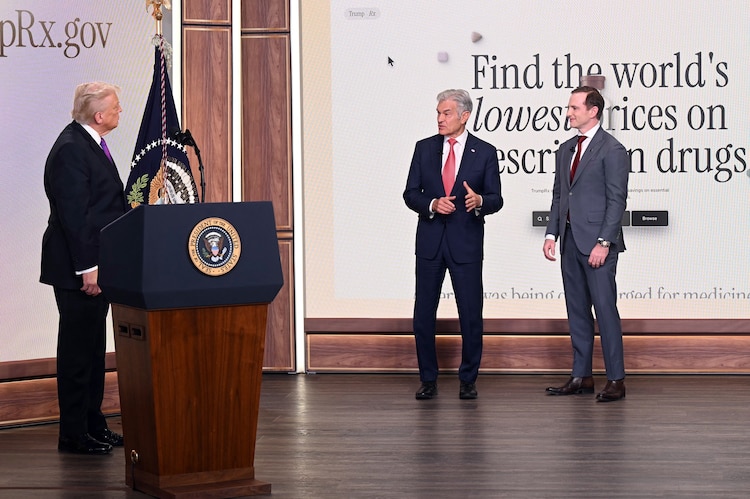
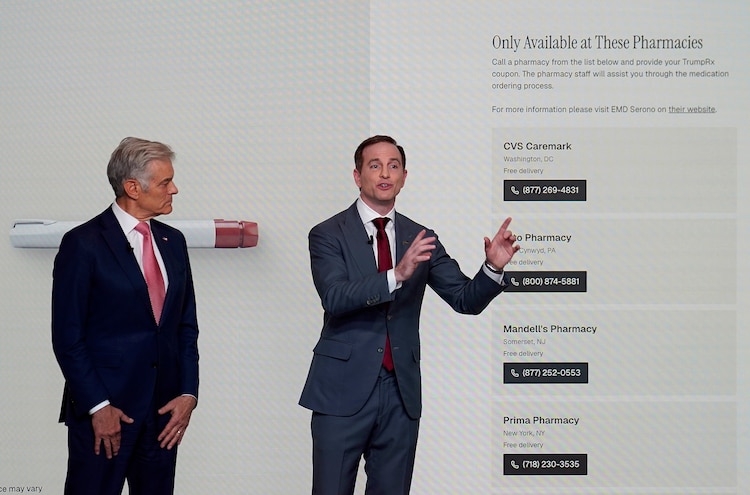
    Chief Design Officer of the National Design Studio Joe Gebbia speaks as Administrator for the Centers for Medicare & Medicaid Services Mehmet Oz looks on during an event on drug pricing in the South Court Auditorium on the White House campus on February 5, 2026 in Washington, DC. (Nathan Howard/Getty Images)
    Chief Design Officer of the National Design Studio Joe Gebbia speaks as Administrator for the Centers for Medicare & Medicaid Services Mehmet Oz looks on during an event on drug pricing in the South Court Auditorium on the White House campus on February 5, 2026 in Washington, DC. (Nathan Howard/Getty Images)

    Mehmet Oz, the charismatic administrator of the Centers for Medicare and Medicaid Services (CMS), and Joe Gebbia, director of the newly minted National Design Studio, joined Trump for the rollout. Gebbia walked attendees through the user-friendly interface, showing how to search for meds, bundle coupons for commonly paired prescriptions, and even locate pharmacies offering home delivery. “I can call any one of these pharmacies, and they deliver it straight to my home. It’s that simple,” Gebbia said, emphasizing the site’s focus on transparency and convenience.

    White House officials credited the National Design Studio—bolstered by tech-savvy hires like Edward Coristine, known for his bold online presence—with crafting a smooth platform. This stands in stark contrast to the infamous 2013 debut of Healthcare.gov under President Obama, which crashed spectacularly, enrolling just six people on day one and becoming a Republican punching bag. Trump, keen to sidestep such pitfalls, kept TrumpRx.gov’s scope modest but impactful, aiming for quick wins that resonate with voters weary of skyrocketing drug bills.

    From a right-of-center vantage, this initiative is a textbook example of Trump’s deal-making prowess: using executive muscle to wring concessions from an industry long accused of gouging consumers. Prescription spending, which eats up about 9% of U.S. health care dollars, has climbed relentlessly despite bipartisan promises to curb it. Trump’s first-term tweaks briefly reversed that trend, a feat he ranks among his greatest hits. Now, with “Most Favored Nation” pricing—tying U.S. costs to lower international rates—the administration is pushing boundaries, even pressuring foreign leaders to shoulder more R&D burdens.

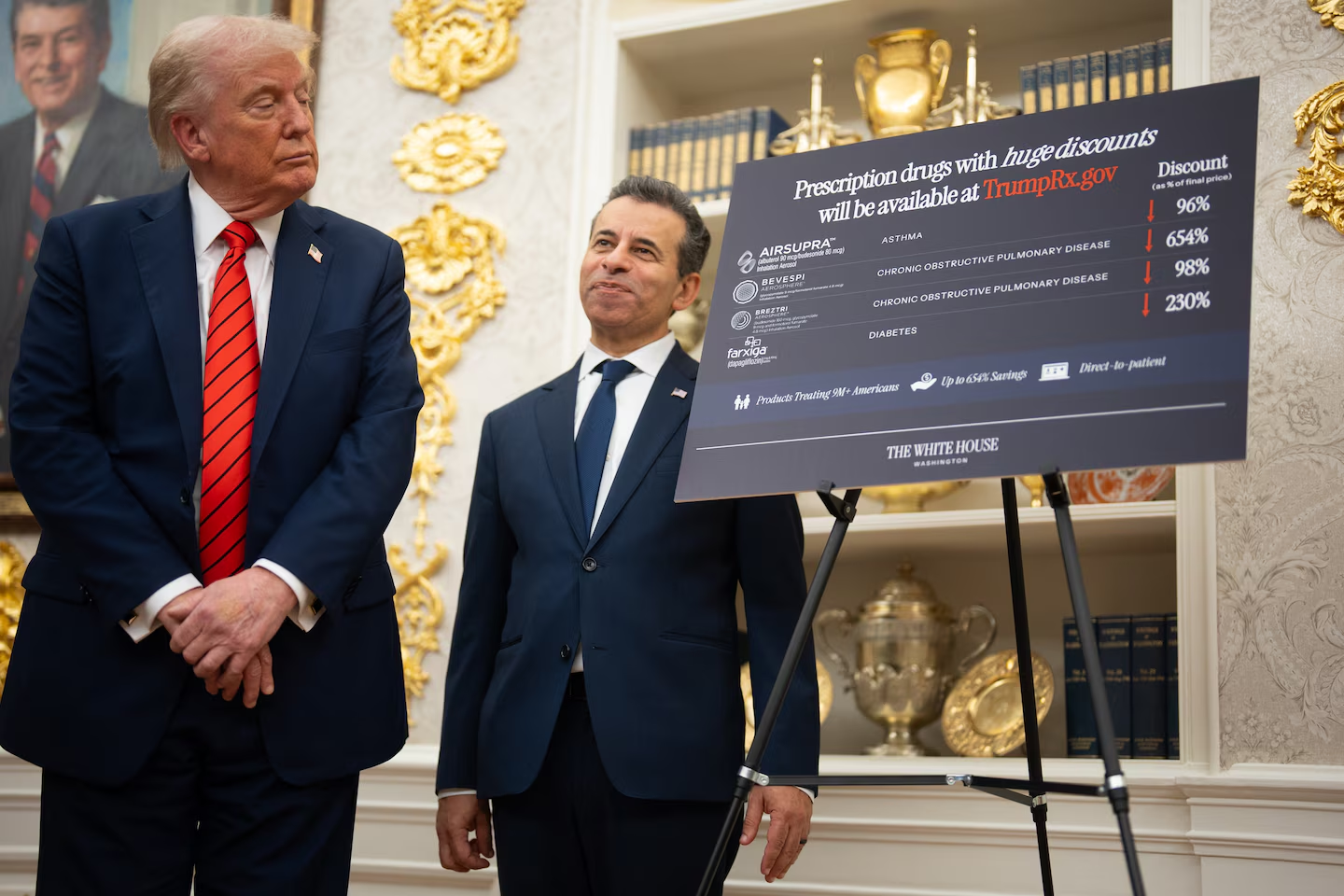
    US President Donald Trump (L) listens as the Administrator for the Centers for Medicare & Medicaid Services Mehmet Oz (C) and the chief design officer of the National Design Studio Joe Gebbia introduce the new TrumpRx website, in the South Court Auditorium of the White House in Washington, DC, on February 5, 2026. (Saul Loeb/AFP via Getty Images)
    US President Donald Trump (L) listens as the Administrator for the Centers for Medicare & Medicaid Services Mehmet Oz (C) and the chief design officer of the National Design Studio Joe Gebbia introduce the new TrumpRx website, in the South Court Auditorium of the White House in Washington, DC, on February 5, 2026. (Saul Loeb/AFP via Getty Images)

    Yet, experts caution that the program’s reach may be limited. “TrumpRx doesn’t sell medications,” the site clarifies upfront. “Instead, it connects patients directly with the best prices, increasing transparency and cutting out costly third-party markups.” While that could help uninsured or high-deductible plan holders, critics note that many already snag discounts via manufacturer sites or pharmacy benefit managers. Craig Garthwaite, health care director at Northwestern’s Kellogg School of Management, called it “far from revolutionary,” pointing out that for pricier brand-name drugs, cash payments remain out of reach for most—insurance is the real safety net.

    Skeptics, including Democrats, question the vagueness of the pledges and potential legal snags. Expedited FDA reviews dangled as incentives raise red flags for former officials, who warn of safety risks and possible illegality. Congressional Democrats like Sen. Ron Wyden (D-Ore.) demand transparency: “The Administration has yet to provide any public information that the announcements will result in any real savings for consumers,” he said in a joint statement with colleagues last December. Economists echo this, suggesting list-price cuts might not trickle down amid existing rebates.

    Even Mark Cuban, the billionaire entrepreneur behind Cost Plus Drugs—a similar discount platform and frequent Trump foil—offered measured praise during an October Senate hearing. “I don’t think it solves the ultimate problem of how the system is designed, but I think it’s something that we obviously agree on,” Cuban said, acknowledging the shared goal of affordability.

    A screenshot of a Zepbound order on the TrumpRx website. Preview Filters Source Info
    A screenshot of a Zepbound order on the TrumpRx website. Preview Filters Source Info

    Politically, drug costs could be a midterm wildcard. Democrats hold a polling edge on health care overall (42-26% trust on the ACA), but it’s slimmer on prescriptions (35-30%), an arena where Trump’s relentless focus might pay dividends. He’s woven TrumpRx into his “Great Healthcare Plan,” urging Congress to enshrine it in law. With midterms looming, the site could deliver tangible savings stories for GOP campaigns, blunting Democratic attacks on affordability.

    Still, broader systemic fixes—like negotiating Medicare prices or import reforms—remain elusive, constrained by industry lobbying and court challenges. For now, TrumpRx.gov stands as a symbolic win: a branded portal putting money back in Americans’ pockets, courtesy of the dealmaker-in-chief. As Trump eyes legacy and electoral gains, this could indeed tip scales in key battlegrounds.

  • UnitedHealth Turns to Trump Allies Amid Washington Challenges

    UnitedHealth Turns to Trump Allies Amid Washington Challenges


    Stock Widget


    In the high-stakes world of American healthcare, where billions of dollars in federal funds hang in the balance, UnitedHealth Group Inc. UNH -2.45% ▼ is pulling out all the stops to navigate a storm of regulatory scrutiny and policy shifts under the Trump administration. The nation’s largest health insurer, grappling with criminal investigations into its lucrative Medicare Advantage business and looming threats to its billing practices, has turned to a time-tested Washington strategy: leveraging connections to former President Donald Trump’s inner circle. From high-level meetings with Justice Department officials to dinners with Medicare overseers and a surge in lobbying expenditures, UnitedHealth is working overtime to plead its case directly with the powers that be.


    This aggressive outreach comes at a pivotal moment for the Minnetonka, Minnesota-based giant. UnitedHealth’s Medicare Advantage segment, which generated over $100 billion in revenue in 2023 according to Medicare data, has long been the crown jewel of its operations. These private plans, which manage federal benefits for seniors and disabled individuals, have been a boon for insurers, offering higher reimbursements than traditional fee-for-service Medicare. But recent changes to federal payment rules under the Biden administration, coupled with ongoing probes, have eroded profitability and wiped out nearly 40% of the company’s market value since April.

    The company’s troubles intensified in May when The Wall Street Journal first reported that the Justice Department’s criminal fraud unit had launched an investigation into UnitedHealth’s Medicare practices. Shortly thereafter, UnitedHealth secured an unusual meeting with senior Justice Department officials, including Chad Mizelle, the attorney general’s chief of staff. According to people familiar with the meeting, the discussion touched on the probes targeting the company—a move that former prosecutors described as atypical for a firm in the early stages of a criminal inquiry.

    “You don’t typically see companies under investigation getting face time with top brass like that,” said Barbara McQuade, a former U.S. attorney for the Eastern District of Michigan and a legal analyst who has followed similar cases. “The goal in investigations is to maintain independence and avoid any perception of favoritism or leaks. This kind of access raises eyebrows.”

    UnitedHealth’s CEO, Stephen Hemsley, who returned to the role in May after serving as chairman and previously as CEO, has been at the forefront of these efforts. Hemsley, a veteran of the company since the 1990s, recently met with White House Chief of Staff Susie Wiles to discuss Medicare policy and other healthcare issues, though government investigations were not on the agenda, according to a White House official. Earlier in the summer, Hemsley dined with Chris Klomp, the official overseeing Medicare at the Centers for Medicare & Medicaid Services (CMS), where they delved into topics like Medicare-plan billing policies and the supplemental benefits offered through private plans, sources familiar with the matter said.

    These engagements underscore a broader playbook in Washington: direct access to decision-makers. UnitedHealth has also sought meetings with President Trump himself, though it has not yet secured one, according to people close to the discussions. The company is particularly focused on resolving the ongoing investigations, which include not only the criminal probe but also civil and antitrust inquiries.

    The backdrop to these maneuvers is a company in recovery mode. UnitedHealth’s stock has shown some tentative signs of stabilization since Hemsley’s return, but the Washington overhang persists. The insurer was already reeling from the tragic public murder of Brian Thompson, CEO of its UnitedHealthcare insurance unit, in December 2024—an event that shocked the industry and added to operational disruptions. Amid this, Hemsley has outlined a recovery plan emphasizing cost controls, operational efficiencies, and advocacy in policy circles.

    Financially, the hits have been hard. Changes to Medicare billing rules implemented by the Biden administration began impacting results in earnest this year, squeezing margins in the Medicare Advantage business. Investors are now laser-focused on how the Trump administration will handle these practices. Mehmet Oz, Trump’s nominee for CMS administrator and a high-profile television personality turned public health advocate, has vowed a crackdown on certain insurer tactics, including those employed by UnitedHealth. “We’re going to root out waste, fraud, and abuse in Medicare,” Oz said during his confirmation hearings earlier this year, signaling potential further reimbursement cuts or stricter oversight.

    AA1MvBeA
    White House chief of staff Susie Wiles© Andrew Harnik/Getty Images

    To counter these threats, UnitedHealth has ramped up its Washington presence dramatically. In the first half of 2025, the company spent $7.7 million on lobbying—roughly double the amount from the same period in 2024, according to its own disclosure filings with the Senate. This surge outpaced rivals: Humana Inc. and Cigna Group saw only modest increases in their lobbying budgets during the same timeframe.

    A key part of this strategy involves hiring influencers with deep Trump ties. UnitedHealth brought on Brian Ballard, a prominent fundraiser for the president and founder of Ballard Partners, as its top outside lobbyist. Ballard’s firm, which started representing UnitedHealth in 2024, has become the company’s highest-paid external advocacy group, per disclosure records. Ballard, known for his access to the White House and Capitol Hill, has been instrumental in facilitating connections.

    The company also enlisted Jesse Panuccio, a former senior Justice Department official from Trump’s first term who now partners at Boies Schiller Flexner LLP. Panuccio played a role in arranging the meeting with Justice Department officials, including Mizelle, sources said. Additionally, in a shareholder lawsuit filed against the company, UnitedHealth in July replaced its legal team from WilmerHale—a firm criticized by Trump—with Robert Giuffra, the president’s personal lawyer and a securities litigator at Sullivan & Cromwell, along with his colleagues.

    This shift in legal representation highlights the personalized nature of influence-peddling in the Trump era. “Lobbying spending often ticks up year over year, but 2025 is on track to shatter records,” said Anna Massoglia, a researcher at OpenSecrets.org, a nonpartisan group that tracks money in politics. “With the administration’s inner circle so accessible, companies are going all-in on direct relationships. It’s more nuanced now—you can court the president, his family, and allies outright.”

    AA1MvO3p
    Jesse Panuccio, who was a senior Justice Department official in President Trump’s first term.© Chip Somodevilla/Getty Images

    UnitedHealth’s disclosures paint a picture of an all-hands-on-deck approach. The company has increased its roster of lobbyists and lawyers with Trump-era credentials, aiming to shape policies on Medicare payments, supplemental benefits, and regulatory relief. In a statement to reporters, UnitedHealth emphasized its proactive stance: “Public policy shapes healthcare across America, and it’s our responsibility to engage with the administration and Congress at all levels to improve patient access and affordability,” a spokesman said. “This is especially true now as critical decisions are being made.” The spokesman added that lobbying expenditures fluctuate annually based on needs.

    Executives have been candid with Wall Street about these efforts. In a recent earnings call, Hemsley told analysts that the company has been “engaged and collaborative with the administration,” providing management with “a seat at the table,” according to notes from a Morgan Stanley investor briefing last week. This engagement yielded a tangible win in August, when the Justice Department cleared UnitedHealth’s long-stalled $3.3 billion acquisition of home-health provider Amedisys Inc. after the company agreed to divestitures. The deal, first announced in 2023, had been bogged down in antitrust reviews.

    The White House has downplayed any special treatment. “The Administration routinely meets with insurers to deliver on the President’s mandate of improving healthcare and lowering costs for everyday Americans,” said Kush Desai, a White House spokesman, in response to inquiries about UnitedHealth’s outreach.

    Yet, the investigations remain a thorn in UnitedHealth’s side. When the Journal broke the story of the criminal probe in May, the company initially stated it had not been formally notified and robustly defended its Medicare Advantage integrity. “We have full confidence in our practices,” a spokesman said at the time. But by July 24, in a securities filing with the U.S. Securities and Exchange Commission, UnitedHealth disclosed that it had proactively reached out to the Justice Department and was complying with formal criminal and civil requests. The filing reiterated the company’s commitment to cooperation.

    The probe, led by the Justice Department’s criminal fraud unit, is examining potential overbilling and other practices in Medicare Advantage, sources familiar with the matter confirmed. It remains active, with no resolution in sight. Civil investigations by the Department of Health and Human Services and antitrust scrutiny of mergers add layers of complexity.

    Former Justice officials like McQuade stress the rarity of such high-level interventions. “You don’t want to give anyone a heads-up,” she said, referring to the risks of discussing active cases. Panuccio, who helped orchestrate the meeting, did not respond to requests for comment.

    For UnitedHealth, the stakes couldn’t be higher. Medicare Advantage accounts for a significant portion of its $371 billion in total 2024 revenue, and any adverse policy changes could derail its growth trajectory. The company serves about 8 million enrollees in these plans, making it the market leader with a roughly 30% share. Rivals like Humana, which derives even more of its business from Medicare Advantage, are watching closely, though their lobbying increases have been more measured.

    Broader industry dynamics are at play. The Trump administration has promised to overhaul healthcare, with Oz’s CMS nomination signaling a focus on efficiency and fraud reduction. Insurers fear this could mean clawbacks on prior payments or caps on supplemental benefits like dental and vision coverage, which have driven enrollment surges. Enrollment in Medicare Advantage plans hit 33 million in 2025, up from 29 million the prior year, per CMS data.

    UnitedHealth’s pivot to Trump allies reflects a sea change in corporate advocacy. In Trump’s first term, industries from tech to energy hired former administration officials to navigate deregulation. Now, with a second term underway, the trend is accelerating. “Companies are figuring out how to win over the new guard,” Massoglia said. “It’s not just about money—it’s about relationships.”

    As UnitedHealth pushes forward, the outcomes of these efforts will shape not only its fortunes but the future of privatized Medicare. For now, Hemsley and his team are betting on personal diplomacy to turn the tide. Whether it pays off remains to be seen, but in Washington, access is everything.

  • Boston Scientific Stock Is on Pause. Its Earnings Could Get It Moving Higher Again

    Boston Scientific Stock Is on Pause. Its Earnings Could Get It Moving Higher Again

    Boston Scientific Corp. (NYSE: BSX), a leading global medical device manufacturer, is facing an unusual period of stagnation. Known for delivering consistent performance over the years, the company’s stock has treaded water for the last six months. But with the release of its second-quarter earnings scheduled for Wednesday, investors and analysts alike are watching closely for signs of renewed momentum.

    Boston Scientific’s stock has historically been a favorite among long-term investors, with a solid track record of innovation in minimally invasive medical technologies. Over the past five years, BSX has significantly outperformed many of its peers in the medtech sector, driven by robust product pipelines and strategic acquisitions.

    However, since January 2025, the stock has shown little movement—hovering around the $66 to $70 range. This is despite broader market indices, including the S&P 500 and the Nasdaq Composite, reaching new highs fueled by strong tech and healthcare performance.

    Market analysts attribute the recent pause in momentum to a combination of valuation concerns and investor wait-and-see behavior ahead of earnings. “Boston Scientific is not underperforming—it’s consolidating,” said Linda Corrigan, Senior HealthTech Analyst at Fairview Investments. “Investors are waiting for a new catalyst.”

    That catalyst could come in the form of Boston Scientific’s Q2 earnings report, which is expected before the market opens on Wednesday.

    Wall Street consensus estimates forecast revenue of $3.77 billion for the quarter, up 9.3% year-over-year, and earnings per share (EPS) of $0.61, compared to $0.53 in Q2 2024. The company has beaten EPS estimates in 8 of the last 10 quarters, and analysts are optimistic it will continue that trend.

    “The real story will be in the company’s guidance and commentary on growth drivers like the Watchman FLX Pro, Farapulse, and recent expansion in Asia-Pacific markets,” said John Nathan, Equity Research Director at Harding Wealth. “If they deliver a solid beat and raise, BSX could break out of its holding pattern.”

    Boston Scientific continues to benefit from its diversified product offerings across cardiology, urology, neuromodulation, and endoscopy. The Watchman heart device and Farapulse pulsed field ablation system remain two of its most closely watched products, with the latter recently gaining traction in Europe and awaiting wider U.S. adoption.

    Moreover, the company’s $3.7 billion acquisition of Axonics earlier this year has expanded its footprint in sacral neuromodulation and is expected to be accretive to earnings by late 2025.

    In its last earnings call, CEO Mike Mahoney emphasized “strong momentum across our growth platforms” and hinted at further investment in AI-driven diagnostics and robotic-assisted technologies—an area Boston Scientific is expected to ramp up through 2026.

    Despite the flat trading pattern, institutional interest in BSX remains strong. According to Bloomberg data, over 68% of the float is held by institutions, including major players like Vanguard, BlackRock, and T. Rowe Price.

    The stock currently trades at a forward price-to-earnings (P/E) ratio of 24.5, roughly in line with the sector average. Some analysts believe this leaves room for upside if the company can deliver a strong beat and raise guidance.

    Technical analysts note a key resistance level at $71.50. A strong earnings report could push the stock through this ceiling, with bullish targets around $75 to $78 in the near term.

    Boston Scientific is at a critical juncture. While its fundamentals remain strong and its long-term outlook is bright, the next few days could determine whether BSX resumes its upward climb or continues to linger in limbo. Wednesday’s earnings report will be a major inflection point for the stock—and possibly for investors seeking medtech exposure in a high-growth, post-pandemic landscape.

  • Trump’s 200% Tariff Threat Leaves Pharma Firms Scrambling for Contingency Plans

    Trump’s 200% Tariff Threat Leaves Pharma Firms Scrambling for Contingency Plans

    Novartis AG NOVN –.–%
    Sanofi SA SAN –.–%
    Roche Holding AG ROG –.–%
    Eli Lilly and Co LLY –.–%
    Johnson & Johnson JNJ –.–%

    U.S. pharmaceutical companies are racing to assess the fallout from President Donald Trump’s proposal of a 200% tariff on imported pharmaceutical products, a policy that has sent shockwaves through the global drug industry and sparked intense scenario planning among manufacturers and investors.

    Speaking on Tuesday, Trump reiterated that long-delayed, industry-wide tariffs are imminent, following the launch of a Section 232 national security investigation into pharmaceutical supply chains in April. While he hinted that the tariffs wouldn’t take effect immediately — instead offering a grace period of 12 to 18 months — industry analysts and executives warn the impact could be both disruptive and long-lasting.

    “This kind of tariff would inflate production costs, compress profit margins, and risk severe supply chain disruptions, leading to drug shortages and higher prices for U.S. consumers,” analysts at Barclays warned in a research note Wednesday.

    Even with a grace period, the pressure is building. UBS called the delay “insufficient time” for pharmaceutical manufacturers to shift operations back to the U.S., noting that relocating commercial-scale production typically takes four to five years.

    According to Pharmaceutical Research and Manufacturers of America (PhRMA), a mere 25% tariff would already drive up U.S. drug prices by $51 billion annually, translating to as much as a 12.9% increase in consumer prices. The group blasted the proposed 200% levy as “counterproductive” to public health, especially given rising inflation and mounting healthcare costs.

    “A 100% or 200% tariff would be potentially disastrous for every person because we need those pharmaceuticals, and it takes those companies a long time to produce them here in the U.S.,” said Afsaneh Beschloss, founder and CEO of RockCreek Group, speaking on CNBC’s Closing Bell.

    Many of the world’s leading drugmakers — including Roche, Novartis, Sanofi, Bayer, and AstraZeneca — manufacture much of their product outside the U.S., particularly in Europe, India, and Asia, where costs are lower and supply chains more mature.

    In anticipation of potential fallout, global firms are exploring relocation strategies and cost restructuring. Roche, for instance, stated it is “monitoring the situation closely” and advocating for policies that reduce barriers to patient access while continuing to expand its U.S. manufacturing footprint.

    Bayer said it is focused on “securing supply chains and minimizing any potential impact,” while Novartis confirmed no changes to its current U.S. investment strategy but emphasized ongoing collaboration with the U.S. administration and trade associations.

    Other firms — such as Sanofi, AstraZeneca, and Novo Nordisk — have remained largely silent, either declining comment or citing pre-earnings quiet periods.

    Trump’s administration argues that reshoring pharmaceutical production is a national security imperative, especially after the COVID-19 pandemic exposed vulnerabilities in the global medical supply chain. Historically, pharmaceuticals have been exempt from trade tariffs due to their essential nature. But Trump has long criticized the industry for “offshoring profits” while “overcharging American patients.”

    The president’s remarks on Tuesday reinforced this stance, describing the move as a necessary step toward bringing “American-made medicine” back to domestic shelves. Critics, however, argue that such sweeping tariffs could drive up drug costs while placing undue stress on an industry already grappling with R&D inflation, regulatory pressures, and price transparency reforms.

    The pharmaceutical industry had hoped for a carve-out from broad tariffs — a strategy that appears increasingly unlikely. Some optimism has shifted toward future trade negotiations that might soften the blow.

    The recently signed U.S.-U.K. trade agreement, while thin on specifics, includes a provision to negotiate preferential treatment for British pharmaceutical products and ingredients, contingent on the outcome of the Section 232 probe.

    Swiss and EU pharmaceutical exporters may be pursuing similar carve-outs, but progress has been slow. With the final Section 232 report due by the end of July, drugmakers are bracing for a pivotal policy moment — one that could redefine their long-term U.S. market strategy.

  • WeightWatchers has filed for bankruptcy

    WeightWatchers has filed for bankruptcy

    WeightWatchers, the 62-year-old program that revolutionized dieting for millions of people around the world, has filed for bankruptcy.

    The company announced Tuesday it has entered Chapter 11, which “will bolster its financial position, increase investment flexibility in its strategic growth initiatives, and better serve its millions of members around the world.”

    The company, now known as WW International, has struggled with about $1.5 billion in debt and has failed to keep pace with more convenient weight loss options, including GLP-1 drugs like Ozempic, over counting points and calories.

    During the bankruptcy process, its massive amount of debt will be eliminated, and it expects to emerge in about 40 days as a publicly traded company. Operations for its members will continue as normal, it said.

    “The decisive actions we’re taking today, with the overwhelming support of our lenders and noteholders, will give us the flexibility to accelerate innovation, reinvest in our members, and lead with authority in a rapidly evolving weight management landscape,” said CEO Tara Comonte in a release.

    WW International has a had rough few years after a turnaround plan from its former CEO, Sima Sistani, failed. She was forced out of her position in September 2024 after a two-and-a-half-year stint.

    Sistani bought a telehealth platform that connected patients with doctors who can prescribe weight-loss and diabetes drugs, representing a radical change for a service that made its name for in-person meetings and portion control. But the pivot didn’t work, and the stock has plummeted.

    Sistani was replaced by Comonte, a former chief financial officer at fast food chain Shake Shack. Its most recent earnings release in February revealed a 12% decline in members and that its $100 million in interest payments on debt is a “a significant ongoing burden for the company.”

    WW took another hit last year when star investor Oprah Winfrey announced she was leaving the company’s board after nearly a decade holding that position and donated all of her stock to a museum.

    The former talk show host credited the program for help losing 40 pounds in 2016 but later revealed that she had also used an unnamed weight loss drug to lose more.

    WW’s history

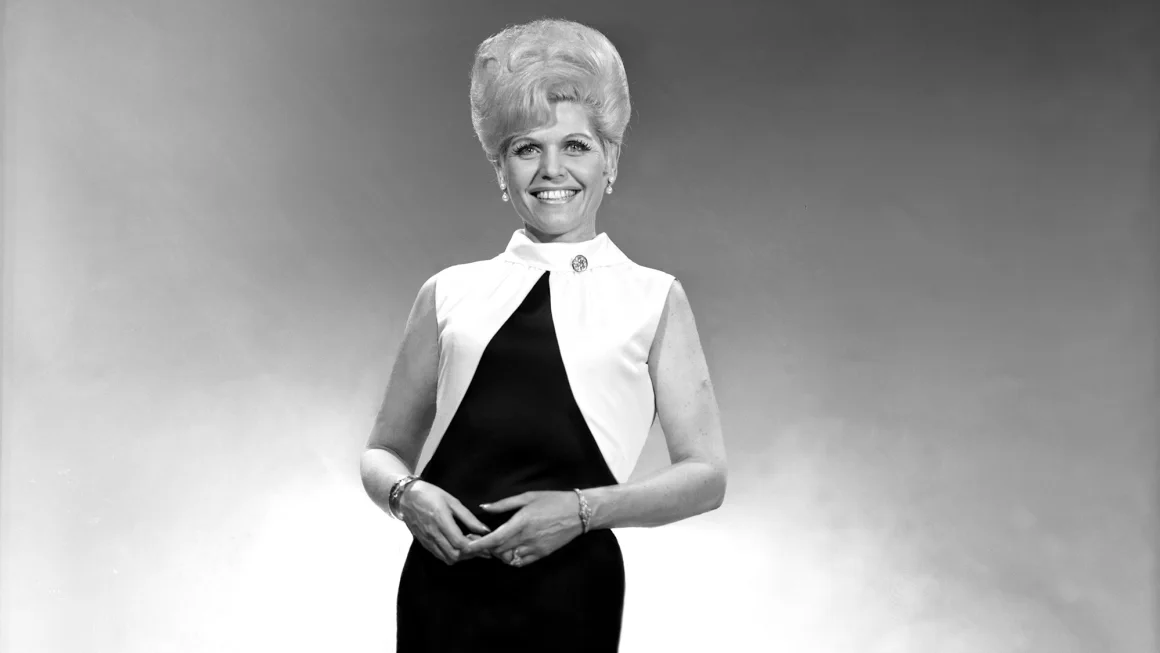
    The company was founded in 1963 by Jean Nidetch, a self-described “overweight housewife obsessed with cookies” who was fed up with fad diets and pills.

    She began hosting weekly meetings at her home with friends to discuss their difficulties with dieting and exercise. “Compulsive eating is an emotional problem,” Nidetch told Time magazine in 1972, “and we use an emotional approach to its solution.”

    f webp
    Founder and director of Weight Watchers Inc. Jean Nidetch in 1965. (Michael Ochs Archives/Getty Images)

    Abiding by her philosophy — “It’s choice, not chance, that determines your destiny” —Nidetch lost more than 70 pounds and kept it off.

    Part of its success can be attributed to its points system, where one number represents each food and drink’s calories, saturated fat, sugar and protein. The company had 3.3 million subscribers at the end of 2024.

    WW’s shares have devolved into a penny stock, a far cry from when it was trading at its peak at around $100 in 2018.

  • Rite Aid’s second bankruptcy filing comes surprisingly soon, less than a year after the company’s previous emergence from Chapter 11

    Rite Aid’s second bankruptcy filing comes surprisingly soon, less than a year after the company’s previous emergence from Chapter 11

    Rite Aid filed for bankruptcy protection Monday for the second time, less than a year after the embattled drugstore chain emerged from Chapter 11 as a private company.

    Rite Aid said in a news release that it’s looking for a buyer and is in “active discussions” with multiple prospects. The Chapter 11 filing in U.S. Bankruptcy Court in New Jersey gives Rite Aid access to $1.94 billion in new financing to fund the sale process, during which it plans to keep stores open.

    The company did not respond to The Washington Post’s request for comment.

    Rite Aid first filed for bankruptcy in October 2023 and received $3.45 billion in new financing to support its reorganization. The company emerged from Chapter 11 in September after slashing almost $2 billion in debt and closing hundreds of stores.

    Despite this downsizing, Rite Aid has “continued to face financial challenges” that have intensified as the retail and health-care sectors evolve, chief executive Matt Schroeder said in a statement, adding that the retailer will focus on keeping pharmacy service uninterrupted.

    Rite Aid’s October 2023 bankruptcy filing also allowed the company to resolve hundreds of lawsuits alleging that it unlawfully filled opioid prescriptions, a practice that fueled the nation’s opioid crisis, according to allegations by several cities, counties and states.

    The flood of litigation, which also targeted CVS and Walgreens, has resulted in more than $50 billion in settlements with state and local governments — upending the country’s three major pharmacy retailers.

    Those settlements come as traditional pharmacy companies also face rising competition from e-commerce giants such as Walmart and Amazon, which offer same-day prescription delivery. Walgreens announced last year that it would close a “significant portion” of its almost 9,000 U.S. locations and agreed last March to take itself private as part of an acquisition by private-equity firm Sycamore Partners.

    Meanwhile, CVS, the country’s largest national chain, announced in 2021 that it would shutter 900 stores over three years and outlined plans last October to lay off almost 3,000 employees to cut costs.

    Rite Aid, the third-largest national stand-alone pharmacy chain, has about 1,200 stores, according to its website. The Philadelphia-based retailer has closed more than 1,000 stores since its 2023 bankruptcy filing. Most recently, it said it would shutter all of its stores in Michigan and all but four stores in Ohio by the end of September.

    Rite Aid is the latest in a string of retail bankruptcies in the past year, with Forever 21, Joann, Party City and Big Lots all recently filing for Chapter 11 protection. Coresight Research in December projected that more than 7,300 store locations would shutter by the end of 2024, compared with about 5,500 in 2023. Bankruptcies in the sector this past year almost doubled.

  • Johnson & Johnson Adjusts Its AI Strategy

    Johnson & Johnson Adjusts Its AI Strategy

    Johnson & Johnson has shifted its generative AI strategy away from broad experimentation across the healthcare conglomerate to a more focused approach.

    Chief Information Officer Jim Swanson said the move ensures that the company allocates resources only to the highest-value generative AI use cases, while it cuts projects that are redundant or simply not working, or where a technology other than GenAI works better.

    “That was a pivot we made after about a year of learning,” Swanson said. “Now we’ve moved from the thousand flowers to a really prioritized focus on GenAI.”The “thousand flowers” approach involved a number of use case ideas germinating from across the company, which made their way through a centralized governance board. At one point, employees were pursuing nearly 900 individual use cases, many that were redundant or simply didn’t work, he said. And as the company tracked the broad value of AI, including generative AI, data science and intelligent automation, it found that only 10% to 15% of use cases were driving about 80% of the value, he added.

    Now J&J is drilling down into high-value generative AI use cases around drug discovery and supply chains, as well as an internal chatbot to answer questions on company policy.

    “We’re prioritizing, we’re scaling, we’re looking at the things that make the most sense,” he said. “That was part of the maturation process we went through.”

    Since ChatGPT’s 2022 debut, companies have been grappling with where and how to start applying generative AI. Many, including J&J, encouraged experimentation, a strategy that set employees up to learn and test the technology and build applications that could see wider adoption across the enterprise.

    Yet in some cases, they are finding that too much experimentation can be at odds with actually finding business value and as a result are looking to forge a new strategy

    J&J began its pivot last year, removing a centralized governance board responsible for vetting employee GenAI ideas. It then distributed governance responsibilities to various corporate functions, including commercial, supply chain and research, that had a better handle on whether the use cases were actually driving value in their area. Those groups were able to shut down or consolidate redundant use cases and focus resources into the ones that were working.

    One example that is working is a “Rep Copilot,” which helps coach sales representatives on how to engage with healthcare professionals about new treatments. The company is piloting this in its Innovative Medicine business segment, which develops new treatments for oncology and other areas, and is now working to expand that pilot to its MedTech segment, which sells robotics and hardware like hip replacements and lenses.

    GenAI also is being used for an internal chatbot that ingests information about company policies and benefits to help reduce the some 10 million interactions employees have every year with the services team.

    In drug discovery, the company is looking at whether GenAI can help researchers find the optimal moment to add a solvent to turn a liquid molecule into a solid. Swanson said J&J also is testing how AI can help identify and mitigate supply-chain risks, including the impact of a shortage of a given raw material.

    The company is tracking progress in three buckets: first, the ability to successfully deploy and implement use cases; second, how widely they are adopted; and third, the extent to which they deliver on business outcomes.

    Swanson said the broad experimentation phase was necessary to learn about the technology and what it was good at. “You had to take an iterative approach to say, ‘Where are these technologies useful and where are they not?’ And I’m still a believer that there’s a lot more hype than there is substance,” he said.

    “We had the right plan three years ago, but we matured our plan based on three years of understanding,” he said. “This is the better way to run now.”