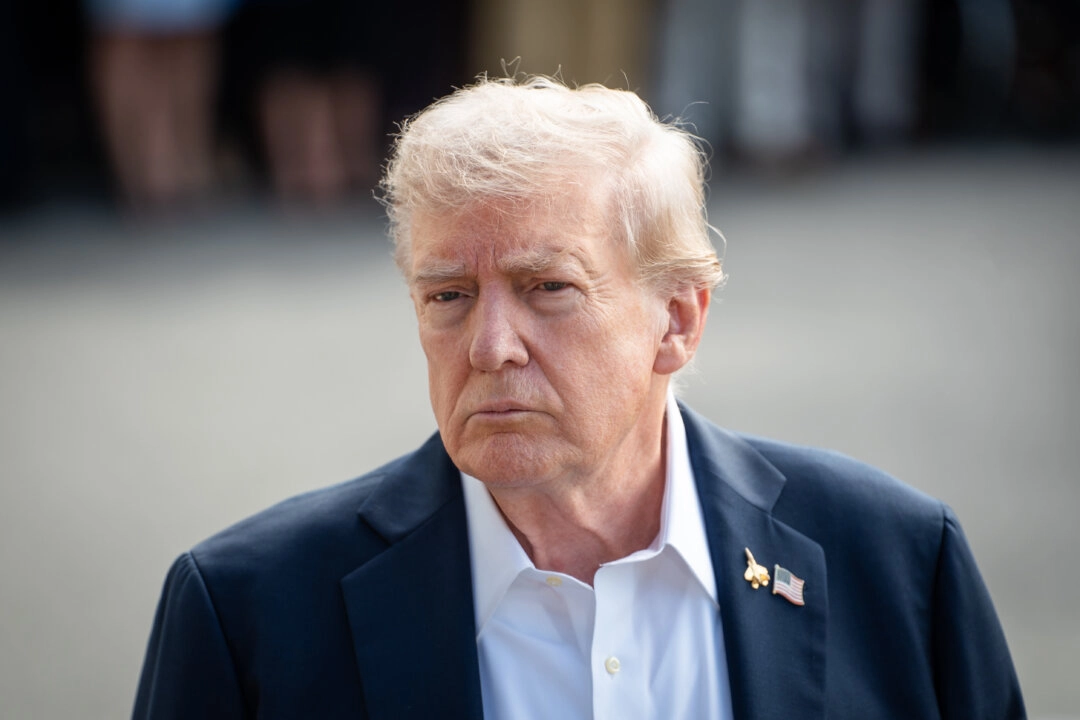
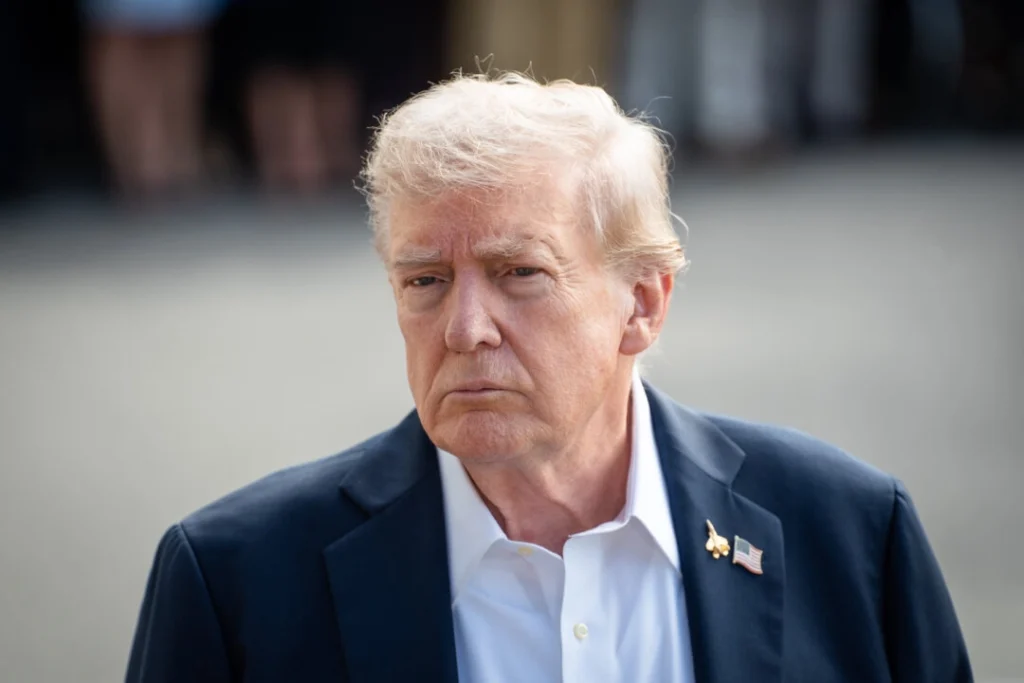
President Donald Trump on Sunday called for an end to an “epidemic of violence” across the United States following a shooting that left casualties at a Mormon church in Michigan, calling it a “targeted attack” against Christians.
Trump said in a post on Truth Social that he was “briefed on the horrendous shooting” and that the FBI was “immediately” on the scene after the shooting.
“This appears to be yet another targeted attack on Christians in the United States of America,” Trump wrote in the post. “The Trump Administration will keep the Public posted, as we always do. In the meantime, PRAY for the victims, and their families.”
The president added in all caps that “this epidemic of violence in our country must end, immediately.”
Trump appeared to reference recent high-profile shootings, including a mass shooting at a Catholic church last month, the assassination of conservative commentator Charlie Kirk earlier this month, and a shooting that left one person dead at an Immigration and Customs Enforcement (ICE) building in Dallas several days ago. A shooting at a North Carolina marina on Saturday night also left three people dead and eight others injured.
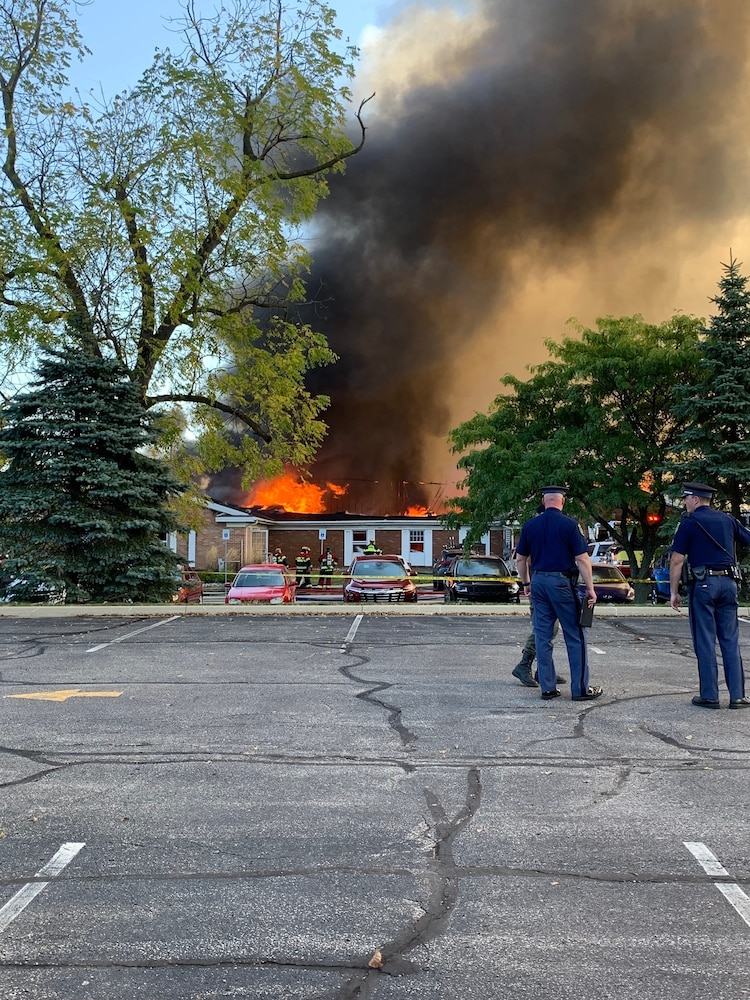
Hundreds of people were inside The Church of Jesus Christ of Latter-day Saints in Grand Blanc Township when a 40-year-old man rammed his vehicle into the front door, exited the vehicle, and started shooting, Police Chief William Renye told reporters in a news conference.
The suspect is believed to have also set the church on fire, Renye said. Flames and smoke could be seen for hours before the blaze was put out. First responders were then seen sifting through the wreckage.
“We do believe we will find some additional victims once we find the area where the fire was,” Renye said.
The suspect used an assault rifle in the shooting, Renye said.
An assault rifle generally refers to a select-fire, fully automatic rifle. Machine guns were effectively banned in a 1986 measure called the Firearm Owners Protection Act, only allowing machine guns that were made before 1986 available to civilians and generally making them rare and expensive to obtain.
Police said they did not yet have a motive for the fire or shooting. The church, encircled by a parking lot and a large lawn, is located near residential areas and a Jehovah’s Witness hall.
The Church of Jesus Christ of Latter-day Saints, also known as the Mormons, said that Sunday’s shooting left “multiple individuals” injured in a “tragic act of violence.”
“The Church is in communication with local law enforcement as the investigation continues and as we receive updates on the condition of those affected,” the statement from church spokesperson Doug Andersen reads. “We offer thanks to the emergency responders who are assisting victims and families.”
“Places of worship are meant to be sanctuaries of peacemaking, prayer and connection,” Andersen added.
Other officials at the state and federal level issued a statement in the wake of the shooting, including FBI Director Kash Patel and Attorney General Pam Bondi.
Patel, who said that FBI officials are currently responding to the shooting, wrote in a post on X that “violence in a place of worship is a cowardly and criminal act” and added that “our prayers are with the victims and their families during this terrible tragedy.”
“Such violence at a place of worship is heartbreaking and chilling,” Bondi wrote. “Please join me in praying for the victims of this terrible tragedy.” She added that she has been receiving briefings on the incident.
Michigan Gov. Gretchen Whitmer said in a statement that she was grateful to the first responders who arrived on the scene and said that violence at place of worship “is unacceptable.”
LONDON — Ellie Potts goes dancing with her friends most weeks. They don’t put on the latest Taylor Swift or Ed Sheeran, though – they much prefer English country dances that were popular more than 200 years ago.
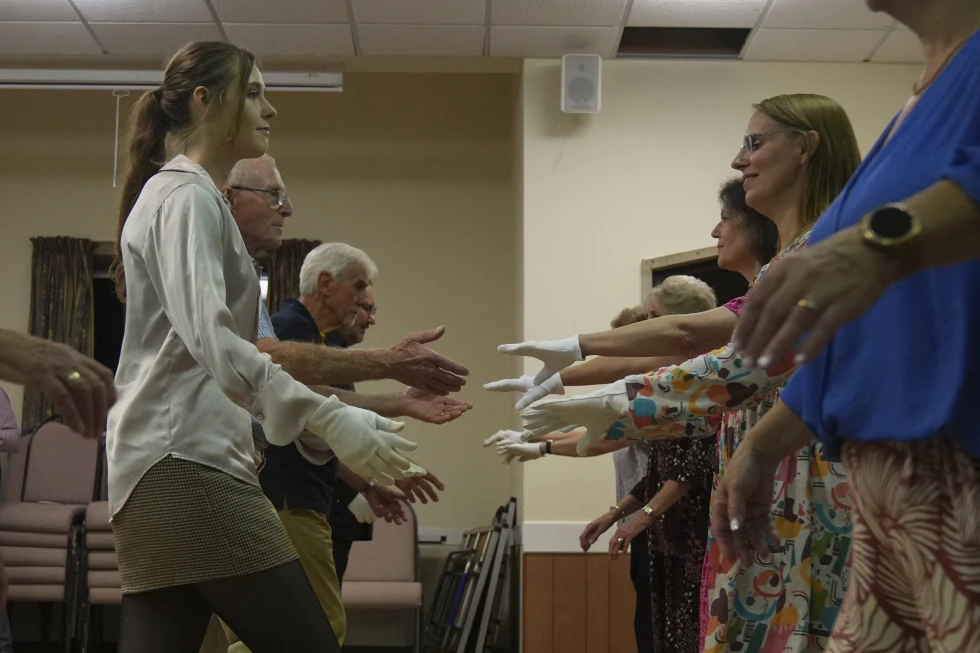
As the music starts, about two dozen men and women curtsy and bow, extend a gloved hand to their partner, before dancing in circles or skipping in elaborate patterns around each other.
Like many of her fellow Hampshire Regency Dancers, Potts is a devotee of Jane Austen and all things from the Regency period. Not only have they studied the books and watched all the screen adaptations – they also research the music, make their own period dresses, and immerse themselves in dances Austen and her characters would have enjoyed in centuries past.
“I’ve been interested in Jane Austen since I was about 8 or 9,” said Potts, 25. “I mainly joined (the dance group) so I can have balls and things to go to in my costumes, but I really got into it. I’ve been surprised how much I enjoy the dancing.”
There’s no shortage of grand costumed balls and historical dancing this year, which marks the 250th anniversary of Austen’s birth. This weekend, thousands of fans who call themselves “Janeites” are descending on the city of Bath for a 10-day festival celebrating the beloved author of “Pride and Prejudice” and “Sense and Sensibility.”
The highlight is a Regency costumed promenade on Saturday, where some 2,000 people in their finest bonnets, bows and costumes will parade through the streets of Bath. Organizers say the extravaganza holds the Guinness World Record for the “largest gathering of people dressed in Regency costumes.”
Bonny Wise, from Indiana, is attending her sixth Jane Austen festival in Bath. This time she’s bringing four period dresses she made, and will lead a tour group of 25 Austen enthusiasts from all over the United States.
“I started planning a tour four years ago, when I realized this was a big year for Jane,” said Wise, 69. She credited the 1995 adaptation of “Sense and Sensibility” with sparking her obsession.
“That movie just opened up a whole new world for me,” she said. “You start with the books, the movies, then you start getting into the hats, the tea, the manners … one thing just led to another.”
Wise said she loves the wit, humor and social observations in Austen’s books. She also finds the author’s own life story inspiring.
“I admire Jane and what she managed as a woman in that era, her perseverance and her process of becoming an author,” she said.
The Jane Austen Society of North America, the world’s largest organization devoted to the author, says it has seen a recent influx of younger fans, though most of its members – 5,000 to date – skew older.
“We’re growing all the time because Jane Austen is timeless,” said Mary Mintz, the group’s president. “We have members from Japan, India. They come from every continent except Antarctica.”
Many festival-goers will be making a pilgrimage to Steventon, the small village in rural Hampshire, southern England, where Austen was born in 1775.
The author lived in Bath, a fashionable spa town in the 18th and 19th centuries, for five years. Two of her novels, “Persuasion” and “Northanger Abbey,” feature scenes set in the World Heritage city.
Bath is also the filming location for parts of “Bridgerton,” Netflix’s wildly popular modern take on period drama based loosely on the Regency period, the decade when the future King George IV stood in as prince regent because his father was deemed unfit to rule due to mental illness.
Thanks to the show, Austen and Regency style – think romantic flowing gowns, elegant ballrooms and high society soirees – have become trendy for a new generation.
“I think Jane Austen is on the rise,” Potts said. “She’s definitely become more popular since ‘Bridgerton’.”
In a church hall in Winchester, a few streets away from where Austen was buried, the Hampshire Regency Dancers gather weekly to practice for the many performances they’re staging this year in honor of the author.
The group selects dances that appear in screen adaptations of Austen’s novels, and members go to painstaking detail to ensure their costumes, down to the buttons and stitching, are authentic looking.
“We go to a lot of trouble to get things as close to the original as possible,” said Chris Oswald, a retired lawyer who now chairs the group. “For me it’s about getting a better understanding of what life was like then, and in the process of doing that getting a better understanding of Jane Austen herself.”
Oswald is passionate about his group’s showcases in Hampshire, or what he jokingly calls “Jane Austen land.”
“People get quite touched because they are walking where Jane Austen actually walked. They dance in a room that Jane Austen danced in,” he said. “For people who are very into Jane Austen, that’s extremely special.”
Many “Janeites” say they get huge enjoyment in making Austen’s words and imageries come to life in a community of like-minded people.
Lisa Timbs, a pianist who researches the music in Austen’s life and performs it on an antique pianoforte, puts it succinctly: She and her Regency friends are “stepping back in time together.”
“I think it’s an escape for a lot of people,” Timbs added. “Perhaps it’s to escape the speed, noise and abrasiveness of the era in which we find ourselves, and a longing to return to the elegance and indulgent pleasures of what was really a very fleeting period in history.”
Pope Leo XIV says tech companies developing artificial intelligence should abide by an “ethical criterion” that respects human dignity.
AI must take “into account the well-being of the human person not only materially, but also intellectually and spiritually,” the pope said in a message sent Friday to a gathering on AI attended by Vatican officials and Silicon Valley executives.
“No generation has ever had such quick access to the amount of information now available through AI,” he said. But “access to data — however extensive — must not be confused with intelligence.”
He also expressed concern about AI’s impact on children’s “intellectual and neurological development,” writing that “society’s well-being depends upon their being given the ability to develop their God-given gifts and capabilities.”
That statement from the Pope came on the second of a two-day meeting for tech leaders in Rome to discuss the societal and ethical implications of artificial intelligence. The second annual Rome Conference on AI was attended by representatives from AI leaders including Google, OpenAI, Anthropic, IBM, Meta and Palantir along with academics from Harvard and Stanford and representatives of the Holy See.
The event comes at a somewhat fraught moment for AI, with the rapidly advancing technology promising to improve worker productivity, accelerate research and eradicate disease, but also threatening to take human jobs, produce misinformation, worsen the climate crisis and create even more powerful weapons and surveillance capabilities. Some tech leaders have pushed back against regulations intended to ensure that AI is used responsibly, which they say could hinder innovation and global competition.
“In some cases, AI has been used in positive and indeed noble ways to promote greater equality, but there is likewise the possibility of its misuse for selfish gain at the expense of others, or worse, to foment conflict and aggression,” Leo said in his Friday statement.
Although it doesn’t have any direct regulatory power, the Vatican has been increasingly vocal on AI policy, seeking to use its influence to push for ethical technological developments.
In 2020, the Vatican hosted an event where tech leaders, EU regulators and the late Pope Francis discussed “human-centric” AI, which resulted in the Rome Call for AI Ethics, a document outlining ethical considerations for the development of AI algorithms. IBM, Microsoft and Qualcomm were among the signatories who agreed to abide by the document’s principles.
Two years later, Francis called for an international treaty to regulate the use of AI and prevent a “technological dictatorship” from emerging. In that statement — which came months after an AI-generated image of Francis in a puffy coat went viral — he raised concerns about AI weapons and surveillance systems, as well as election interference and growing inequality. In 2024, he became the first pope to participate in the G7 summit, laying out the ethical framework for the development of AI that he hoped to get big tech companies and governments on board with.
Following Francis
When Pope Leo XIV became leader of the Catholic Church last month, he signaled that his papacy would follow in Francis’ footsteps on topics of church reform and engaging with AI as a top challenge for working people and “human dignity.”
The new pontiff chose to name himself after Pope Leo XIII who led the church during the industrial revolution and issued a landmark teaching document which supported workers’ rights to a fair wage and to form trade unions. With the development of AI posing a similar revolution to the one during the 19th century, Leo has suggested that the church’s social teaching — which offers a framework on engaging with politics and business — be used when it comes to new tech advancements.
“In our own day, the church offers to everyone the treasury of her social teaching in response to another industrial revolution and to developments in the field of artificial intelligence that pose new challenges for the defense of human dignity, justice and labor,” Leo said in that May address.
The Friday event, which took place inside the Vatican’s apostolic palace, included a roundtable discussion on AI ethics and governance. Among those present from the Vatican side were Archbishop Vincenzo Paglia, who has engaged with business leaders on AI, and Archbishop Edgar Peña Parra, who holds the position of “sostituto” (substitute) in the Vatican, a papal chief of staff equivalent.
Earlier this week, Leo referenced AI during a speech to Italian bishops, talking about “challenges” that “call into question” the respect for human dignity.
“Artificial intelligence, biotechnologies, data economy and social media are profoundly transforming our perception and our experience of life,” he told them. “In this scenario, human dignity risks becoming diminished or forgotten, substituted by functions, automatism, simulations. But the person is not a system of algorithms: he or she is a creature, relationship, mystery.”
A key issue at Friday’s event is AI governance, or how the companies building it should manage their need to generate profit and responsibilities to shareholders with the imperative not to create harm in the world. That conversation is especially pressing at a moment when the United States is on the brink of kneecapping the enforcement of much of the limited regulations on AI that exist, with a provision in President Donald Trump’s proposed agenda bill that would prohibit the enforcement of state laws on AI for 10 years.
In his statement, Leo called on tech leaders to acknowledge and respect “what is uniquely characteristic of the human person” as they seek to develop an ethical framework for AI development.
Pope Leo XIV, the newly elected pontiff, must answer to at least one more higher power: the IRS.
The United States generally requires all citizens to file an annual tax return, even those who live out of the country. But assuming he doesn’t renounce his U.S. citizenship, Leo — born in the Chicago area and known until this week as Robert Prevost — has special tax considerations, both as a clergyman and now as the head of a foreign government.
Leo’s situation differs from that of other popes in recent memory, because many countries do not assess taxes on citizens living abroad. “Recent popes from Poland, Germany and Argentina were not taxed by their home countries,” said Jared Walczak, a vice president of the Tax Foundation,a nonpartisan think tank in Washington, who called the first American pope’s accounting situation “uncharted.”
The pope’s job as a member of the clergy does not exempt him from U.S. taxes. American citizens abroad must generally file tax returns if their income level and other personal circumstances would require them to file if they were living in the U.S., according to the Internal Revenue Service.
That doesn’t mean they have to pay the same amount in taxes. Americans who spend the year in a foreign country can exclude much of their earnings from U.S. income tax. For the 2025 tax year, Americans abroad can exclude up to $130,000 in foreign income.
That doesn’t apply to income earned working for a foreign government, however, so that won’t let Leo off the hook, as he is in the employ of the Vatican.
That means Leo will need to calculate the value of his earnings. The pope does not earn a set salary, but the Vatican covers his housing, food, travel and health care, and provides a monthly stipend for personal expenses. (“When I need money to buy shoes or something, I ask for it,” is how the latePope Francis, an Argentine native, once explained it.) Leo probably will need an accountant to determine how to translate such benefits into income for a U.S. tax return.
Leo’s housing at the Vatican is likely exempt, whether he chooses to live in the grand Apostolic Palace like prior popes or the more humble Santa Marta guesthouse where Francis resided. Walczak said that employer-provided housing is generally not taxed as income if the housing is on the business’s property and it is “essential” that the employee live there for the benefit of the business. The papal palace, Walczak said, “is not a taxable fringe benefit.”
Also, the U.S. grants clerics special tax benefits relating to their housing — a “parsonage” exemption — that don’t apply to workers in other professions.
If Americans living abroad pay income taxes to a foreign government, that amount can be subtracted from their U.S. tax liability thanks to the foreign tax credit. That may have applied to Leo during the many years he worked in Peru, which also taxes full-year residents on all of their worldwide income. He became a Peruvian citizen in 2015.
Walczak said that he doesn’t expect Leo to end up paying U.S. taxes but that it’s possible the IRS will issue a private letter specifically addressing his situation. Or Congress might even pass a law spelling out the tax situation of the first American pope, Walczak speculated.
What makes all of this even more complicated is that Leo is the head of state of the Vatican.
Since 2015, the Vatican has been affected by a U.S. federal law that requires financial institutions around the world to report to the IRS details of accounts held by U.S. clients, theVatican Bank’s 2023 annual report said. “For customers who are nonresident in Italy, the principles of international tax law are applied. This means that each customer must declare his or her holdings and all derived income in his or her country of tax residence in accordance with the laws of that country,” the report states.
U.S. citizens living abroad have to file a report with the Treasury Department’s Financial Crimes Enforcement Network if they have “signature authority” — meaning control over the use of funds or other assets — over foreign bank accounts whose total value exceeds $10,000, according to Brittany Benson, an analyst with the Tax Institute at H&R Block. “This would likely apply [to Pope Leo XIV] if he has signature authority on Vatican accounts,” Benson said in an email to The Washington Post.
Edward A. David, an assistant professor in the department of theology and religious studies at King’s College London, said most of the Vatican’s income comes from donations, admission to museums, and the property it owns around the world and in the Vatican itself.
David said it’s hard to predict how the unprecedented situation will work in reality. “U.S. tax law is very far-reaching. And while there might be an exemption for heads of state, this is brand-new territory for us and brand-new territory for the United States and the Vatican.”
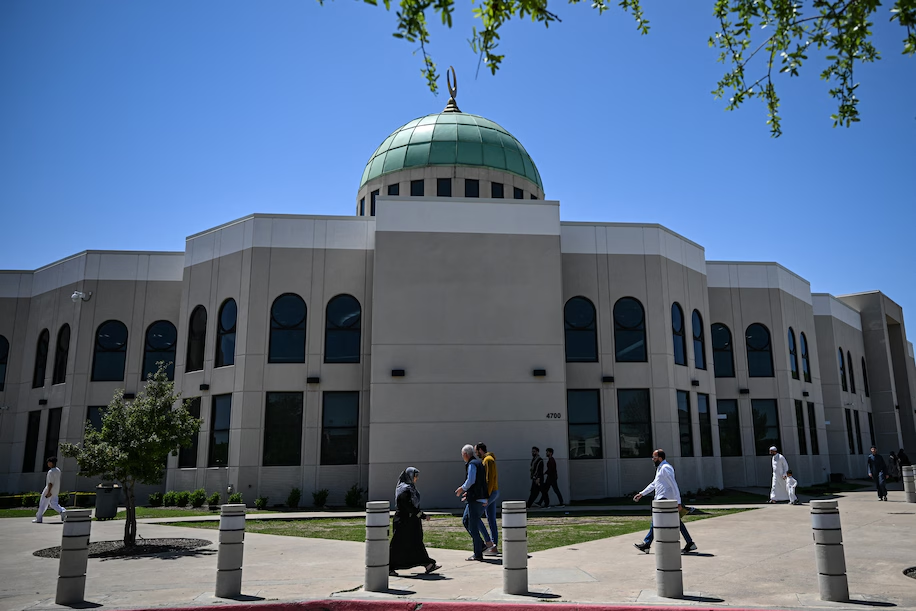
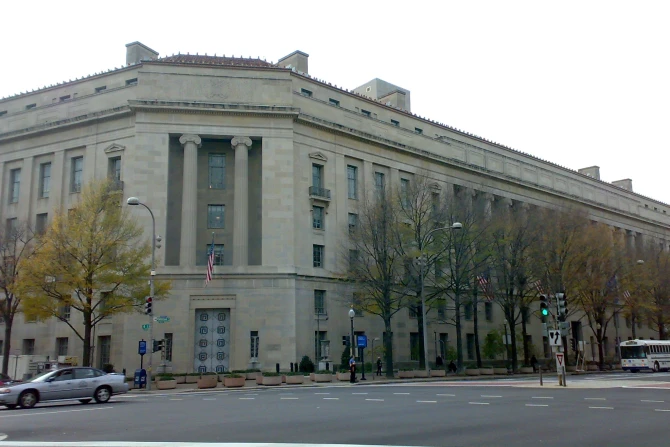
The Justice Departmentwill investigate whether a planned real estate development around one of North Texas’s largest mosques violates federal law, Sen. John Cornyn (R) said Friday after weeks of calling the project antisemitic and anti-Christian.
Attacks over the developmentoutside Dallas have been amplified by Cornyn, TexasAttorney General Ken Paxton (R), Gov. Greg Abbott and right-wing bloggers who baselessly claim it would create a Muslim-only community and impose Islamic law on residents.
Leaders for the East Plano Islamic Center, the mosque that is backing the project dubbed EPIC City, have repeatedly denied the accusations and called the attacks on their planned development Islamophobic. If built, EPIC City would span about 400 acres and create housing, day-care facilities, medical clinics and schools, according to marketing material.
“I am grateful to Attorney General Bondi and the Department of Justice for hearing my concerns and opening an investigation,” Cornyn said in a statement. “Religious discrimination and Sharia Law have no place in the Lone Star State. Any violations of federal law must be swiftly prosecuted, and I know under the Trump administration, they will be.”
Dan Cogdell, an attorney for EPIC City, said the development would cooperate with the federal investigation, noting that the Muslim community behind the project had nothing to hide.
“From day one, their intention was to comply completely and wholeheartedly with the law,” said Cogdell, who defended Paxton during the Republican firebrand’s 2023 impeachment trial. “And they’ve just been vilified, assailed and attacked.”
Cogdell added, “What is crazy to me is how far we haven’t come since 9/11. The words ‘mosque,’ ‘Islam,’ ‘Muslim’ in the year of our Lord 2025 are still such a triggering event.”
The Justice Departmentdid not respond to a request for comment.
EPIC City was announced about a year ago, according to its social media pages. Developers said they would use empty land in Josephine, Texas, northeast of Dallas, to build a “vibrant, multigenerational, and inclusive master planned community.”
As EPIC City was selling shares and building out its plans, none of which featured materials that required residents to be Muslim, an uproar by conservatives overshadowed the project. Cogdell said the first incidents came from right-wing accounts on X, which caught the attention of senior Republican leaders in Texas.
In late March, EPIC City wasslammed with a flurry of investigations. Abbott opened three inquirieslooking into “potential criminal activities,” discrimination in violation of the Texas Fair Housing Act and any potential “financial harm on Texas.” Paxton began an investigation intowhether EPIC City violated Texas consumer protection laws.
The scrutiny intensified in April when Abbott ordered that EPIC City cease all construction,saying that the development “did not submit the required permits to begin construction.” Cogdell saidthe project was in a “pre-planning stage” and was in the process of obtainingbuilding permits.
“We’re getting the applications for the permits,” Cogdellsaid. “Of course, in the meantime, we’ve got to comply with this document request or this motion to compel or this threat letter.”
Cornyn wrote to the Justice Department’sCivil Rights Division on April 11 requesting an additional investigation into the project that he said was an “exclusive religious settlement” governed by “Islamic principles.”
The letter drew condemnation from the Council on American-Islamic Relations, whichsent a letter to Attorney General Pam Bondi opposing a federal investigation.
“Senator Cornyn’s false claims are not supported by any facts,” the letter read. “Across the United States, faith-based communities, including Christian senior centers and Orthodox Jewish neighborhoods, exist without facing similar scrutiny. Muslim-led developments must be treated equally under the law.”
EPIC City also issued its own response to the upheaval, writing in an April 5 Facebook post that it was elected officials who were spreading “isolation and exclusivity.” In response, dozens of commenters wrote on the social media post that the development wasn’t welcome in America.
Cogdell said EPIC City will continue pursuing its plans.
“They’re spending more on lawyers than they ever thought they would need,” Cogdell saidof his clients at East Plano Islamic Center. “They are committed to making sure this project gets done, and we’ll do everything we can to comply with the law — for the 1,000th time.”
In a breach that’s sending shockwaves through legal, religious, and victim advocacy circles, a massive cyberattack has exposed confidential records related to decades of Catholic Church sex-abuse cases, including sealed court documents, internal communications, and victim settlements. The breach, confirmed by multiple law enforcement agencies and diocesan officials, is being described as one of the largest data leaks involving a religious institution in U.S. history.
The cyberattack, first discovered on April 29, 2025, targeted the IT systems of the United States Conference of Catholic Bishops (USCCB) and several major dioceses, including those in Boston, Los Angeles, and Chicago. Forensic analysis by federal cybersecurity experts and private firms indicates that more than 1.7 terabytes of data were exfiltrated, including:
Unpublished victim testimonies from abuse investigations between 1960 and 2022
Internal emails between bishops and legal counsel discussing clergy misconduct cases
Settlement agreements, many previously sealed, detailing payments to survivors and confidentiality clauses
Personnel files of clergy members under investigation or accused of abuse
Litigation strategy documents outlining efforts to delay or suppress public disclosure
The hackers, who have not been publicly identified, published a portion of the data on the dark web and provided links to journalists and advocacy groups. The FBI and the Cybersecurity and Infrastructure Security Agency (CISA) have launched a joint investigation.
“This is a deeply troubling breach that threatens the privacy of survivors and the integrity of ongoing investigations,” said FBI Cyber Division spokesperson Emily Ramirez. “We are treating this as a national security priority due to the scale and sensitivity of the data involved.”
The USCCB confirmed the breach in a public statement issued May 5, calling it a “malicious and criminal violation of data security and individual dignity.” The Conference said it is working with law enforcement and cybersecurity consultants to assess the full scope of the intrusion and to notify affected individuals.
Bishops from several dioceses have expressed concern and issued apologies to victims whose privacy may have been compromised. Cardinal Joseph Hanley of the Archdiocese of Los Angeles acknowledged that “some of the files released were never intended for public viewing—not to hide the truth, but to protect the victims and their families from further trauma.”
However, critics say the breach has revealed the extent to which Church officials worked behind the scenes to shield clergy and limit financial liability.
“What these files show is not just abuse, but the systematic cover-up of abuse,” said Mitchell Garvey, legal director of the Survivors Advocacy Legal Foundation. “Many of these cases were never going to see daylight. This hack pulled back the curtain.”
The leaked data is already reshaping legal battles in multiple jurisdictions. Attorneys for abuse survivors in Massachusetts and Illinois have filed motions to reopen cases based on newly surfaced documents that suggest Church officials misled courts or withheld evidence.
At the same time, ethical concerns have emerged around the public use of hacked information—particularly as it relates to victim identities and medical histories.
“Some of the files contain graphic, personal accounts of trauma,” said Anne Doyle, editor of BishopAccountability.org. “While the transparency is important, we must tread carefully to avoid retraumatizing survivors.”
Several media outlets have chosen not to publish raw documents or names of victims, even as advocacy groups press for full disclosure.
While no group has formally claimed responsibility, cybercrime experts believe the attack may have been ideologically motivated rather than financially driven. The sophistication of the breach—employing custom malware and multi-stage phishing campaigns—suggests a state-sponsored or activist-backed operation.
Sources familiar with the investigation point to a loosely organized digital collective with a history of targeting institutions accused of human rights violations. Similar tactics were seen in the 2023 hack of an international adoption agency implicated in child trafficking.
“We’re likely looking at a network of activist-hackers who believe institutions like the Church are not being held fully accountable by legal systems,” said Joshua Knight, a cybersecurity fellow at the Atlantic Council. “They’ve weaponized transparency.”
Though the breach centers on U.S. dioceses, officials in the Vatican and other national conferences are bracing for potential fallout. Several files refer to international transfers of clergy accused of abuse, raising fresh scrutiny of the Church’s long-criticized practice of reassigning rather than defrocking problem priests.
Pope Francis, speaking from the Vatican on May 9, said the Church “must always be on the side of truth and the suffering,” while also condemning the breach as a “violation of human dignity.”
The cyberattack has unleashed a new era of reckoning for the Catholic Church—not just about the sins of the past, but about the mechanisms that kept them hidden. Wall Street, civil society, and religious observers alike are grappling with the implications of digital exposure in a faith institution that has long relied on privacy, tradition, and internal process.
Whether the breach will lead to justice or simply more pain remains to be seen.
Cardinal Robert Francis Prevost, a native of Chicago who is now the first American-born pope, has spent most of his career outside of the United States, ministering to the dispossessed and marginalized.
The “Latin Yankee,” as he is known in Rome, worked 20 years in Peru’s poorest enclave — falling so in love with the country that he became a naturalized citizen. His commitment there echoes the legacy of Pope Francis, an Argentine who became the Catholic Church’s first leader from South America.
“He’s right out of Francis’s playbook,” said Kathleen Sprows Cummings, a professor of history at the University of Notre Dame who focuses on U.S. Catholics. “He ticks off all the boxes of a future pope: a pastoral heart, managerial experience and vision.”
Francis turned to Prevost on repeated occasions. In 2022, he had him preside over a revolutionary reform: adding three women to the voting bloc that decides which bishop nominations go forward to the pope. Yet his successor is considered more middle of the road, pragmatic as well as cautious.
In picking the 69-year-old Prevost, the papal conclave in Rome looked past allegations that hehad mishandled or failed to act on sexual abuse cases involving priests in both Peru and the United States.
He was selected despite being “an enigma to cardinals, especially to American cardinals, because he spent his life outside of the United States,” said Jon Morris, a theologian and former priest who has been in Rome to observe the transition as a Fox News contributor.
Prevost’s childhood roots were deep on Chicago’s South Side, where he grew up worshiping at St. Mary of the Assumption Church on E. 137th Street. Local media have reported that his father, of French and Italian ancestry, was an educator who served in the church as a catechist and that his mother, of Spanish ancestry, was a librarian. Members of the clergy would come to his family’s home from across Illinois for community and his mother’s tasty cooking, according to the Pillar, a Catholic media project.
As a youth, he served as an altar boy and went to the parish school and then a seminary high school. He attended Villanova University, graduating with a bachelor’s degree in mathematics in 1977. He was ordained five years later and completed a doctorate in canon law at the Pontifical University of St. Thomas Aquinas in Rome. Then came two decades of service in Peru, much of it as a missionary and parish priest.
Prevost, who is fluent in English, Spanish, Portuguese, Italian and French, was twice elected top leader of the centuries-old Order of St. Augustine. Its website describes the international order as “living together in harmony, being of one mind and one heart on the way to God,” calling nothing your own and living communally.
Francis tracked Prevost’s career for years, sending him back to Peru in 2014 after appointing him apostolic administrator of the Diocese of Chiclayo, in the country’s northwest. In 2015, he was named bishop there.
In 2023, the pope appointed Prevost to dual roles: president of the Pontifical Commission for Latin America and leader of the Dicastery for Bishops, a powerful office at the Vatican that selects bishops around the world. He held that latter position until Francis died on April 21.
His role in two different cases of sexual abuse by priests in Chicago and Peru ultimately did not derail him.
The first case dates to about 25 years ago, when Prevost led the Augustinian Province of Chicago. A priest who church leaders found had sexually abused minors was allowed to stay at an Augustinian monastery near a Catholic elementary school. The Vatican denied Prevost ever authorized that arrangement.
More recently, questions were raised about Prevost’s knowledge of abuse allegations in the Chiclayo diocese during his tenure as bishop. Two priests were accused of molesting three young girls, and a complaint this year by Survivors Network of Those Abused by Priests (SNAP) alleged that “Prevost failed to open an investigation [and] sent inadequate information to Rome.”
The Vatican again denied any wrongdoing by Prevost.
“Given what we know about the pervasiveness of clerical sexual abuse, it is certainly plausible that abuse occurred on his watch; he was superior general of a congregation of priests that ministers in 50 countries across the globe,” Cummings said. “It’s also entirely conceivable that he failed to act decisively in punishing perpetrators and supporting victims but, sadly, that’s true of almost all the men who occupied positions of high leadership in the Catholic Church in the second half of the 20th century. The cardinal electors would be hard-pressed to find a man among their number whose record on this issue is spotless.”
Because he has crisscrossed multiple borders — both geographic and religious — Prevost had a prominence going into the conclave that few other cardinals had, Cummings said.
In a 2023 interview with Vatican News, Prevost spoke about the essential leadership quality of a bishop.
“Pope Francis has spoken of four types of closeness: closeness to God, to brother bishops, to priests and to all God’s people,” he said. “One must not give in to the temptation to live isolated, separated in a palace, satisfied with a certain social level or a certain level within the church.
“And we must not hide behind an idea of authority that no longer makes sense today,” he continued. “The authority we have is to serve, to accompany priests, to be pastors and teachers.”
VATICAN CITY — As the cardinalsprepare to enter the Sistine Chapel in procession Wednesday for the start of the conclave to pick the next pope, talk is swirling that the throne of St. Peter could go to a first pontiff from the United States. Just as many voices herald the chances of three Italians and a come-from-behind Spaniard serving in Morocco. A Filipino, a Frenchman, a Congolese and a long-monastic Swede are talks of the town too.
Yet as all eyes wait for the billowing white smoke that signals Habemus Papam — “We have a pope” — the wisest watchers have a warning.
Nobody really knows who will be the next pope, at a time of deep church division.
Once they enter the chapel at 4:30 p.m., the cardinals under 80 — including nearly two dozen from countries that have never had a voice in a conclave before — will be sequestered for votes, released only to retire to their boardinghouse for meals and rest, until a new pope is found. Under the ceiling depicting Michelangelo’s outstretched God creating Adam, there will be no interpreters, no speeches, no lobbying (theoretically). There will be only prayer, chatter and votes.
To keep themselves pure of secular influence — and, in 2025, viral social media posts — the serene prelates will be asked not to bring their cellphones. One of the cardinals who is sick, however, may earn the right to vote from his room.
Tables are set up in the Sistine Chapel for the conclave. (Simone Risoluti/Reuters)
In the hour or so after white smoke, but before the new pope’s name is announced in Latin from the central balcony of St. Peter’s Basilica, the tea leaf reading will commence. Should a decision come Wednesday — when there is just one ballot, during which consensus is rarely reached — the choice could signify the elevation of a familiar cardinal viewed by his peers as a pillar of stability in unsettled times. Or, that a star somehow electrified the conclave.
Bracing for a marathon
After Wednesday night, four votes will be held during each full-day session. Francis and Benedict XVI were elected in five and four votes, respectively. Should that pattern be followed again, a decision would come Thursday. If the choice bleeds into a third day — or, shockingly, longer — the narrative of a house divided will begin to take hold. The last time a conclave went five dayswas more than a century ago, in 1922.
Since Francis’s death, cardinals have laid out conflicting visions for the future of the church, and some have been bracing the faithful for what could be a nail-biter of a marathon. In the largest conclave in history — there are 133 voting members in Vatican City — so many cardinals are new and unfamiliar to their peers that the prelates, who normally meet in pre-conclave morning assemblies, held an extended afternoon session this week. Adding to the challenges, not all of them speak fluent Italian — Vatican City’s lingua franca.
“We hope the new Pope will arrive in three [or] four days,” Chaldean Patriarch Cardinal Louis Raphael Sako told journalists this week.
In an act of high ceremony, most cardinals, singing the Litany of the Saints as they approach the chapel, will wear red garments with a sash, a rochet vestment, a mozzetta cape, and a pectoral cross with red and gold cord, along with a ring, zucchetto skull cap, and the biretta peaked hat. The Cardinals of the Eastern Churches will wear their own “choir dress,” according to the Vatican.
The news media will find out who the new pope is along “with the rest of the people of God” — when the birth and papal names of the new pontiff are heralded to a throng in St. Peter’s by a senior cardinal, the Vatican said. When the new pontiff emerges for his address, the scrutiny will begin.
Will he select the simple white robes and black shoes of Francis, or return to the bling-y red slippers and red velvet mozzetta favored by Benedict? Will he address the crowd, as Francis did, by humbly calling himself the “bishop of Rome” and, in lieu of a lofty blessing to the faithful, ask the faithful to pray for him instead?
“Popes are always compared to their predecessors,” said the Rev. Thomas Reese, 80, a veteran Vatican watcher now in Rome, and who was also in the city for the 2005 and 2013 conclaves. “Catholics tend to support whoever is pope,” he added. “But who knows this time in the age of social media.”
View of the “Room of Tears,” a small room next to the Sistine Chapel where the newly elected pope will don the white papal vestments for the first time. (Vatican Media/Reuters)
It’s long been said that no one from the United States will be pope, based on the argument that the country already enjoys outsize global power. But there have been whispers in recent days about the rising odds for Cardinal Robert Prevost, a Chicago native who has spent most of his career in Peru and Rome, as well as the traditionalist Archbishop of New York, Cardinal Timothy Dolan.
An American? A Spaniard? A monastic Swede?
Prevost is regarded as a pragmatist who wasselected by Francis to lead the powerful bishop-picking department at the Vatican, making him extremely well-known among the voting cardinals. Dolan, perhaps the most recognized bishop in the United States, is a St. Louis native who worked in Milwaukee before he went to New York: a gregarious, TV-friendly figure who prayed at President Donald Trump’s 2025 inauguration.
Some experts have noted that with so many new cardinals and in such a big conclave, Dolan’s high profile could help him break through the Vatican’s American taboo.
Several Vatican watchers have been dazzled by Cardinal Cristóbal López Romero, a humble Spaniard said to have impressed his peers during his pre-conclave speech and interactions, as Francis did before his election.Romero is the archbishop of Rabat, Morocco.
“I’m fully in tune with everything Francis proposed — his way of acting, speaking, and leading,” López Romero told the news agency of his Salesian religious order last week. “But I don’t say ‘I belong to Francis,’” he said. “I’m of Christ. I’m of the Gospel. And if I love Francis, it’s because he’s pure Gospel.”
As is customary, no contender is publicly advocating for the job, and most are demurring, saying they don’t want the nod. Swedish Cardinal Anders Arborelius, a Catholic convert in a Protestant-dominant country who spent decades in monastic life, said he has been mobbed by patriotic Swedes celebrating his chances.
“It’s a bit ridiculous in Sweden that Swedes are so nationalistic,” Arborelius told The Washington Post. Someone the cardinal knows, he said, had asked an AI bot what his chances were. Arborelius said he was relieved when they were in the single digits.
“I was very happy. Because I don’t have this strong leadership — what do you call it? — management type,” he said.
He candidly outlined the struggle among cardinals over the criteria for the next pope. He said cardinals wanted an evangelizer to cope with “many difficult issues” including the “war in Europe” and “Trump in America.” But less clear is whether the faith needed a “prophetic figure” who was “charismatic,” or someone more reflective and transitional, “like Benedict” was between John Paul II and Francis.
One refrain being echoed, he said, was concern for migrants — many of whom are Catholic.
“If you take that issue, migration … we know it’s a political issue in many countries, but it’s also kind of biblical,” he said.“The people of Israel, Abraham, migrated,” he said. “The church is built up from migrants.”
“It’s part of human history where God brings people to different places. And when we look for a person to guide the church, it has to be someone who somehow answers what we would have seen in Jesus himself, who somehow has to reflect something of his mystery.”
Asked about the harsh critiques of Francis being leveled by some cardinals ahead of the conclave, Cardinal Michael F. Czerny, a Czech-born Canadian prelate and longtime senior Vatican official, described them as typical of an era of social media saturation and intense news cycles where “everything goes without restraint.”
But “Francis invited debate,” he said. “He would not want to be seen as beyond criticism.”
Asked if nationality was being taken into consideration in the selection process, he said, “I hope not, because it shouldn’t be.”
From left, in yellow, Filipino Cardinals Luis Antonio Tagle, Jose Advincula and Pablo Virgilio David attend Sunday mass at the Pontificio Collegio Filippino in Rome on Sunday. (Eloisa Lopez/Reuters)
On Sunday, several of the top contenders celebrated Mass in Rome at their so-called titular churches, or the local houses of worship where far-flung cardinals serve as ceremonial patrons. Their homilies are often viewed as papal auditions.
Behind a photo of Francis set among devotional candles at Santa Maria ai Monte, an ornate Roman church completed in the 16th Century, a cleric who was among the late pope’s favorites — Cardinal Jean-Marc Noël Aveline of Marseille — appeared to take a page from Francis’s book of inclusion. “Let’s be unafraid of those who are different from us, because every man and every woman is a brother and a sister for whom Christ died,” Aveline, an Algerian-born Frenchman, told a standing-room-only Mass.
A few blocks away,a favorite of church conservatives — Hungary’s Peter Erdo — defended the traditions of the faith at the Basílica di Santa Francesca Romana. “The main [source] of our knowledge of the historical Christ is the sacred scripture, but also the tradition of the church,” he said. “Tradition is not [just] a counter-history, but rather a testimony.”
They buried him. They mourned him. And they have gathered to pick his successor. But it’s still all about Pope Francis.
More than two weeks after Francis died, the cardinals who will begin voting in the Sistine Chapel on Wednesday to pick the next pope have been signaling whether they want to follow Francis’ lead, turn back or find some compromise between the two.
In homilies, public and private conversations, and most of all in remarks to their fellow cardinals in daily meetings behind the Vatican walls, the people who will choose the next pope have been holding what amounts to a referendum on Francis’ legacy. They have also been considering whether they want to perpetuate the so-called “Francis effect,” the idea that a charismatic, inclusive person of moral conscience on the geopolitical stage might draw new followers and lure lapsed Catholics back into the church.
“There are various wishes” within the group, said Cardinal Anders Arborelius of Sweden, who has been mentioned as a potential candidate for pope. Some want to elect a pontiff “who can follow in the footsteps of Francis. Some others said, ‘No, no. Not at all.’”
There is plenty in Francis’ legacy to fight over. During his 12-year pontificate, he made global headlines for landmark declarations that encouraged liberals, whether Catholic or secular. Of gay priests he said, “Who am I to judge,” and he allowed the blessing of same-sex couples. He raised his voice for migrants, implored world leaders to face a warming climate and criticized what he saw as the excesses of capitalism and the exploitation of the poor.
Francis greeting Syrian refugees upon their arrival in Rome in 2016. (Pool photo by Filippo Monteforte)
Within the church, he expanded the College of Cardinals to what he called “the peripheries,” nations far from the Vatican with the fastest-growing populations, as well as to some places where Catholics are an overwhelming minority. He struck a deal with the Chinese government, in the hopes of increasing the church’s presence, although some critics believed it compromised the church’s independence in China.
He invited laypeople, including women, into meetings of bishops that he envisioned as the church’s main decision-making bodies. He reformed the Vatican bureaucracy that governs the church, introduced measures to increase transparency of the church’s infamously murky finances, and enacted decrees to increase accountability for church leaders who committed or covered up cases of sexual abuse.
Some cardinals want to move ahead with those upheavals, or even leap forward with bigger changes. Others want to roll them back. But the largest rifts may be over the contentious issues in which Francis walked up to the line, but didn’t cross.
Those include long stashed but controversial issues such as the ordination of women as Catholic deacons, the requirement of celibacy for priests, and the church’s teachings about homosexuality and the use of birth control.
In the wake of Francis’ papacy, the stakes extend beyond the Catholic church. He was a rare mediagenic leader who could be as popular with secular audiences as he was with the faithful, someone viewed by many as an ethical compass in an increasingly confusing political landscape. While many world leaders have moved to shut their doors to migrants and abandon the care of the poor, Pope Francis stood for openhearted acceptance, a position that resonated with churchgoers as well as some of those who had never gone to Mass.
Yet it was that very popularity outside the church doors that sometimes made him a lightning rod for his opponents within the church.
In 2013, more than a million people gathered on Copacabana Beach in Rio de Janeiro for Francis’s visit to Brazil. (Felipe Dana/Associated Press)
“There’s a need to return the church to Catholics,” Cardinal Camillo Ruini, a conservative lion of the old guard and an Italian power player under John Paul II and Benedict XVI, said in an interview with Corriere della Sera, an Italian newspaper. He added that “those who are most favorable to Francis are mostly laymen while those against are often believers.”
Others said that the conclave should not be a global popularity contest. Cardinal Mauro Piacenza said he found all the outcries for a Francis sequel “sentimental.” Cardinal Gerhard Ludwig Müller of Germany, a conservative who ran the church’s office on doctrine until Francis fired him, said those who wanted “a pope for everybody,” who would continue in Francis’ direction, were generally “the media and all the former opponents against the church — the atheists.”
But the conservatives are in the minority, at least among those who will cast their ballots for a pope. Francis had deep support inside the church, particularly among the cardinals of voting age. He appointed 80 percent of them, and most are committed to continuing at least partly along the path he mapped out.
“Since we are now at a time when we are all rethinking the nature of the Church, I hope that the new Pope will be someone who is moving in the same direction” as Francis, said Cardinal Tarcisio Isao Kikuchi, the archbishop of Tokyo.
If not, some cardinals fear that the church will become further isolated from modernity and the reality of the lives of its members.
“This cannot be the time that panders to the instinct to turn back,” Cardinal Baldassare Reina, an Italian elevated to that role by Francis, said in his homily in St. Peter’s Square last week. Among Francis’s many appointees from around the globe, that instinct was strong.
Cardinals will begin voting in the Sistine Chapel on Wednesday to pick the next pope. (Christopher Furlong/Getty Images)
Even if the cardinals select a pope they believe will take up the baton from Francis, “I don’t think there’s any guarantee that the future will be just a straight line carrying on from Francis,” said Archbishop Paul Gallagher, the Vatican’s foreign minister and a close aide to Francis. “The next pope will have his own convictions and his own contribution to make. And it may be that he will emphasize different things than Francis has emphasized.”
Given that Francis was a complicated leader who sometimes contradicted himself and did not meet the expectations he raised, the cardinals do not stack up neatly for or against him. They are fragmented into groups formed around ideology, region, pet issues, cultural differences, common languages and personal vendettas.
The result, some church analysts say, could be more of a compromise candidate.
That could be a pastor in the mold of Francis, but one who is more disciplined in his public statements, or a pope who makes up for a lack of personal charisma with a skill for steady governance. The cardinals with a shot at becoming pope have, for the most part, steered clear of speaking publicly about the divisive issues that Francis raised, but did not decide on, such as permitting women to become deacons, married men to become priests or divorced and remarried Catholics to receive communion. Francis himself was considered traditional and gave little indication before his election that he would be such a boundary-pushing pope.
There are multiple permutations, but what is certain is that the next pope will leave his own mark. The real question, some church analysts say, is whether the pope’s vision trickles down to the people leading the parishes where everyday Catholics practice their faith.
“The tragedy of Pope Francis is that people listened to him, they loved him, they thought, this is the kind of priest I want in my parish,” said the Rev. Thomas J. Reese, a veteran Vatican analyst. “And they went to their parish and they did not find Francis.”
Guesses about who the next Roman Catholic pope will be often prove inaccurate. Before the selection of Pope Francis in 2013, many bookmakers had not even counted him among the front-runners.
This time, predictions are further complicated, because Francis made many appointments in a relatively short period during his tenure, diversifying the College of Cardinals and making it harder to identify movements and factions within the group.
Still, discussion of potential names began long ago behind the Vatican’s walls and beyond. As the cardinals began meeting in Rome after Pope Francis’ funeral, papal watchers scrutinized snippets of statements emerging from their discussions, trying to discern whether the electors were leaning toward a candidate who would build on Francis’ agenda or one who would represent a return to a more traditional style.
Cardinals Pietro Parolin of Italy and Luis Antonio Gokim Tagle of the Philippines have been the most mentioned candidates to replace Pope Francis in the days before the conclave, which starts Wednesday. But conclaves are often unpredictable, and this one — with so many new cardinals from so many places who do not know each other well — has even more potential to surprise. A long list of other contenders has already emerged.
Pietro Parolin
Cardinal Pietro Parolin, a mild-mannered Italian centrist, addressing the United Nations General Assembly in New York in September. (Dave Sanders/The New York Times)
It seems that everyone knows Cardinal Pietro Parolin, the Vatican secretary of state under Francis. Cardinal Parolin will preside over the papal election and has emerged as a leading compromise candidate.
A quiet, plodding Italian with a famously inscrutable poker face, Cardinal Parolin, 70, is deeply cautious. But at a time of global upheaval, that is not necessarily a disqualifier. Even his backers grant that he lacks Francis’ charisma and global symbolism — but as the leader of the Vatican machinery for the past decade, he enacted Francis’ vision.
Cardinals have talked about Cardinal Parolin as someone who could have a steady, bureaucratic hand on the church’s wheel. His critics on the left question his past comments about same-sex marriage, which he called a “defeat for humanity,” and his lack of pastoral experience. His critics on the right criticize his role in the church’s efforts to make inroads in China, which has required negotiations with Communist leaders.
But few prelates who know him have strong feelings about him either way. And after the eventful and, for some, divisive dozen years under Francis, bland but competent may be just what the cardinals are looking for.
On migration, for example, whereas Francis excoriated the inhumanity of great powers turning the Mediterranean into a graveyard, Cardinal Parolin said after a meeting with Italy’s right-wing prime minister, Giorgia Meloni, that immigration was “a very, very complex subject.”
— Jason Horowitz and Patricia Mazzei
Luis Antonio Gokim Tagle
Cardinal Luis Antonio Tagle, right, in Jakarta, Indonesia, last September. He has long been seen as a front-runner to be pope.(Gregorio Borgia/Associated Press)
Luis Antonio Gokim Tagle, 67, a liberal-leaning cardinal from the Philippines, has for years been deemed a front-runner to be pope and would be the first pope from Southeast Asia.
An ally of Francis who has worked at the Vatican in recent years, Cardinal Tagle has a highly personable approach in line with Francis’ attention to the poor and those in need in developing countries.
He also comes from a region of the world where Catholicism continues to grow, and where Francis paid particular attention to trying to build a church with a less Eurocentric future.
At the Vatican, Cardinal Tagle has overseen missionary work. Widely known by his nickname “Chito,” he is often called the “Asian Francis” for his ability to connect with the poor, his call for action against climate change and his criticism of the “harsh” stance adopted by some Catholic clerics toward gay people, divorced people and unwed mothers. Cardinal Tagle is popular for his humility, and his homilies have drawn the faithful to the pews and to Facebook streams.
But as leader of the church in the Philippines, he was criticized by activists and fellow priests as being timid about the scourge of clerical sexual abuse. He has also been faulted by some as not adequately addressing former President Rodrigo Duterte’s drug war, in which tens of thousands of people were summarily executed. Cardinal Tagle did not respond to a request for an interview.
— Sui-Lee Wee and Aie Balagtas See
Fridolin Ambongo
Cardinal Fridolin Ambongo in Kinshasa, Congo’s capital, in February. While electing an African pope would be a break from tradition, the continent’s Catholic hierarchy is among the world’s most conservative.(Hardy Bope/Agence France-Presse/Getty Images)
Cardinal Fridolin Ambongo, 65, the archbishop of Kinshasa, the capital of the Democratic Republic of Congo, has been considered a possible contender since Francis made him a cardinal in 2019.
Pope Francis had long urged the Catholic Church to “go to the peripheries,” meaning communities in Africa and Asia, where the church also is the most vibrant. One persistent question has been when the church might reinforce that commitment by choosing a pope from Africa. Catholics make up about 18 percent of the continent’s population and generate more seminarians than any other part of the world.
Pope Francis, an Argentine, was the first non-European to lead the church since 741. Even so, Francis was from a family with Italian roots.
Yet there is a certain paradox involved in choosing any successor from Africa. While it would be a break from tradition, the Catholic hierarchy in Africa is among the most conservative.
Cardinal Ambongo was close to Pope Francis, one of just nine members of an advisory group known as the Council of Cardinals. But the cardinal led the opposition to Francis’ 2023 ruling that priests could bless same-sex couples.
— Neil MacFarquhar
Anders Arborelius
Anders Arborelius became a cardinal in 2017. He has expressed deep concern for migrants, as Francis did.(Alberto Pizzoli/Agence France-Presse/Getty Images)
Bishop Anders Arborelius of Stockholm, 75, who converted to Catholicism at age 20, is Sweden’s first Catholic cardinal.
Although Sweden was once predominantly Lutheran and is now largely secular, the Roman Catholic Church has grown there in recent years, and Cardinal Arborelius says that many of the Catholics there have an immigrant background. Francis’ elevation of the cardinal in 2017 was seen as another attempt to appoint cardinals in places that did not have one before, and to reach out to countries where Catholics are a minority.
In a recent interview, Cardinal Arborelius said the biggest challenges facing the church were building bridges in a polarized world, giving greater influence to women within the church and helping families pass on the faith.
Cardinal Arborelius, who belongs to the Carmelite religious order, has expressed support for migrants, as Francis did. In the interview, he expressed deep concern about growing anti-migrant sentiments, including in Sweden. As for the blessings of same-sex couples, he said, “We have to go to the gay people with much love,” adding, “even if we cannot recognize gay marriage.”
He played down his chances of becoming pope. At 75, “I would be too old,” he said. He said he was told that, according to an A.I. chatbot, his chances were 5 percent. “I had to laugh,” he said.
— Emma Bubola
Jean-Marc Aveline
Cardinal Jean-Marc Aveline, shown in Rome on Sunday, had a good relationship with Francis, and the two shared a simple personal style.(Amanda Perobelli/Reuters)
Cardinal Jean-Marc Aveline, 66, from Marseille in France, has spent years promoting dialogue among faiths in the port city, which is known for its diverse cultures and religions but is also plagued by poverty and crime.
Having a background in interreligious dialogue not only was important to Francis but also has become an important area for the Catholic Church.
Among candidates, Cardinal Aveline would be a less obvious choice. Working in his favor: He mixes Francis’ openness to dialogue with deep theological knowledge. Possibly working against him: Conclaves have not been warm to French candidates since the 14th century, when a French pope moved the papacy to Avignon in the south of France.
He had a good relationship with Francis and shared a similarly simple personal style; he has been known to do his own laundry and likes to drive his own car.
Unlike Francis, Cardinal Aveline has refrained from openly taking stands on contentious issues within the church, such as the blessing of gay couples or giving communion to divorced people, both of which Francis allowed. Both detractors and supporters describe Cardinal Aveline as embracing “classic” positions on church doctrine.
— Emma Bubola
Charles Maung Bo
Cardinal Charles Maung Bo of Myanmar, shown Friday in Rome, has been outspoken in calling for peace and dialogue since Myanmar’s 2021 military coup.(Antonio Masiello/Getty Images)
Cardinal Charles Maung Bo is well known and influential among Asian leaders of the Roman Catholic Church. He has employed a delicate diplomatic touch as the leader of a Catholic minority in Myanmar, a predominantly Buddhist country.
The archbishop of Yangon, he became Myanmar’s first cardinal in 2015. And as his conflict-torn country’s most prominent Roman Catholic, he has been an outspoken religious leader, calling for peace and dialogue since a military coup in 2021.
The cardinal has also defended Myanmar’s persecuted Muslim Rohingya people, a highly delicate topic there.
He has described the Rohingya as victims of “ethnic cleansing,” but he also advised Pope Francis before the pontiff’s 2017 visit to Myanmar to avoid using the word Rohingya. It is a contested term in Myanmar, and the cardinal said he feared backlash against the country’s Catholics if Francis uttered it.
Cardinal Bo, 76, has also reprimanded the international community for inaction over the persecution of Uyghur Muslims in China.
— Patricia Mazzei
Pablo Virgilio Siongco David
Cardinal Pablo Virgilio Siongco David performing Mass last month in Caloocan City, Philippines.(Eloisa Lopez/Reuters)
Cardinal Pablo Virgilio Siongco David, 66, from the Philippines is considered an outside contender to succeed Pope Francis.
Experts say that while Cardinal Tagle, also from the Philippines, has attracted more attention, Cardinal David’s slightly lower profile might help, even as his relative youth could count against him.
Shortly after being appointed bishop in Manila in 2015, the prelate was faced with difficult choices when a wave of executions by police officers and vigilantes hit his diocese.
The killings were set off by the campaign by Mr. Duterte, then the president, to eliminate illegal drugs, and the climate of violence that prevailed made staying quiet a safer choice. Instead, the bishop, who was elevated to cardinal in December, began keeping a list of those killed in his diocese, set up mission stations to provide aid to locals and publicly denounced the killings.
In an effort to communicate Catholic teaching more effectively to lay people as bishop, he set up a weekly show on YouTube. He also regularly took part in community efforts to clean up local rivers, partly to show that Catholic leaders should not be cloistered in fine buildings.
— Matthew Mpoke Bigg
Peter Erdo
Cardinal Peter Erdo at Christmas Mass in Budapest last year. He speaks or understands English, French, German, Italian, Russian and Spanish, which would be a plus in serving a global flock. (Attila Kovacs/EPA/Shutterstock)
Cardinal Peter Erdo of Hungary, 72, an expert on canon law, is expected to be a front-runner among cardinals who long for a return to the conservatism of Popes John Paul II and Benedict XVI.
He has spoken out against allowing divorced Catholics to receive communion, for example. But Hungarians who have worked with him say he is less doctrinaire than some fans believe.
Known for his diplomatic skills and command of several languages, he has built bridges with Catholic leaders in Latin America and Africa and reached out to Hungary’s Jewish community.
But he has devoted most of his career to scholarship and has had little direct experience dealing with the day-to-day problems of churchgoers, which could work against him as the church tries to reverse a drift toward secularism across Europe.
Cardinal Erdo has generally avoided intervening in Hungary’s polarized politics but dismayed liberal-minded Hungarian Catholics by failing to defend Francis against a campaign of abuse by the media machine of Hungary’s prime minister, Viktor Orban, during Europe’s migration crisis.
— Andrew Higgins
Fernando Filoni
Cardinal Fernando Filoni at the Vatican last month. He has not overseen a parish or a diocese, roles that are often considered prerequisites for a pope, but he has been praised for his diplomatic work.(Amanda Perobelli/Reuters)
Cardinal Fernando Filoni, 79, is a seasoned Vatican diplomat who may best be known for his role as the Holy See’s envoy to Iraq, where he refused to leave as bombs began to fall during the American-led invasion in 2003.
As an Italian multilingual diplomat, Cardinal Filoni is seen as a possible candidate for pope in part because of his lengthy and high-profile service overseas. He has served in Sri Lanka, Iran, Brazil, Jordan and Hong Kong, where he lived while he was the Vatican’s official envoy to the Philippines, and was also responsible for the Vatican’s relationship with China.
Cardinal Filoni was close to both John Paul II and Benedict XVI, but analysts suggested that Pope Francis appeared not to favor him.
Because of his international experience and role overseeing missions, the cardinal came into the meetings that preceded this week’s conclave to select Francis’ successor knowing many of his fellow electors.
Cardinal Filoni has not overseen a parish or a diocese, roles that are usually considered important prerequisites for a pope. But Vatican experts have praised his commitment to his diplomatic work. He was one of the few high-profile Western figures to remain in Iraq during the war. He became a witness to the power cuts, kidnappings, murders, declining health care and failing infrastructure that affected the citizens of the country, and he was seen as a protector of minority Christians there.
If selected, Cardinal Filoni would likely serve a shorter time as pope, observers say, and could allow younger cardinals time to mature and be considered for the top job.
— Motoko Rich
Mario Grech
Cardinal Mario Grech, center, in October with Pope Francis and other cardinals at a Synod of Bishops meeting in Vatican City.(Andrew Medichini/Associated Press)
Cardinal Mario Grech, 68, comes from Malta, an archipelago in the Mediterranean with a relatively small population.
Still, the cardinal — the former bishop of the Maltese island of Gozo — has emerged as a candidate for pope because of his role as secretary general of the Synod of Bishops, a Vatican body that considers “questions pertaining to the activity of the church in the world.”
Pope Francis made the most recent synod much more inclusive and participatory, and Cardinal Grech’s role in stewarding these efforts to open up the church stand in contrast to some of his own history. While he was bishop of Gozo, from 2005 to 2020, he held conservative stances on several issues, including homosexuality and the legalization of divorce, which he opposed when Malta held a referendum in 2011.
He changed his tone under Francis, a progressive, and the cardinal is now seen as someone who would bring continuity to the papacy.
At a time when many cardinals are new and not well acquainted with one another, Cardinal Grech might benefit from his dealings at the Synod, where he met dozens of them in person. He has also taken up global causes that were close to Francis. Malta is a key point of entry in the Mediterranean for migrants arriving from Africa, and Cardinal Grech has called on Europe to open its doors, not close them.
Like other senior church leaders over the last 20 years, Cardinal Grech has been accused by some of not doing enough to reckon with sexual abuse that took place in his diocese. Cardinal Grech did not immediately respond to a request for comment.
— Elisabetta Povoledo
Claudio Gugerotti
Cardinal Claudio Gugerotti leading Mass at St. Peter’s Basilica at the Vatican this month.(Tiziana Fabi/Agence France-Presse — Getty Images)
Vatican officials have mentioned Cardinal Claudio Gugerotti as a potential kingmaker in the conclave to choose a new pope thanks to his ties to churches and influential figures around the world.
Cardinal Gugerotti, 69, is Italian and speaks Armenian, English, Greek, Kurdish and Russian. In recent years, he led the Vatican office that oversees the Eastern Catholic Churches, 23 self-governing bodies, mainly in Eastern Europe, that have their own liturgy and traditions.
After years of working in Rome, he also knows his way around the Vatican.
Despite his connections, some Vatican observers believe his candidacy is a long shot since he has never served in a pastoral role as a bishop. Pastoral experience is widely seen as a prerequisite for becoming pope, especially after Francis put it at the center of his pontificate.
Cardinal Gugerotti knows the former Soviet region well, which has been especially important in church diplomacy since Russia’s full-scale invasion of Ukraine. He has served as papal envoy in former Soviet republics like Belarus and Georgia and, in 2015, took on that position for Ukraine.
Some Ukrainians who have dealt with him have said that he has not done enough to make it clear, amid calls for peace, that Russia was the aggressor in the war. Cardinal Gugerotti did not respond to a request for comment for this article.
— Matthew Mpoke Bigg
José Tolentino Calaça de Mendonça
Cardinal José Tolentino Calaça de Mendonça during a Mass in St. Peter’s Basilica in February.(Massimo Percossi/EPA Shutterstock)
Cardinal José Tolentino Calaça de Mendonça, 59, would not the first poet to become pontiff should he be chosen: There have been several in history, including Leo XIII, who in 1887 published poems in Latin, and John Paul II, who penned poems throughout his life.
But Cardinal de Mendonça’s poetry has received several literary prizes in his native Portugal, and when Francis gave him his red cardinal hat in 2019, he told him, “You are the poetry.” He is also a biblical scholar; he is well regarded in intellectual circles outside the Roman Catholic world and he is well known internationally.
The two men first met in 2017, and Francis called him to Rome in 2018 to be the archivist and librarian of the Vatican Library, a post he held for four years. In 2022, Francis named him the Vatican’s culture chief, and in that role he was behind several initiatives reaffirming the church’s commitment to art and its desire for dialogue with the contemporary world.
In that spirit, he brought international artists and comedians — including those known to be controversial — to meet with Francis at the Vatican. His office was also involved in drafting a document, published in January, that warned about the potential for “the shadow of evil” in artificial intelligence, which it said offered “a source of tremendous opportunities but also profound risks.”
He is considered to have been close to Francis, and his papacy would most likely be one of continuity. He has been supportive of outreach to L.G.B.T.Q. Catholics, and some conservatives have been critical of him.
— Elisabetta Povoledo
Seán P. O’Malley
Cardinal Seán P. O’Malley at commencement at Boston College in 2023. He is seen as globally minded while understanding the dynamics of the American church. (Steven Senne/Associated Press)
Cardinal Seán P. O’Malley is the recently retired archbishop of Boston.
One of Pope Francis’ trusted allies, he took over the archdiocese of Boston in 2003 when the sexual abuse crisis was erupting in the Catholic Church, replacing Cardinal Bernard Law, who resigned after revelations that he had protected abusive priests for years. Cardinal O’Malley led the region through a painful period of rebuilding and reform before stepping down from the role last year.
In some ways, he is a long-shot candidate. At age 80, he is too old to vote for the next pope, and the voting cardinals almost always choose their successor from among their own ranks. In addition, the chance of an American pope’s being elected is widely thought unlikely.
But Cardinal O’Malley is known to be respected across political divides. He was made a cardinal by Pope Benedict XVI in 2006, and a month after his election in 2013, Pope Francis included him as the only American in an inner circle of counselors. Pope Francis also made him a leader of the Vatican’s office on sexual abuse, and he was an adviser in the reform of the Vatican bureaucracy.
At a moment when questions of American power, in the church and worldwide, worry many church leaders in other parts of the world, Cardinal O’Malley is also seen as globally minded while still understanding the complicated dynamics of the American church. He speaks at least eight languages fluently and is a Capuchin Franciscan friar known for wearing his habit as an expression of humility.
Soft-spoken and yet authoritative, Cardinal O’Malley is known for speaking out not only against abortion but also against gun violence, and he has called repeatedly for a ban on assault weapons.
— Elizabeth Dias
Pierbattista Pizzaballa
Cardinal Pierbattista Pizzaballa in the West Bank city of Bethlehem in December. He has spent most of his career in the Middle East.(Pool photo/Alaa Badarneh)
Although Pierbattista Pizzaballa, 60, became a cardinal only in 2023, his experience in the Middle East, one of the world’s most heated conflict zones, helped him rise to prominence.
In the days after Hamas attacked Israel on Oct. 7, 2023, the cardinal, the Latin patriarch of Jerusalem, offered himself up as a hostage in exchange for the freedom of children who had been kidnapped to Gaza. The offer, reported by Vatican News, the Holy See’s news portal, was not taken up, but it nevertheless drew attention to him.
As an Italian, Cardinal Pizzaballa would bring the papacy back under the control of a country that dominated it for centuries, after a gap of almost 50 years.
But Cardinal Pizzaballa is seen as a Vatican outsider, given that he has spent decades in the Middle East rather than building alliances closer to home. Some cardinals and other members of the Roman Catholic Church’s hierarchy are also concerned that Cardinal Pizzaballa may be too young for the job.
His reverence for traditional elements of church practice has made him palatable to some conservatives. But his positions on many issues that have caused division in the church are not known.
— Matthew Mpoke Bigg and Isabel Kershner
Robert Francis Prevost
Cardinal Robert Francis Prevost has said that a church leader is “called authentically to be humble, to be close to the people he serves, to walk with them, to suffer with them.”(Christopher Furlong/Getty Images)
There has never been a pope from the United States, and the conventional wisdom remains that any American would be a long shot.
Yet one American who some Vatican watchers say could scrape together enough votes is Cardinal Robert Francis Prevost, 69, a Chicago-born polyglot who is viewed as a churchman who transcends borders. He served for two decades in Peru, where he became a bishop and a naturalized citizen. He then rose to lead his international religious order. Until the death of Pope Francis, he held one of the most influential Vatican posts, running the office that selects and manages bishops globally.
The cardinal, who is a member of the Order of St. Augustine, resembles Francis in his commitment to the poor and migrants. Often described as reserved and discreet, Cardinal Prevost would depart stylistically from Francis. His supporters say he would most likely continue the consultative process started by Francis to invite lay people to meet with bishops.
It is unclear whether he would be as open to gay, lesbian, bisexual and transgender Catholics as Francis was. Although he has not said much recently, in a 2012 address to bishops, he lamented that Western news media and popular culture fostered “sympathy for beliefs and practices that are at odds with the Gospel.” He cited the “homosexual lifestyle” and “alternative families comprised of same-sex partners and their adopted children.”
The cardinal, like many others, has drawn criticism over his dealings with priests accused of sexual abuse. Attempts to reach the cardinal were not successful.
— Motoko Rich
Joseph W. Tobin
Cardinal Joseph W. Tobin in March. He is known for his support of women, gay people and immigrants.(Tierney L. Cross/The New York Times)
Cardinal Joseph W. Tobin is the archbishop of Newark, which has one of the most ethnically diverse archdioceses in America.
When Pope Francis named him a cardinal in 2016, he was the first to hold the post in Newark, across the Hudson River from New York City in New Jersey. He replaced an archbishop who refused communion to politicians who supported abortion rights and who also failed to ensure that a priest who was convicted of child sexual abuse would have no access to children.
Cardinal Tobin is known for his support of women, gay people and immigrants. His views were shaped after working as a parish priest, and then spending years traveling the world as leader of his religious order, the Redemptorists.
Pope Benedict brought him to the Vatican to help lead the office that oversees religious orders, but after he defended nuns who were being investigated by the Vatican for insufficient adherence to orthodoxy, he was sent to Indianapolis to serve as its archbishop. There, in 2016, he insisted that the church would continue to resettle Syrian refugees even after Mike Pence, then the governor of Indiana, tried to block the move.
He has shown support for the idea of women becoming deacons and said that he did not see “a compelling theological reason why the pope couldn’t name a woman cardinal.”
— Elizabeth Dias
Peter Turkson
Cardinal Peter Turkson at the Vatican in 2021. His star dimmed after Francis accepted his resignation from running a major church office.(Guglielmo Mangiapane/Reuters)
A few years ago, Cardinal Peter Turkson of Ghana was on many shortlists to be the next pope.
He was considered a favorite in the 2013 conclave that elected Pope Francis, and he worked closely with the pontiff on major issues. But his star dimmed after Francis accepted his resignation from running a major church office.
Cardinal Turkson, 76, is still considered among the most prominent African cardinals who could continue Francis’ vision on social justice, economic equality and the environment. But he is now given only an outside shot.
In a 2017 overhaul of the Vatican bureaucracy, Francis kept him on as the head of the office for Promoting Integral Human Development, which became a larger and more empowered department. The office followed social justice, migration and environmental issues key to Francis’ agenda and was thus seen as central. Cardinal Turkson represented the Vatican at the highest levels around the world, including at the United Nations.
But an investigation into the office’s governance and operations was soon followed by Cardinal Turkson’s resignation. Cardinal Turkson framed it simply as the end of his term, but some Vatican observers took it as a negative judgment on his management ability.
Born into a family of 10 children with a once-Methodist mother and a Muslim paternal uncle, he said he learned interfaith dialogue at home, and he went on to study in seminaries in Ghana and New York. A speaker of six languages, according to a Vatican profile, Cardinal Turkson studied in Rome for a doctorate in scripture studies. He climbed the ranks, became an archbishop under John Paul II and headed up a Vatican office under Benedict XVI.
— Jason Horowitz
Matteo Zuppi
Cardinal Matteo Zuppi welcomed parishioners after celebrating Mass at the Cathedral of the Immaculate Conception in Moscow in 2023.(Alexander Zemlianichenko/Associated Press)
Cardinal Matteo Maria Zuppi of Italy, 69, stands out among the contenders who reflect Francis’ view that the church should be representative of and support the poor. Francis promoted this progressive native of Rome to the rank of cardinal in 2019 and assigned him several important missions.
Cardinal Zuppi is closely tied to Sant’Egidio, a Catholic community known for its service to the poor and conflict resolution.
Vatican watchers say the group became an increasingly important lobby under Francis, but that link has also raised concerns that, if elected pope, he would be overly influenced by the group.
In 2015, Francis named him archbishop of Bologna, one of the most important posts in Italy. There, Don Matteo, as he is known, continued to work with poor people and migrants. “Welcoming migrants is a historic challenge for Europe,” he has said. “Christ invites us to not turn away.” And in recent years, Francis appointed Cardinal Zuppi to the key role of envoy for Ukraine matters.
He has also been welcoming to L.G.B.T. Catholics, writing the preface for the Italian edition of the Rev. James Martin’s 2017 book, “Building a Bridge,” which called for the church to find new pastoral ways of ministering to gay people.
— Elisabetta Povoledo
A correction was made on April 22, 2025 : An earlier version of this article misstated where Cardinal Matteo Maria Zuppi is from. He is a native of Rome, not Bologna.
A correction was made on April 23, 2025: An earlier version of this article referred incorrectly to the geographic background of previous popes. Luis Antonio Tagle, a cardinal from the Philippines, would be the first pope from Southeast Asia, but not Asia as a whole.
Cookie Consent
We use cookies to improve your experience on our site. By using our site, you consent to cookies.
Contains information related to marketing campaigns of the user. These are shared with Google AdWords / Google Ads when the Google Ads and Google Analytics accounts are linked together.
90 days
__utma
ID used to identify users and sessions
2 years after last activity
__utmt
Used to monitor number of Google Analytics server requests
10 minutes
__utmb
Used to distinguish new sessions and visits. This cookie is set when the GA.js javascript library is loaded and there is no existing __utmb cookie. The cookie is updated every time data is sent to the Google Analytics server.
30 minutes after last activity
__utmc
Used only with old Urchin versions of Google Analytics and not with GA.js. Was used to distinguish between new sessions and visits at the end of a session.
End of session (browser)
__utmz
Contains information about the traffic source or campaign that directed user to the website. The cookie is set when the GA.js javascript is loaded and updated when data is sent to the Google Anaytics server
6 months after last activity
__utmv
Contains custom information set by the web developer via the _setCustomVar method in Google Analytics. This cookie is updated every time new data is sent to the Google Analytics server.
2 years after last activity
__utmx
Used to determine whether a user is included in an A / B or Multivariate test.
18 months
_ga
ID used to identify users
2 years
_gali
Used by Google Analytics to determine which links on a page are being clicked
30 seconds
_ga_
ID used to identify users
2 years
_gid
ID used to identify users for 24 hours after last activity
24 hours
_gat
Used to monitor number of Google Analytics server requests when using Google Tag Manager