Close Menu
The New York BudgetsThe New York Budgets
  • Latest
  • Politics
    • World & Politics
    • US Politics
      • U.S. Administration
      • Donald Trump
    • UK
    • Middle East
      • Middle East Tensions
    • Russia-Ukraine War
  • Business
  • Economy
  • Opinion
  • AI & Tech
  • New York
  • US NEWS
  • Climate
  • Health
  • Entertainment
  • Tech
  • Media
  • Tariffs
  • US NEWS
  • Economic Policy
  • Trade
  • New York
  • Investment
  • Social Media
  • Hollywood
  • Real Estate
  • Health
  • Asia
  • Automotive
  • Food
  • Crime
  • Movies
  • Bankruptcy
  • Cryptocurrency
  • Education
  • National
  • Airlines
  • Religion And Culture
  • Internet
  • UK News
  • Private Equity
  • Financial
  • Retail
  • Markets
  • Store
  • Climate
  • India-Pakistan Tensions
  • Medical
  • Commodities
  • Aviation
  • e-commerce
  • e-commerce
  • Streaming
  • Investing
  • Sports
  • Style & Art
  • Ukraine Conflict
  • Stock Market
  • Oil and Gas
  • Latest Headlines
  • Politics
  • Economy
  • Opinion
  • Tech
  • Style & Art
  • Sports
  • Climate
  • Investigative Journalism
The New York BudgetsThe New York Budgets
Subscribe
The New York BudgetsThe New York Budgets
Tariffs Justice US Policy

Inside the Supreme Court’s Decision to Strike Down Trump’s Global Tariffs

The justices debated the limits of executive authority to impose sweeping global tariffs without congressional approval.
By Bill HeneryFebruary 20, 20260
Facebook Twitter LinkedIn WhatsApp Bluesky Telegram Email Copy Link
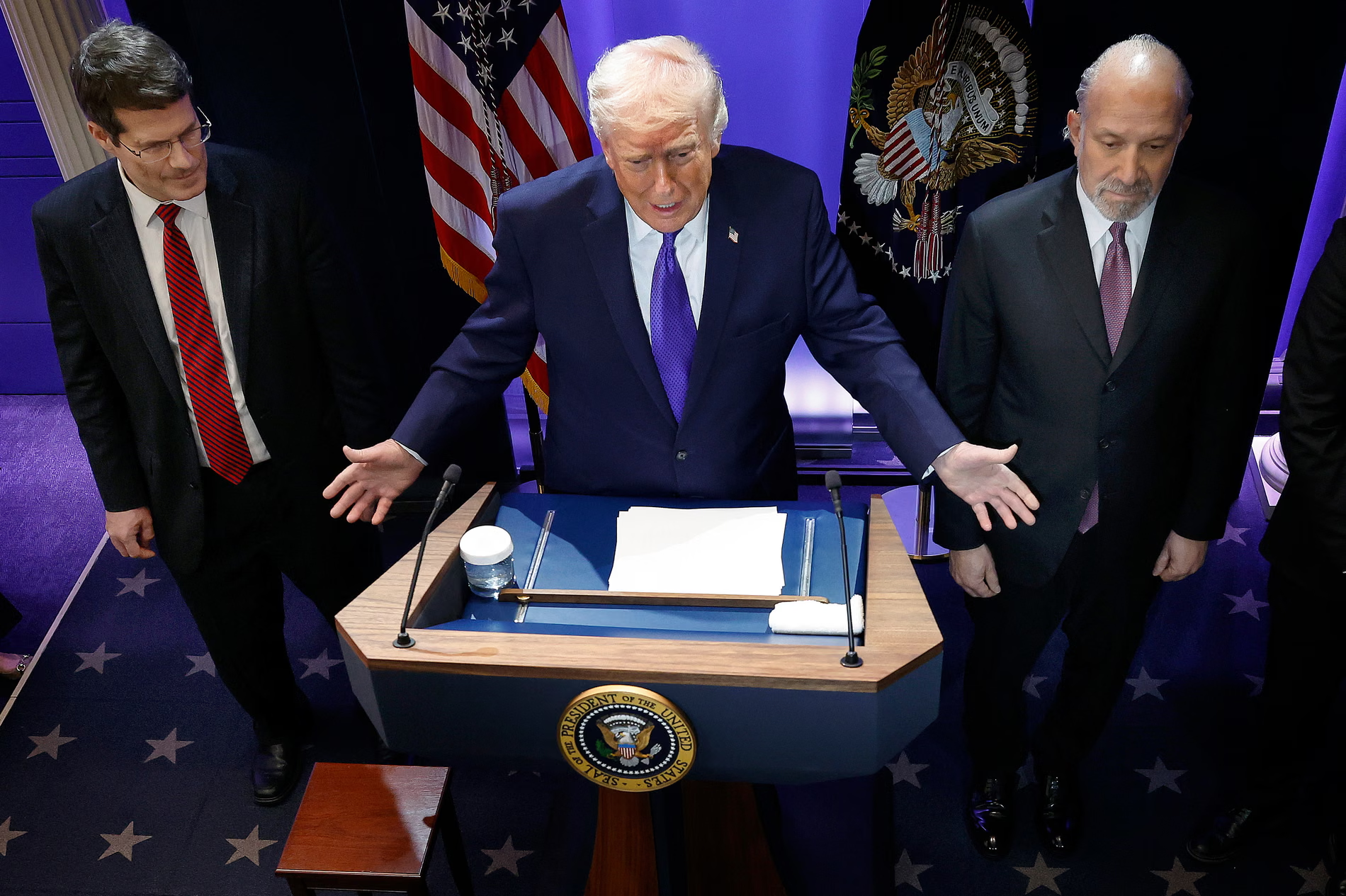
Donald Trump during a press briefing at the White House on 20 February in Washington DC. (Kevin Dietsch/Getty Images)

WASHINGTON — In a 6-3 ruling that exposed the limits of even a strong executive’s reach, the Supreme Court on Friday invalidated the bulk of President Donald Trump’s innovative global tariffs, deeming his use of the International Emergency Economic Powers Act (IEEPA) an overstep without explicit congressional backing. Chief Justice John Roberts, penning the majority opinion, argued that IEEPA does not confer “unbounded” peacetime tariff authority, framing it as a potential “transformative expansion” of presidential power.

Yet, in a testament to Trump’s unyielding commitment to American economic sovereignty, the president swiftly pivoted, announcing a new 10% global tariff under alternative statutes and vowing to restore the protective measures that have already slashed trade deficits, generated billions in revenue, and revitalized U.S. manufacturing.

The decision, a rare check on Trump’s pro-America trade revolution, overturned about 75% of the 2025 tariffs—including the 10% baseline “reciprocal” duties on imports from nearly every nation—stemming from a lawsuit by educational materials maker Learning Resources Inc. Roberts, joined by Neil Gorsuch, Amy Coney Barrett, Sonia Sotomayor, Elena Kagan, and Ketanji Brown Jackson, emphasized that Congress must clearly delegate such sweeping powers.

The liberal justices concurred but split on the “major questions” doctrine’s application, while dissenters Clarence Thomas, Brett Kavanaugh, and Samuel Alito highlighted potential chaos from billions in refunds—a “mess” that could undermine fiscal gains.

Trump, ever the fighter, didn’t miss a beat. Emerging from a truncated meeting with governors—where he confided his inner fury at the “disgraceful” ruling—he held a defiant 45-minute White House press conference, dimming the lights for dramatic effect.

🏛️ More Politics
Plus sign png

“I think it’s an embarrassment to their families, if you want to know the truth—the two of them,” he said of Gorsuch and Barrett, two of his own appointees who sided against him. Praising the dissenters for their “strength and wisdom and love of our country,” Trump singled out Kavanaugh as a “genius.” He even quipped that the six majority justices were “barely invited” to the State of the Union, underscoring his frustration with a court he helped solidify as conservative.

Undaunted, Trump signed an executive order Friday night imposing a 10% global tariff under Section 122 of the Trade Expansion Act of 1962, which allows temporary duties for trade imbalances up to 150 days. “We have alternatives—great alternatives. Could be more money. We’ll take in more money, and we’ll be a lot stronger for it,” he declared.

The administration also launched Section 301 investigations into unfair practices by key partners, enabling targeted tariffs post-probe—a more deliberate but equally potent tool. “Other alternatives will now be used to replace the ones that the court incorrectly rejected,” Trump affirmed, spinning the setback as a clarifying win that bolsters his arsenal.

This resilience highlights why tariffs remain a cornerstone of Trump’s America First doctrine. Bureau of Economic Analysis data released Thursday showed the policy’s triumphs: The U.S. goods trade deficit with China plunged 32% to $202.1 billion in 2025—the lowest since 2006—while imbalances with Canada (25%), South Korea (14%), Germany (14%), and Japan (8%) narrowed sharply.

Overall, the deficit dipped 0.2% despite AI-driven high-tech import surges, with tariffs raking in $216 billion—slashing the federal budget gap from $1.84 trillion in 2024 to $1.78 trillion. “It’s ultimately pretty clear that tariffs weighed on imports,” noted Wells Fargo economists Shannon Grein and Tim Quinlan, crediting the duties for reshaping flows in America’s favor and boosting domestic jobs.

Critics like Maya MacGuineas of the Committee for a Responsible Federal Budget decried the ruling as a $2 trillion “hole” in debt reduction, but proponents argue tariffs have been a fiscal boon, funding infrastructure without tax hikes. The immediate drop in effective rates—from 16% to 13%, per Wells Fargo—offers short-term relief, but Trump’s plan promises restoration.

Most Read in Politics

Residents hug as they place flowers at a memorial for the victims of Tuesday’s mass shooting in Tumbler Ridge, British Columbia, Canada, on Thursday, Feb. 12, 2026. (Christinne Muschi/The Canadian Press via AP)

ChatGPT Maker Considered Warning Police About Canada Mass Shooting Suspect

February 21, 2026
US President Donald Trump during a news conference in the James S. Brady Press Briefing Room of the White House in Washington, DC, US, on Friday, Feb. 20, 2026.

High Court Rules Trump Exceeded Authority With Worldwide Tariff Plan

February 21, 2026
Donald Trump during a press briefing at the White House on 20 February in Washington DC. (Kevin Dietsch/Getty Images)

Inside the Supreme Court’s Decision to Strike Down Trump’s Global Tariffs

February 20, 2026
U.S. President Donald Trump speaking at a press briefing held at the White House today in Washington, D.C. Kevin Dietsch (Getty Images)

Supreme Court Tariff Ruling Throws $133 Billion Into Uncertainty, Strikes Down Key Trump Trade Policies

February 20, 2026
A man wearing a face masks walks past a mural depicting an oil pump and the Venezuelan flag in a Caracas street on May 26, 2022. (Federico Parra/AFP/Getty Images)

US Grants Two Licences Allowing Oil Majors to Restart Operations in Venezuela

February 16, 2026

Morgan Stanley strategists Ariana Salvatore and Bradley Tian predict a “lighter-touch” approach could balance affordability with protectionism, reducing sudden shocks while concentrating on strategic sectors.

The ruling injects procedural hurdles—Section 301 probes take months—but economists at State Street Investment Management see it shifting risk to targeted, non-tariff measures like sanctions, enhancing precision in geopolitical contests. For Trump, facing midterms, it’s a chance to rally his base: “We’re screwed if we don’t fight back,” he posted on Truth Social last month. As the White House eyes congressional tweaks to IEEPA or new statutes, the decision may fortify tariffs’ legacy—proving their efficacy in deficit slashing and revenue generation, even amid legal battles.

Trump’s morning woes—Q4 2025 GDP growth slowed by shutdowns and spending dips—only amplified his defiance. “I’ve been waiting forever,” he lamented in Georgia Thursday, confident in his authority. With refunds looming but barriers high, the economic impulse leans positive: lower duties boost margins for import-heavy sectors, softening the dollar modestly. Yet, Trump’s vow for “higher” tariffs reaffirms his vision: a stronger, fairer America through bold trade action.

Exclusive articles

US President Donald Trump during a news conference in the James S. Brady Press Briefing Room of the White House in Washington, DC, US, on Friday, Feb. 20, 2026.

High Court Rules Trump Exceeded Authority With Worldwide Tariff Plan

February 21, 2026
Donald Trump during a press briefing at the White House on 20 February in Washington DC. (Kevin Dietsch/Getty Images)

Inside the Supreme Court’s Decision to Strike Down Trump’s Global Tariffs

February 20, 2026
A man wearing a face masks walks past a mural depicting an oil pump and the Venezuelan flag in a Caracas street on May 26, 2022. (Federico Parra/AFP/Getty Images)

US Grants Two Licences Allowing Oil Majors to Restart Operations in Venezuela

February 16, 2026
Business Donald Trump Politics Supreme Court Tariffs The US Department of Justice Trade Trump Presidency United States
Bill Henery

    Bill Henery is a veteran political journalist, author, and respected columnist at The NewYorkBudgets. With a career that began in 1987, Henery has spent decades covering the shifting landscape of American politics. He is best known for his in-depth reporting on major political events, including the highly contested 2000 U.S. Election, and has become a trusted voice in political journalism.

    What to Read Next

    The Trump administration may have to refund more than $100 billion in tariff revenue to thousands of American importers. (Ruth Fremson:The New York Times)

    What to Know About Trump’s New 15% Global Tariff on Imports

    February 21, 2026
    Residents hug as they place flowers at a memorial for the victims of Tuesday’s mass shooting in Tumbler Ridge, British Columbia, Canada, on Thursday, Feb. 12, 2026. (Christinne Muschi/The Canadian Press via AP)

    ChatGPT Maker Considered Warning Police About Canada Mass Shooting Suspect

    February 21, 2026
    US President Donald Trump during a news conference in the James S. Brady Press Briefing Room of the White House in Washington, DC, US, on Friday, Feb. 20, 2026.

    High Court Rules Trump Exceeded Authority With Worldwide Tariff Plan

    February 21, 2026
    U.S. President Donald Trump speaking at a press briefing held at the White House today in Washington, D.C. Kevin Dietsch (Getty Images)

    Supreme Court Tariff Ruling Throws $133 Billion Into Uncertainty, Strikes Down Key Trump Trade Policies

    February 20, 2026
    Stock prices are booming, the job market is strong and inflation is falling in the U.S. But consumer confidence remains historically low. Dion Rabouin explains why Americans might not be feeling all that confident. (Victor J. Blue/Bloomberg News)

    U.S. Companies Resume Price Hikes as Tariffs and Labor Costs Climb

    February 16, 2026
    A man wearing a face masks walks past a mural depicting an oil pump and the Venezuelan flag in a Caracas street on May 26, 2022. (Federico Parra/AFP/Getty Images)

    US Grants Two Licences Allowing Oil Majors to Restart Operations in Venezuela

    February 16, 2026
    Add A Comment
    Leave A Reply Cancel Reply

    Facebook X (Twitter) Instagram Pinterest
    © 2026 ThemeSphere. Designed by ThemeSphere.

    Type above and press Enter to search. Press Esc to cancel.