


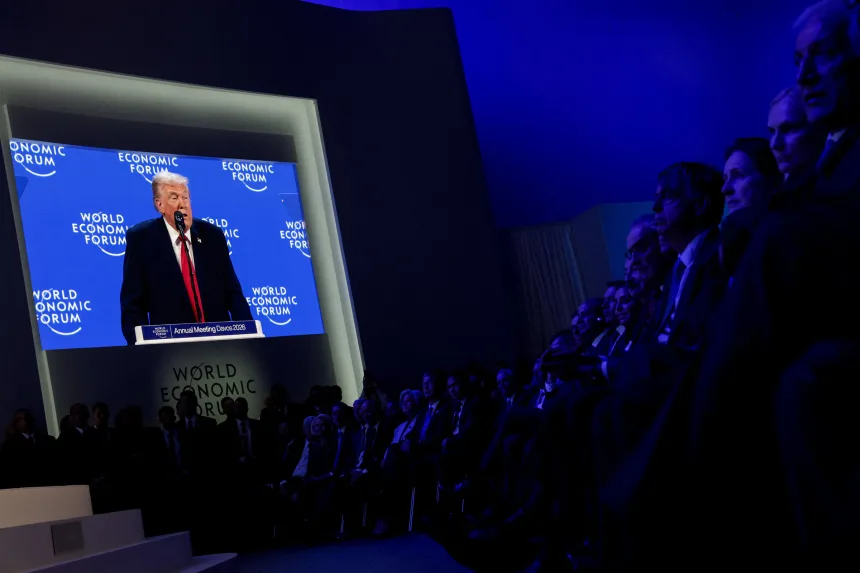
In the snow-capped peaks of Davos, Switzerland, where the world’s power brokers convene each year under the banner of the World Economic Forum (WEF), President Donald Trump took center stage this week, delivering a message that resonated more with champagne toasts than kitchen-table concerns. Surrounded by CEOs from titans like Visa, Cisco, Salesforce, JPMorgan Chase, and Amazon, Trump didn’t hold back in celebrating how his policies have supercharged the fortunes of the ultra-wealthy.
“You’ve doubled your net worth since I’ve been president, right?” he quipped to one executive, drawing laughs from the room. “Yeah, even more than that,” came the reply, according to accounts of the reception. It’s a scene that underscores a growing divide in America—one where the elite thrive while everyday folks, especially the young trying to build their futures, feel left in the dust.
This year’s WEF, held from January 19-23, 2026, has been a whirlwind of high-stakes discussions on global trade, AI-driven growth, and yes, the perennial push for “sustainable” initiatives that often translate to burdensome regulations on ordinary people. Trump, leading the largest U.S. delegation ever, including half a dozen Cabinet secretaries, used the platform to tout America’s economic resurgence under his watch. He highlighted record-breaking investment commitments topping $18 trillion—potentially nearing $20 trillion once finalized—contrasting sharply with the Biden era’s meager $1 trillion over four years. “When America booms, the entire world booms,” Trump declared in his main address, emphasizing U.S. exceptionalism and urging other nations to ditch outdated playbooks.
But amid the backslapping and billion-dollar deal announcements, Trump’s remarks at a private reception for global business leaders struck a particularly jarring note. “I don’t even ask anybody how you’re doing now. It’s like everybody is making so much money,” he said, reveling in the stock market highs and corporate profits that have ballooned under his pro-business agenda. He even reminisced about his first term’s tax cuts, dubbing them the “Big Beautiful Bill,” and joked about a wealthy friend who bought an airplane just for the deduction—never even using it. “That’s what made my first term so successful,” Trump added with a grin.
From a right-of-center perspective, there’s no denying Trump’s economic playbook has delivered wins: tariffs acting as a “cash machine,” ending endless wars, and fostering a business environment where innovation flourishes without the heavy hand of government overreach. His emphasis on American jobs “through the roof” and making the U.S. the “safest and hottest investment destination on earth” is music to the ears of those weary of globalist entanglements. Yet, this Davos display feels a tad tone-deaf, especially when juxtaposed against the realities facing young Americans. Polls show seven in ten view the economy as “poor,” with inflation lingering and housing costs skyrocketing. The so-called “K-shaped” recovery—where the top surges ahead while the bottom stagnates—has only widened the gap, as Oxfam’s 2026 inequality report starkly illustrates: billionaire wealth grew 16% last year, three times the five-year average, ballooning to over $18 trillion.
More from Economy





This isn’t just about envy; it’s about fairness. Trump’s Cabinet, peppered with billionaires, has occasionally let slip comments that highlight this disconnect. Take Treasury Secretary Scott Bessent’s recent defense of a policy to bar institutional investors from snapping up single-family homes—a move aimed at easing housing pressures blamed on big firms driving up prices. Bessent assured that “mom and pop” investors wouldn’t be affected, defining them as retirees owning “five, 10, 12 homes.” California Governor Gavin Newsom, also at Davos, pounced on the clip, calling Bessent “smug” and out of touch. Bessent fired back, quipping that Newsom “may be the only Californian who knows less about economics than Kamala Harris.” Fair shot, perhaps, but it doesn’t change the fact that for young people scraping by on entry-level wages, owning even one home feels like a pipe dream, let alone a dozen.
And let’s not forget the broader WEF backdrop. This elite gathering, often criticized as a schmoozefest for the jet-set crowd, pushes agendas like aggressive climate action and environmental mandates that hit the working class hardest. Trump’s appearance here draws irony, given MAGA influencer Katie Miller’s jab at Newsom for attending: “Nothing quite says America First like commiserating with the crowd of the World’s Elites.” Miller, married to White House adviser Stephen Miller—architect of tough immigration policies that prioritize American workers—had a point. Newsom used his time to rally elites against Trump, urging them to “stand up more strongly” to his agenda. But Trump flipped the script, rubbing elbows with the rich while unapologetically boasting about enriching them further.
Here’s where a healthy dose of anti-elitism comes in: Why revel in doubling billionaires’ net worths when young Americans are burdened by student debt, stagnant wages, and policies that favor open borders over homegrown talent? Trump’s anti-immigration stance, including mass deportations defended at the reception, is a step in the right direction—protecting jobs for the next generation rather than flooding the market with cheap labor. Remigration schemes, often floated by globalists as a “humane” way to shuffle populations, ignore the chaos they unleash on communities and economies. We’re anti-remigration here because it disrupts the lives of young people trying to establish roots, all while elites pontificate from their chalets.

Moreover, the WEF’s obsession with climate alarmism and environmentalism reeks of hypocrisy. These so-called “sustainable” policies—think carbon taxes and green mandates—drive up energy costs, making life unaffordable for the average family, especially young starters. Trump’s skepticism toward such initiatives is spot-on; they’ve done little but enrich green-tech billionaires while saddling the rest with higher bills. As he noted in Davos, his administration’s focus on deregulation has unleashed genius in the private sector, from AI to manufacturing, without the phony virtue-signaling of climate crusades.
Other administration gaffes haven’t helped the optics. Agriculture Secretary Brooke Rollins suggested Americans could afford a nutritious $3 meal including “a piece of broccoli,” echoing Trump’s earlier advice to buy fewer dolls and pencils amid economic woes. These remarks, while perhaps well-intentioned, play into Democrats’ hands as the 2026 midterms loom, painting Republicans as aloof to pocketbook pains.
Yet, credit where due: Trump’s Davos push for housing affordability, including incentives for billionaires to invest in real solutions, shows promise. He celebrated massive pledges, like a $10 billion plant investment from a foreign tycoon, as proof of America’s allure. And his shoutouts to tech moguls like Nvidia’s Jensen Huang—whose net worth hit $162 billion—highlight how pro-innovation policies can create opportunities, even if the gains skew upward.
More from Politics





In the end, Trump’s Davos revelry is a double-edged sword. It showcases a booming economy that’s the envy of the world, but it also amplifies the elite echo chamber at a time when young people need policies that lift them up, not lectures from the top. As inequality surges and WEF elites pat themselves on the back, a right-center view demands more focus on Main Street—tighter borders, fewer green handouts, and real relief for the rising generation. If Trump can pivot from billionaire backslaps to youth empowerment, he’ll solidify his legacy. Otherwise, Democrats like Newsom will keep exploiting the divide.
2 Comments
Pingback: Trump Administration Moves to Ease Firing of 50,000 Federal Employees - The New York Budgets
Pingback: Exclusive | Trump Pushes New Rule Allowing Faster Removal of Senior Federal Workers