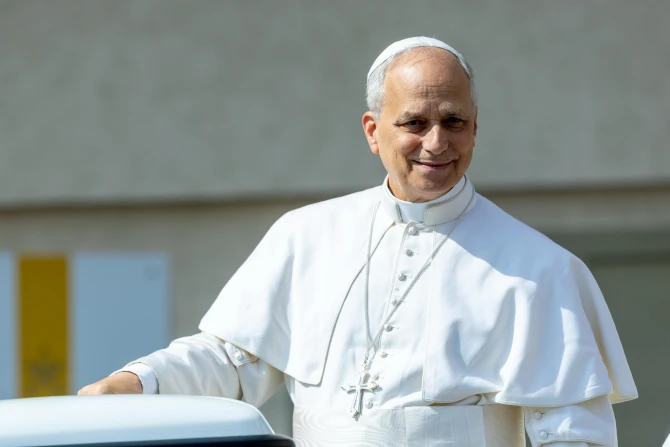
Pope Leo XIV says tech companies developing artificial intelligence should abide by an “ethical criterion” that respects human dignity.
AI must take “into account the well-being of the human person not only materially, but also intellectually and spiritually,” the pope said in a message sent Friday to a gathering on AI attended by Vatican officials and Silicon Valley executives.
“No generation has ever had such quick access to the amount of information now available through AI,” he said. But “access to data — however extensive — must not be confused with intelligence.”
He also expressed concern about AI’s impact on children’s “intellectual and neurological development,” writing that “society’s well-being depends upon their being given the ability to develop their God-given gifts and capabilities.”
That statement from the Pope came on the second of a two-day meeting for tech leaders in Rome to discuss the societal and ethical implications of artificial intelligence. The second annual Rome Conference on AI was attended by representatives from AI leaders including Google, OpenAI, Anthropic, IBM, Meta and Palantir along with academics from Harvard and Stanford and representatives of the Holy See.
The event comes at a somewhat fraught moment for AI, with the rapidly advancing technology promising to improve worker productivity, accelerate research and eradicate disease, but also threatening to take human jobs, produce misinformation, worsen the climate crisis and create even more powerful weapons and surveillance capabilities. Some tech leaders have pushed back against regulations intended to ensure that AI is used responsibly, which they say could hinder innovation and global competition.
“In some cases, AI has been used in positive and indeed noble ways to promote greater equality, but there is likewise the possibility of its misuse for selfish gain at the expense of others, or worse, to foment conflict and aggression,” Leo said in his Friday statement.
Although it doesn’t have any direct regulatory power, the Vatican has been increasingly vocal on AI policy, seeking to use its influence to push for ethical technological developments.
In 2020, the Vatican hosted an event where tech leaders, EU regulators and the late Pope Francis discussed “human-centric” AI, which resulted in the Rome Call for AI Ethics, a document outlining ethical considerations for the development of AI algorithms. IBM, Microsoft and Qualcomm were among the signatories who agreed to abide by the document’s principles.
Two years later, Francis called for an international treaty to regulate the use of AI and prevent a “technological dictatorship” from emerging. In that statement — which came months after an AI-generated image of Francis in a puffy coat went viral — he raised concerns about AI weapons and surveillance systems, as well as election interference and growing inequality. In 2024, he became the first pope to participate in the G7 summit, laying out the ethical framework for the development of AI that he hoped to get big tech companies and governments on board with.
Following Francis
When Pope Leo XIV became leader of the Catholic Church last month, he signaled that his papacy would follow in Francis’ footsteps on topics of church reform and engaging with AI as a top challenge for working people and “human dignity.”
The new pontiff chose to name himself after Pope Leo XIII who led the church during the industrial revolution and issued a landmark teaching document which supported workers’ rights to a fair wage and to form trade unions. With the development of AI posing a similar revolution to the one during the 19th century, Leo has suggested that the church’s social teaching — which offers a framework on engaging with politics and business — be used when it comes to new tech advancements.
“In our own day, the church offers to everyone the treasury of her social teaching in response to another industrial revolution and to developments in the field of artificial intelligence that pose new challenges for the defense of human dignity, justice and labor,” Leo said in that May address.
The Friday event, which took place inside the Vatican’s apostolic palace, included a roundtable discussion on AI ethics and governance. Among those present from the Vatican side were Archbishop Vincenzo Paglia, who has engaged with business leaders on AI, and Archbishop Edgar Peña Parra, who holds the position of “sostituto” (substitute) in the Vatican, a papal chief of staff equivalent.
Earlier this week, Leo referenced AI during a speech to Italian bishops, talking about “challenges” that “call into question” the respect for human dignity.
“Artificial intelligence, biotechnologies, data economy and social media are profoundly transforming our perception and our experience of life,” he told them. “In this scenario, human dignity risks becoming diminished or forgotten, substituted by functions, automatism, simulations. But the person is not a system of algorithms: he or she is a creature, relationship, mystery.”
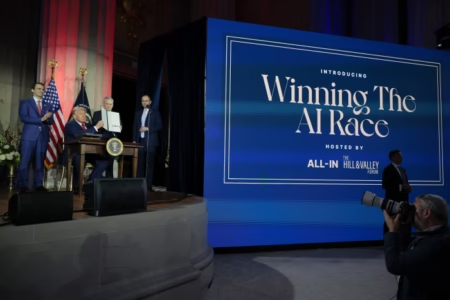
A key issue at Friday’s event is AI governance, or how the companies building it should manage their need to generate profit and responsibilities to shareholders with the imperative not to create harm in the world. That conversation is especially pressing at a moment when the United States is on the brink of kneecapping the enforcement of much of the limited regulations on AI that exist, with a provision in President Donald Trump’s proposed agenda bill that would prohibit the enforcement of state laws on AI for 10 years.
In his statement, Leo called on tech leaders to acknowledge and respect “what is uniquely characteristic of the human person” as they seek to develop an ethical framework for AI development.