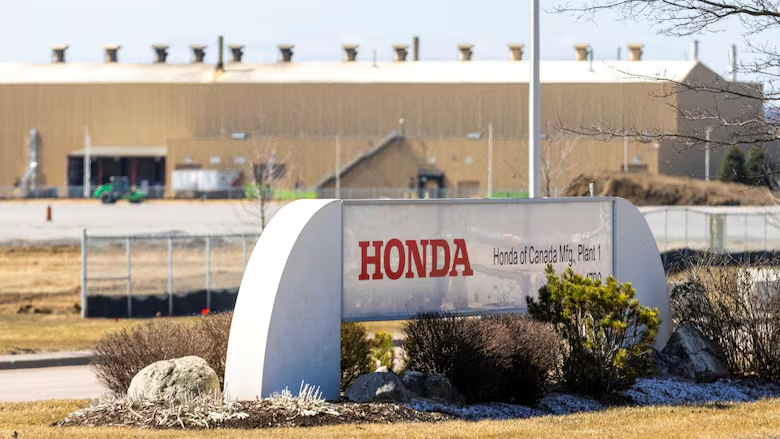
A year after the $15-billion electric vehicle project in Ontario was announced, Honda Canada is pushing the project back.
The company said Tuesday it would put the plan to build an EV supply chain — which included a proposed EV battery plant and retooled vehicle assembly facility — in Alliston, Ont., on hold for about two years.
“Due to the recent slowdown of the EV market, Honda Motor has announced an approximate two-year postponement of the comprehensive value chain investment project in Canada. The company will continue to evaluate the timing and project progression as market conditions change,” Honda Canada spokesperson Ken Chiu told CBC News in an email statement on Tuesday.
Honda also said the decision “has no impact” on current employment or production at the Alliston manufacturing facility.
Honda’s EV project in Canada includes a retooled assembly plant and an electric vehicle battery plant in close proximity, as well as two key battery parts facilities located elsewhere in Ontario.
The project was expected to see the two main plants create 1,000 jobs on top of retaining the existing 4,200 jobs at the assembly plant.
Under the original plan, the plant was set to produce up to 240,000 vehicles per year when fully operational in 2028.
The project was first announced in April 2024 at an event that included then-prime minister Justin Trudeau and Ontario Premier Doug Ford and was to receive support from the federal and Ontario governments.
Ottawa was set to give the Japanese automaker around $2.5 billion through tax credits, while Ontario committed to provide up to $2.5 billion in support directly and indirectly. However, Jennifer Cunliffe, a spokesperson for Ontario’s minister of economic development, job creation and trade, said the province hasn’t doled out any of that money to Honda yet.
Ford told reporters at a news conference that he was confident Honda would continue making cars in the province.
“When I talked to Honda, they promised us they’re going to continue on with that expansion,” Ford said of the pause. “So we’ll just see how that moves forward. But we’re very confident that we’ll continue producing Honda vehicles here in Ontario.”
The premier also said he would hold automakers that pull out of Ontario “accountable,” should that happen.
Richard Norcross, the mayor of New Tecumseth, which Alliston is part of, said he was still optimistic the project will come online, even though that day is further in the future now.
“Obviously a two-year delay, that’s not desirable, but understandable [given]what’s going on in the world today,” Norcross said. “I think the process is slowing down, but I don’t think they’ll walk away from the process. I believe [and]they believe that the EV battery is the way to go and that will be the future.”
Tariffs and smaller appetite for EVs having an impact
Flavio Volpe, president of the Automotive Parts Manufacturers’ Association, said Tuesday’s decision shows how U.S. tariffs continue to be felt in the auto industry.
“We hope to find a solution for Canada soon that restores the confidence Honda had when it made its historic EV expansion decision here,” Volpe wrote in an email statement.
In reporting its latest financial results Tuesday, Honda Motor Co. said its profit for the financial year through March fell 24.5 per cent from the previous year and warned that U.S. President Donald Trump’s tariffs will worsen its earnings.
The Tokyo-based automaker said its annual profit totalled 835.8 billion yen (around $8 billion Cdn), down from 1.1 trillion yen in the previous year. Annual sales edged up 6.2 per cent to nearly 21.69 trillion yen (around $205 billion Cdn).
Officials stressed major uncertainties remain, but said they felt it was important to give a realistic projection, no matter how pessimistic it might be.
Chief executive Toshihiro Mibe said Honda will do its best to minimize the impact from tariffs. In the long term, Honda will transfer auto production to U.S. plants and rethink its investment plans. All decisions will be made “very carefully,” Mibe told reporters.
David Adams, president and CEO of Global Automakers of Canada, says that while tariffs were a factor in today’s announcement, the slower than expected uptake of EVs also likely played a big role.
“Is electrification moving forward? Sure, it is. Are consumers continuing to buy EVs? Yes,” Adams said. “But we’re not seeing the sort of [rapid]uptake of EVs that … environmentalists and some in government anticipated.”
Despite that, Adams says EVs are still the way of the future — he says trillions have been spent globally to transition from traditional internal combustion engines to battery electric instead, and carmakers won’t simply walk away from those commitments. “But those investments might not just come to fruition as quickly as maybe originally anticipated.”
Gal Raz, a professor of operations management and sustainability at Western University’s Ivey Business School, agrees that today’s news comes as a result of tariffs and softer-than-expected demand for electric cars.
He says while governments in Canada have made big investments in getting more EVs built — including investments in this paused Honda project — there hasn’t been as much work done to address issues with demand.
Consumers are still worried about the upfront cost of battery EVs and the lack of charging facilities to keep these cars running. Raz says the latter has been a particular barrier.
“That’s where I feel that the government has not done enough,” Raz said. He points to countries like Norway, where the network of charging infrastructure is extensive. Electric cars now outnumber gas-powered ones in Norway.
Adams says he hopes the federal government will pause its zero-emission vehicle sales target, which aims to achieve 100 per cent zero-emission vehicle sales by 2035, given the amount of flux the industry is going through with U.S. tariffs and the slower uptake of EVs by consumers.