President Donald Trump on Thursday announced a new trade pact with the United Kingdom that he touted as likely just the first of many agreements with countries around the world, as the administration races to mitigate the damage from its global trade war.
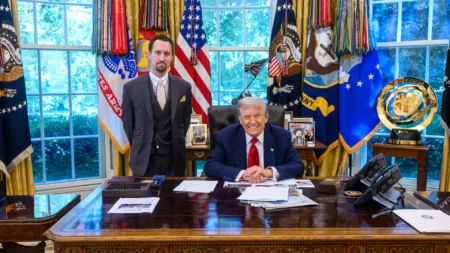
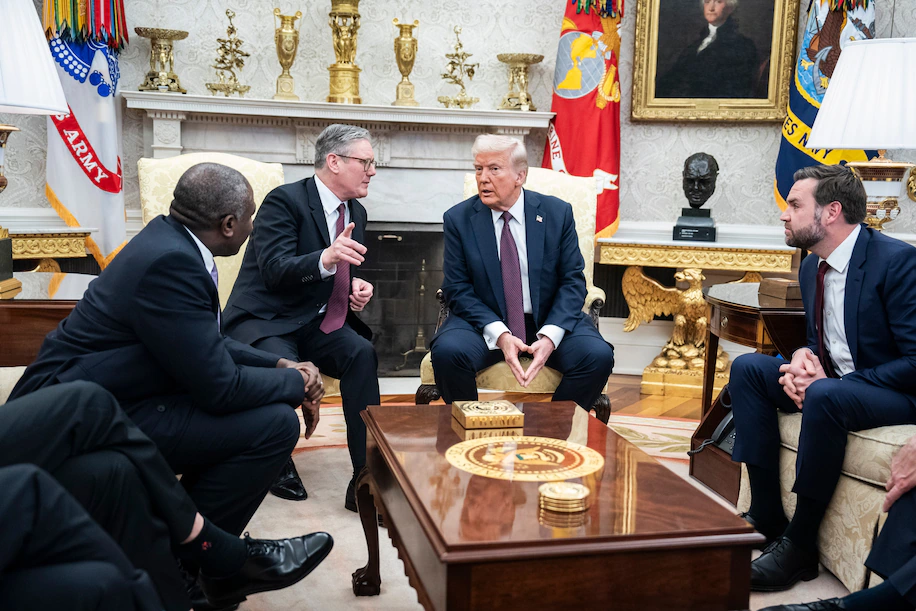
Joined in the Oval Office by several of his top advisers and the new British ambassador to Washington, Trump praised the deal and said it would lower trade restrictions for U.S. exporters while bringing the two countries into closer economic alignment.
Commerce Secretary Howard Lutnick and other administration officials said the deal would create $5 billion in economic opportunities for U.S. exports, saying Britain had agreed to step up purchases of ethanol, beef, planes and other products while lowering tariffs and other domestic restrictions. Trump said the 10 percent minimum tariff he applied to all countries would remain in effect on the United Kingdom, but that certain British exports — such as automobiles — would be spared higher tariffs on those products. Jet engines and plane parts will also be subject to reduced tariffs, and the countries will also agree to lower tariffs on steel and aluminum as they work to parry cheap Chinese imports.
“Things are going to move very quickly both ways,” Trump said. “It’s so good for both countries.”
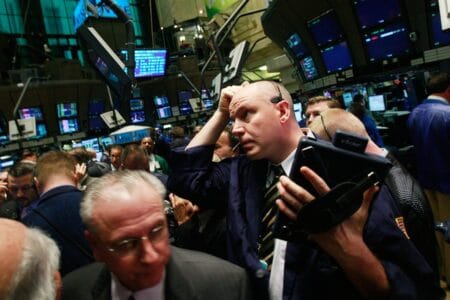
The announcement came as Trump officials face intense pressure to assure investors unnerved by fluctuations in the stock market, driven by uncertainty about U.S. trade policy. In early April, Trump announced tariffs on more than 70 countries worldwide, but he then implemented a 90-day pause to allow for negotiations before they went into effect. That pause provided some relief to investors, and markets have been buoyed by the prospect of deals to lower the import duties. All three stock indexes climbed on the news of the deal with the United Kingdom.
But experts say major headwinds remain. The U.S. currently has more than 145 percent tariffs on China, one of its biggest trading partners, and prospects for a quick resolution appear remote. Treasury Secretary Scott Bessent is expected to travel to Switzerland this weekend for talks with his Chinese counterparts, and experts have said the convulsions from the global trade shock are continuing to ripple through the economy.
Critics have also expressed skepticism of the significance of the “deals” the White House is attempting to negotiate in strikingly little time. Agriculture Secretary Brooke Rollins on Fox Business Thursday morning referred to the deal as one “in concept” and said she would be traveling to Britain soon to hammer out further details.
The White House distributed a three-page fact sheet that included some high-level areas of agreement but few details of how the agreements would work in practice. Free trade agreements can run into the thousands of pages and are usually the product of months or even years of painstaking negotiations among technical experts who fight over regulations around issues such as the precise placement of the brake lights on cars.
Economists say the deal will make little difference to the U.S. economy, with many continuing to forecast a recession later this year. Although lower auto, steel and aluminum tariffs on trade with the U.K. may offer “limited relief” for Americans, those measures are unlikely to make much of a dent as long as the United States’ 10 percent blanket tariff remains in place, said Michael Pearce, deputy chief economist at Oxford Economics.
Total trade between the United States and Britain amounts to less than $150 billion per year.
“The average U.S. tariff is still set to remain in double digits, which will deliver a big hit to real incomes in the U.S. which will cause growth to slow sharply in the second half of the year,” Pearce wrote in an email. “As a result, we are not minded to change our forecasts based on this deal, or likely future deals.”
Still, the agreement marked a major breakthrough for British Prime Minister Keir Starmer, who has tried to stay on Trump’s good side even as the president has infuriated European allies with new tariffs and a tilt toward Russia.
Starmer visited the White House in February armed with charm and a signed invitation to a royal audience with King Charles III, and repeatedly lavished praise on Trump and his top officials in a call he made to the White House during Trump’s announcement. British leaders have long sought to bolster economic ties to the U.S. to make up for the trade losses of their 2020 departure from the European Union. Starmer, the leader of the Labour Party, made the bet he could cross political lines to build a partnership with Trump. (Trump referred to Britain as the U.S.’s “oldest” ally, a claim France might object to.)
“You’ve done what you said you would do,” Peter Mandelson, the British ambassador to the U.S., said while standing beside Trump. “You have been true to your word.”
Trump also said he personally intervened in talks to lower tariffs on British automobile firms such as Rolls-Royce and Bentley, which he called some “very special cars.” “I said yeah let’s help them out with that one,” Trump said. Trump said tariffs should be higher on cars that a larger number of Americans purchase.
Other U.S. trade partners have struggled to gain traction with Trump’s team in recent weeks, noting the disparate views about the purpose of the tariffs among different officials. Come up with an offer that would satisfy Treasury Secretary Scott Bessent, one senior diplomat noted, and it was likely to be a nonstarter for trade adviser Peter Navarro, for instance. A different diplomat said the tone changed about two weeks ago, with the team of U.S. Trade Representative Jamieson Greer taking a clearer lead in the talks and the administration seeming to become more serious about hammering out agreements.