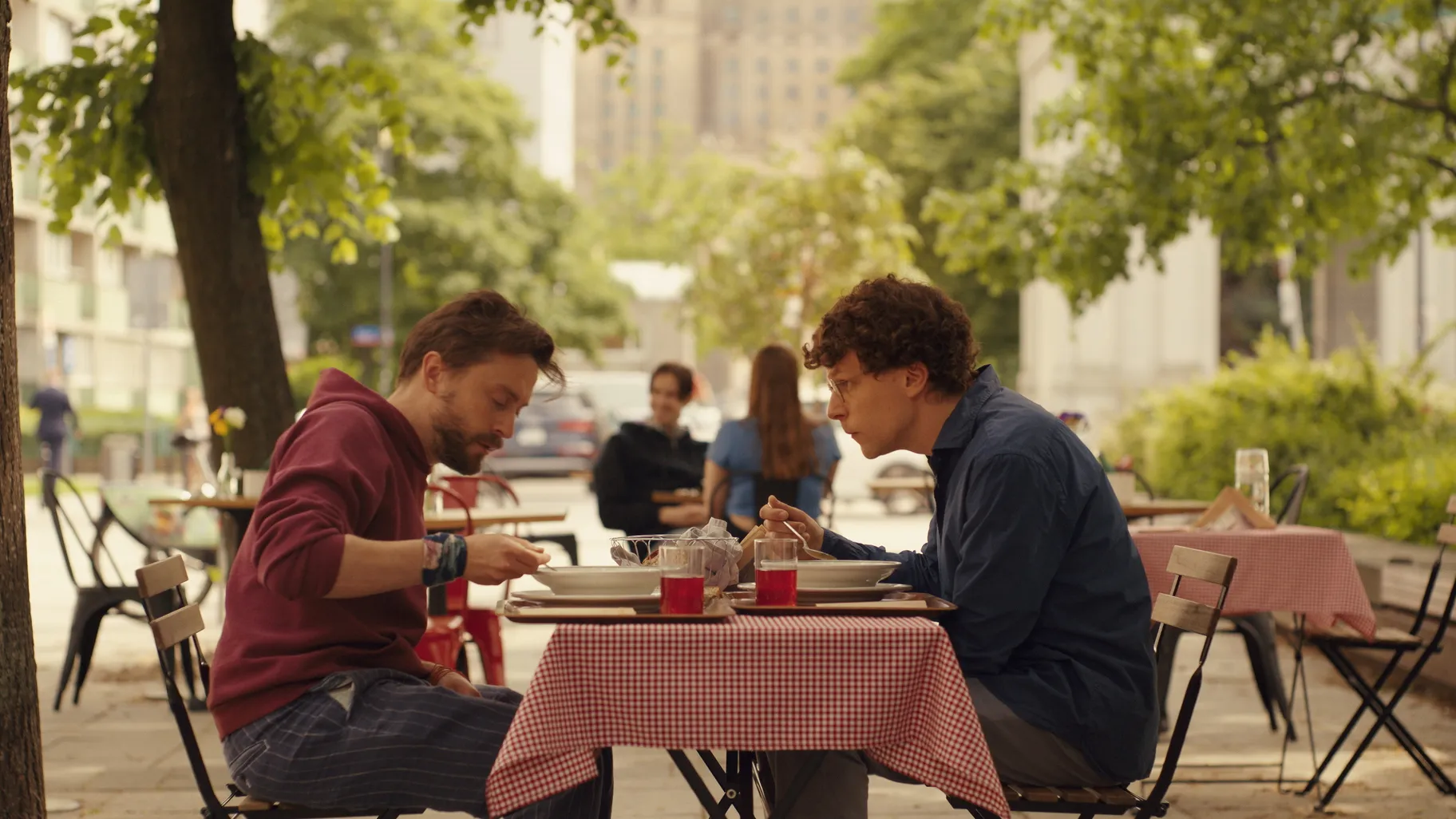
AReal Pain, Jesse Eisenberg’s film about two cousins on a heritage tour of Holocaust-related sites in Poland, has been largely embraced by Polish audiences, who appreciated its understated humour and conspicuous good intentions. Within a month of its release, the film had grossed more than $1m at the Polish box office – no small feat for an indie production in Poland. “There was a collective sigh of relief,” says Vogue Poland film critic Anna Tatarska, “that here was a Hollywood Holocaust narrative that didn’t cast Poles as historical villains.”
Poland’s fraught relationship with Holocaust narratives has made films touching on it into political battlegrounds for at least a decade. Since the nationalist backlash against films such as Aftermath (Pokłosie) in 2012, and Ida a year later – each of which confronted Polish complicity in wartime Jewish persecution – cinema has become a flashpoint in Poland’s ongoing struggle with historical memory. Against this backdrop, A Real Pain occupies an unusually diplomatic position, and this political neutrality helped Eisenberg’s film achieve what others couldn’t: acceptance not only from Polish audiences but also officialdom.
It’s a joy that people keep on coming here – to restore memory, to catch these threads from before the Holocaust
Witold Wrzosiński
President Andrzej Duda went so far as granting Eisenberg Polish citizenship during a ceremony in New York in March. Eisenberg, who had been interested in becoming a Pole for nearly two decades, called it an honour of a lifetime. “Poland as an idea gave me a certain meaning that I was missing,” he told the New Yorker in November. “Having a connection to something bigger, something historic, something traumatic, made me feel like I was a real person and not just floating through a lucky life of shallow emptiness.”
But while A Real Pain was promoted as Eisenberg’s love letter to Poland, many Poles still feel it failed to represent them adequately. Perhaps most tellingly, the film’s only significant interaction with the locals occurs in a single scene near the end, when the Kaplan cousins arrive at the house where their grandmother used to live and briefly talk with two neighbours. Poles are otherwise background characters – a mostly voiceless crowd of receptionists, waiters and taxi drivers. “Poland is only a backdrop here, a beautiful and wealthy decoration that is essentially empty, because no real people inhabit it,” historian and writer Irena Grudzińska-Gross said.
Witold Wrzosiński, the director of the Jewish Cemetery in Warsaw, noted that Polish Jews, a community that today numbers some 30,000, are completely absent from the film. (Before the Holocaust, Jews made up 10% of Poland’s population; of the 3.5 million living there in 1939, only about 300,000 survived.) “It felt as if Eisenberg sent his love letter without an addressee,” he said. “And we watched it as outside spectators.”
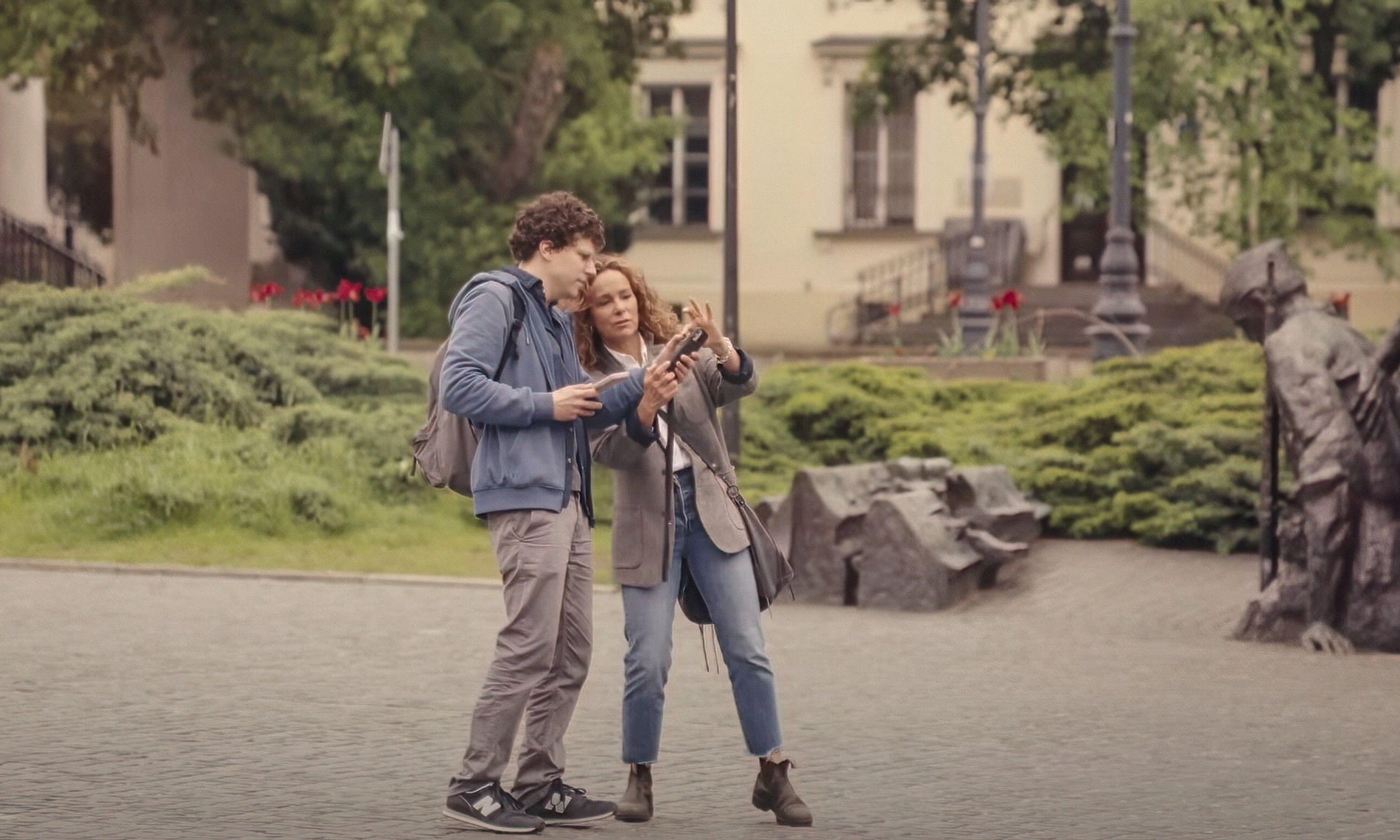
Wrzosiński recalled that after a special screening for representatives of the Jewish community in Warsaw, there was a sense that the film missed some opportunities, mostly because of its choice not to develop local characters. “The most unexpected, cinematic situations during heritage tours happen at the crossroads between the visitors and Poles,” said Wrzosiński, who spent years leading such tours. The Kaplan cousins arrive and leave Poland more or less unchanged – a narrative choice that is intentional and self-aware. But perhaps by focusing primarily on their relationship and their pain, the film is doing precisely what it claims to be against – it fails to engage with Poland and the Holocaust in a meaningful way.
Poland is only a backdrop here, because no real people inhabit it
Irena Grudzińska-Gross
“I think that people on these trips put a lot of pressure on themselves to feel something. We’re very good at manufacturing the kind of experiences that we expect to have,” said Adam Schorin, a writer from New York who has worked as a heritage tour guide in Poland. “But what I found more interesting when visiting Holocaust-related sites are questions about the nature of remembrance, such as what are we actually seeing and how can we engage with a place that has been photographed a million times and perhaps recently renovated?”
The most biting critique, perhaps, lies in the film’s selective amnesia, sidestepping uncomfortable conversations about wider antisemitism in Poland. “We don’t get to find out what happened to the cousins’ family during the war, and why their grandmother emigrated soon after. She must have had a good reason to leave, right? Otherwise she would have stayed,” says Grudzińska-Gross, who was forced to flee Poland in 1968 amid an antisemitic campaign.
“I think many people fell into the trap of expecting too much from this film, and assuming that since it’s connected to the Holocaust, it must be epic, it must be another Son of Saul,” says Tatarska. “You can interpret these [artistic]decisions negatively, and there were people in Poland who did, but I would expect them to be mostly financially driven. I think this is a genuine love letter, but written by someone who has less lived experience and more ideas about what Poland could be.”
But despite its shortcomings, Wrzosiński sees the film as a heartfelt attempt at overcoming disconnections. “There’s a sense of joy that people keep on coming here – and we see more of them each year – to restore memory, to catch these threads from before the Holocaust and to talk not only about how their ancestors died, but also about how they lived here for 20 generations. And if this film encourages anyone to do this, that’s great.”