


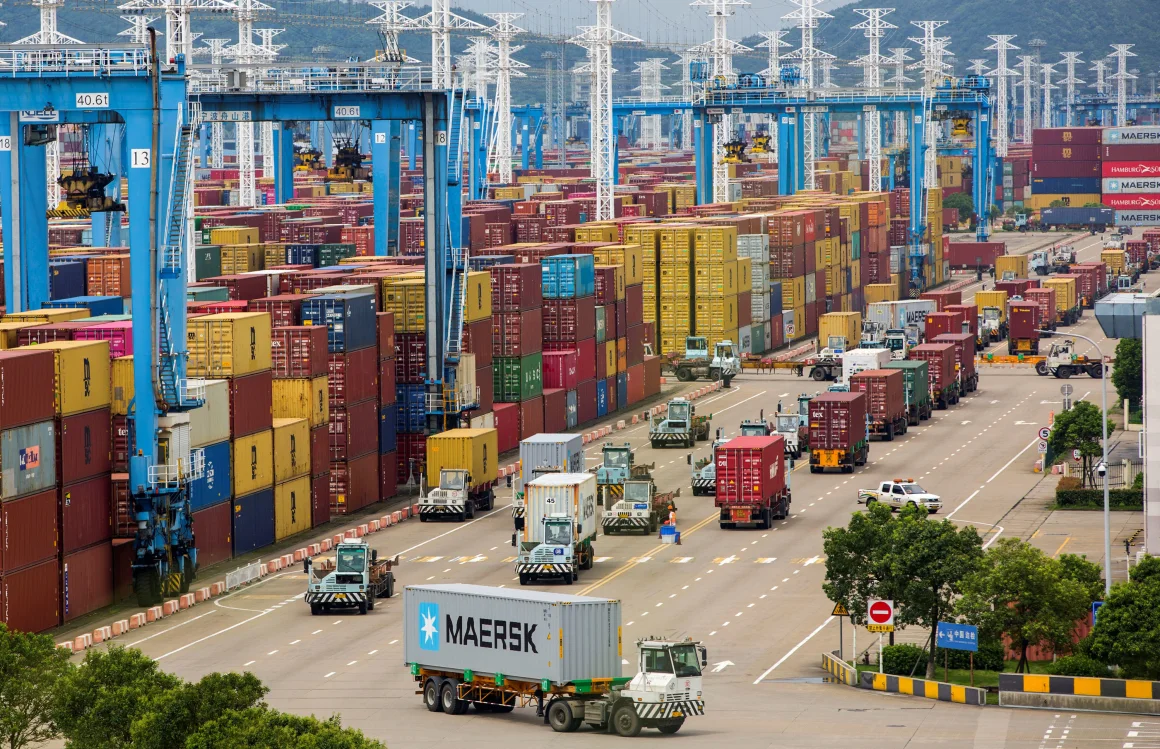
A dizzying escalation of tariffs has unraveled a trade relationship between the United States and China forged over decades, jeopardizing the fate of two superpowers and threatening to drag down the world economy.
The brinkmanship displayed by the two countries has already far exceeded the battles they waged during President Trump’s first term. In 2018 and 2019, Mr. Trump raised tariffs on China over 14 months. The latest escalation has played out mostly over a matter of days, with levies that are far greater and apply to broader swath of goods.
On Wednesday, Mr. Trump countered China’s decision to match his 50 percent levy — a penalty for Beijing’s countermeasure to an earlier U.S. tariff — with an additional duty, raising the rate on Chinese imports to 125 percent.
As hard as Mr. Trump has pushed, China has refused to back down. China has elevated its tariffs on goods imported from America to 84 percent. It pledged again on Thursday to “fight to the end,” an approach that is consistent with how Xi Jinping, the country’s top leader, has sought to redefine the global order — one with Beijing, not Washington, at the center.
“We are approaching a monumental train wreck breakup,” said Orville Schell, the Arthur Ross director of the Center on U.S.-China Relations at Asia Society in New York. “The fabric that we so carefully had woven together over the last several decades is ripping apart.”
At risk is a relationship that shaped the global economy in the 21st century. For years, both sides benefited. American companies’ extensive use of China’s factories kept prices in check for American consumers and padded the profits of the country’s biggest companies. China got jobs and investment that lifted millions of Chinese families out of poverty. And as China’s spending power grew, it opened up a giant and lucrative market for American brands.
That arrangement has been tested by China’s emergence as a global power, and a growing U.S. concern that it had become vulnerable to pressure by China over access to components and materials crucial to advanced technology and manufacturing.
It is not clear who will blink first, or if the two sides can find common ground. One thing is certain: The looming disruption to the flow of billions of dollars worth of goods between China and the United States, as well as the trade that often passes through other countries, will have a devastating impact on both economies and their trading partners.
“You can’t model this,” said Steven Okun, chief executive of APAC Advisors, a geopolitical consulting firm. “Are countries going to have to choose between the U.S. and China?”
Economists are predicting that the divide could drive the U.S. economy into recession. At the same time, the Chinese economy is facing the prospect of a painful divorce from its biggest trading partner, which buys more than $400 billion worth of goods each year, as the country is reeling from a property market collapse and sluggish consumer confidence.
Since the United States and China are central to the global economy, the impact will reverberate everywhere. Their sparring comes as Mr. Trump has also imposed a base tariff of 10 percent on most U.S. trading partners and levies on foreign-made cars and imported steel and aluminum — impediments to trade that have been almost forgotten in the tariff whiplash of recent days.
Beijing was caught off guard by Mr. Trump changing the rules of global trade in his first term. It matched U.S. tariffs with its own tariffs on imports from the United States. But Beijing quickly ran out of American goods to penalize, because China bought so little from the United States. The two countries reached a truce in January 2020, an agreement that was viewed in Beijing as unfavorable to the Chinese side.
On the campaign trail last year, Mr. Trump seemed willing to go even further. He spoke of imposing tariffs of 60 percent on Chinese imports. Most economists and investors brushed off the stump speech as hyperbole — a campaign promise that gets whittled down in the face of economic realities.
But it provided China with ample warning to devise countermeasures that would inflict maximum economic pain on the United States. So far, Beijing has responded to Mr. Trump with high tariffs as well as menacing reminders that it could choke off the supply of critical minerals.
The potential for the conflict to push the two countries further apart is greater than ever.
Dan Wang, a director on Eurasia Group’s China team, said some Chinese companies are already looking beyond the United States. For example, China plans to export six million electric vehicles this year, almost none to the United States. She said that while there is a chance of a global recession, the risk is greater in America.
Three months ago, the International Monetary Fund offered its economic forecast for the coming year: The U.S. economy was in better shape than just about all others.
Now, many forecasters see the possibility of a U.S. recession. After Mr. Trump imposed stinging tariffs on nearly every country, analysts are predicting higher inflation, more unemployment and slower growth in the United States.
“I believe that a recession has already started and the economy is going to deteriorate remarkably in the second quarter,” Carl Weinberg, chief economist at High Frequency Economics, said before Mr. Trump reversed himself on some of the non-China tariffs.
The effect of the tariffs will be felt across the U.S. economy. Wendong Zhang, an assistant professor of applied economics and policy at Cornell University, said 73 percent of smartphones, 78 percent of laptops, 87 percent of video game consoles and 77 percent of toys in the United States come from China.
China, for its part, is still digging out of a property crisis that has touched its entire economy. Local governments are struggling to raise enough money to pay for entitlement programs, while financial institutions are saddled with debt. Unemployment is high, and young people are struggling to find promising jobs.
On Thursday, Goldman Sachs downgraded expectations for the Chinese economy, even though it is anticipating a huge amount of stimulus spending by Beijing. It lowered its growth outlook for this year to 4 percent, from 4.5 percent — high growth by American standards but a sluggish pace for China.
China has relied on an outpouring of goods from Chinese factories to offset weakness in the rest of its economy. But the U.S. tariffs will sap demand and China’s other trading partners, already wary about a deluge of Chinese goods, might be reluctant to pick up the slack.
For small businesses in both China and the United States, the sudden rupture in the trading partnership is devastating. It presents an existential threat for John K. Thomas, whose business in California making electronic thermometers for animals depends on buying electric components made in China and selling the finished goods to Chinese dairy farms.
“For China to become my second-biggest customer base has been crucial for our business to continue in the last 15 years,” said Mr. Thomas of his company, GLA Agricultural Electronics, which was founded in 1969.
The past three days have been a roller coaster for Mr. Thomas as the two countries pushed each other to the brink. On Sunday, he raced to get units shipped to his largest customer in China before a round of 34 percent tariffs on American goods would take effect.
After Mr. Trump announced additional tariffs, the Chinese customer asked for more, anticipating a response from Beijing. Mr. Thomas scrambled to pull together more of the product, but China beat him to the punch and said it had raised tariff rates again to 84 percent, effectively ending any chance at keeping the customer for now.
“We were close to being priced out of the Chinese market,” he said. “At 84 percent, we are completely shut out.”


1 Comment
Your point of view caught my eye and was very interesting. Thanks. I have a question for you.