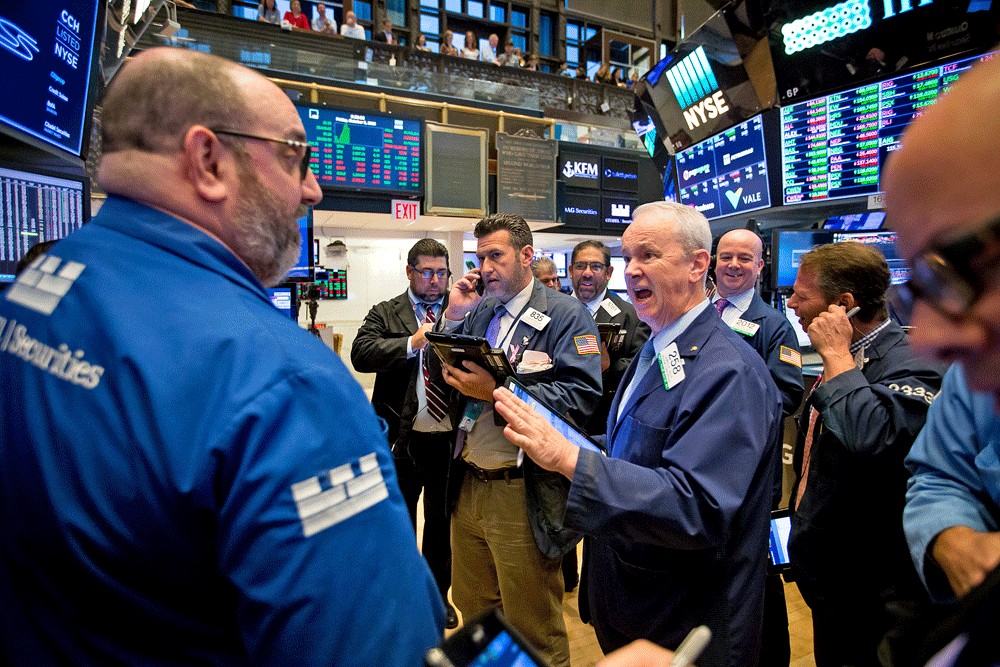
The stock market staged a brief rally Tuesday on hopes that President Donald Trump would turn from raising tariffs to cutting deals, before sinking amid renewed tough talk by administration officials. The S&P 500 index closed down 1.5 percent, bringing its total loss since the mid-February start of Trump’s trade offensive to almost 20 percent, the official indication of a bear market.
Stocks jumped nearly 4 percent in the first hour of trading, after Treasury Secretary Scott Bessent told CNBC that nearly 70 countries had approached the United States about negotiating over trade barriers. The next escalation of U.S. tariffs was just hours away. But the president fueled the upbeat mood with a subsequent social media post, describing a “great call” with South Korea’s acting president about a potential bargain.
Yet the market rebound soon fizzled.
On Capitol Hill, some of the president’s top aides sought to clarify the trade war’s murky parameters.
Jamieson Greer, the president’s chief trade negotiator, described the nation’s $1.2 trillion trade deficit as an emergency that required “urgent” efforts to reshape the U.S. economy. Greer brushed aside lawmakers’ complaints about potential costs to consumers and businesses, telling the Senate Finance Committee, “The president is fixed in his purpose.”
Bessent, meanwhile, sought to calm Republican fears that Trump’s bare-knuckled assault on the global trading system might trigger a politically lethal recession. During an hour-long meeting hosted by House Majority Whip Tom Emmer (R-Minnesota), Bessent briefed lawmakers and Jay Timmons, the head of the National Association of Manufacturers, on the administration’s plans for a manufacturing revival.
One week after Trump’s announcement of the highest import taxes in more than a century, investors, companies and lawmakers continue trying to make sense of his ultimate goal. For now, the administration says the president is advancing on twin tracks: raising tariffs to encourage manufacturers to return to the United States, while fielding offers by other nations to lower their barriers to U.S. products.
Despite swelling criticism from lawmakers and chief executives, the administration appears vindicated by the eagerness of foreign leaders hoping to avert U.S. tariffs by making a deal with Trump. In her daily briefing for reporters, White House press secretary Karoline Leavitt struck a combative tone.
“America does not need other countries as much as other countries need us,” she said.
The president’s high-risk strategy is already paying off, according to Greer, who cited recent investment announcements by automakers and other manufacturers planning to expand their U.S. operations. Likewise, officials from Argentina, Vietnam and Israel have indicated they will drop their tariff and regulatory barriers to U.S. exports.
Greer and other administration officials are engaged in talks with countries such as Japan and South Korea.
But there is no immediate prospect of talks with the nation at the center of U.S. trade complaints: China. After China imposed a 34 percent tariff on U.S. goods, in retaliation for Trump’s April 2 announcement, the president added an additional 50 percent tax on top of his earlier moves.
As of 12:01 a.m. Wednesday, American importers of some Chinese products will pay a tax of up to 129 percent.
Greer said the administration was “disappointed” with China’s failure to comply with the 2020 “phase one” trade deal Trump signed in his first term, which committed Beijing to make substantial purchases of U.S. farm, energy and manufactured goods. Amid the disruption of the pandemic, which erupted within weeks of the White House signing ceremony for the deal, China fell short of its commercial promises.
After Trump said he would impose the additional 50 percent tariff, China’s Commerce Ministry called the president’s move “a mistake on top of a mistake.” If the United States waged a trade war against China, it would “fight to the end,” the ministry said.
Administration official say they have the advantage over Chinese President Xi Jinping, since Americans buy roughly three times as much from China as the Chinese buy from U.S. companies. Trump said China “panicked” in opting to retaliate for his tariffs.
“The president believes that Xi and China want to make a deal. They just don’t know how to get that started,” Leavitt told reporters.
The administration’s unruly nature, however, is shadowing the president’s policy aims. Growing acrimony between Elon Musk, the world’s richest man, and Peter Navarro, a White House trade adviser, spilled into public view in recent days.
After Navarro disparaged Musk during a CNBC interview as a “car assembler” rather than a manufacturer, the Tesla CEO savaged the former university professor in posts on X as “dumber than a sack of bricks” and “Peter Retarrdo.”
The extraordinary display was praised by Leavitt as evidence of the administration’s transparency.
“Boys will be boys, and we will let their public sparring continue,” she said.
Greer’s congressional testimony offered additional details of Trump’s plan. Asked by several senators whether American businesses would win exclusions from the tariffs to continue importing products that they could not obtain from domestic suppliers, Greer said no.
“The president does not intend to have exclusions,” he said, adding that granting them would undermine the planned economic restructuring. “We’re trying to remedy a situation that’s persisted for many years.”
Though quick to praise the president’s goals, Republicans on the Finance Committee repeatedly voiced worry over the short-term economic costs.
Sen. James Lankford (R-Oklahoma) told Greer a constituent had relocated his supply chain from China to Vietnam in response to the president’s first-term trade policy only to find that he would now be paying a new 46 percent tariff on Vietnamese products.
Cattle ranchers in Montana were distressed by a 92 percent decline in Chinese purchases of U.S. beef last month, as the trade war intensified, according to Sen. Steve Daines (R-Montana).
And Sen. Thom Tillis (R-North Carolina) pronounced himself “skeptical” that the administration could wage a trade war against dozens of countries simultaneously.
“This is creating some anxiety,” said Sen. Todd Young (R-Indiana).
Some big-name tech stocks with notable morning gains joined the broader market in retreating, with Alphabet, Amazon, Apple and Tesla in negative territory Tuesday afternoon.
Stock analysts characterized Tuesday morning’s rally as a natural reaction after weeks of declines, capped by the harshest three-day sell-off in years.
With tariff negotiations beginning, markets “may be an important step closer to finding an equilibrium,” Mark Zabicki, chief investment officer at LPL Financial, wrote in a Tuesday research note.
Some Asian and European markets recovered Tuesday despite the Chinese threats of trade war escalation.
Germany’s DAX gained about 2.5 percent, and London’s FTSE 100 climbed 3.3 percent. Japan’s Nikkei 225 jumped 6 percent, while Hong Kong’s Hang Seng Index and India’s Sensex were both up 1.5 percent.
But markets in several Southeast Asian countries, which are vulnerable to any disruption of global trade, suffered more losses. Markets in Vietnam and Indonesia declined more than 7 percent, while an index linked to Thailand was down more than 4 percent. Taiwan’s Taiex fell 4 percent.