

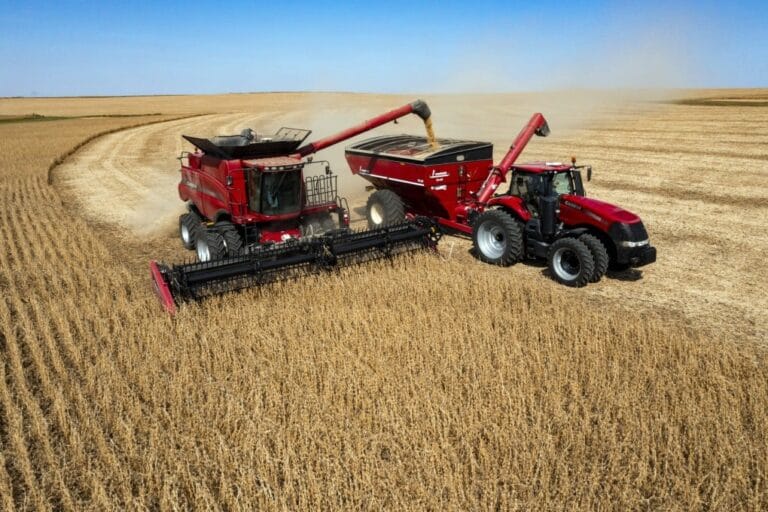
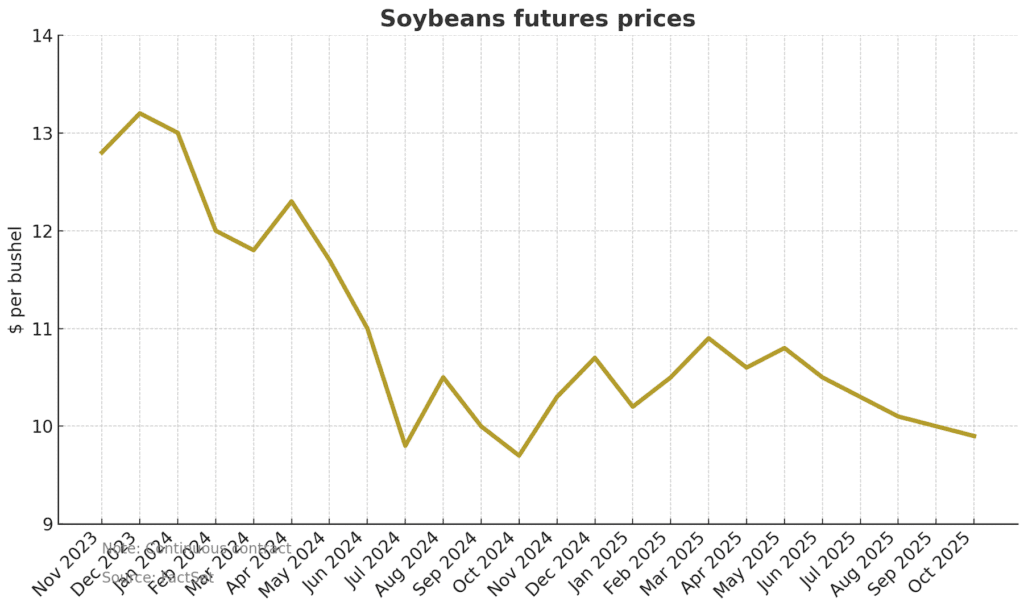
In the heart of the Midwest, where golden fields stretch toward the horizon under a crisp autumn sky, the hum of combines should signal prosperity. Instead, for America’s soybean farmers, harvest season has become a grim countdown to financial ruin. As they reap what the U.S. Department of Agriculture (USDA) projects to be a record 4.2 billion bushel crop this year, their largest buyer—China—has vanished from the market, leaving silos overflowing and prices plummeting to five-year lows around $9.50 per bushel.
China hasn’t booked any U.S. soybean purchases in months; farmers warn of ‘bloodbath’
The trade war between the United States and China, now in its second year under President Donald Trump’s renewed tariff regime, has turned soybeans into collateral damage. Beijing’s retaliatory 25% tariffs on U.S. agricultural imports have priced American beans out of the Chinese market, where they once commanded over half of the $24.5 billion in annual U.S. soybean exports.
From January through August 2025, Chinese imports of U.S. soybeans totaled a mere 200 million bushels—down from nearly 1 billion bushels in the same period of 2024, according to USDA trade data. That’s a 80% plunge, robbing Midwestern farmers of billions in revenue and forcing a scramble for alternative markets that may never fully compensate.
“We’ll see the bottom drop out if we don’t get a deal with China soon,” warns Ron Kindred, a veteran farmer managing 1,700 acres of corn and soybeans in central Illinois. Halfway through his harvest, Kindred has locked in contracts for just 40% of his crop at prices already eroding below $10 per bushel in local elevators. The remaining 60% sits in limbo, a high-stakes bet on a breakthrough in Washington-Beijing negotiations. “There’s no urgency on China’s side, and the farm community’s clock is ticking louder every day,” he adds.
Kindred’s plight echoes across the soybean belt, from Illinois prairies to Iowa’s rolling hills. Rising input costs—fertilizer up 20-30% year-over-year, equipment maintenance strained by inflation, and a glut of both corn and soybeans flooding domestic markets—were squeezing margins even before the trade spat escalated.
Now, with China’s boycott, the USDA estimates average losses of up to $64 per acre for Illinois growers alone, the nation’s top soybean-producing state with 6.2 million acres planted this year. University of Illinois Extension economists project total state-level shortfalls could exceed $400 million if export volumes don’t rebound by spring 2026.
Enter the Trump administration’s lifeline: a proposed $10-14 billion farmer aid package, building on December 2024’s $10 billion relief bill. The Wall Street Journal reported last week that President Trump, speaking at the White House on October 6, vowed to “do some farm stuff this week” to cushion the blow.
Aides say he’s slated to huddle with Agriculture Secretary Brooke Rollins as early as Friday to finalize funding sources, leaning heavily on the $215 billion in tariff revenues collected during fiscal 2025 (October 2024-September 2025), per U.S. Treasury figures. “The president is deploying every tool in the toolbox to keep our farmers farming,” a USDA spokesman told Reuters.
Yet for many in the heartland, the aid feels like a temporary fix for a structural crisis. Soybean farmers, who backed Trump overwhelmingly in 2024 (with 62% of rural voters in key swing states like Iowa and Wisconsin casting ballots for him, per Edison Research exit polls), are voicing frustration laced with loyalty. “We voted for strong trade deals, not handouts,” says Scott Gaffner, a third-generation farmer in southern Illinois tending 600 acres. His crop, typically destined for Chinese ports, now languishes in on-farm silos as he frets over fixed costs like diesel fuel and seed that have surged 15% since planting. “We’re not just anxious; we’re angry. When the administration’s jetting off to Spain for TikTok talks while our harvest rots, it feels like we’re the last priority.”
Gaffner’s son, Cody, the would-be fourth generation on the land, echoes the generational stakes. “If I return after college, it’ll be with a second job just to make ends meet,” the 22-year-old says. Their story underscores a broader ripple: Rural economies, where agriculture drives 20-25% of GDP in states like Illinois and Iowa, are buckling. Tractor sales at CNH Industrial, a Decatur, Illinois-based giant, plunged 20% in the first half of 2025, CEO Gerrit Marx revealed in an August interview at the Farm Progress Show. “The good news only flows when China places orders,” Marx said, a sentiment that hung heavy over the event in the self-proclaimed “soy capital of the world”—a title now whispered to be shifting south to Brazil.
Dean Buchholz, a DeKalb County, Illinois, peer of Gaffner’s, is already waving the white flag. After decades in the fields, skyrocketing fertilizer bills and sub-$10 soybean futures have convinced him to retire. “I figured I’d farm till they buried me,” the 58-year-old says. “But with debt piling up and health acting up, it’s time to rent out the acres. This trade war’s the final straw.”
Desperate diplomacy: Chasing markets in unlikely corners
With China—home to the world’s largest hog herd and importer of 61% of global traded soybeans over the past five years, per the American Soybean Association—off the table, U.S. agribusiness is on a global charm offensive. Trade missions to Nigeria, memorandums with Vietnam, and a 50% surge in sales to Bangladesh (up to 400,000 metric tons through July 2025) highlight the scramble. Yet these “base hits,” as Iowa farmer Robb Ewoldt calls them, pale against China’s home-run demand.
Ewoldt, who farms 2,000 acres near Des Moines, jetted to Rome in January to woo a Tunisian poultry giant. “They grilled me: Can we count on steady U.S. supply, or will you switch crops and jack up prices?” he recalls. Tunisia’s imports, while growing, total under 100,000 tons annually—barely a blip. “It helps long-term, but right now, we’re cash-strapped. My operation burns a million bucks a year; without sales, we’re dipping into reserves just to cover debt service.”
Across the Mississippi, Morey Hill has logged thousands of miles this year, from Cambodia’s fish ponds to Morocco’s chicken coops. In Phnom Penh last week, the Iowa grower evangelized to importers about swapping low-protein “fish meal” for U.S. soybean meal, touting yields that could fatten local aquaculture 20-30%. “We’ve got success stories—Vietnam’s up 25% year-over-year to 1.2 million tons,” Hill says. But even aggregated, the EU and Mexico (combined $5 billion in sales) plus risers like Egypt, Thailand, and Malaysia can’t fill the void: Total U.S. soybean exports dipped 8% to 18.9 million metric tons through July, USDA Census Bureau data shows.
Industry lobbies are pulling levers too. The U.S. Soybean Export Council sponsored a June Vietnam mission yielding $1.4 billion in MOUs for ag products, including soy. August brought Latin American buyers to Illinois for farm tours, though exports to Peru and Nicaragua remain negligible.
In Nigeria, a modest 64,000 tons shipped last year hasn’t translated to 2025 bookings yet. And Secretary Rollins’ September tweet hailing Taiwan’s “$10 billion” four-year ag commitment? It’s a rebrand of existing $3.8 billion annual flows, not new money, USDA clarifications confirm.
“There’s talk of India, Southeast Asia, North Africa as future markets,” says Ryan Frieders, a 49-year-old Waterman, Illinois, farmer who joined a February trek to Turkey and Saudi Arabia. “But nothing explodes overnight to replace China.” Frieders, facing $8-10 per acre losses per University of Illinois models, plans to bin most of his harvest, gambling on futures prices rebounding above $11 by Q1 2026.
The shadow of South America and tariff games
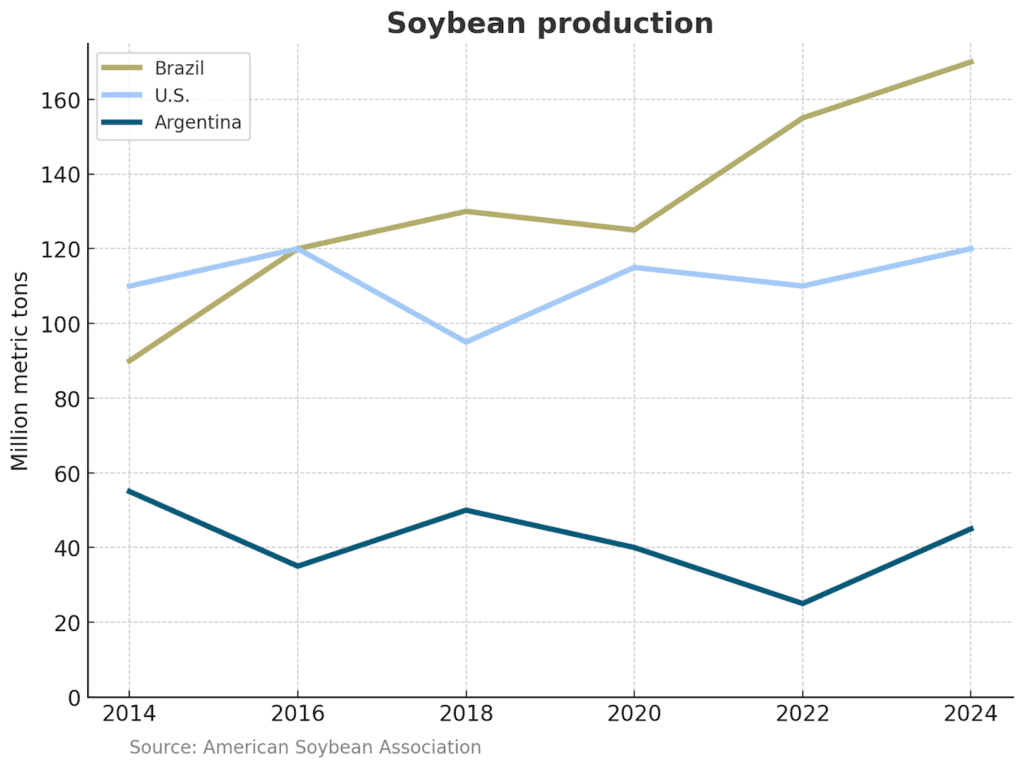
As U.S. beans languish, Brazil and Argentina feast. China, pivoting since 2018’s first trade war, now sources 80% of its needs from South America. Last month, Argentine President Javier Milei’s temporary export tax suspension lured $500 million in Chinese cargoes, traders at the Chicago Mercantile Exchange report. U.S. beans traded at $0.80-$0.90 per bushel cheaper than Brazilian equivalents for September-October shipment, but Beijing’s 23% tariff tacks on $2 per bushel—enough to divert 5 million metric tons southward.
“The frustration is overwhelming,” says Caleb Ragland, 39, Kentucky farmer and American Soybean Association president. On Truth Social Wednesday, Trump himself griped: “Our Soybean Farmers are hurting because China, for ‘negotiating’ reasons, isn’t buying.” He teased soybeans as a centerpiece in his upcoming summit with Xi Jinping in four weeks. Treasury Secretary Scott Bessent, speaking Thursday, promised a Tuesday announcement on aid, potentially including a $20 billion swap line for Milei—irking U.S. growers who see it as subsidizing their rivals.
On Friday, soybean futures closed at $9.42 per bushel on the CME, down 2% weekly amid harvest pressure and zero Chinese bookings. Analysts at Zaner Ag Hedge forecast a “bloodbath” if no deal materializes by November: Storage costs could add $0.50 per bushel, while on-farm debt—$450 billion industry-wide, per Farm Credit Administration—balloons.
The trade war’s winners? South American exporters, grinning from bumper crops (Brazil’s output hits 155 million metric tons this year, USDA estimates), and U.S. tariff coffers, flush for bailouts. Losers abound: From Decatur’s processing plants, once buzzing with Chinese-bound shipments, to the 1.2 million farm jobs at risk nationwide, per the American Farm Bureau Federation.
For Kindred, Gaffner, and their ilk, the math is merciless. “We want trade, not aid,” Gaffner insists. “China’s building routes elsewhere; once they’re hooked on Brazil, we might never claw it back. That’s not just my farm—it’s the next generations, the rural towns, the whole engine of America’s breadbasket.”
As combines roll on, the Midwest holds its breath. A Xi-Trump handshake could flood elevators with orders; stalemate risks a cascade of foreclosures and fallow fields. In this high-stakes harvest, soybeans aren’t just seeds—they’re the fragile thread binding U.S. farmers to their future.


2 Comments
Pingback: September Job Growth Surprises: 119,000 New Jobs Added, Defying Expectations - The New York Budgets
Pingback: US-Japan Panel Holds Second Meeting to Advance $550B Trade Deal Investments - The New York Budgets