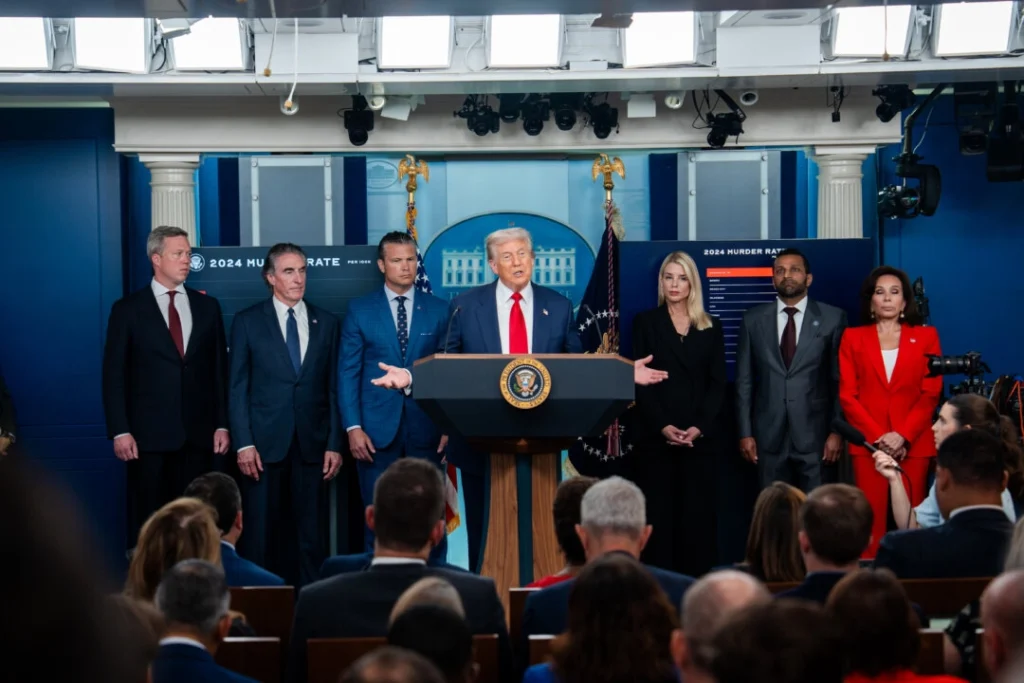
WASHINGTON — As President Donald Trump federalizes Washington, D.C.’s police and deploys the National Guard to curb crime in the nation’s capital, he is signaling a broader push to address violent crime in other major U.S. cities. During an August 11, 2025, press conference at the White House, Trump named Chicago, New York City, Los Angeles, Oakland, and Baltimore as areas of concern, describing them as “bad, very bad.” While violent crime rates have recently declined nationwide, these cities continue to grapple with elevated homicide and felony numbers, some exceeding levels from a decade ago.
The President’s Powers and Legal Challenges
Trump’s actions in Washington, D.C., stem from his declaration of a crime emergency, leveraging Section 740 of the District of Columbia Home Rule Act. This allows him to control the city’s Metropolitan Police Department for up to 30 days without Congressional approval. He has called on Congress, currently in its August recess, to extend this authority, hinting that a national emergency declaration could bypass legislative delays if needed.

However, extending similar measures to other cities faces significant hurdles. Unlike D.C., where the president has direct authority, state and local governments control law enforcement in Chicago, New York, Los Angeles, Oakland, and Baltimore. Trump’s deployment of National Guard troops to Los Angeles is under scrutiny, with U.S. District Judge Charles Breyer examining whether it violates the Posse Comitatus Act (PCA), which restricts federal military involvement in domestic law enforcement. In D.C., Trump has avoided PCA conflicts by deploying the District of Columbia National Guard under Title 32 duty status, maintaining local authority while supporting police operations.
Trump also criticized no-cash bail policies, which he believes exacerbate crime, urging Congress to act. Illinois eliminated cash bail in 2023, as did Los Angeles County for most offenses. New York State followed suit in 2019. “Maybe they’ll self-clean up, and maybe they’ll self-do this and get rid of the cashless bail thing and all of the things that caused this problem,” Trump said during the press conference.
Chicago: A Focal Point
Chicago tops Trump’s list of concern, with the president stating, “If we need to, we’re going to do the same thing in Chicago.” The city recorded 573 homicides in 2024, the highest in the U.S., though down from 620 in 2023, according to the Chicago Police Department. Shootings and vehicular hijackings also declined, but thousands of incidents persist. In the first half of 2025, homicides dropped 32 percent to 188 compared to the same period in 2024, yielding a homicide rate of over 21 per 100,000 residents.
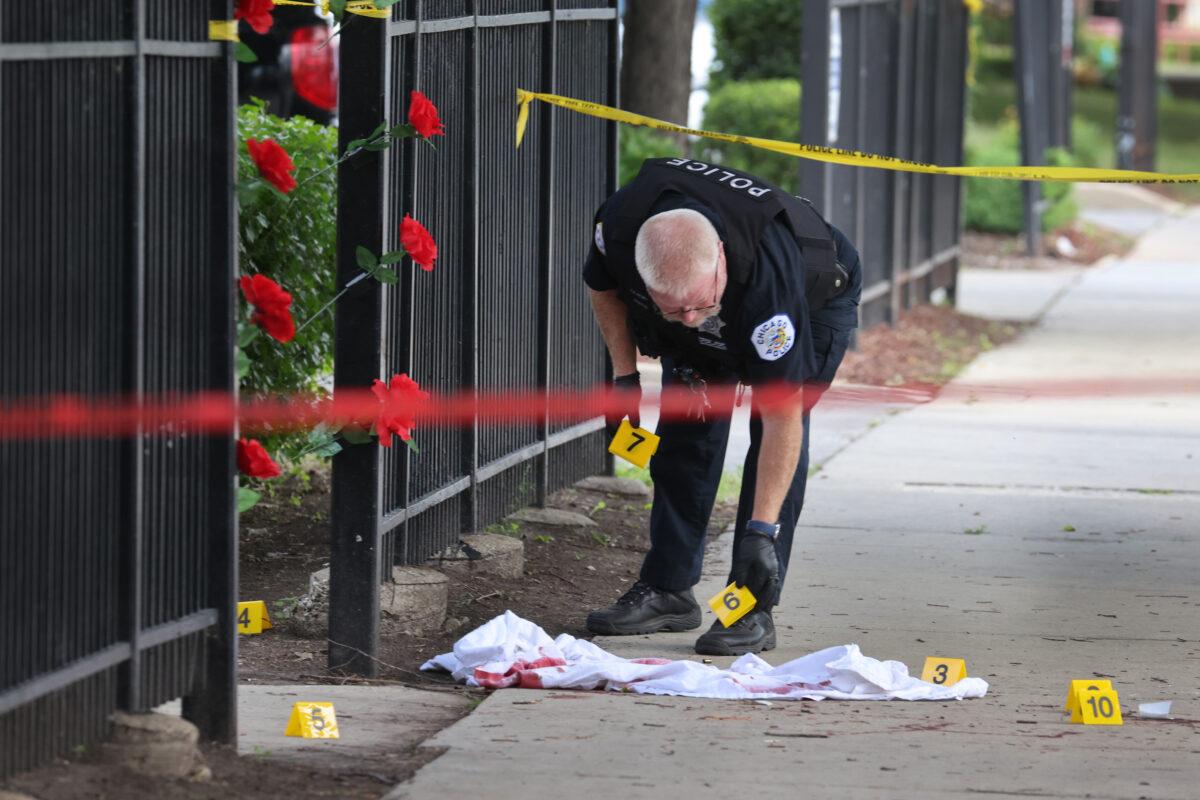
While this rate is lower than the 1990s peak, it exceeds levels from the 2000s and early 2010s, per a University of Chicago Crime Lab analysis. An Illinois Policy Institute report further noted a decline in homicide arrest rates, falling from 42 percent a decade ago to 27 percent between June 2024 and June 2025, highlighting challenges in law enforcement effectiveness.
New York City: Persistent Challenges
Trump signaled that New York City is next on his radar, stating, “I’m going to look at New York in a little while.” The city reported 382 murders and non-negligent manslaughters in 2024, down from a 2021 peak of 488 but higher than the 2013–2019 period, which saw a low of 292 in 2017, according to city data. By August 10, 2025, the New York Police Department recorded 188 murders, a 23.6 percent decrease from the same period in 2024. Robberies and felonious assaults also declined, but rape incidents rose 21.6 percent, with 1,748 cases in 2024 compared to 1,455 in 2023. Felonious assaults reached 29,461 in 2024, up from a low of 16,284 in 2008.
Los Angeles, Oakland, and Baltimore: Mixed Trends
Trump’s remarks also targeted Los Angeles, Oakland, and Baltimore, with the president noting that the latter two are “so far gone” and urging Los Angeles to “watch” D.C.’s example. Los Angeles saw 264 homicides in 2024, down from 327 in 2023, per FBI and Los Angeles Police Department data. The first half of 2025 showed further declines, with Mayor Karen Bass touting a trajectory toward the lowest homicide levels in six decades. Oakland reported 81 murders in 2024, a significant drop from 120 in 2023, aligning with late 1990s and early 2000s lows, according to the University of California, Berkeley School of Law. Homicides in Oakland fell 21 percent in the first half of 2025 compared to 2024.
Baltimore recorded 201 homicides in 2024, down from 260 in 2023, with a 2024 homicide rate of over 35 per 100,000, among the highest for large U.S. cities, per Baltimore Police Department data. The city’s 2025 midyear report showed 68 homicides, a decrease from 88 in the same period of 2024.
While Trump’s focus on crime has sparked debate, posts on X highlight mixed sentiments. On August 13, noted that Trump singled out cities with Black mayors and large minority populations, suggesting a political dimension to his rhetoric, though this claim remains inconclusive. Conversely, azpublicmedia reported on August 15 that mayors of the targeted cities—Baltimore, Los Angeles, Chicago, New York, and Oakland—emphasized declining crime rates, countering Trump’s narrative.
As Trump pushes for federal intervention, legal and political constraints may limit his ability to replicate D.C.’s model elsewhere. The outcome of Judge Breyer’s ruling on the Los Angeles deployment and Congress’s response to Trump’s call for expanded powers will shape the feasibility of his plans. For now, the president’s focus on urban crime underscores a broader agenda to prioritize public safety, even as cities report progress in reducing violence.