American businesses and families are staring down the barrel of another self-inflicted energy crisis, this one entirely of President Donald Trump’s making. Just weeks into his second term, the former real-estate developer turned wartime president has plunged the United States into a costly military showdown with Iran — and the bill is already landing squarely at the gas pump, on airline tickets, and in the supply chains that keep corporate America humming.
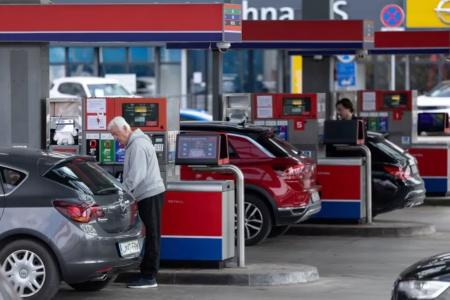
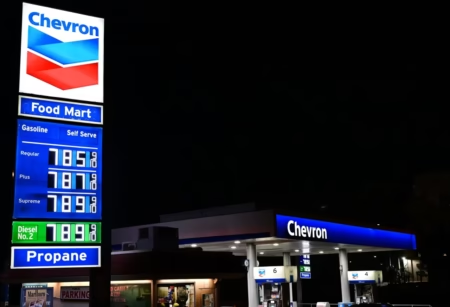
The average price of a gallon of regular gasoline across the United States jumped 34 cents in the past week alone to $3.32 on Friday, according to AAA data. Diesel prices have climbed even faster. Industry analysts warn the upward spiral has only just begun. When oil first spiked after Trump ordered strikes on Iran last week, many on Wall Street assumed cooler heads — or at least economic reality — would prevail and force a swift diplomatic off-ramp. That assumption now looks painfully naïve.
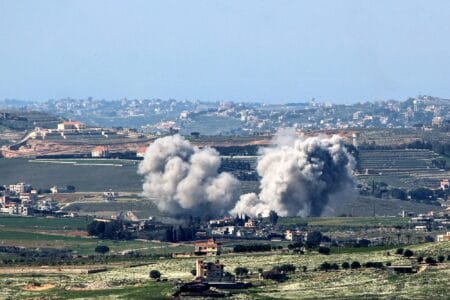
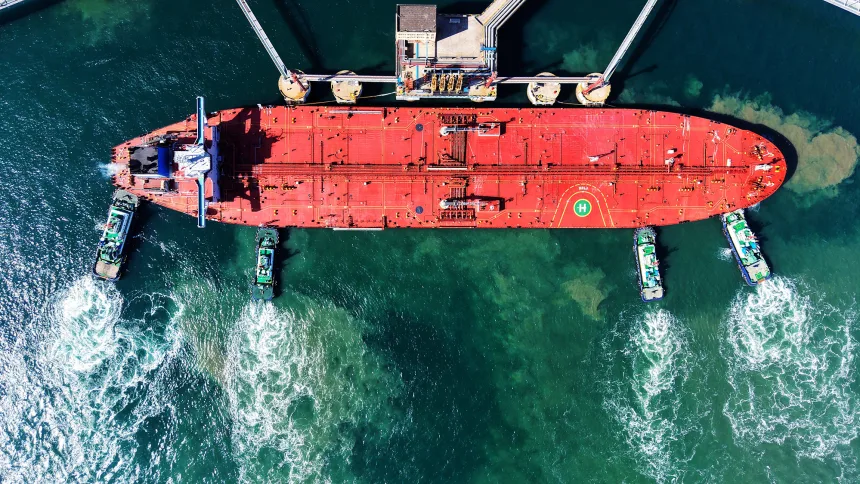
Instead, U.S. and Israeli strikes continue, Iranian drones are hitting energy infrastructure in Saudi Arabia and Qatar, and hundreds of oil tankers sit idle in the Persian Gulf, too terrified to run the gauntlet of the Strait of Hormuz. The result? A textbook supply shock that is hammering businesses large and small.
Qatar’s energy minister, Saad Sherida al-Kaabi, delivered the latest gut punch in an interview with the Financial Times on Friday. He warned that without an immediate de-escalation, Persian Gulf producers will be forced to halt output “within days,” sending global oil prices toward $150 a barrel — more than double pre-war levels. That would push U.S. pump prices back to the $5-a-gallon peaks last seen after Russia’s invasion of Ukraine in 2022.
“If the Trump administration does not do something to restore confidence in ships traveling through the Strait of Hormuz, these prices are going to keep heading up,” said Patrick De Haan, head of petroleum analysis at GasBuddy. “I don’t wake up too many mornings and get the chills when I look at the morning oil price numbers. It’s starting to feel like 2022 all over again.”
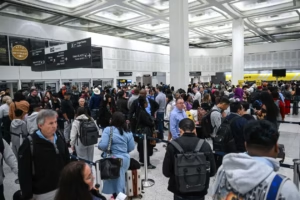
The pain is already rippling far beyond the neighborhood Exxon station. United Airlines CEO Scott Kirby told investors at an industry conference Friday that jet-fuel costs are climbing so fast that airfares will have to follow — and quickly. Shipping rates are rising in tandem. Travis Maderia, co-founder of New York-based LobsterBoys, which exports live Maine lobsters to restaurants worldwide, put it bluntly: “Transportation is a big part of our business. When airline prices go up, the cost of sending lobsters overseas can be dramatically impacted.”

Oil derivatives are embedded in everything from plastic packaging and semiconductor chemicals to industrial gases. BloombergNEF natural resources research chief David Doherty notes that Iran’s cheap drone attacks have made defending scattered energy infrastructure far harder than in past Middle East conflicts. “It is harder to protect oil infrastructure,” he said. “Defending the same breadth of space has become much more difficult than it was in the past.”
Even Trump’s attempts to calm markets have fallen flat. On Truth Social he doubled down: “There will be no deal with Iran except UNCONDITIONAL SURRENDER!” Treasury Secretary Scott Bessent announced a 30-day waiver allowing India to keep buying Russian oil and floated “unsanctioning” more Russian barrels on Fox News. The president also offered political risk insurance to tanker companies and hinted at U.S. Navy escorts through the Strait.
Market research firm Macquarie told clients the same day that those promises look hollow: escort vessels are “often unavailable due to other military priorities such as missile intercepts or striking Iran.” The firm warned of “an extremely large oil price move” within weeks if the Hormuz chokepoint stays blocked.
Restarting shuttered Gulf production won’t be simple either. Vidya Mani, visiting supply-chain scholar at Cornell University’s SC Johnson College of Business, explained: “It is not as simple as flipping a switch back on. You have to get drilling operations going again. You have to get workers back in.
Most Read in Politics



When there is a conflict like this, workers leave and the number that come back in may not be as many as you need.” She and other analysts now see $150 oil as a realistic near-term scenario — levels last touched in July 2008.
Alex Jacquez, policy chief at the progressive-leaning but economically focused Groundwork Collaborative (and a former Biden White House energy adviser), captured the growing frustration on Wall Street: “The markets are starting to realize there may be no off-ramp here. There was this thinking that if oil prices start to soar that Trump would back down in Iran. But that is not the way things are aligning. The president has shown no appetite for changing course.”
For an administration that campaigned on “lower prices” and “pro-business” policies, the optics are disastrous. A Washington Post-ABC News-Ipsos poll last month found most Americans already view health care, cars, and housing as unaffordable.
Republicans made lowering the cost of living the centerpiece of their midterm strategy. Now Trump’s foreign policy gamble is delivering the opposite — and doing so at the worst possible moment for corporate balance sheets and consumer wallets.
The irony is thick. In 2022, when Russia invaded Ukraine, energy markets were disrupted by an external aggressor. This time, as Jacquez noted, “we didn’t choose to do this ourselves” — yet the economic damage looks disturbingly familiar.