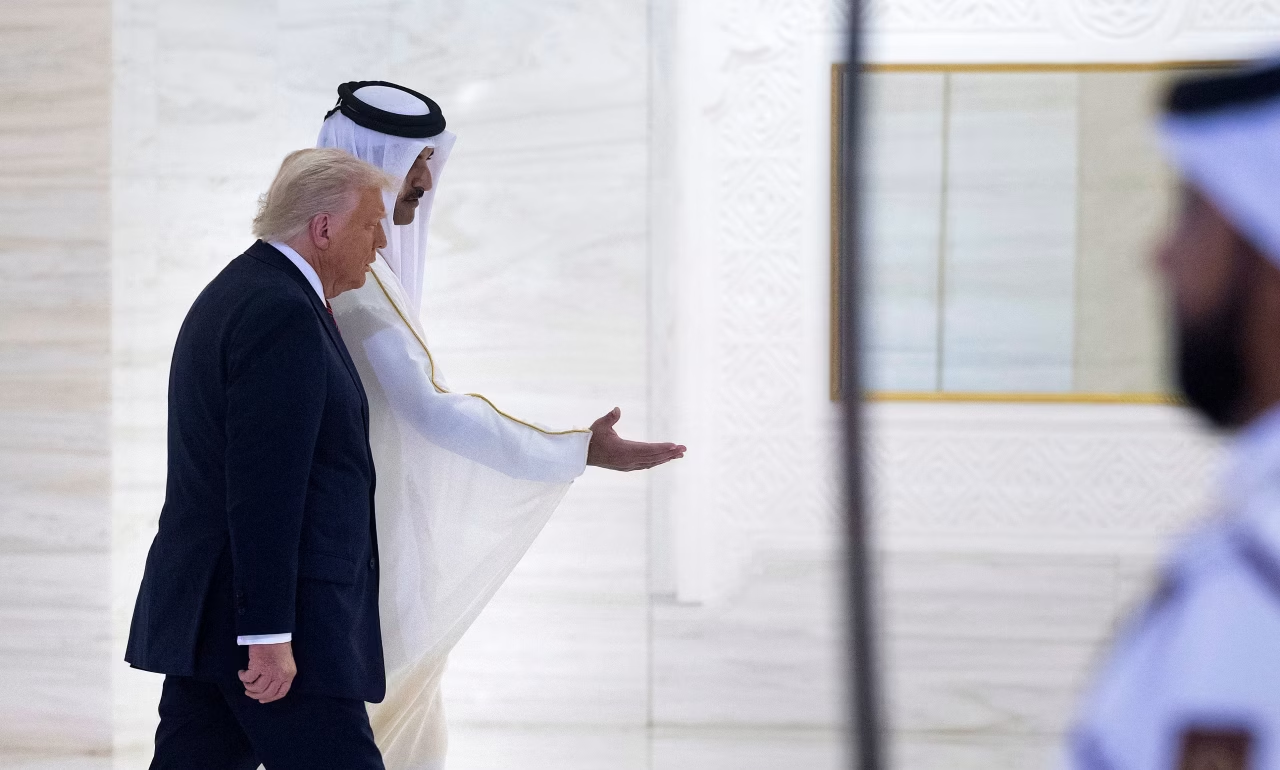
Qatar, a nation roughly the size of Connecticut with a population smaller than Brooklyn’s, has leveraged its immense natural gas wealth to secure outsize influence in Washington and across the American academic and defense establishment. Over the past two decades, the Gulf monarchy has quietly spent billions of dollars on U.S. military cooperation, educational partnerships, and lobbying efforts—building a powerful soft power machine that has reshaped its image from regional outlier to indispensable partner.
At the core of Qatar’s U.S. influence strategy is Al Udeid Air Base, a sprawling American military installation outside Doha that hosts over 10,000 U.S. troops and serves as the forward headquarters for U.S. Central Command (CENTCOM). Since 2002, Qatar has spent an estimated $8 billion building and upgrading the facility, essentially offering it to the Pentagon rent-free.
“No other country in the region provides this level of military infrastructure support without asking much in return,” said Gen. Kenneth McKenzie, former CENTCOM commander. “It makes Qatar indispensable to American operations in the Middle East.”
In return, the U.S. has shielded Qatar from regional isolation campaigns, particularly during the 2017 blockade by Saudi Arabia, the UAE, Egypt, and Bahrain. Despite Qatar’s ties to Islamist groups and accusations of enabling Hamas financing, Washington has largely stood by Doha—a testament to the strategic leverage gained through deep pockets.
While its military investments fly under the radar, Qatar’s most public-facing influence effort has been its massive donations to American universities. According to U.S. Department of Education data, Qatari entities have contributed more than $4.7 billion to U.S. colleges since 2000, making it one of the largest foreign donors to American higher education.
Much of that money flows through Education City, a Doha-based campus complex hosting satellite branches of top-tier U.S. institutions including Georgetown, Northwestern, Carnegie Mellon, Texas A&M, and Cornell Medical College. While universities claim academic independence, critics argue the funding creates subtle forms of censorship and political self-censorship.
“No university wants to lose a $300 million donor,” said Deborah Lipstadt, U.S. Special Envoy to Combat Antisemitism, who has raised concerns about foreign influence. “That money buys access, and sometimes silence.”
In 2021, a congressional probe led by the House Education and Labor Committee found that several schools failed to report Qatar-linked donations in full, raising transparency and national security red flags.
Qatar has also cultivated a powerful presence in the Beltway’s influence industry. Since 2017, it has spent over $147 million on lobbying and public relations firms, according to the Justice Department’s Foreign Agents Registration Act (FARA) database. Notable beneficiaries include Skadden, Arps, Nelson Mullins, and former U.S. Attorney General John Ashcroft’s firm.
Qatar’s lobbying offensive intensified after the 2017 blockade, as it sought to shape U.S. public opinion and policymaking in its favor. In one instance, Qatar funded trips for over 250 American academics and opinion leaders to Doha, many of whom later wrote op-eds supporting Qatar’s position.
Additionally, Qatari-linked organizations have poured millions into American think tanks including the Brookings Institution, Atlantic Council, and Center for Strategic and International Studies (CSIS)—often sponsoring research and panel discussions on Gulf security and U.S.-Qatar relations.
Qatar’s investments have paid geopolitical dividends. Despite its support for groups like the Muslim Brotherhood and Al Jazeera’s frequent criticisms of U.S. allies, Washington continues to view Doha as a stabilizing partner. Qatar has also positioned itself as a mediator in high-stakes diplomacy, most notably brokering prisoner exchanges with Iran and facilitating ceasefire talks between Hamas and Israel.
The recent release of American-Israeli hostage Edan Alexander from Gaza, mediated in part by Qatari diplomats, is the latest example of its delicate balancing act—simultaneously housing a U.S. air base and hosting Hamas leadership in luxury hotels.
“Qatar plays every side, and they do it well,” said Steven Cook, senior fellow at the Council on Foreign Relations. “It’s transactional diplomacy, backed by enormous capital.”
Still, the tide may be turning. With bipartisan concern mounting over foreign interference in U.S. academia and defense policy, Qatar’s influence machine is facing greater scrutiny. A bipartisan bill introduced in April 2025 would require all universities receiving more than $10 million in foreign aid to submit detailed reports to the Treasury Department.
Furthermore, Republican lawmakers have proposed conditioning future military cooperation on Qatar’s transparency about Hamas ties and human rights practices, particularly its treatment of migrant workers and LGBTQ individuals.
“You can’t be both an ally and an enabler of terrorists,” said Rep. Mike Waltz (R-FL), who sits on the House Armed Services Committee. “We need to hold Qatar to the same standards we expect from any partner.”
Qatar’s influence in the U.S. was not inherited—it was engineered. Through a meticulous mix of strategic military support, educational philanthropy, and relentless lobbying, the Gulf state has carved out a role far greater than its size would suggest. As global politics evolve, the question is whether Washington will continue to accept Doha’s deep pockets as a substitute for shared values.