President Trump’s trade war had, until Sunday night, centered on goods — cars, toys, food, clothes, the tangible stuff we put in and out of virtual and physical shopping carts.
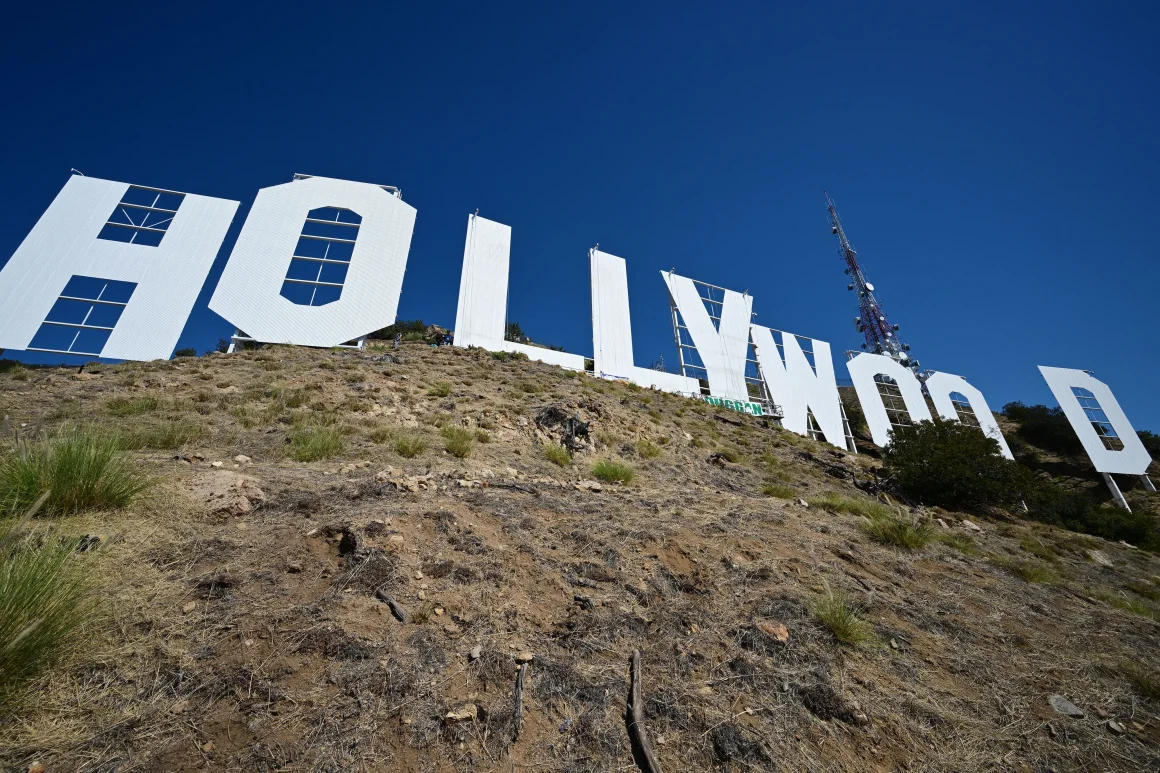
But those goods make up less than a quarter of the American economy. The bigger chunk of our economic pie is known as services — think Google, Netflix, Facebook, the plumbing of the internet, banking, insurance. And, yes, Hollywood films, the industry Trump now thinks needs saving with — you guessed it — tariffs!
ICYMI: Trump wrote on Truth Social late Sunday that he was directing the government to “immediately begin the process of instituting a 100% Tariff on any and all Movies coming into our Country that are produced in Foreign Lands.” (Watch out, Hayao Miyazaki — your days of flooding the American market with mystical whimsy and childlike wonderment are over.)
Of course, Hollywood studios (and anyone thinking about it for more than a few seconds) were left scratching their heads over how such a tax would work.
As we’ve come to expect with Trump 2.0, it’s not clear whether the president is serious. Jon Voight, who serves as one of Trump’s Hollywood Ambassadors, said Monday that he met with Trump recently to discuss “certain tax provisions that can help the industry – some provisions that can be extended and others than could be revived or instituted.” But that sounds like mostly incentives, not tariffs. In other words, Voight recommended a carrot and Trump announced a stick.
California Governor Gavin Newsom on Monday appeared to prefer a gentler approach, calling on Trump to work with California to create a $7.5 billion federal tax credit for the movie and television industry. Currently, tax incentives are exclusively the realm of states and municipalities.
“We’ve proven what strong state incentives can do. Now it’s time for a real federal partnership to Make America Film Again,” Newsom said in a post on X “@POTUS, let’s get it done.”
The White House said hours after he posted published that “no final decisions” had been made, and Trump later told reporters he wanted to run the idea by folks in the movie industry.
If he is serious about foreign movie tariffs, though, Trump would be opening a new front in a war he has no real plan to win. And he’d be admitting to the world that his love of tariffs is not, as he’s long claimed, tied to some deep concern about trade imbalances but rather a desire to wield an economic cudgel.
The Goods Place
Perhaps because Trump’s intellectual allegiance to opinions he formed 40-plus years ago is so strong, he may be imagining container ships full of VHS tapes and spools of Kodachrome crossing the oceans when he thinks of the global film industry.
But movies are not goods that travel in and out of ports — they are intellectual property that fall under the “services” economy. To tax a movie like a good, the administration would have to clearly define what a movie’s value is, and determine how much overseas production would classify a project as an “import.” (Plus, some poor writer’s room will have to start working on the next season of Emily in Paris under the new title Emily in Albuquerque.)
The goods/services distinction matters a great deal. Because for all of Trump’s outrage over the fact that America buys more goods from overseas than it sells, the US exports far more services than it imports. (It’s a “services surplus” — the “rural juror” of econ jargon.)
In fact, the US is the biggest exporter of services in the world. That gives our trade partners leverage they could use against us.
“If Trump is serious about tariffs on movies, it’s a very dangerous escalation,” economist Justin Wolfers noted on Bluesky. “We would be extremely vulnerable to any service-based retaliation.”
The good news is, the president may not be serious. In keeping with Trumpian tariff tradition, he announced the import tax with few details in a late-night social media post with the kind of dramatic capitalizations you might associate with a teen group chat (“The Movie Industry in America is DYING a very fast death,” it begins.)
Asked about the tariffs in a press briefing Monday afternoon, Trump was less definitive than he’d been Sunday night, saying: “We’re going to meet with the industry; I want to make sure they’re happy about it.”
Spoiler alert, Mr. President: They’re not happy. Several movie studio and streaming industry executives who spoke with CNN are downright apoplectic, my colleagues Brian Stelter and Jamie Gangel write.
Shares of Netflix, Disney and CNN parent company Warner Bros. Discovery fell on Monday.
To be fair, Trump has hit on a real issue dogging Hollywood known as “runaway production.” For years, foreign cities like Toronto and Dublin have offered large tax breaks to film and television studios. In response, California Governor Gavin Newsom has proposed a massive tax credit to bring back production to Hollywood.
But industry sources told Brian and Jamie the idea of using tariffs “would represent a virtually complete halt of production … But in reality, he has no jurisdiction to do this, and it’s too complex to enforce.”