
The world’s two largest powers are closer to a full economic break than ever, as President Donald Trump and Chinese leader Xi Jinping refuse to back down in a trade war that has become a high-stakes game of chicken — raising the specter of mass economic fallout and heightened risk of conflict between Washington and Beijing.
A week after Trump’s “Liberation Day” tariffs roiled global markets, his administration has put China in its crosshairs, shifting his global trade war from a crusade against what he called foreign freeloading to a winner-takes-all confrontation with Beijing.
China on Friday countered Washington’s levies by raising tariffs on all U.S. goods to 125 percent, while it dismissed U.S. measures as “economically meaningless” and Xi urged European nations to join Beijing in resisting Trump’s “unilateral bullying.” A day earlier, Trump confirmed he had hiked tariffs on Chinese imports to 145 percent — the fourth such escalation since taking office two months ago. The Trump administration said late Friday that it would exempt many consumer electronics, like the popular iPhone, from tariffs even as it didn’t back down from the broad levies.
But analysts and people close to officials in China’s leadership circles say beneath the growing market panic over the tariffs lies a deeper concern: Trump’s erratic early moves — and the absence of any meaningful back-channel between Washington and Beijing since January — mean there are few tools available to steer the relationship back on course.
“Everyone is so fixated on tariffs, but we are at a level where this is past tariffs; we have backed into decoupling,” said Jude Blanchette, who runs the China Research Center at the Rand Corporation.
“Beijing was tolerant of tariff increases and other increases so long as they thought they had a chance to sit down with Trump and stabilize the relationship. This is so completely off the table now,” he said.
The flow of trade and investment between the world’s two largest economies has long been a stabilizing force in a fraught diplomatic relationship between superpowers. The severing of these economic ties, what has become known as “decoupling,” could remove a key guardrail, fundamentally reordering the global economy and increasing the chance of an actual shooting war, analysts warn.
Trump and his appointees are rallying behind the idea that the sudden reversal on implementing most tariffs was a strategic move to outmaneuver Beijing and are now betting that China will back down.
Speaking at an American Bankers Association conference in Washington on Wednesday, Treasury Secretary Scott Bessent said he expects a wave of new deals with U.S. allies and a coordinated approach to confronting China.
“They can raise their tariffs. But, so what?” he said in a separate interview with Fox Business on Wednesday. “No one wins in a war, but its proportionality, and the proportionality for the Chinese is going to be much worse,” he said.
But Chinese officials have signaled that Beijing is bracing for a protracted economic battle with the United States — determined not to show weakness at home and still smarting from the belief that it gained little from the intense dealmaking of Trump’s first term.
In Beijing, two people familiar with internal discussions said a core group of senior officials have been tasked with rolling out a set of preplanned measures to match any U.S. economic salvos — including some actions drafted weeks before Trump took office on Jan. 20. They include tariffs on specific U.S. industries and restrictions on U.S. firms.
‘Bullying and hostility’
Lines of communication between the two superpowers came to a screeching halt Monday when Donald Trump posted on Truth Social: “All talks with China concerning their requested meetings with us will be terminated!”
Beijing responded with a sharp warning that it would not bow to “pressure, threats and blackmail.”
“Trump basically is open to some kind of deal, but he now seems to have dug himself into a hole where he’s not willing to talk to China unless China kind of grovels before him, and China is certainly not going to do that. And that means that the most likely direction things go now is just escalation,” said Jake Werner, director of the East Asia Program at the Quincy Institute.
While Beijing had braced for a possible tariff escalation, Chinese diplomats were caught off guard by the speed and scale of the past week’s moves, according to people familiar with internal discussions in Beijing and who, like others interviewed, spoke on the condition of anonymity to describe sensitive diplomacy.
Part of the shock stemmed from the aggressiveness of Trump’s opening moves, despite making little effort to engage Chinese officials during his first two months in office.
The Trump administration’s use of fentanyl to justify its first round of tariffs particularly frustrated Chinese officials. Beijing had already taken modest but meaningful steps to address its role as the top global supplier of fentanyl ingredients — scheduling over 50 new precursors in coordination with Biden administration working groups and making hundreds of domestic arrests.
Unlike their Canadian and Mexican counterparts, who vociferously pushed back on Trump’s threats, Chinese officials shunned public gestures in reaction to the tariffs and instead tried to establish a back channel to bypass what they saw as political theater.
In February, former Chinese ambassador to the United States Cui Tiankai quietly led the first of multiple delegations to Washington, meeting with think tank representatives and exploring how Beijing might engage the new administration. During Trump’s first term, a similar back channel between Cui and Jared Kushner, the president’s son-in-law, served as a key conduit to lay the groundwork for meetings between the two leaders.
People familiar with Cui’s mission said he brought proposals approved by the highest levels of the Communist Party outlining potential concessions Beijing was prepared to make in negotiations.
However, those efforts — including a return visit by Cui last week — have yet to yield meaningful inroads with the new administration, despite public signals from both Trump and China’s Foreign Ministry that they’re open to dialogue.
“It feels pointless,” said one of the people in Beijing, noting the difference from the first Trump administration. Now it’s “just bullying and hostility.”
“This is certainly going to be quite different from what the Chinese side is used to,” said Yao Yang, an economist at China’s Peking University. “It’s very difficult to even contact the American government. The whole American government listens to just one guy.”
‘Willing to fight’
The past week has demonstrated how far the relationship has soured since Trump’s first trade war with China in 2018, and which deepened during the Biden administration.
“I was really shocked,” said Xin Qiang, deputy director of the Center for American Studies at Fudan University in Shanghai. “I didn’t expect the situation to deteriorate to this extent in just a few days.”
Analysts say the president now faces a ticking clock: managing the escalating standoff with Beijing while scrambling to secure deals with allies hit with tariffs — all in a race to build a united front that could block China from circumventing the hefty trade measures.
“The next 90 days are crucial. … If President Trump can ink deals with these 75 countries and get their buy-in to block China’s transshipping efforts, then America has the chance to build a trade coalition that doesn’t include Beijing. It’s an enormous opportunity,” said Michael Sobolik, senior fellow at Hudson Institute.
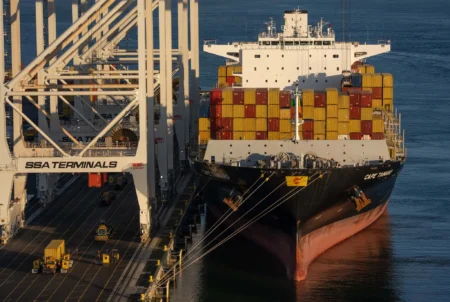
Transshipping — the practice of rerouting goods through a third country to dodge high tariffs — was a strategy some Chinese companies adopted following the 2018 trade war, using countries like Vietnam as intermediaries.
As the world’s largest exporter, China posted a global trade surplus of around $1 trillion last year and remains heavily reliant on external demand. But financial analysts say it’s now unlikely to hit its annual GDP growth target of 5 percent.
On Thursday, Goldman Sachs cut its China GDP forecast to 4 percent. Trump has also warned of “transition problems” in the U.S. economy as part of his tariff program, urging Americans to “hang on” as market shock waves continue and the likelihood of a recession grows.
Analysts also say the longer the trade war drags on, the more likely it is that retaliation spreads to other areas of rivalry between the two countries — in particular, Washington’s relationship with Taiwan, the democratic island that Beijing claims as its own and has threatened to take by force.
Yun Sun, director of the China program at the Stimson Center, compared the current moment to Trump’s first term, when U.S.-China ties went into free fall after the 2020 “phase one” trade deal largely collapsed and China did not meet its purchase commitments. Washington and Beijing butted heads over China’s aggression in the South China Sea and U.S. support of Taiwan.
“There is a pattern of starting with tariffs, forcing China to concede. And when China refuses to do so, it very quickly spills over into other domains because Trump believes in the maximum pressure campaign,” Yun said.
“The danger is that when two confident leaders decide to engage in a game of chicken it makes the escalation so much more difficult because … they both believe that they will win,” Yun said.
Trump’s public messaging to Xi has been mixed. The two leaders spoke in the days leading up to Trump’s inauguration, with the U.S. president calling Xi “a smart guy.” In March, hopes for a meeting appeared to gain some traction when Sen. Steve Daines (R-Montana) visited Beijing and suggested he was laying the groundwork for a leader-level summit. But prospects for an immediate meeting now appear dashed.
“China took measures, and then Trump raised tariffs again, but there is still room for negotiation,” said Zhu Feng, professor and dean of the School of International Studies at Nanjing University.
Chinese officials — both in public and private — are letting it be known that Beijing’s door is still open to accommodation with the Trump administration. Yun, who described recent meetings with Chinese interlocutors, said: “The message is pretty much that we want to talk, but we’re also willing to fight.”