Hong Kong-listed shares of China’s Xiaomi surged over 5% to hit a record high on Friday, a day after its electric car drew a strong response from customers.
The consumer electronics company, a relatively newer player in the EV market, took aim straight at rival Tesla with its new electric luxury vehicle, YU7. The SUV’s pricing starts at 253,500 yuan ($35,322), CEO Lei Jun said Thursday, pointing out that the vehicle was 10,000 yuan cheaper than Tesla’s Model Y, which starts at 263,500 yuan in China.
The YU7 received more than 200,000 orders within just three minutes of its launch, Xiaomi said.
Prior to the official price announcement, a Citi report had listed expectations that the YU7 SUV would be priced around 250,000 yuan to 320,000 yuan ($34,800 to $44,590), forecasting monthly sales of about 30,000 units. Once the pace picks up, Citi predicts annual sales of 300,000 to 360,000 units.
Xiaomi’s company’s SU7 sedan launched last year was also priced below Tesla’s Model 3.
Lei on Thursday claimed the YU7 beat Tesla’s Model Y on a range of metrics, but still came short on driver assist. The YU7 comes with driver-assist software, the most advanced version of which is powered by Nvidia’s Thor chip. Pre-sales start at 10 p.m. on Thursday, with deliveries expected within one to five weeks.
Xiaomi had initially said it would launch its YU7 in July. The earlier event takes place amid an intensifying electric car price war.
Xiaomi revealed its YU7 SUV in late May, less than a year after launching its first electric car, and claimed the vehicle would have a driving range of at least 760 kilometers (472 miles) on a single charge.
That’s well above the 719 kilometers advertised for Tesla’s extended-range Model Y. Driving range has been a selling point for consumers worried about frequent battery charging.
While Xiaomi has not promoted its artificial intelligence as much as other consumer brands, Thursday’s launch event showcased several AI car features, such as allowing drivers to change a song using hand motions, or ask a phone app to describe where the car is parked.
The YU7 also supports Apple Car Play and Apple Music, Lei said.
The AI glasses, which rival Meta’s Ray Bans smart offering, can change the tint of the lenses and scan a QR code to make payments, mimicking China’s mobile smartphone apps. Xiaomi also announced similar features to those of the Meta glasses, such as being able to take photos and videos, as well as use interactive AI to identify a flower or translate text.
Xiaomi’s AI glasses start at 1,999 yuan ($279). A Xiaomi spokesperson said there were currently no plans to sell the glasses overseas. Meta’s version isn’t officially sold in China.
Some of President Donald Trump’s steepest tariffs are on products like washing machines, and on Thursday, GE Appliances said it would spend a half a billion dollars to make even more of them in the United States.
Tariffs, however, weren’t the driving factor behind the decision, the company’s CEO says, but they did serve as an accelerant.
GE Appliances announced it would spend $490 million to move some washing machine production from China and build a high-tech clothes care operation at its massive industrial park and headquarters in Louisville, Kentucky, where it already churns out washers and dryers for the US market.
The move of more than a dozen front-load washer models comes as US trade policy uncertainty has reached a high-stakes fever pitch as Trump’s July 9 tariffs deadline approaches.
GE Appliances move that is expected to be complete in 2027 and add 800 jobs, has been in the works for six years — shortly after a new line of front-load washers launched in 2019 — and follows a several-year stretch of high-dollar investments made to bolster the company’s US manufacturing footprint, CEO Kevin Nolan told CNN.
“We’ve had a strategy that making appliances in America makes sense; it’s an economic thing, and it’s also how we can serve our customers in a better, more efficient way,” Nolan said, adding that GE appliances is “nota company that was saying, ‘Hey, we’re going to outsource everything, and oh my God, now we’ve got to bring it back.’”
“[The trade policy] makes the payback for these things much, much greater,” Nolan added. “And with that, of course it’s going to accelerate (plans), because the quicker we can do these things, the quicker we can realize those benefits.”
The emergence and threat of tariffs also are influencing future decisions, Nolan said, noting that plans to reshore other components and parts are moving up the pecking order.
Earlier this week, an expansion of Trump’s 50% tariffs on steel extended to “derivative products,” including consumer appliances such as dryers, washing machines, refrigerators, ovens and garbage disposals. The US currently has a minimum 30% tariff on Chinese exports; however, it has soared as high as 145% in recent months.
“The current trade policy is the most dynamic thing anyone’s ever seen in their business career; I mean, it can change in a day, it can change in a week, it can change in a month,” Nolan said. “These investments are strategic, and you’ve got to look at the long term and what makes sense. You can’t do these just for trade policies.”
The move follows similar reshoring efforts made by GE Appliances in recent years, Nolan said. The company, which has been a subsidiary of China-based Haier Group since 2016, has invested $3.5 billion in its US manufacturing facilities during the past decade, he said.
Still, in recent months, the dramatic shifts in US trade policy and the Trump administration’s tumultuous tariff rates have loomed large over manufacturers like GE Appliances and its parent company’s appliance-making affiliate Haier Smart Home.
Earlier this month, Haier Smart Home executives told investors that the company’s localized supply chain in North America could help reduce its tariff exposure, according to translated company filings from June 4. Haier also flagged opportunities in “tariff-driven competitor weakness,” according to the filing.
Tariffs accelerated decision
In 2019, GE Appliances wanted to move quickly to market after developing what it believed was an innovation in the clothes care space: Making a less stinky front-load washer.
“To get this washer out fast, we said we’re going to tackle building the dryer plant (in Louisville) to make those and we’ll share the load and have the washer made in China,” he said. “We always had a forward-looking view that this thing was going to come back to America, but to get the things in the market quick, we did it that way in China first.”
The high-tariff environment “definitely made the numbers on this look very good; so, we said, ‘OK, let’s pull this thing in; let’s get this thing done now,’ because it just makes sense. The engineering work’s been going on; there’s a reason we can move fast on this,” he said. “But these tariffs could go away tomorrow, and once we make these decisions, we don’t back off. So that’s where you’ve got to make sure it’s the right thing to do.”
The half-a-billion-dollar investment announced Thursday will bring over more than 15 models of front-load washing machines, including a washer-dryer combo, to the 750-acre, multi-plant Appliance Park, where the company already manufactures top-load washers and clothes dryers.
The latest addition — which is expected to heavily feature automation, including robotics, automated guided vehicles and autonomous mobile robots — is expected to bring the company’s clothes care production at the site to 33 football fields in size.
Still, when it’s complete in 2027, the new production lines are expected to result in the addition of 800 full-time jobs to the 8,000-person campus.
“It’ll definitely be our flagship plant from a technology standpoint, so a lot of opportunities for upskilling employees,” Nolan said, referring to efforts for employees to learn new skills. “In order to be able to successfully manufacture in the United States, we have to be efficient.”
In recent years GE Appliances has touted a “zero distance” strategy to be closer to customers from a physical and design standpoint. To that end, the company’s 11 US plants include maker spaces and microfactories aimed at innovation and small-batch production.
The approach is a far cry from that taken in the 1980s and 1990s, when then-General Electric CEO Jack Welch leaned heavily into outsourcing and offshoring.
GE Appliances declined to share specifics as to what percentage of its manufacturing is now domestic versus overseas; however, the intent is to continue the reshoring efforts and expanding US manufacturing operations, Nolan said.
Why reviving US manufacturing isn’t easy
Trump, like presidents Obama and Biden before (and after) him, has long stated a desire to revive the US manufacturing industry and sought to wield tariffs to make that happen. However, economists and supply chain efforts have questioned the effectiveness in broad-based tariffs to that approach.
Several companies in recent months have announced plans to make investments in US manufacturing in recent months — with the White House taking credit — however, not only were these decisions already longer term in nature, any kind of large-scale rebound in domestic manufacturing will take time, said Jason Miller, a professor of supply chain management at Michigan State University.
“Right now, given all the profound uncertainty about tariffs, folks are not going to take action until some clarity emerges,” he said.
Companies that are able to announce or make moves now, he added, likely have existing capacity currently in place. To build a factory from scratch not only would take many months, if not many years, and then companies would run up against another challenge: finding enough skilled workers, he said.
About 22% of US plants have cited a lack of labor or labor skills as a key reason for their facilities running below full capacity, Miller said, citing his analysis of recent Census Bureau data.
GE Appliances has a waitlist of folks for jobs at its plants, but there’s still a huge need for a stronger pipeline of skilled workers, Nolan said.
“That’s just a national shortage,” he said. “When you look at us versus other countries, how many engineers are graduated, we’re way underrepresented. And then when you look at out of those engineers who are skilled in the art of manufacturing, it’s even worse. That’s the thing as a nation we’ve got to really grapple with.”
Meta on Wednesday prevailed against a group of 13 authors in a major copyright case involving the company’s Llama artificial intelligence model, but the judge made clear his ruling was limited to this case.
U.S. District Judge Vince Chhabria sided with Meta’s argument that the company’s use of books to train its large language models, or LLMs, is protected under the fair use doctrine of U.S. copyright law.
Lawyers representing the plaintiffs, including Sarah Silverman and Ta-Nehisi Coates, alleged that Meta violated the nation’s copyright law because the company did not seek permission from the authors to use their books for the company’s AI model, among other claims.
Notably, Chhabria said that it “is generally illegal to copy protected works without permission,” but in this case, the plaintiffs failed to present a compelling argument that Meta’s use of books to train Llama caused “market harm.” Chhabria wrote that the plaintiffs had put forward two flawed arguments for their case.
“On this record Meta has defeated the plaintiffs’ half-hearted argument that its copying causes or threatens significant market harm,” Chhabria said. “That conclusion may be in significant tension with reality.”
Meta’s practice of “copying the work for a transformative purpose” is protected by the fair use doctrine, the judge wrote.
“We appreciate today’s decision from the Court,” a Meta spokesperson said in a statement. “Open-source AI models are powering transformative innovations, productivity and creativity for individuals and companies, and fair use of copyright material is a vital legal framework for building this transformative technology.”
Though there could be valid arguments that Meta’s data training practice negatively impacts the book market, the plaintiffs did not adequately make their case, the judge wrote.
Attorneys representing the plaintiffs said in a statement said that they “respectfully disagree” with the decision.
“The court ruled that AI companies that ‘feed copyright-protected works into their models without getting permission from the copyright holders or paying for them’ are generally violating the law,” the statement said. “Yet, despite the undisputed record of Meta’s historically unprecedented pirating of copyrighted works, the court ruled in Meta’s favor.”
Still, Chhabria noted several flaws in Meta’s defense, including the notion that the “public interest” would be “badly disserved” if the company and other businesses were prohibited “from using copyrighted text as training data without paying to do so.”
“Meta seems to imply that such a ruling would stop the development of LLMs and other generative AI technologies in its tracks,” Chhabria wrote. “This is nonsense.”
The judge left the door open for other authors to bring similar AI-related copyright lawsuits against Meta, saying that “in the grand scheme of things, the consequences of this ruling are limited.”
“This is not a class action, so the ruling only affects the rights of these thirteen authors — not the countless others whose works Meta used to train its models,” he wrote. “And, as should now be clear, this ruling does not stand for the proposition that Meta’s use of copyrighted materials to train its language models is lawful.”
Additionally, Chhabria noted that there is still a pending, separate claim made by the plaintiffs alleging that Meta “may have illegally distributed their works (via torrenting).”
Earlier this week, a federal judge ruled that Anthropic’s use of books to train its AI model Claude was also “transformative,” thus satisfying the fair use doctrine. Still, that judge said that Anthropic must face a trial over allegations that it downloaded millions of pirated books to train its AI systems.”
“That Anthropic later bought a copy of a book it earlier stole off the internet will not absolve it of liability for the theft, but it may affect the extent of statutory damages,” the judge wrote.
While Disney insists that the P&T division is critical to its future success, the layoffs nonetheless cut an additional two percent of the company’s workforce.
This latest round of cost cutting is just one of a long series of cuts lasting several years. Indeed, it isn’t even the first round of layoffs this month.
Early this month the company pushed out several hundred workers from its marketing for both film and television, television publicity, and its casting and development departments.
It was the fourth round of layoffs in the last ten months and came about a month after 200 employees were eliminated in March.
The layoffs in March hit Disney’s ABC News Group and Disney Entertainment Networks unit. That round of layoffs even included the elimination of its once popular “538” website.
Disney’s job shedding campaign has been going on for several years as the company struggles to reign in expenses in the wildly changing entertainment scene and as Hollywood and streaming continues to lose power over America. In August of 2024, for instance, Disney shed 140 jobs in its entertainment divisions, including ABC television.
In 2023, the company had its largest layoff by dumping some 7,000 employees.
Salesforce is accelerating its use of artificial intelligence in automating workloads, according to CEO Marc Benioff.
“All of us have to get our head around this idea that AI could do things, that before, we were doing, and we can move on to do higher-value work,” he said in an interview with Bloomberg, noting that the technology currently accounts for about 30% to 50% of the company’s work.
Technology companies are hunting for new ways to trim costs, boost efficiencies and transform their workforce with the help of AI.
The aftershocks have already hit the tech industry, with the software giant cutting more than 1,000 positions earlier this year as it restructured around AI.
Other technology companies have made similar moves, including cybersecurity giant CrowdStrike.
Klarna CEO Sebastian Siemiatkowski said the company has shrunk its headcount by 40% due in part to AI investment, while Amazon CEO Andy Jassy said the e-commerce giant will use artificial intelligence to reduce roles.
Benioff called the rise of AI in the workforce a “digital labor revolution,” estimating that the software company has reached about 93% accuracy with the technology.
“It’s pretty good,” he said, but it’s not “realistic” to hit 100%. He added that other vendors are at “much lower levels because they don’t have as much data and metadata” to build higher accuracy.
Shell rebuffed a Wall Street Journal report that said the oil giant was in early talks to take over rival company BP.
“This is further market speculation. No talks are taking place,” the company said in a statement Wednesday.
An agreement between the two rival oil corporations would be the largest oil deal in modern times, with BP valued around $80 billion, the WSJ reported. The report about a potential deal comes as geopolitical tensions threaten to jeopardize the broader oil and gas market.
“As we have said many times before we are sharply focused on capturing the value in Shell through continuing to focus on performance, discipline and simplification,” Shell said in adifferent statement. BP declined to comment.
BP stock had risen as much as 10.5% Wednesday after news of prospective talks, though the rise has tapered.
Bloomberg first reported on the speculation of a takeover in May. BP has been struggling, underperforming Shell by 17% over the past year and 84% over the past 5 years, according to a RBC research report last month. But Shell stands to benefit from BP’s liquified natural gas portfolio, and the RBC report said Shell still needs to work on its energy transition strategy as well as the longevity of its crude oil and natural gas portfolio.
BP axed thousands of jobs in January and cut its investments in clean energy a month later, aiming to grow its oil and gas production instead. The company’s stock plummeted almost 16% over 2024 as it floundered and attempted to ease investors’ concerns over its energy transition strategy.
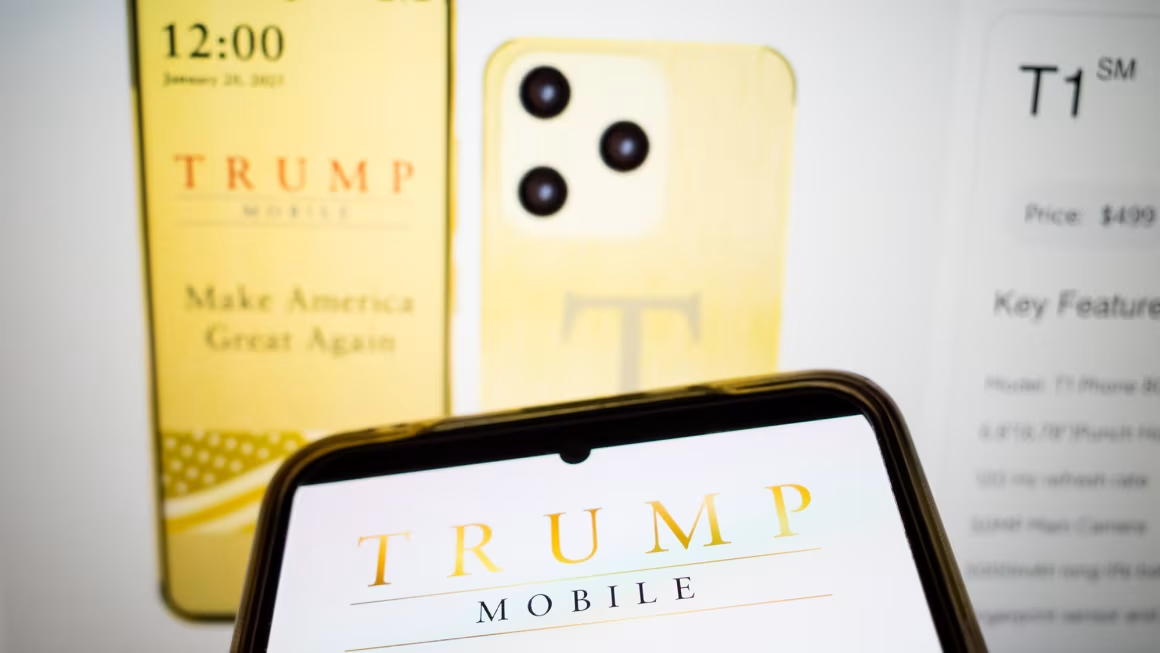
Trump Mobile, the wireless service provider and phone company launched by the Trump Organization, no longer promises on its website that its upcoming smartphone will be made in America.
The company adjusted language on its website on or around June 22 to drop the “Made in USA” claim, according to captures of the site by the Internet Archive. As of June 25, the company says the T1 8002 phone was “designed with American values in mind.” The website previously said the phone was “Made in the USA,” according to screenshots taken by NY Budgets earlier in June and archived versions of the site from June 18. The Verge first reported the change.
The revised language comes after industry analysts expressed skepticism about the phone’s American origins, noting that its specifications resembled a phone made by a Chinese manufacturer.
Despite changed language on the site, a spokesperson for Trump Mobile told Fox News that “the T1 phones are proudly being made in America.”
“Speculation to the contrary is simply inaccurate,” the statement said.
The Trump Organization’s press release from last week announcing Trump Mobile still says the $499 gold-colored phone will be “proudly designed and built in the United States.”
In the formal announcement from Trump Tower on June 16, Trump Mobile partner Pat O’Brien said, ”we are going to be doing phones that we are going to build in America.” But later, in a clip from an interview with conservative media personality Benny Johnson, Eric Trump said “eventually all the phones can be built in the United States of America.”
Ryan Reith, group vice president for the International Data Corporation’s Worldwide Device Tracker, previously told CNN that terms like “designed” and “built” are very vague. That makes it unclear precisely what parts of the phone making process would have taken place in the US. Apple, for example, designs its phones in California, but assembles them in areas like China and India with components from international suppliers.
Trump Mobile’s website says the phone is “brought to life right here in the USA.”
“There (are) no phones that are really being built in the US from start to finish,” Reith said last week when Trump Mobile was announced.
Some of the T1 8002 phone’s specifications also have changed, according to the Trump Mobile website. While the phone was originally listed as having a 6.78-inch screen, the website now says it has a 6.25-inch screen. That’s a noticeable change in size similar to the difference between an iPhone 16 and an iPhone 16 Pro Max. It’s rare for a tech company to make such a drastic change after announcing a phone.
Trump Mobile also no longer lists the phone’s memory, the part of the phone that stores app data and impacts performance when switching between apps.
Todd Weaver, CEO of Purism, one of the only known companies to actually manufacture a cell phone in the United States, and Max Weinbach, an analyst at market research firm Creative Strategies, independently told NY Budgets previously that they believe the originally announced T1 phone looks like a version of the already available Revvl 7 Pro 5G. That phone is made by China-based Wingtech, which provides manufacturing services for smartphones and other products, and retails for around $169 on Amazon.
The debut of Trump Mobile came as President Trump, who is not involved in the daily operations of the Trump Organization run by his sons, has been pressuring tech giants like Apple and Samsung to make their smartphones in the United States. The move is part of a push to bring manufacturing jobs back to America, although experts have said making phones domestically at scale is a challenging, if not impossible, task – particularly under the September timeframe originally promised.
“Unless the Trump family secretly built out a secure, onshore or nearshore (fabrication) operation over years of work without anyone noticing, it’s simply not possible to deliver what they’re promising,” Weaver previously said.
Hawaiian Airlines disclosed a cybersecurity event affecting some of its IT systems on June 26, sparking concerns across the industry. Despite the breach, the airline emphasized that flight operations remained unaffected, and the Federal Aviation Administration confirmed there was no safety impact.
Hawaiian identified a “cybersecurity event” on June 23, first notifying the public early on June 26 via its newsroom.
The airline did not specify which IT systems were targeted, though third-party reporting suggests reservation, check-in, and backend tools may have been affected.
No ransomware group has claimed responsibility, and there have been no confirmed ransom demands or data breaches.
Despite the disruption, Hawaiian affirmed that “flights are operating safely and as scheduled,” and brought in cybersecurity experts and federal authorities to manage the incident.
The FAA’s safety office affirmed it’s in active contact with Hawaiian and there is no impact on flight safety. Monitoring continues as investigators work to contain and resolve the situation.
Cybersecurity experts note that airlines are increasingly being targeted due to their reliance on interconnected systems storing sensitive passenger data. Google’s Mandiant, for example, suggests the attack bears hallmarks of the notorious Scattered Spider gang—though no definitive attribution has been made.
This incident follows similar cyberattacks in recent months—including those affecting WestJet and Japan Airlines—and underscores a systemic vulnerability in aviation’s digital infrastructure.
Hawaiian’s cybersecurity event also drew attention on financial markets. Alaska Air Group (parent company of Hawaiian) saw shares dip slightly following news of the incident, though broader upward trends attributed to travel recovery persisted.
Ensure critical systems (booking, check-in, loyalty) are fully reinstated. Forensics underway—CISA, FBI, Mandiant-like firms assisting in attribution. FAA and CISA to determine compliance or mitigation steps. Strengthen MFA, patch legacy systems, and consolidate redundancies.
Dr. Darren Williams, CEO of BlackFog, warns that airlines must elevate defenses beyond basic protections:
“The primary goal of cyber attacks is often not just to access systems but to use sensitive or personal data as leverage for extortion… operators must remain vigilant”.
Though Hawaiian Airlines has contained the incident without disrupting flights, the episode serves as a stark reminder: one weak link in IT systems can potentially cripple core airline operations. The coming weeks will be pivotal—bringing scrutiny from regulators, deep technical audits, and attention to whether sufficient resilience is being built across the aviation industry.
Cybercriminals have breached insurance giant Aflac, potentially stealing Social Security numbers, insurance claims and health information, the company said Friday, the latest in a spree of hacks against the insurance industry.
With billions of dollars in annual revenue and tens of millions of customers, Aflac is the biggest victim yet in the ongoing digital assault on US insurance companies that has the industry on edge and the FBI and private cyber experts scrambling to contain the fallout.
Erie Insurance and Philadelphia Insurance Companies have also reported hacks this month, which in those cases have caused widespread disruptions to IT systems used to serve customers. All three insurance-company hacks are consistent with the techniques of a young and rampant cybercrime group known as Scattered Spider, people familiar the investigation tell CNN.
“This attack, like many insurance companies are currently experiencing, was caused by a sophisticated cybercrime group,” Aflac said in a statement on Friday, without naming Scattered Spider. Aflac said it “stopped the intrusion within hours” after discovering it last week, that no ransomware was deployed, and that it continues to serve its customers.
It was too early to tell, the company said, how much customer information may have been stolen, but the potential exposure is vast. Aflac is one of the largest providers of supplemental health insurance in the US for medical expenses that aren’t covered by a primary provider.
The hackers used “social engineering” to worm their way into its network, according to Aflac. That tactic can involve duping someone into revealing security information to help gain access to a network. It’s a hallmark of Scattered Spider attackers, who are known to pose as tech support to infiltrate big corporations.
The loose group of cybercriminals is considered dangerous and unpredictable, in part because it is believed to be comprised of youths in the US and the UK known for aggressively extorting their victims. Scattered Spider shot to infamy in September 2023 when they were linked to a pair of multimillion-dollar hacks on famous Las Vegas casinos and hotels MGM Resorts and Caesars Entertainment.
The hackers’ tactics, and the way they target big swaths of American industries at a time, has cybersecurity executives pleading with companies to be wary of suspicious phone calls to their employees. Just last month, they were suspects in multiple cyberattacks on American retail companies.
“If Scattered Spider is targeting your industry, get help immediately,” said Cynthia Kaiser, who until last month was deputy assistant director of the FBI’s Cyber Division and oversaw FBI teams investigating the hackers. “They can execute their full attacks in hours. Most other ransomware groups take days.”
Scattered Spider often registers web domains that look very much like trusted help desks that companies use for IT support, the cybersecurity firm Halcyon, where Kaiser now works, says in a forthcoming report.
While concerns about Iranian cyber capabilities are in the news because of the Israel-Iran war, “the threat I lose sleep over is Scattered Spider,” said John Hultquist, chief analyst at Google’s Threat Intelligence Group. “They are already taking food off shelves and freezing businesses. The Iranian hackers may not even have Internet access, but these kids are in play right now.”
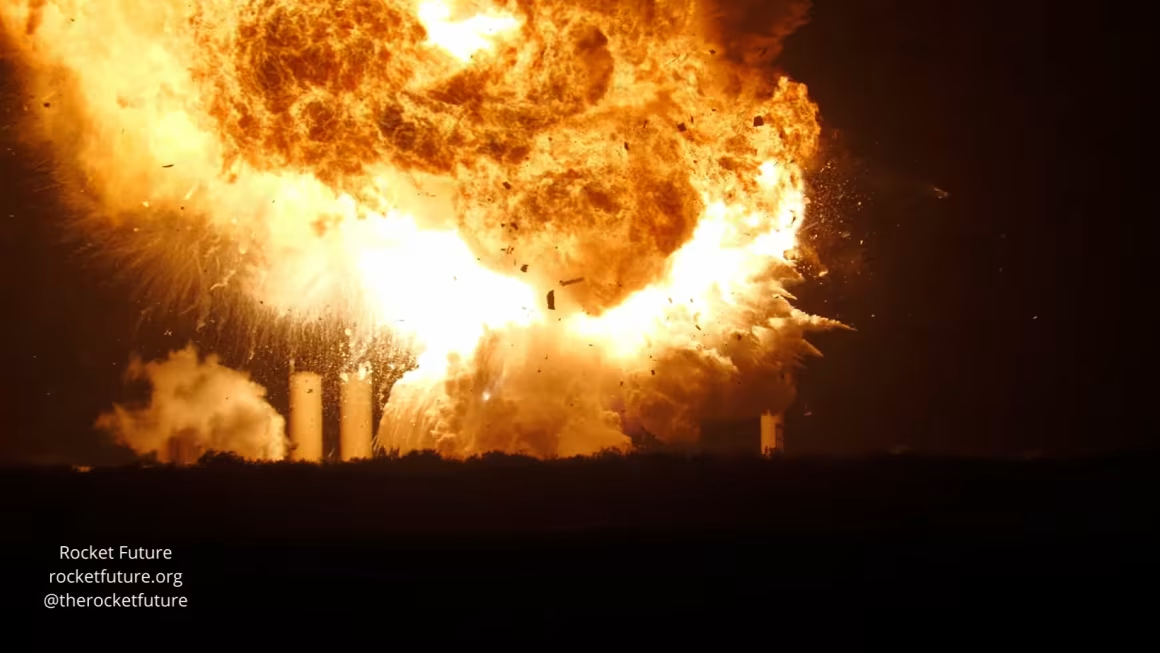
The explosion of a SpaceX Starship vehicle during a routine ground test Wednesday sent out a shock wave of fire and smoke that appeared to engulf the company’s testing facilities in Starbase, Texas. The mishap raised questions about the company’s ability to hash out significant design and engineering challenges on a vehicle considered crucial to SpaceX’s founding goal of eventually carrying convoys of people to Mars.
When SpaceX CEO Elon Musk spoke to employees in South Texas in late May, aiming to once again stoke support for his Mars ambitions, he emphasized the metric by which he would gauge success: “Progress is measured by the timeline to establishing a self-sustaining civilization on Mars.”
Later in his speech — which Musk gave two days after the company’s most recently launched Starship prototype failed upon reentry, marking the third premature ending for a test flight this year — he spelled out the exact timeline SpaceX would chase. The road map hinges on specific deadlines dictated by the laws of physics, thanks to just how far Earth is from the red planet.
The distance between Earth and Mars can range from about 35 million miles to 250 million miles (56 million kilometers to 400 million kilometers), depending on where each planet lies in its orbital path around the sun. To save time and fuel costs, missions aiming to visit the red planet must wait until it’s at its ideal point relative to Earth — prime alignment opportunities, otherwise known as a “Mars transfer windows,” that span a few weeks and occur only about every 26 months.
Missions save time and fuel costs by launching when Mars is at its ideal point relative to Earth. (SpaceX)
The next window, during which the travel time to Mars is cut down from over a year to just six to nine months, is coming up in late 2026. Musk’s road map suggests SpaceX hopes to send up to five uncrewed Starship vehicles loaded with cargo to Mars during that time. But there are several major concerns that SpaceX will need to address before its first cargo ship sets out for the red planet, and Wednesday’s explosion — Starship’s fourth so far this year — may be evidence of that.
Anticipated upgrade for Starship
Musk spoke to the feasibility of reaching Mars in 2026 during that May speech, saying that he imagined there was only a “50/50 chance” SpaceX could get a Starship spacecraft to Mars next year.
Before the 2026 Mars transfer window opens, SpaceX plans to debut another upgraded version of the Starship spacecraft and Super Heavy rocket booster — which together make up the most powerful launch system ever constructed.
On the new Starship system, both the first-stage booster and upper-stage ship will be slightly larger and together will be able to carry 661,387 pounds (300 metric tons) of propellant.
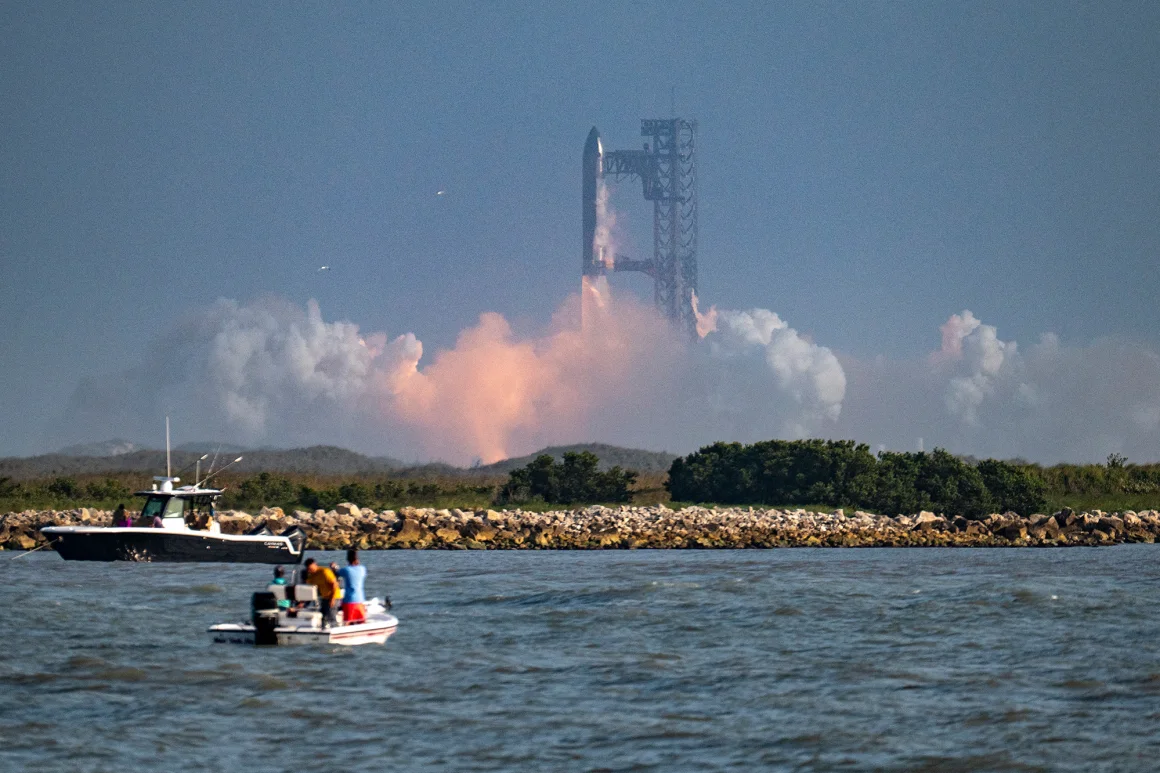
The SpaceX Starship rocket launches on its ninth uncrewed test flight from Starbase, Texas, on May 27. (Sergio Flores/AFP/Getty Images)
It’s a substantial upgrade similar to the one SpaceX debuted earlier this year, Starship Version 2, which added 25% more propellant capacity compared with earlier test flight models.
And SpaceX has struggled to get Version 2 to perform as expected: The first two test flights, carried out in January and March, each failed minutes after takeoff, raining debris near populated islands east of Florida.
The last test flight in May made it farther into flight, but the Starship spacecraft lost control before reentry, leading to a nail-biting, uncontrolled descent into the Indian Ocean.
And Wednesday’s explosion during a routine ground test raises even more concerns about how long it will take SpaceX to fine-tune Starship’s design and guarantee it can transport cargo or humans safely. The company hasn’t revealed how much of a setback it might be for the vehicle or its launch facilities.
Preliminary data suggested the explosion was caused by a gas tank that exploded, Musk said in a social media post. The tank “failed below its proof pressure,” he said, meaning that prior stress tests and the known properties of the tank suggested it should have survived the scenario. It’s potentially a unique problem that has never been observed before.
During his May 29 speech, Musk emphasized that introducing even more upgrades and further stretching Starship’s size is crucial to long-term success.
“It takes three major iterations of any major new technology to have it really work well,” Musk told employees during his Starship update.
An unprecedented challenge
Musk has said he hopes the updated Starship will make its flight debut by the end of the year.
But even if the new version pulls off a pristine test flight along the same suborbital route where SpaceX has carried out previous Starship test missions, it won’t guarantee the vehicle is ready for an interplanetary excursion.
That’s because, even with added fuel capacity, Starship must be topped off with more propellant after it reaches space to make the long trip to Mars.
SpaceX plans to do this by launching a series of tankers, or Starship vehicles designed to carry batches of fuel and oxidizer. Those tankers would rendezvous with the Starship while it idles in Earth’s orbit, transferring thousands of pounds of propellant and delivering the fuel the vehicle needs to continue its journey deeper into the solar system.
Notably, transferring fuel between two vehicles in space has never been done before.
“We’ve never done that. Nobody’s done that — transferring fuel from one spacecraft to another in orbit autonomously,” said Bruce Jakosky, a professor emeritus of geological sciences at the University of Colorado Boulder’s Laboratory for Atmospheric and Space Physics.
“That’s difficult,” Jakosky added, especially considering the Starship vehicle runs on cryogenic fuels — essentially oxygen and methane that are kept at temperatures so cold they liquify. And in the microgravity environment of orbit, that fuel can float about in its tank rather than settling in one place. So, among myriad other technical difficulties, SpaceX will likely have to devise pumps or motors that can effectively funnel the fuel from one ship to another.
Currently, it’s not even clear how many tankers SpaceX would need to launch to give one Starship vehicle enough gas for a trip to Mars. (In prior estimates, NASA personnel and third-party experts projected it may take roughly one dozen Starship tankers for a moon mission.)
In his speech, Musk said that he believed in-space fuel transfer would be “technically feasible.”
SpaceX will not attempt to carry out its first tanker flight test before next year, Musk added.
Barriers to reentry
Even after SpaceX sorts out the propellant transfer problem, they’ll face another significant technological question: How will Starship survive the trip down to the surface of Mars?
Musk last month called this issue “one of the toughest problems to solve.”
“No one has ever developed a truly reusable orbital heat shield so that is extremely difficult to do,” he said. “This will be something that we’ll be working on for a few years, I think, to keep honing.”
Vehicles that need to safely land on planetary bodies while traveling at orbital speeds must have a component called a heat shield — a special coating on the vehicle’s exterior that serves as a buffer to the scorching temperatures generated by the process of entering a planet’s atmosphere.
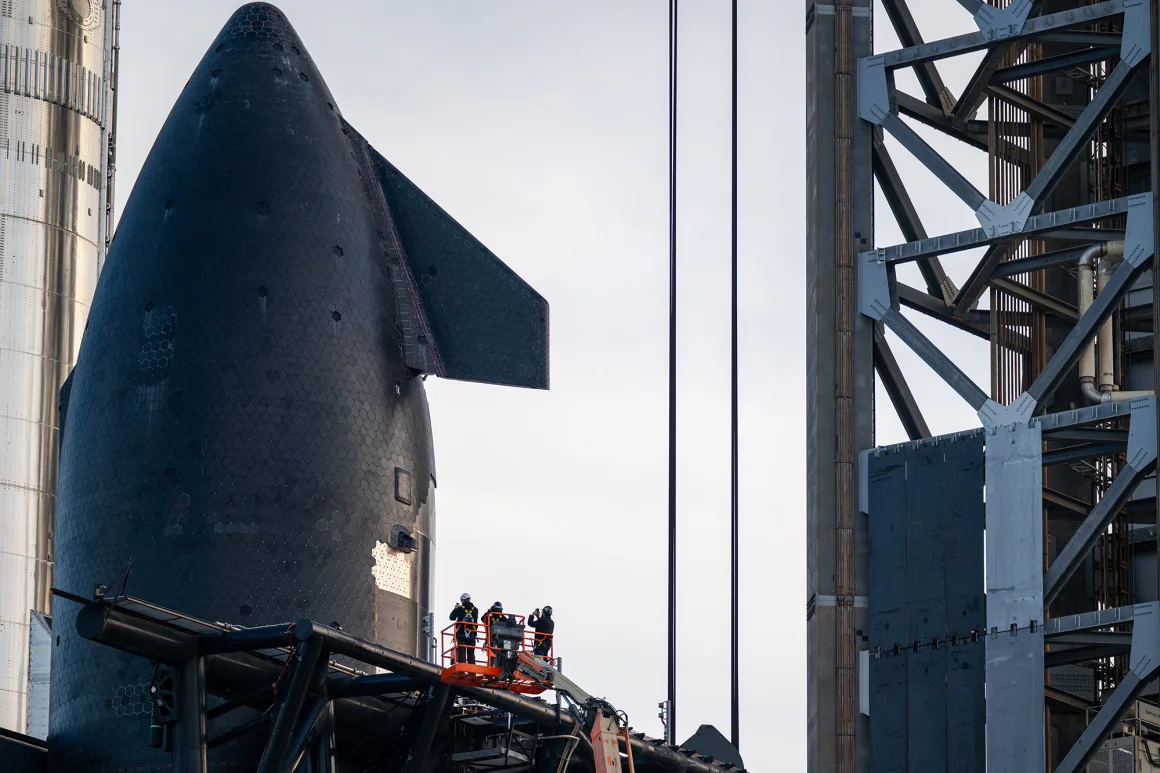
Workers survey the SpaceX Starship rocket on March 3 ahead of its eighth uncrewed test flight. (Brandon Bell/Getty Images)
On Mars, one crucial problem is the air: It’s almost entirely made up of carbon dioxide.
When Starship slams into Mars’ atmosphere, it will violently compress the air in front of it and create searing temperatures. And the conditions of reentry are so intense that the process literally rips electrons away from atoms and splits molecules, turning the carbon dioxide into carbon and oxygen — the latter of which may start to “oxidize” or essentially incinerate the spacecraft’s heat shield, Musk said.
Reentry on Mars will actually produce more heat–shield-destroying oxygen than the process of returning to Earth, Musk noted. Starship’s heat shield will ultimately need to be durable enough to survive both types of reentry, potentially multiple times.
The human problem
While the odds of SpaceX solving all the necessary technical quandaries in time to send a cargo-filled Starship to Mars at the end of next year are likely small, even larger problems must be solved later down the road.
If SpaceX wants to send humans to the red planet, for example, the company must figure out how to ensure Starship’s exterior can keep people safe from the deadly radiation that will shower down throughout the six-month journey. Life support systems with plenty of breathable air would need to be on board.
As Musk put it, every single human need must be accounted for. “You can’t be missing even, like, the equivalent of vitamin C,” he said.
Once a Starship vehicle reaches its destination, it would likely need to top off its fuel at a Martian depot before returning home — another feat that presents enormous technological challenges.
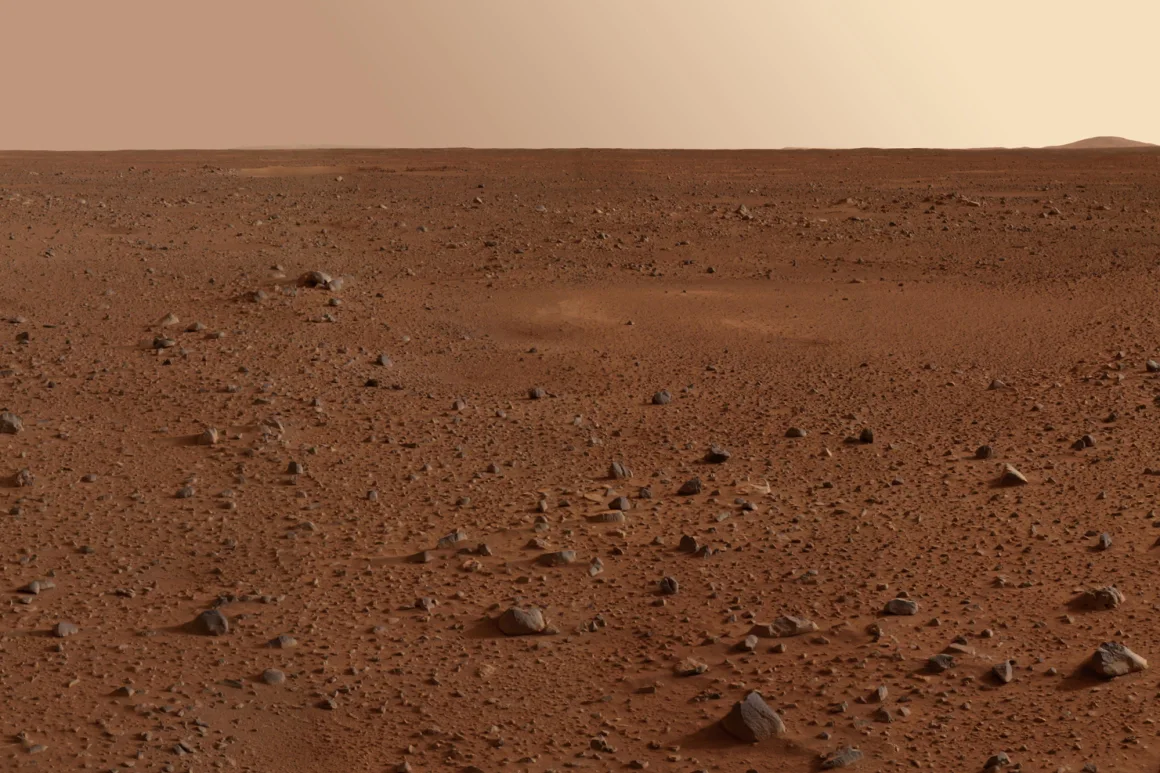
Starship’s heat shield will need to be durable enough to survive a trip to the surface of Mars. (NASA/JPL/Cornell)
The idea that enough infrastructure will exist on Mars by 2029 — or 2031, as Musk has said in prior social media posts — to make such a crewed mission possible is outlandish.
Still, industry experts say SpaceX’s bold ambitions spark both excitement and skepticism.
“I am a fan of what SpaceX is trying to do. I totally subscribe to this vision of a multi-planetary society,” said Olivier de Weck, the Apollo Program Professor of Astronautics and Engineering Systems at the Massachusetts Institute of Technology. “But it’s a logistical problem first and foremost. And what’s lacking to me is the thought about the cycling, the fuel production — and the return to Earth.”
But Phil Metzger, a planetary physicist with the Florida Space Institute, emphasized that SpaceX does tend to deliver on its promises, even if it’s a few years behind schedule.
“I feel like they got unlucky on some of their (Starship test flight failures), having the types of failures they had the last three in a row,” Metzger said. “Considering their design and development philosophy, I think they’re still within the window of expected outcomes.”
But, Metzger added, “we’re reaching the point where you start to worry.”
Cookie Consent
We use cookies to improve your experience on our site. By using our site, you consent to cookies.
Contains information related to marketing campaigns of the user. These are shared with Google AdWords / Google Ads when the Google Ads and Google Analytics accounts are linked together.
90 days
__utma
ID used to identify users and sessions
2 years after last activity
__utmt
Used to monitor number of Google Analytics server requests
10 minutes
__utmb
Used to distinguish new sessions and visits. This cookie is set when the GA.js javascript library is loaded and there is no existing __utmb cookie. The cookie is updated every time data is sent to the Google Analytics server.
30 minutes after last activity
__utmc
Used only with old Urchin versions of Google Analytics and not with GA.js. Was used to distinguish between new sessions and visits at the end of a session.
End of session (browser)
__utmz
Contains information about the traffic source or campaign that directed user to the website. The cookie is set when the GA.js javascript is loaded and updated when data is sent to the Google Anaytics server
6 months after last activity
__utmv
Contains custom information set by the web developer via the _setCustomVar method in Google Analytics. This cookie is updated every time new data is sent to the Google Analytics server.
2 years after last activity
__utmx
Used to determine whether a user is included in an A / B or Multivariate test.
18 months
_ga
ID used to identify users
2 years
_gali
Used by Google Analytics to determine which links on a page are being clicked
30 seconds
_ga_
ID used to identify users
2 years
_gid
ID used to identify users for 24 hours after last activity
24 hours
_gat
Used to monitor number of Google Analytics server requests when using Google Tag Manager