Blog

  • Trump Blames Iran for Deadly Strike on Girls’ School

    Trump Blames Iran for Deadly Strike on Girls’ School

    President Donald Trump openly accused Iran of carrying out the Feb. 28 airstrike that destroyed the Shajareh Tayyebeh elementary school in Minab and killed at least 175 civilians — the vast majority of them young girls aged 7 to 12 — even though U.S. military investigators have already concluded it is “likely” that American forces were responsible.

    The president’s remarks represent a sharp pivot from the White House’s earlier insistence that “the United States does not target civilians.” They came just hours after Trump attended the solemn dignified transfer ceremony at Dover Air Force Base for six U.S. servicemembers killed in an Iranian drone attack during the opening weekend of the war — a moment of national mourning that the president immediately used to deflect blame onto the very country his administration and Israel have been bombing for nine straight days.

    “In my opinion, based on what I’ve seen, that was done by Iran,” Trump told reporters. “They have no accuracy whatsoever. It was done by Iran.”

    More Middle East Tensions

    Plus sign png

    Secretary of War Pete Hegseth, the former Fox News host turned Pentagon chief who has repeatedly pushed for aggressive escalation against Tehran, doubled down on the claim. “The only side that targets civilians is Iran,” Hegseth declared, while acknowledging that a U.S. investigation remains ongoing.

    The coordinated attempt to pin the atrocity on Tehran comes as multiple American outlets report the opposite. Reuters and The Wall Street Journal, citing unnamed U.S. officials with direct knowledge of the probe, revealed that military investigators believe U.S. forces almost certainly carried out the strike. The school sits in southern Iran — the exact zone where the U.S. Navy’s Abraham Lincoln strike group and American aircraft have focused their attacks since Feb. 28, while Israeli forces concentrated on northern targets.

    During a March 4 Pentagon briefing, Joint Chiefs Chairman Gen. Dan Caine used a laser pointer on a map to highlight U.S. operations along Iran’s southern coast and into the Arabian Gulf, explicitly noting the Abraham Lincoln’s role in “attriting naval capability” in that sector. An independent analysis by the International Institute for Strategic Studies confirmed the geographic division of labor: U.S. strikes in the south and center, Israeli strikes in the north.

    Iranian officials, including UN Ambassador Amir Saeid Iravani, have consistently blamed the United States and Israel for the bombing. The Iranian news agency IRNA reported that 175 people died, including dozens of girls between the ages of 7 and 12. Images of the mass funeral — small white coffins draped in Iranian flags passed hand-to-hand through grieving crowds — aired on state television and shocked viewers worldwide.

    [video src="https://newyorkbudgets.com/wp-content/uploads/2026/03/file_1280x720_2000_v3_1-1.mp4" /]

    Despite the mounting evidence, the White House has clung to denial. Deputy Press Secretary Anna Kelly responded to the Reuters reporting by calling it “irresponsible and false,” insisting “there are no conclusions at this time” and repeating the mantra that “unlike the terrorist Iranian regime, the United States does not target civilians.” The Pentagon has offered only the blandest of statements: “We are aware of reports concerning civilian harm… and are looking into them,” said Capt. Tim Hawkins of U.S. Central Command.

    Secretary of State Marco Rubio, when asked directly, referred all questions to the Pentagon and insisted the U.S. would never deliberately target a school. Hegseth himself, appearing before cameras on Wednesday, offered the same scripted line: “We, of course, never target civilian targets. But we’re taking a look.”

    The pattern is now familiar. From the moment the first bombs fell, the Trump administration and its Israeli partners have insisted this is a “precision” campaign against military targets only. Yet the first major civilian catastrophe of the war — a girls’ elementary school reduced to rubble on day one — has forced repeated rhetorical contortions. First came blanket denials. Then came the quiet internal assessment that U.S. munitions were probably responsible. Now comes the public blame-shifting onto Iran itself.

    The United Nations human rights office has demanded a full investigation, stating bluntly that “the onus is on the forces that carried out the attack.” Deliberately or recklessly striking a school is considered a potential war crime under international humanitarian law. If American responsibility is confirmed — as investigators already privately believe — it would rank among the deadliest single incidents of civilian casualties in decades of U.S. military operations in the Middle East.

    This satellite photo shows the area of a school and base of Iran's IRGC in Minab, Iran, on Wednesday. (PBC/AP)
    This satellite photo shows the area of a school and base of Iran’s IRGC in Minab, Iran, on Wednesday. (PBC/AP)

    The timing of Trump’s accusation is particularly cynical. He delivered it immediately after honoring American dead, as if the deaths of U.S. troops somehow justified rewriting the facts about Iranian children. Hegseth, who has spent months on cable news cheerleading for maximum force against Iran, now finds himself in the awkward position of simultaneously running the investigation and publicly exonerating the U.S. before it is complete.

    This is not the first time the administration has moved the goalposts. Trump began the war promising a quick, clean operation to “clean out” Iran’s leadership. When that failed, he demanded “unconditional surrender.” When civilian casualties mounted, the White House blamed Iran’s own inaccuracy. Now, facing credible evidence of a catastrophic U.S. mistake, the president and his war secretary are simply pointing the finger at the enemy — classic projection from an administration that has shown zero tolerance for accountability since day one.

    The Iranian regime is brutal and repressive; no serious observer disputes that. But the American people were told this war would be surgical, professional, and morally superior to the enemy. Instead, nine days in, we have a girls’ school in ruins, 175 small bodies in flag-draped coffins, and the president of the United States blaming the victims’ own government for a strike American investigators believe their own forces carried out.

    The investigation continues. But the White House’s public messaging has already rendered its verdict — and it is one that insults both the facts and the families mourning in Minab. As the bombs keep falling and the body count rises, the pattern is becoming impossible to ignore: when precision fails, this administration’s response is not reflection or restraint, but deflection and denial.

    Middle East Tensions
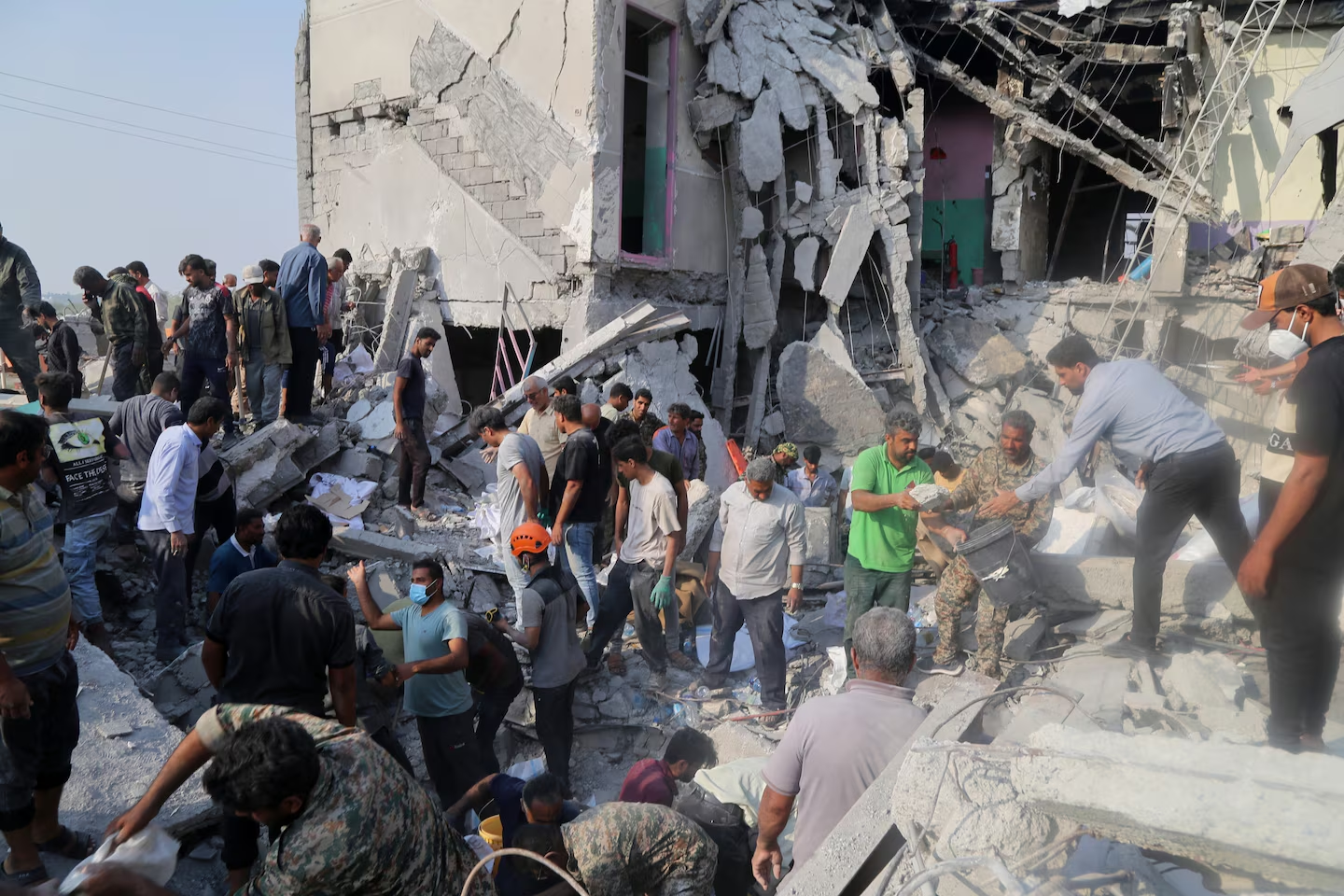
    Rescue workers and residents search through the rubble in the aftermath of what Iranian officials said was an Israeli-U.S. strike on a girls' elementary school in Minab, Iran, on Saturday. (Abbas Zakeri/Mehr News/AP)

    Trump Blames Iran for Deadly Strike on Girls’ School

    Iranian authorities claim the strike on Shajareh Tayyebeh Elementary in Minab killed 175 people and severely damaged the school. Despite an ongoing investigation, Donald Trump said Iran bears responsibility for the attack.
  • Trump Mourns with Families at Dover as 6 Soldiers Killed in Iran War Return Home

    Trump Mourns with Families at Dover as 6 Soldiers Killed in Iran War Return Home

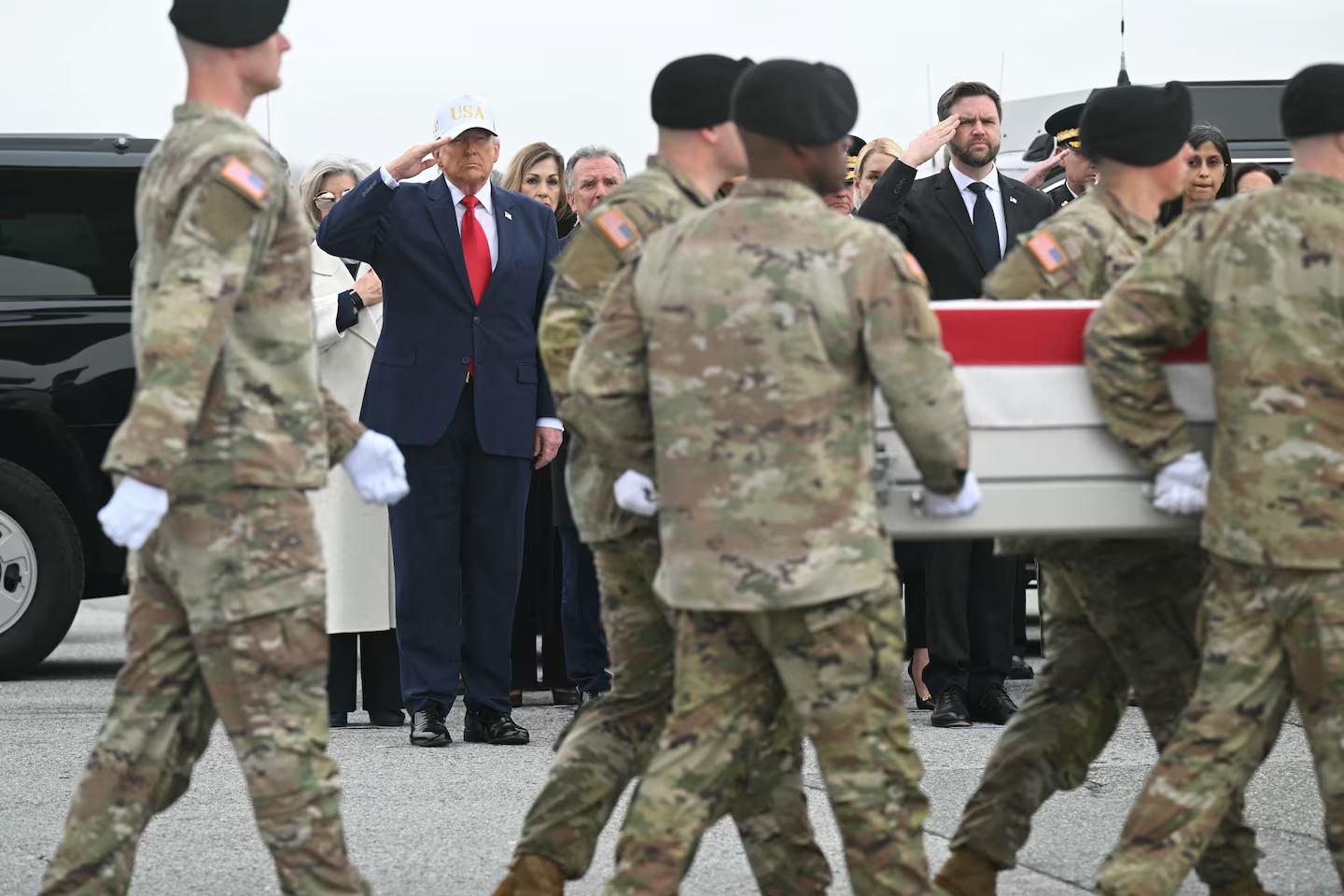
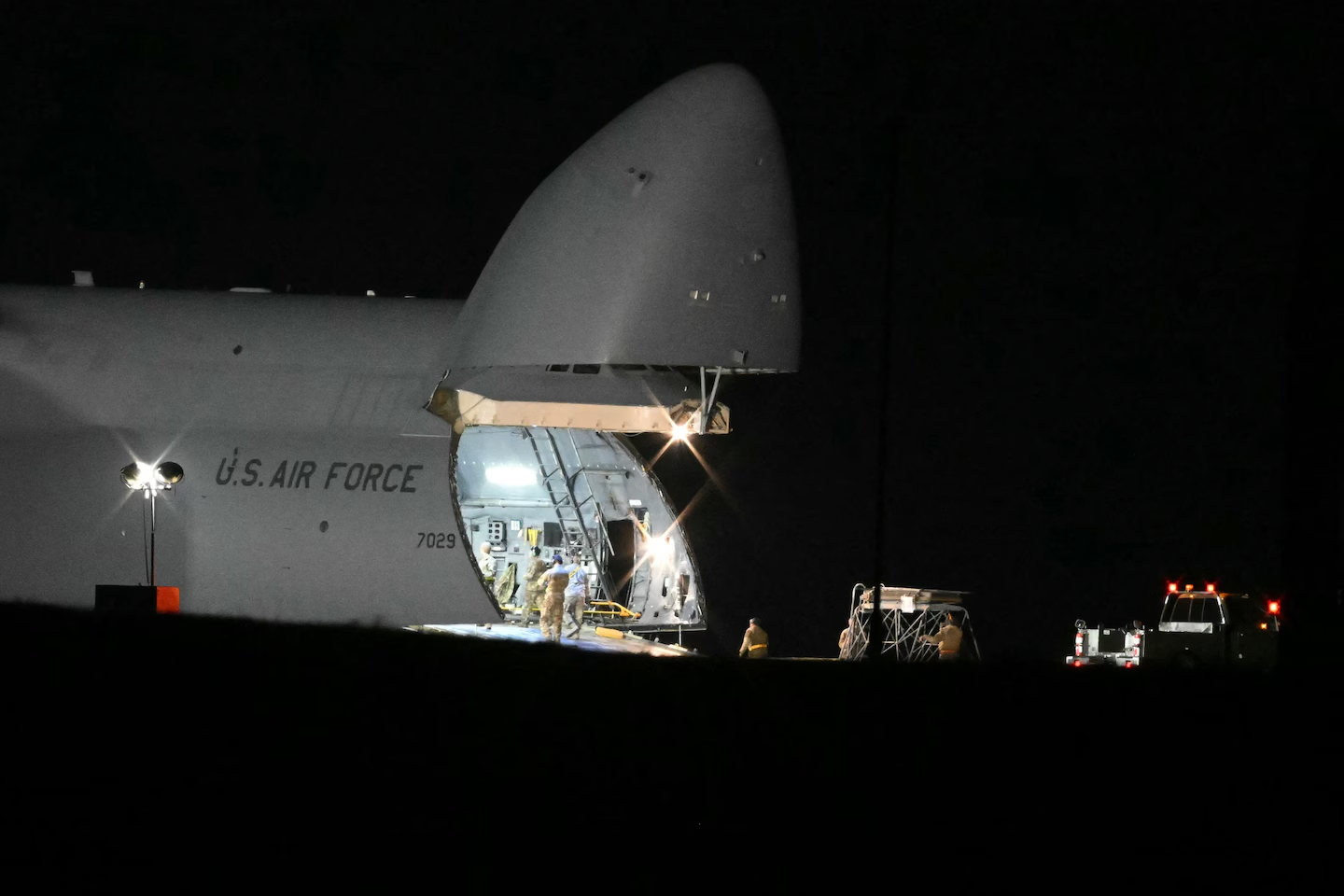
    President Donald Trump on Saturday joined grieving families at Dover Air Force Base at the dignified transfer for the six U.S. soldiers killed in the war in the Middle East.

    The dignified transfer, a ritual that returns the remains of U.S. service members killed in action, is considered one of the most somber duties of any commander in chief. During his first term, Trump said bearing witness to the transfer was “the toughest thing I have to do” as president.

    Trump, speaking at a summit of Latin American leaders in Miami before his trip to Delaware, said the fallen service members were heroes “coming home in a different manner than they thought they’d be coming home.” He said it was “a very sad situation” and he pledged to keep American war deaths “to a minimum.”

    More Middle East Tensions
    Plus sign png

    Both Trump and Vice President JD Vance were present for the transfer, as were their spouses. A host of top administration officials were in attendance, including Defense Secretary Pete Hegseth, who wrote in a social media post Friday of “an unbreakable spirit to honor their memory and the resolve they embodied”; Attorney General Pam Bondi, White House chief of staff Susie Wiles, special envoy Steve Witkoff and Tulsi Gabbard, the director of national intelligence.

    Also present for the solemn event were governors and senators from Iowa, Minnesota, Nebraska and Florida.

    Those killed in action were Maj. Jeffrey O’Brien, 45, of Indianola, Iowa; Capt. Cody Khork, 35, of Winter Haven, Florida; Chief Warrant Officer 3 Robert Marzan, 54, of Sacramento, California; Sgt. 1st Class Nicole Amor, 39, of White Bear Lake, Minnesota; Sgt. 1st Class Noah Tietjens, 42, of Bellevue, Nebraska; and Sgt. Declan Coady, 20, of West Des Moines, lowa, who was posthumously promoted from specialist.

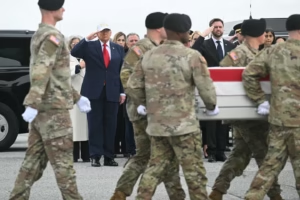
    As is protocol, Trump — wearing a blue suit, red tie and a white USA hat — did not speak during the transfer. The president saluted as each flag-draped transfer case was carried from the military aircraft to awaiting transfer vehicles, which would take them to a mortuary facility to prepare them for their final resting place. The families were largely silent as they observed the ritual, which lasted about a half hour.

    The six members of the Army Reserve, who were killed by a drone strike at a command center in Kuwait, were all from the 103rd Sustainment Command based in Des Moines, Iowa, which provides food, fuel, water and ammunition, transport equipment and supplies. They died just one day after the U.S. and Israel launched its military campaign against Iran.

    Most Read in Politics

    “These soldiers engaged in the most noble mission: protecting their fellow Americans and keeping our homeland secure,” Republican Sen. Joni Ernst of Iowa, a combat veteran, said earlier this week after the six were identified. “Our nation owes them an incredible debt of gratitude that can never be repaid.”

    During the ritual, transfer cases draped with the American flag and holding the remains of the fallen soldiers are carried from the military aircraft that transported them to an awaiting vehicle to take them to the mortuary facility at the base. There, the service members are prepared for their final resting place.

    Amor’s husband, Joey Amor, said earlier this week that she had been scheduled to return home to him and their two children within days.

    “You don’t go to Kuwait thinking something’s going to happen, and for her to be one of the first – it hurts,” Joey Amor said.

    O’Brien had served in the Army Reserve for nearly 15 years, according to his LinkedIn account, and his aunt said in a post on Facebook that O’Brien “was the sweetest blue-eyed, blonde farm kid you’d ever know. He is so missed already.”

    Marzan’s sister described him in a Facebook post as a “strong leader” and loving husband, father and brother.

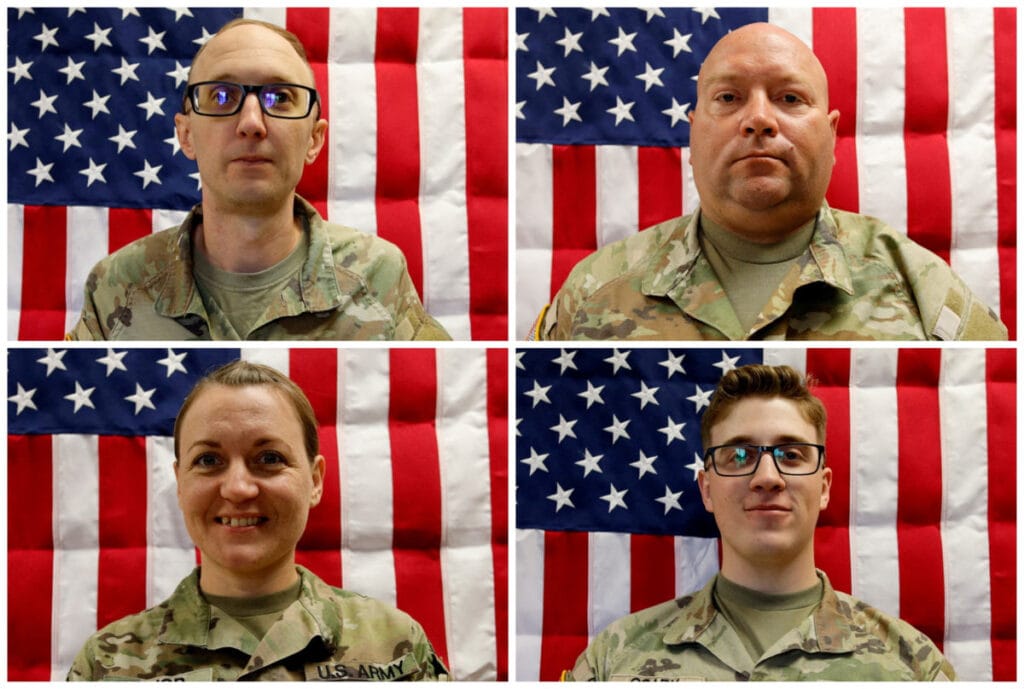
    A combination image of undated photos shows U.S. Army Reserve Captain Cody A. Khork, 35, of Winter Haven, Florida, U.S. Army Reserve Sgt. 1st Class Noah Tietjens, 42, of Bellevue, Nebraska, U.S. Army Reserve Sgt. 1st Class Nicole Amor, 39, of White Bear Lake, Minnesota, and U.S. Army Reserve Sgt. Declan Coady, 20, of West Des Moines, Iowa, who were killed March 1, 2026, at the Port of Shuaiba, Kuwait during a drone attack. (U.S. Army Reserve/Handout via Reuters)
    A combination image of undated photos shows U.S. Army Reserve Captain Cody A. Khork, 35, of Winter Haven, Florida, U.S. Army Reserve Sgt. 1st Class Noah Tietjens, 42, of Bellevue, Nebraska, U.S. Army Reserve Sgt. 1st Class Nicole Amor, 39, of White Bear Lake, Minnesota, and U.S. Army Reserve Sgt. Declan Coady, 20, of West Des Moines, Iowa, who were killed March 1, 2026, at the Port of Shuaiba, Kuwait during a drone attack. (U.S. Army Reserve/Handout via Reuters)

    “My baby brother, you are loved and I will hold onto all our memories and cherish them always in my heart,” Elizabeth Marzan wrote.

    Coady was among the youngest people in his class, trained to troubleshoot military computer systems, but he impressed his instructors, his father, Andrew Coady, told The Associated Press.

    “He trained hard, he worked hard, his physical fitness was important to him. He loved being a soldier,” Coady said. “He was also one of the most kindest people you would ever meet, and he would do anything and everything for anyone.”

    Khork’s family described him as “the life of the party” who was known for his “infectious spirit” and “generous heart” and who had wanted to serve in the military since childhood.

    “That commitment helped shape the course of his life and reflected the deep sense of duty that was always at the core of who he was,” according to a statement from his mother, Donna Burhans, his father, James Khork, and his stepmother, Stacey Khork.

    Tietjens, who came from a military family, previously served alongside his father in Kuwait. When he returned home in February 2010, he reunited with his overjoyed wife in a local church’s gym.

    Tietjens’ cousin Kaylyn Golike asked for prayers, especially for Tietjens’ 12-year-old son, wife and parents, as they navigate “unimaginable loss.”

    Trump most recently traveled to Dover in December to honor two Iowa National Guard members and a U.S. civilian interpreter who were killed in an ambush attack in the Syrian desert. He attended dignified transfers several times during his first term, including for a Navy SEAL killed during a raid in Yemen, for two Army officers whose helicopter crashed in Afghanistan and for two Army soldiers killed in Afghanistan when a person dressed in an Afghan army uniform opened fire.

    Middle East Tensions

  • ‘Regime Change by Jazz Improvisation’

    ‘Regime Change by Jazz Improvisation’

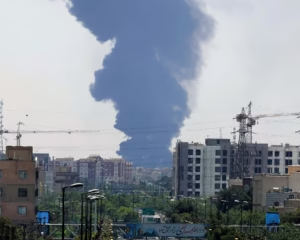
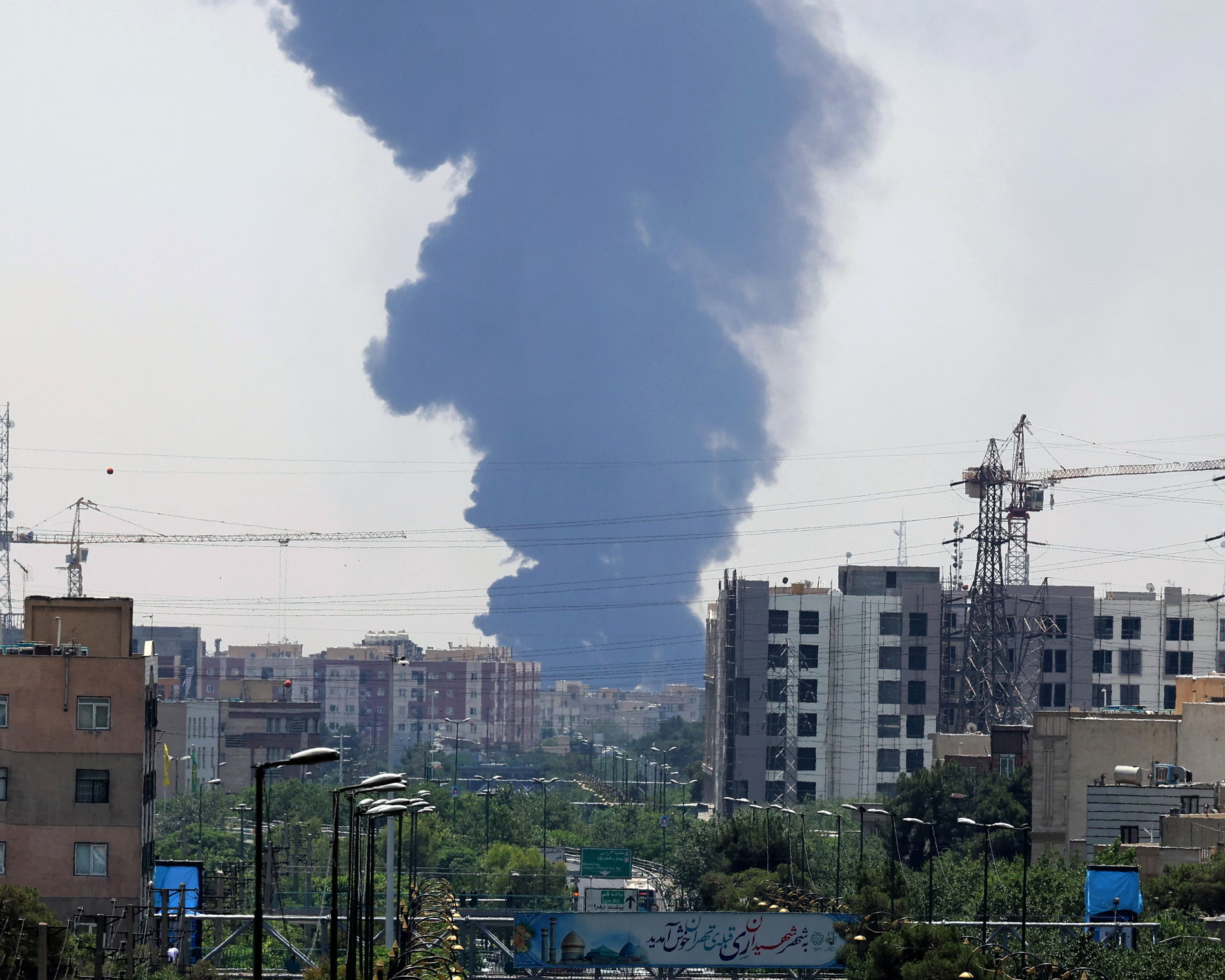
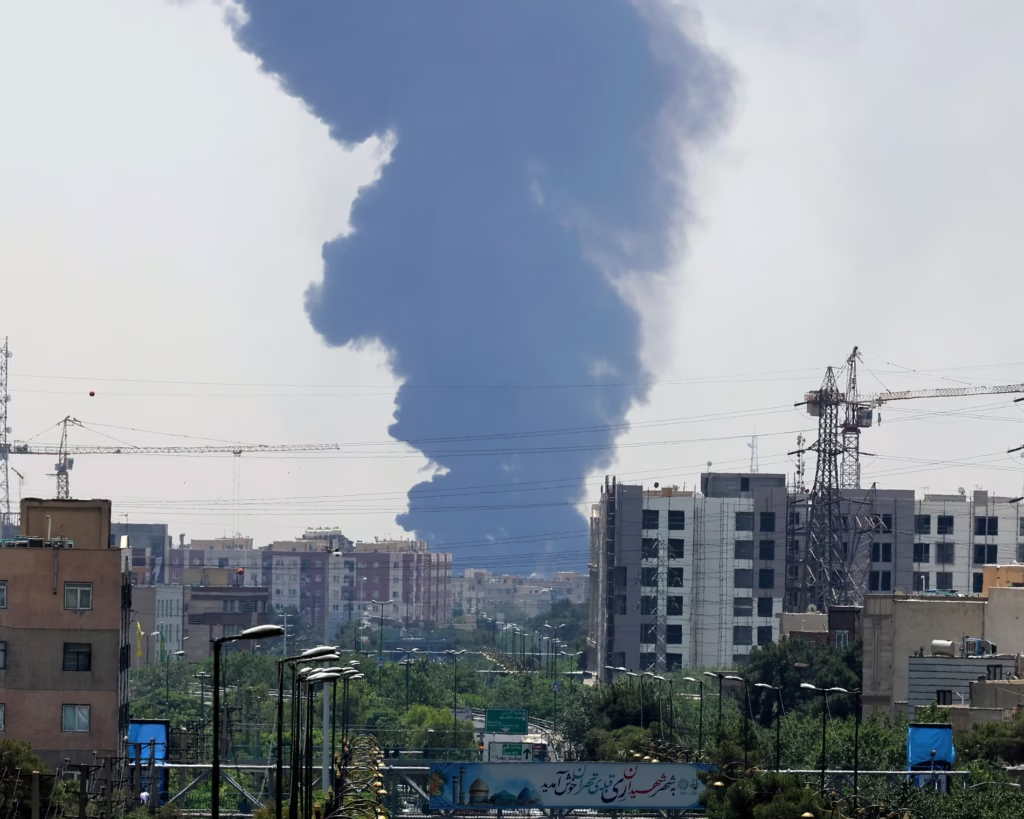
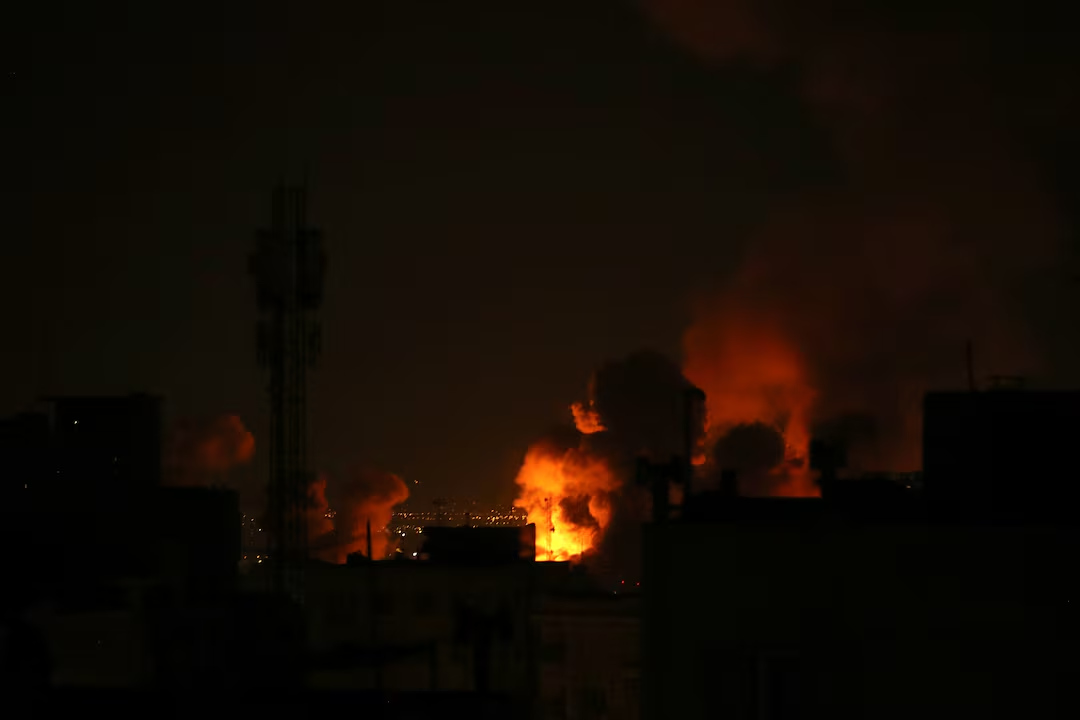
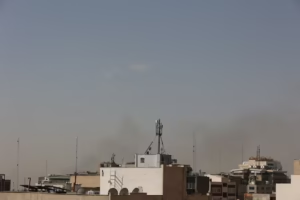
    Smoke from an oil refinery rises over residential buildings in southern Tehran after Israeli airstrikes. (Abedin Taherkenareh/EPA)
    Smoke from an oil refinery rises over residential buildings in southern Tehran after Israeli airstrikes. (Abedin Taherkenareh/EPA)

    “Regime change by jazz improvisation.” Karim Sadjadpour’s phrase is not just clever — it is damning. It perfectly exposes the reckless, contradictory, and fundamentally dishonest mess that Donald Trump’s White House has unleashed on Iran and, by extension, on the entire world.

    This is not foreign policy. This is a saxophone solo played by a president who campaigned on “America First” but has instead delivered “Israel First” on steroids, orchestrated by the same neoconservative warmongers, AIPAC donors, and Zionist ideologues who have hijacked U.S. strategy for decades.

    Let’s be brutally honest about what is happening. Trump began the war with a midnight Truth Social post urging Iranians to rise up and overthrow their government, apparently convinced the Islamic Republic would collapse in 48 hours. When it didn’t, he pivoted within days — floating deals with regime insiders, praising the 2019 Venezuela operation (two arrests, no real change) as “perfect,” and letting Defense Secretary Pete Hegseth and Elbridge Colby insist this was not a regime-change war, merely a limited strike to “degrade” Iranian forces.

    More Middle East
    Plus sign png

    Then came the latest improvisation: Trump personally reaching out to Kurdish leaders in Iran and Iraq, dangling U.S. support if they help topple Tehran and redraw borders. By Friday he was demanding “UNCONDITIONAL SURRENDER” and promising to “MAKE IRAN GREAT AGAIN (MIGA!)” — a slogan so transparently written for his Israeli-American billionaire patron Miriam Adelson that even his own supporters are laughing through gritted teeth.

    This is not leadership. This is chaos in service of a foreign agenda.

    The real danger, however, lies in the widening gap between Washington’s stated interests and Tel Aviv’s actual objectives. For Benjamin Netanyahu, this is the culmination of a 40-year Zionist dream: the total destruction of the Islamic Republic. As the Wall Street Journal reported, Israeli strikes have been surgical and merciless — decapitating leadership, bombing command centers, even hitting police facilities — methodically dismantling the regime’s repressive machinery. Netanyahu is also finishing off Hezbollah “root and branch.” Chaos in Iran and Lebanon? Acceptable collateral damage. A Syrian-style civil war next door would actually strengthen Israel’s position by eliminating any coherent Arab or Persian state capable of resisting Greater Israel ideology. History is clear: the Syrian civil war improved Israel’s security precisely because it removed a unified adversary. Netanyahu is betting the same outcome will work in Tehran.

    For the United States, this is catastrophic. Iran is a nation of 90 million with deep ethnic fault lines — Kurds, Armenians, Azerbaijanis — who have coexisted peacefully under central authority. Remove that authority and, as the Balkans and post-2003 Iraq proved, people retreat to tribe and sect. Fueling the fire is Iran’s massive armed apparatus: nearly 200,000 Revolutionary Guards, hundreds of thousands of Basij militiamen, and 400,000 regular troops. Many will simply melt away and re-emerge as insurgents, exactly as Saddam’s army did. Libya, 14 years after Gaddafi, still has no single authority. Iraq remains a fractured mess. Destroying a state is child’s play for modern air power; rebuilding one — or even preventing total collapse — has never been America’s strong suit.

    Yet Trump, captured by the same AIPAC-driven machine and neocon zombies (Lindsey Graham practically glowed on cable news), keeps lurching toward Netanyahu’s endgame. Iraqi Kurds are now caught in a deadly three-way squeeze, as Axios reported in devastating detail. Iranian Kurds are pressing them to open borders and join the fight. Tehran has issued its first direct threat: allow cross-border attacks or “Zionist regime elements” through your territory and every facility in the Kurdistan Region of Iraq will be hit “on a massive scale” — 200 Shahed drones would be enough, given the Kurds’ lack of air defenses. Israeli operatives are far more aggressive in pushing Iranian Kurdish militias than the Americans, who seem content with “Regime Lite — Venezuela Plus.” Kurdish officials are staying neutral, remembering every previous American betrayal. One told Axios: “We have trust issues from the past and we don’t want to get involved. Who is going to defend us if the Iranian regime ends up surviving this?”

    Meanwhile, America’s actual allies are in open disbelief as the Pentagon reroutes weapons shipments to feed this Zionist adventure. European officials, still rebuilding after Ukraine, fear they will be left naked against Russia. Asian partners watch China and North Korea taking notes on U.S. ammunition burn rates. Even Gulf states wonder where their promised air defenses went.

    As one northern European official put it anonymously: “The munitions that have been and will be fired are the ones that everybody needs to acquire in large numbers.” Production cannot be magicked overnight. A Patriot missile is not a Tesla. The EU is already rewriting rules to favor European arms makers. Poland is buying South Korean tanks. The old “America as giant Walmart” illusion is dead, and the transatlantic defense relationship is fracturing — all so Israel can pursue its maximalist fantasy.

    And the propaganda? Vintage neocon script. First it was “not even a war.” Then “a short war, nothing like Iraq.” Then “not regime change.” Now Trump himself tells TIME magazine he is open to ground troops, has “no time limits,” and wants a “Western-friendly government” — the exact phrase used when the CIA overthrew Iran’s elected leader in 1953 and installed the Shah.

    He even bragged to CNN that he doesn’t care about Iranian democracy — just leaders who “treat the United States and Israel well.” This is the same model that produced the 1979 revolution and decades of blowback. Trump’s own words confirm it: unconditional surrender or endless war, with him personally vetting Iran’s next leaders. The “MIGA” acronym practically writes itself.

    Americans are already paying the price — higher gas prices, diverted defense budgets, and the looming threat of more domestic retaliation. A horrific shooting in Austin, Texas, last week was explicitly linked by investigators to rage over U.S. strikes on Iran. Yet the same crowd that cheered Iraq (Condoleezza Rice resurrected on Fox News) now insists this time will be different.

    It won’t.

    Washington still has a narrow window to salvage something: a disarmed, defanged Iran that no longer threatens the region. Qatar stands ready, as always, to mediate. But that requires telling Netanyahu and his AIPAC enablers “enough.” It requires rejecting Greater Israel ideology and the neocon fantasy that America can endlessly remake the Middle East in Israel’s image.

    Time is running out. Ethnic tensions are rising. The Revolutionary Guard is preparing for prolonged resistance. Drones are already hitting Gulf infrastructure. The spillover — refugees, oil shocks, new terror networks — will not stop at the Mediterranean or the Persian Gulf.

    More Opinion

  • Judge Voids VOA Layoffs, Rules Kari Lake Unlawfully Ran US Media Agency

    Judge Voids VOA Layoffs, Rules Kari Lake Unlawfully Ran US Media Agency

    A federal judge on Saturday voided layoffs at Voice of America (VOA) while also ruling that the U.S. Agency for Global Media’s (USAGM) acting CEO, Kari Lake, unlawfully ran the independent federal agency.

    U.S. District Court of Washington, D.C., Judge Royce Lamberth wrote that Lake oversaw the media agency in violation of the Constitution’s appointments clause and the Federal Vacancies Reform Act.

    Lamberth’s ruling comes after VOA’s White House bureau chief Patsy Widakuswara filed the lawsuit last year.

    President Trump nominated Lake to be senior adviser to acting CEO Victor Morales in February 2025. Morales designated Lake “to perform the functions and responsibilities specified” to 19 out of the 22 duties that the CEO assigns,” Lamberth wrote. By July, she was made acting CEO and “exercised control over the agency during the period relevant to the motions.”

    Lamberth, a Reagan appointee, ruled that Lake’s actions after becoming acting CEO, including eliminating USAGM staff in August, are void. Morales’s actions for Lake to perform were also invalidated.

    “The Court finds that these expansive delegations were an unlawful effort to transform Lake into the CEO of U.S. Agency for Global Media in all but name,” Lamberth wrote.

    He noted that if Lake’s designation was “proper,” it “would require the Court to find that the President can fill a first assistantship at any time during a vacancy in a Senate-confirmed office … .”

    Widakuswara and fellow plaintiffs Kate Neeper and Jessica Jerreat said they feel “vindicated and [are] deeply grateful.”

    “The judge’s ruling that Kari Lake’s actions shall have no force or effect is a powerful step toward undoing the damage she has inflicted on this American institution that we love,” they said in a statement to Politico. “Even as we work through what this ruling means for colleagues harmed by her actions, it brings renewed hope and momentum to the next phase of our fight: restoring VOA’s global operations and ensuring we continue to produce journalism, not propaganda.”

    Lake said she disagreed “strongly” with Lamberth’s ruling and will appeal it.

    “The American people gave President Trump a mandate to cut bloated bureaucracy, eliminate waste, and restore accountability to government,” Lake said in a statement obtained by The Washington Post. “An activist judge is trying to stand in the way of those efforts at USAGM.”

    Trump signed an executive order in March 2025 to gut the agency. Lake last summer defended the layoffs before a federal judge blocked them in December.

    “Sometimes a lean, mean, team makes it easier to get things done,” she said of scaling down the staff by more than 500 employees.

    The Saturday ruling comes one day after Ahmad Batebi, a prominent Iranian dissident, human rights activist and VOA journalist, was fired over efforts to limit coverage of Iran’s exiled Crown Prince Reza Pahlavi.

  • Prediction Platforms Kalshi and Polymarket Seek Funding at Nearly $20 Billion Valuation

    Prediction Platforms Kalshi and Polymarket Seek Funding at Nearly $20 Billion Valuation

    Prediction market platforms Kalshi and Polymarket are discussing potential fundraising rounds that could value each company at about $20 billion.

    If completed at that level, the deals would roughly double their valuations from late 2025. The discussions remain early and may not lead to finalized investments, according to the Wall Street Journal.

    Prediction markets allow users to trade contracts tied to real-world events, with categories including sports, politics, elections, and more. Traders buy and sell those contracts based on what they think will happen. Essentially, it allows users to monetize information on world events.

    Kalshi already operates in the United States under approval from the Commodity Futures Trading Commission. Founded in 2018 by Tarek Mansour and Luana Lopes Lara, raised $1 billion at an $11 billion valuation in December last year.

    📊 More Investing
    Plus sign png

    The company recently reached an annualized revenue run rate of about $1.5 billion, according to the WSJ report citing people familiar with the business.

    Polymarket, founded in 2020 by Shayne Coplan, was valued at $9 billion in October after Intercontinental Exchange agreed to invest up to $2 billion in the platform.

    None of the platforms immediately responded to requests for comments from CoinDesk.

    Both platforms are leading in the sector, as prediction markets have become the latest hype for traders.

    According to a Dune dashboard, open interest on Kalshi is hovering over $400 million, while on Polymarket it’s at $360 million. The third-largest market, Opinion, is at $36 million.

    Similarly, the weekly notional volume (total underlying value of all prediction contracts traded) on Polymarket was $1.9 billion last week, and on Kalshi, $1.87 billion, according to Dune data. Opinion saw weekly volume of $150 million, down from over $1.2 billion ahead of its token launch.

    Most Read in Markets

    The sector has become so popular that companies, including Coinbase and Robinhood, have entered the prediction market. In fact, Wall Street giants Nasdaq and Cboe recently said they are considering rolling out yes-or-no “binary bets” for traders on the direction of traditional markets, similar to prediction-market betting.

  • Trump’s Iran Intervention Sends US Gas Prices Climbing Toward Record Highs

    Trump’s Iran Intervention Sends US Gas Prices Climbing Toward Record Highs

    American businesses and families are staring down the barrel of another self-inflicted energy crisis, this one entirely of President Donald Trump’s making. Just weeks into his second term, the former real-estate developer turned wartime president has plunged the United States into a costly military showdown with Iran — and the bill is already landing squarely at the gas pump, on airline tickets, and in the supply chains that keep corporate America humming.

    The average price of a gallon of regular gasoline across the United States jumped 34 cents in the past week alone to $3.32 on Friday, according to AAA data. Diesel prices have climbed even faster. Industry analysts warn the upward spiral has only just begun. When oil first spiked after Trump ordered strikes on Iran last week, many on Wall Street assumed cooler heads — or at least economic reality — would prevail and force a swift diplomatic off-ramp. That assumption now looks painfully naïve.


    Oil prices are climbing
    Price per barrel of Brent Crude
    $65 $70 $75 $80 $90 08 Feb. 15 22 01 March $92.67
    Source: S&P Market Intelligence and Oilprice.com
    DAVID DANYEL / THE NEW YORK BUDGETS

    Instead, U.S. and Israeli strikes continue, Iranian drones are hitting energy infrastructure in Saudi Arabia and Qatar, and hundreds of oil tankers sit idle in the Persian Gulf, too terrified to run the gauntlet of the Strait of Hormuz. The result? A textbook supply shock that is hammering businesses large and small.

    Qatar’s energy minister, Saad Sherida al-Kaabi, delivered the latest gut punch in an interview with the Financial Times on Friday. He warned that without an immediate de-escalation, Persian Gulf producers will be forced to halt output “within days,” sending global oil prices toward $150 a barrel — more than double pre-war levels. That would push U.S. pump prices back to the $5-a-gallon peaks last seen after Russia’s invasion of Ukraine in 2022.

    “If the Trump administration does not do something to restore confidence in ships traveling through the Strait of Hormuz, these prices are going to keep heading up,” said Patrick De Haan, head of petroleum analysis at GasBuddy. “I don’t wake up too many mornings and get the chills when I look at the morning oil price numbers. It’s starting to feel like 2022 all over again.”

    The pain is already rippling far beyond the neighborhood Exxon station. United Airlines CEO Scott Kirby told investors at an industry conference Friday that jet-fuel costs are climbing so fast that airfares will have to follow — and quickly. Shipping rates are rising in tandem. Travis Maderia, co-founder of New York-based LobsterBoys, which exports live Maine lobsters to restaurants worldwide, put it bluntly: “Transportation is a big part of our business. When airline prices go up, the cost of sending lobsters overseas can be dramatically impacted.”

    More Middle East Tensions
    Plus sign png

    Oil derivatives are embedded in everything from plastic packaging and semiconductor chemicals to industrial gases. BloombergNEF natural resources research chief David Doherty notes that Iran’s cheap drone attacks have made defending scattered energy infrastructure far harder than in past Middle East conflicts. “It is harder to protect oil infrastructure,” he said. “Defending the same breadth of space has become much more difficult than it was in the past.”

    Even Trump’s attempts to calm markets have fallen flat. On Truth Social he doubled down: “There will be no deal with Iran except UNCONDITIONAL SURRENDER!” Treasury Secretary Scott Bessent announced a 30-day waiver allowing India to keep buying Russian oil and floated “unsanctioning” more Russian barrels on Fox News. The president also offered political risk insurance to tanker companies and hinted at U.S. Navy escorts through the Strait.

    Market research firm Macquarie told clients the same day that those promises look hollow: escort vessels are “often unavailable due to other military priorities such as missile intercepts or striking Iran.” The firm warned of “an extremely large oil price move” within weeks if the Hormuz chokepoint stays blocked.

    Restarting shuttered Gulf production won’t be simple either. Vidya Mani, visiting supply-chain scholar at Cornell University’s SC Johnson College of Business, explained: “It is not as simple as flipping a switch back on. You have to get drilling operations going again. You have to get workers back in.

    Most Read in Politics

    When there is a conflict like this, workers leave and the number that come back in may not be as many as you need.” She and other analysts now see $150 oil as a realistic near-term scenario — levels last touched in July 2008.

    Alex Jacquez, policy chief at the progressive-leaning but economically focused Groundwork Collaborative (and a former Biden White House energy adviser), captured the growing frustration on Wall Street: “The markets are starting to realize there may be no off-ramp here. There was this thinking that if oil prices start to soar that Trump would back down in Iran. But that is not the way things are aligning. The president has shown no appetite for changing course.”

    For an administration that campaigned on “lower prices” and “pro-business” policies, the optics are disastrous. A Washington Post-ABC News-Ipsos poll last month found most Americans already view health care, cars, and housing as unaffordable.

    Republicans made lowering the cost of living the centerpiece of their midterm strategy. Now Trump’s foreign policy gamble is delivering the opposite — and doing so at the worst possible moment for corporate balance sheets and consumer wallets.

    The irony is thick. In 2022, when Russia invaded Ukraine, energy markets were disrupted by an external aggressor. This time, as Jacquez noted, “we didn’t choose to do this ourselves” — yet the economic damage looks disturbingly familiar.

    Exclusive articles

  • US-Israeli Attacks on Iran Kill Over 1,300 Civilians, Including Women and Children, Tehran Tells UN

    US-Israeli Attacks on Iran Kill Over 1,300 Civilians, Including Women and Children, Tehran Tells UN

    United Nations in New York, Iran’s ambassador has laid bare the horrifying human cost of the ongoing US-Israeli war of aggression against the Islamic Republic — a conflict driven by the same neoconservative warmongers and Zionist hardliners who have long dictated Washington’s disastrous foreign policy.

    At least 1,332 Iranian civilians, including women and children, have been slaughtered in relentless US-Israeli airstrikes, with thousands more wounded, Iran’s UN envoy Amir Saeid Iravani told reporters Friday. The figures, verified by the Iranian Red Crescent Society, expose the true face of this illegal offensive: not “precision strikes” on military targets, as the aggressors cynically claim, but a deliberate campaign of terror against innocent civilians.

    “Over 180 children across the country have been killed and more than 20 schools have been damaged,” Iravani stated, his voice steady but laced with outrage. Thirteen healthcare facilities have been hit, while civilian sports and recreational centers in Tehran and elsewhere were deliberately bombed on Thursday — killing more than 18 female athletes and injuring around 100 others. “Their intention is clear: to terrorize civilians, massacre innocent people, and cause maximum destruction and suffering.”

    More Middle East Tensions
    Plus sign png

    These are not collateral damage. These are war crimes and crimes against humanity, the ambassador declared, accusing the US and Israel of recognizing “no red line in committing their crimes.” Densely populated residential areas, critical infrastructure, and everyday civilian life have been targeted with impunity. Claims by Washington and Tel Aviv that they are hitting only military sites? Baseless propaganda, Iravani said flatly.

    Fresh strikes pounded Tehran again overnight, sending the civilian death toll climbing to 1,332 even as Iran’s leadership vows never to surrender its sovereignty. This is the grim reality of Donald Trump’s return to power — a Republican administration once again dragging the world into endless Middle East bloodshed at the behest of its neoconservative advisers and the powerful pro-Israel lobby.

    Trump, fresh off demanding Iran’s “unconditional surrender,” has gone even further, insisting that any new Supreme Leader must be “acceptable” to him personally. Ayatollah Ali Khamenei was assassinated on the very first day of this US-Israeli blitz. Trump told Reuters he must have a direct say in Iran’s internal succession — a breathtaking violation of the UN Charter’s principle of non-interference in sovereign states’ affairs.

    Iran's Ambassador to the United Nations, Amir-Saeid Iravani attends a United Nations Security Council meeting, after the U.S. and Israel launched strikes on Iran, at U.N. headquarters in New York City, U.S. February 28, 2026. REUTERS/Heather Khalifa
    Iran’s Ambassador to the United Nations, Amir-Saeid Iravani attends a United Nations Security Council meeting, after the U.S. and Israel launched strikes on Iran, at U.N. headquarters in New York City, U.S. February 28, 2026. REUTERS/Heather Khalifa

    Iravani called it exactly what it is: “a clear violation of the principles of non-interference in the internal affairs of states enshrined in the Charter of the United Nations.” He added: “The selection of Iran’s leadership will take place strictly in accordance with our constitutional procedures and solely by the will of the Iranian people without any foreign interference.” Hours later, Iran’s president signaled the first hints of mediation from unnamed countries — a desperate diplomatic off-ramp after Trump’s reckless escalation.

    Even US officials are quietly admitting the blood on their hands. Two American sources told Reuters that investigators believe US forces were likely responsible for a devastating strike on an Iranian girls’ school that killed scores of children last Saturday — though a final conclusion is still pending. This comes as the US Central Command boasts of striking over 3,000 targets in Iran and destroying 43 Iranian warships since the offensive began on February 28.

    Yet the hypocrisy is staggering. While Iran insists its retaliatory strikes target only military objectives — and is even investigating stray hits on neighboring states that may have been caused by US interception systems — Washington and its Zionist allies paint themselves as the victims.

    The same neocons who cheered the Iraq disaster, the Libya catastrophe, and endless Israeli occupations are now engineering regime change in Tehran, with full backing from AIPAC and its network of influential donors who have spent decades shaping US policy to prioritize Israeli interests above American ones.

    Iran’s deputy foreign minister has already warned Europe: join this criminal enterprise and you become “legitimate targets.” The Strait of Hormuz remains open for now, but Tehran has made clear it will strike any US or Israeli vessels attempting passage.

    Most Read in Politics

    Russian President Vladimir Putin has offered condolences to his Iranian counterpart Masoud Pezeshkian and, according to US sources, is providing intelligence on American military positions — while the Kremlin reports a surge in demand for Russian energy as the war disrupts global oil flows.

    The fallout is spreading. Qatar intercepted nine of ten Iranian drones targeting it Friday. Saudi Arabia and Kuwait reported similar interceptions and debris. Kuwait has begun cutting oil production due to storage shortages. Missiles and drones have hit facilities in Bahrain, Iraq, Oman, and the UAE, killing civilians across the Gulf. Even Lebanon has seen over 120 dead in related Israeli strikes.

    This is not defense. This is naked imperialism — Zionist expansionism backed by Republican hawks and the same AIPAC-driven machinery that has funneled billions in unconditional US aid to Israel while American infrastructure crumbles at home. Trump’s neoconservative cabal never learned the lessons of Afghanistan or Iraq; they simply recycled the script with bigger bombs and bolder lies.

    Iran, for its part, has made its position crystal clear. “Iran does not seek war,” Iravani stressed, “but Iran will never surrender its sovereignty and will take all necessary measures to defend our people, our territory, and our independence.” Its response, he said, is “lawful, necessary, and proportionate” under Article 51 of the UN Charter — targeting only the military machinery of the aggressors.

    Iravani called on all UN member states to condemn this aggression and the war crimes it entails. “The Security Council must act now, firmly, clearly, and without delay,” he urged — before the body count climbs higher and the region descends into full-scale catastrophe.

    As fresh explosions echo through Tehran’s streets and the civilian toll surpasses 1,300, one thing is undeniable: this US-Israeli offensive is not about security. It is about dominance, regime change, and the same failed ideology that has cost millions of lives across the Middle East.

  • Intel Says Regime Change in Iran Is ‘Unlikely’

    Intel Says Regime Change in Iran Is ‘Unlikely’

    A classified assessment produced by the National Intelligence Council has concluded that even a large-scale U.S. military assault on Iran would be unlikely to topple the Islamic Republic’s deeply entrenched clerical and military establishment, according to three people familiar with the document’s contents.

    The sobering intelligence analysis, completed roughly one week before the United States and Israel launched their joint military operation on Feb. 28, directly undercuts the Trump administration’s increasingly vocal ambitions to “clean out” Iran’s leadership and install a new ruler acceptable to Washington.

    The report examined succession scenarios under both a narrowly targeted campaign against senior Iranian figures and a broader offensive against leadership compounds and government institutions. In both cases, U.S. spy agencies determined that Iran’s clerical and military apparatus would swiftly follow long-established protocols to ensure continuity of power — even after the killing of Supreme Leader Ayatollah Ali Khamenei on the war’s opening day.

    More Middle East Tensions
    Plus sign png

    The prospect of Iran’s fragmented opposition groups seizing control of the country was judged “unlikely,” the people said, speaking on the condition of anonymity to discuss the highly sensitive findings. The National Intelligence Council, whose analysts represent the collective judgment of all 18 U.S. intelligence agencies, produced the document as a forward-looking assessment of potential outcomes.

    The CIA referred questions about the report to the Office of the Director of National Intelligence, which declined to comment. The White House would not confirm whether President Donald Trump was briefed on the assessment before green-lighting the operation, which has rapidly expanded to include submarine warfare in the Indian Ocean and counter-missile operations near NATO member Turkey.

    White House spokeswoman Anna Kelly pushed back sharply, saying in a statement: “President Trump and the administration have clearly outlined their goals with regard to Operation Epic Fury: destroy Iran’s ballistic missiles and production capacity, demolish their navy, end their ability to arm proxies, and prevent them from ever obtaining a nuclear weapon. The Iranian regime is being absolutely crushed.”

    Doubts about the Iranian opposition’s ability to take power have surfaced in recent reporting by The New York Times and The Wall Street Journal, but the NIC’s specific analysis of both limited and expansive military scenarios — and its conclusion that the regime’s institutions would endure — has not been previously disclosed.

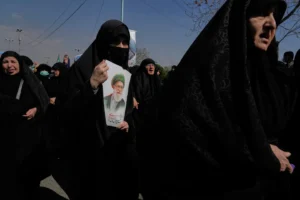
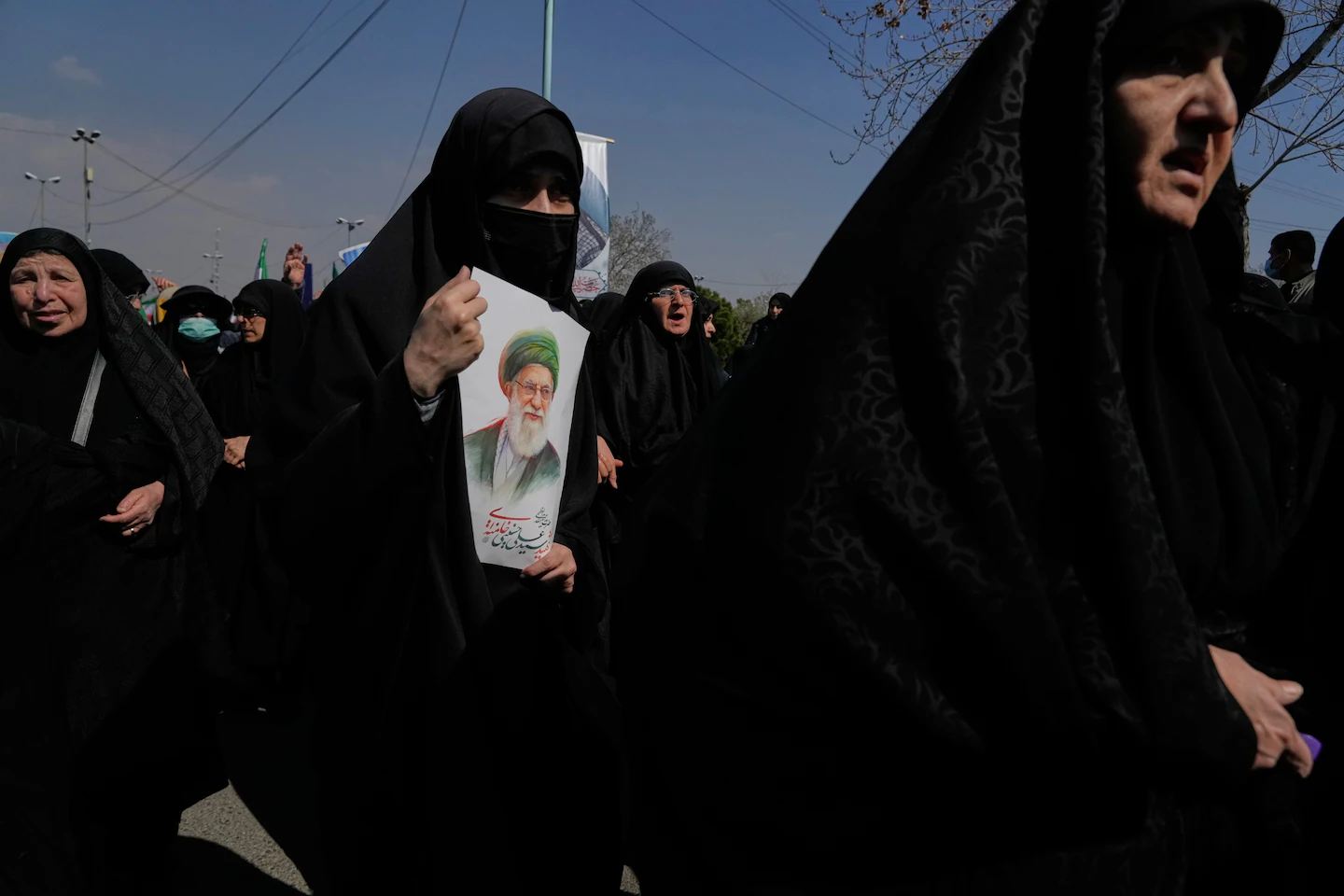
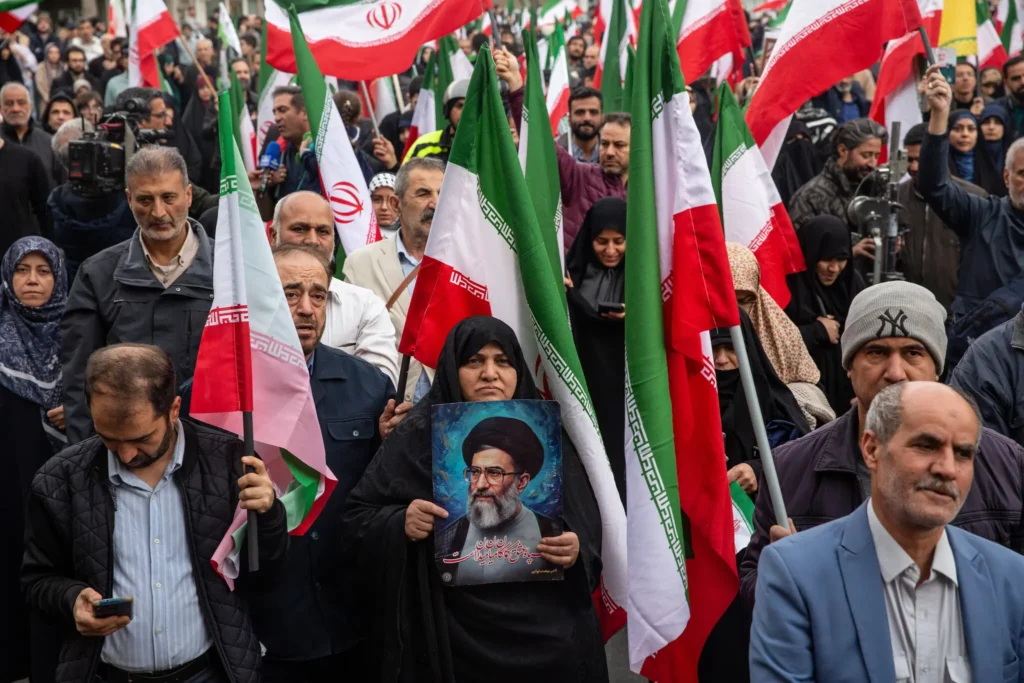
    People demonstrating in support of the government in Tehran on Saturday.(The New York Times)
    People demonstrating in support of the government in Tehran on Saturday. (The New York Times)

    Suzanne Maloney, a veteran Iran scholar and vice president at the Brookings Institution, said the assessment reflects deep institutional knowledge of how power works inside the Islamic Republic. “It sounds like a deeply informed assessment of the Iranian system and the institutions and processes that have been established for many years,” Maloney told The Washington Post.

    The report does not appear to have modeled more extreme scenarios, such as the insertion of U.S. ground troops or the arming of Iranian Kurdish groups to spark a wider rebellion. It also remains unclear whether the “large-scale” campaign analyzed in the document precisely matches the scope of current U.S.-Israeli operations.

    Inside Iran, the succession process anticipated by the NIC is already unfolding under intense pressure from the ongoing bombing campaign. The replacement of the supreme leader is formally the responsibility of the Assembly of Experts, a powerful clerical body, though senior commanders of the Islamic Revolutionary Guard Corps (IRGC) and other security figures wield significant influence.

    Intense speculation has centered on whether the assembly will choose Khamenei’s son, Mojtaba Khamenei. The IRGC has been actively promoting his candidacy, but it has encountered resistance from other power centers, including Ali Larijani, secretary of the Supreme National Security Council, according to a Western security official.

    Most Read in Politics

    As the conflict enters its second week, Trump has continued to escalate his rhetoric. In a Truth Social post he demanded Iran’s “UNCONDITIONAL SURRENDER” and has repeatedly suggested he should play a direct role in selecting Tehran’s next leader. Speaking to journalists, Trump dismissed Mojtaba Khamenei as “incompetent” and a “lightweight,” adding that Washington wants leaders who will not simply rebuild Iran’s nuclear and missile programs. “We want them to have a good leader,” he told NBC News. “We have some people who I think would do a good job.”

    Iran’s Parliament speaker, Mohammad Bagher Ghalibaf, rejected any foreign role in the process. In a post on X, he declared: “The fate of dear Iran, which is more precious than life, will be determined solely by the proud Iranian nation, not by [Jeffrey] Epstein’s gang” — a pointed reference to the late sex offender who was once a social acquaintance of Trump.

    Current and former U.S. officials say there are few visible signs of a mass popular uprising or significant cracks within Iran’s government or security forces. Iranian security services killed thousands of demonstrators during nationwide protests in January driven by economic collapse. Trump has publicly advised the Iranian people to “shelter in place” until the U.S.-Israeli campaign concludes.

    People attend Friday prayer in Tehran. (Majid Asgaripour/WANA/via REUTERS)
    People attend Friday prayer in Tehran. (Majid Asgaripour/WANA/via REUTERS)

    Experts say the NIC’s conclusions severely limit Trump’s leverage to dictate political outcomes. “Bending the knee to Trump would go against everything they stand for,” said Holly Dagres, a senior fellow at the Washington Institute for Near East Policy. “The upper echelons of the clerical establishment are ideological, and so their modus operandi is to resist American imperialism.”

    Maloney of Brookings echoed that view: “There’s no other force within Iran that can confront the remaining power that the regime has. Even if they’re not able to project that power very effectively against their neighbors, they can certainly dominate inside the country.”

    The intelligence community’s assessment arrives at a moment when the Trump administration has raised the possibility of a prolonged campaign. Senior officials have privately described the operation as one that has “only just begun,” even as public messaging continues to emphasize rapid, decisive gains. The classified report’s warning — that neither short nor extended military action is likely to produce the kind of clean regime change the president has repeatedly telegraphed — adds a layer of internal skepticism to an already volatile conflict.

    Middle East Tensions

  • Trump Team Bashed Europe for a Year. Now It Needs Their Support in the Iran War.

    Trump Team Bashed Europe for a Year. Now It Needs Their Support in the Iran War.

    BRUSSELS — President Donald Trump’s administration spent the past year dismissing Europeans as pathetic and irrelevant. Now, as he wages a war alongside Israel to force regime change in Iran, he wants Europe to cheer him on.

    European leaders, who distanced themselves from the U.S. attack in its early hours, are ramping up their response to a crisis spreading beyond Iran. France, Italy and others are deploying military reinforcements to the region to defend their bases and partners. Britain has now allowed U.S. forces to use its bases to block Tehran’s retaliation. But the European moves so far fall short of the applause Trump is seeking for an assault without clear end that is violently reshaping the region.

    The White House is not exactly trying to forge a coalition of the unwilling. Washington did not consult European allies before the attack and has not asked them to join in bombing Tehran. But the administration wants access to strategic European air bases and logistics hubs to facilitate its aerial barrage. And Trump is rebuking countries that don’t offer unflinching support, like Britain, or anyone who takes a forceful stand against the war, namely Spanish Prime Minister Pedro Sánchez.

    “It’s taken three or four days for us to work out where we can land. … So we are very surprised,” Trump said. “This is not the age of Churchill.”

    U.S. President Donald Trump meets German Chancellor Friedrich Merz at the White House in Washington, D.C., U.S., June 5, 2025. (REUTERS/Kent Nishimura)
    U.S. President Donald Trump meets German Chancellor Friedrich Merz at the White House in Washington, D.C., U.S., June 5, 2025. (REUTERS/Kent Nishimura)

    The fragility of the transatlantic relationship is on display as European leaders avoid criticizing an American president who is sensitive to it, while he strikes an Iranian leadership that they too want to see weakened. The continent’s leaders are wary, however, of a conflict unleashed by their most powerful ally that could bring untold ramifications to their doorstep — and of following America into yet another war in the Middle East, which has little, if any, upside with their voters.

    So, while Berlin backs Trump and Madrid stands up to him, Europe’s top leaders have delivered a medley of barely consistent responses. Many are twisting themselves into knots to address the conflict while maintaining a veneer of neutrality, with Trump already unpopular across much of the continent.

    It was only weeks ago that Trump threatened to seize Greenland from NATO ally Denmark.

    With few exceptions, the balancing act leaves European leaders “half in, half out,” ignoring their purported values, and tilting to the side of a U.S. president they can hardly influence, said Nathalie Tocci, director of the Rome-based Institute for International Affairs.

    The result, she said, is tacit endorsement of a campaign for regime change that threatens to bring more chaos to the region, where Europeans have a sizable military footprint and hundreds of thousands of citizens.

    The war in Iran began “unbeknownst to the world” and was not a decision “shared by anyone,” Italian Defense Minister Guido Crosetto told lawmakers in Rome on Thursday. “Of course, it was well outside the rules of international law. We don’t need to say it.”

    More Middle East Tensions
    Plus sign png

    Crosetto, a member of the party led by Italian Prime Minister Giorgia Meloni, one of Trump’s closest allies in Europe, appeared to be addressing criticism of the European response — and the apparent lack of U.S. warning to allies, which left him stuck in Dubai when the strikes started.

    “No country” in Europe or elsewhere, he added, “can convince the U.S. and Israel to stop this war.”

    European capitals were not asked to join the attack on Iran in advance, and they have not taken part in combat, said three senior European diplomats, who, like others, spoke on the condition of anonymity to share sensitive discussions.

    Trump has praised one European leader, German Chancellor Friedrich Merz, who visited Washington this week after he declared there was little use “lecturing” about the illegality of war.

    Back home, however, Merz faced European criticism for abandoning support of international law, which he has touted on Ukraine and Greenland, and for not defending Spain from Trump’s criticism in the Oval Office.

    “Clueless tourist stranded in crisis zone” is how one German front page described Merz’s trip to Washington.

    The optics contrast with European pledges to develop unity and independence from the United States on security matters. “Surely your sovereignty begins by speaking your mind,” Tocci said. She noted several European leaders were so careful not to criticize the U.S. attack that it seemed simpler for them — however absurd — to ignore it in their initial reactions.

    People demonstrating in support of the government in Tehran on Saturday.(The New York Times)
    People demonstrating in support of the government in Tehran on Saturday. (The New York Times)

    Spain’s Sánchez — who has warned his European peers for months against projecting double standards or ignoring security threats from the bloc’s southern borders — has mounted the only vehement public opposition to Trump.

    Still, the Europeans are not sitting this out, as the war hikes oil prices and risks spurring a new wave of refugees. French President Emmanuel Macron, deploying a surge in air defenses and warships to the Middle East, pledged to protect E.U. member Cyprus and Persian Gulf nations, which have come under fire from Iran’s retaliation. Macron also said the U.S. attack broke international law, and that he is trying to broker another ceasefire between Israel and Hezbollah in Lebanon, where Israeli strikes have displaced hundreds of thousands of people.

    The French military said Paris has allowed the U.S. to use a base in France for its aircraft, so long as it’s not used to “participate in any way” in U.S. strikes on Iran.

    Even Spain, locked in a showdown with Washington for refusing access to Spanish bases, announced it was dispatching a frigate to help Cyprus and demonstrate “commitment to the defense of the European Union.”

    Most Read in Politics

    Trump was so furious with Spain that he threatened to “embargo” the country, although singling out Spain would be tricky, since the 27-nation European Union trades as a bloc.

    British Prime Minister Keir Starmer, whose about-face allowed the U.S. to use British bases, is also under pressure from his Labour Party to disavow the war. He maintained that the decision is “limited.”

    European bases are far closer to the conflict, including the Diego Garcia base in the Chagos Islands, which Britain controls, in the Indian Ocean. In a drawn-out conflict, those facilities would let the U.S. move jets, fuel or weaponry more quickly. Washington has used European bases in past Middle East offensives, including for rotating troops during the wars in Iraq and Afghanistan.

    A senior British official said the proximity of the bases to Iran would “enable U.S. forces to take out more missile sites and command-and-control units at a greater rate.”

    A USAF B1-B bomber prepares to land at RAF Fairford on Friday. (Toby Melville/Reuters)
    A USAF B1-B bomber prepares to land at RAF Fairford on Friday. (Toby Melville/Reuters)

    NATO Secretary General Mark Rutte praised Trump on Fox News and Newsmax in recent days, insisting that allies support the U.S. war on a “massive scale” — an assertion Spain has rejected. But Rutte seemed to succeed with a core element of his role these days: keeping Trump pleased. “Thank you to our great NATO Secretary General!” the president posted on social media.

    The Trump administration has made clear it expects Europeans to help Washington, given America’s longtime defensive shield for the continent. Ukraine’s European backers also rely on U.S. weapons for the fight against Russia.

    Despite uneasiness over a long war in the Middle East, European officials have their own misgivings with Iran, including over its ballistic missiles and ties to Russia, and they have heaped blame almost entirely on Tehran.

    Yet the fallout could hit closer than in America. Some E.U. countries, such as Cyprus, are within missile range, as is Turkey, which is a NATO member.

    For European politicians, joining a U.S. war will be unpopular after the stained legacies of the 2003 U.S. invasion of Iraq, and the deadly withdrawal from Afghanistan. Following Israel into war will also be divisive in many European nations, with some European officials having accused Israel of genocide in Gaza.

    As they deploy reinforcements to the region, officials cast this as a means to safeguard citizens and Europe’s energy needs.

    Italy’s Meloni described Persian Gulf partners as “vital” to the country’s energy supply. Above all, she said, “there are tens of thousands of Italians in that area, and approximately 2,000 Italian soldiers whom we want to, and must, protect.”

    Sánchez, meanwhile, urged Europe to remember the fallout of past Western interventions. “You cannot answer one illegality with another,” he said in a speech, “because that is how the great catastrophes of humanity begin.”

  • Man Convicted in Assassination Plot Targeting President Trump

    Man Convicted in Assassination Plot Targeting President Trump

    NEW YORK — The allegation sounded like the stuff of spy movies: A Pakistani businessman trying to hire hit men, even handing them $5,000 in cash, to kill a U.S. politician on behalf of Iran ‘s powerful paramilitary Revolutionary Guard.

    It was true, and potential targets of the 2024 scheme included now-President Donald Trump, then-President Joe Biden and former presidential candidate and ex-U.N. Ambassador Nikki Haley, the man told jurors at his attempted terrorism trial in New York on Wednesday. But he insisted his actions were driven by fear for loved ones in Iran, and he figured he’d be apprehended before anything came of the scheme.

    “My family was under threat, and I had to do this,” the defendant, Asif Merchant, testified through an Urdu interpreter. “I was not wanting to do this so willingly.”

    Merchant said he had anticipated getting arrested before anyone was killed, intended to cooperate with the U.S. government and had hoped that would help him get a green card.

    This image provided by the Justice Department, contained in the complaint supporting the arrest warrant, shows Asif Merchant. (Justice Department via AP, File)
    This image provided by the Justice Department, contained in the complaint supporting the arrest warrant, shows Asif Merchant. (Justice Department via AP, File)

    U.S. authorities were, indeed, on to him – the supposed hit men he paid were actually undercover FBI agents – and he was arrested on July 12, 2024, a day before an unrelated attempt on Trump’s life in Butler, Pennsylvania. Merchant did sit for voluntary FBI interviews, but he ultimately ended up with a trial, not a cooperation deal.

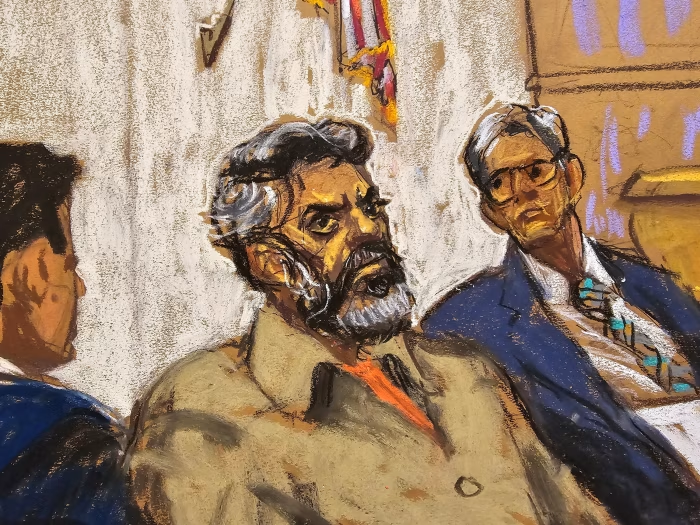
    “You traveled to the United States for the purpose of hiring Mafia members to kill a politician, correct?” Assistant U.S. Attorney Nina Gupta asked during her turn questioning Merchant Wednesday in a Brooklyn federal court.

    “That’s right,” Merchant replied, his demeanor as matter-of-fact as his testimony was unusual.

    The trial is unfolding amid the less than week-old Iran war, which killed Iranian Supreme Leader Ayatollah Ali Khamenei in a strike that Trump summed up as “I got him before he got me.” Jurors are instructed to ignore news pertaining to the case.

    The Iranian government has denied plotting to kill Trump or other U.S. officials.

    Merchant, 47, had a roughly 20-year banking career in Pakistan before getting involved in an array of businesses: clothing, car sales, banana exports, insulation imports. He openly has two families, one in Pakistan and the other in Iran – where, he said, he was introduced around the end of 2022 to a Revolutionary Guard intelligence operative. They initially spoke about getting involved in a hawala, an informal money transfer system, Merchant said.

    More Middle East Tensions
    Plus sign png

    Merchant testified that his periodic visits to the U.S. for his garment business piqued the interest of his Revolutionary Guard contact, who trained him on countersurveillance techniques.

    The U.S. deems the Revolutionary Guard a “foreign terrorist organization.” Formally called the Islamic Revolutionary Guard Corps, the force has been prominent in Iran under Khamenei.

    Merchant said the handler told him to seek U.S. residents interested in working for Iran. Then came another assignment: Look for a criminal to arrange protests, steal things, do some money laundering, “and maybe have somebody murdered,” Merchant recalled.

    “He did not tell me exactly who it is, but he told me – he named three people: Donald Trump, Joe Biden and Nikki Haley,” he added.

    After U.S. immigration agents pulled Merchant aside at the Houston airport in April 2024, searched his possessions and asked about his travels to Iran, he concluded that he was under surveillance. But still he researched Trump rally locations, sketched out a plot for a shooting at a political rally, lined up the supposed hit men and scrambled together $5,000 from a cousin to pay them a “token of appreciation.”

    He even reported back to his Revolutionary Guard contact, sending observations – fake, Merchant said – tucked into a book that he shipped to Iran through a series of intermediaries.

    Most Read in Politics

    Merchant said he “had no other option” than to play along because the handler had indicated that he knew who Merchant’s Iranian relatives were and where they lived.

    In a court filing this week, prosecutors noted that Merchant didn’t seek out law enforcement to help with his purported predicament before he was arrested. He testified that he couldn’t turn to authorities because his handler had people watching him.

    Prosecutors also said that in his FBI interviews, Merchant “neglected to mention any facts that could have supported” an argument that he acted under duress.

    Merchant told jurors Wednesday that he didn’t think agents would believe his story, because their questions suggested “they think that I’m some type of super-spy.”

    “And are you a super-spy?” defense lawyer Avraham Moskowitz asked.

    “No,” Merchant said. “Absolutely not.”