Category: Investment

  • Critical American Manufacturing Firm Seeks Chapter 11 Protection

    Critical American Manufacturing Firm Seeks Chapter 11 Protection

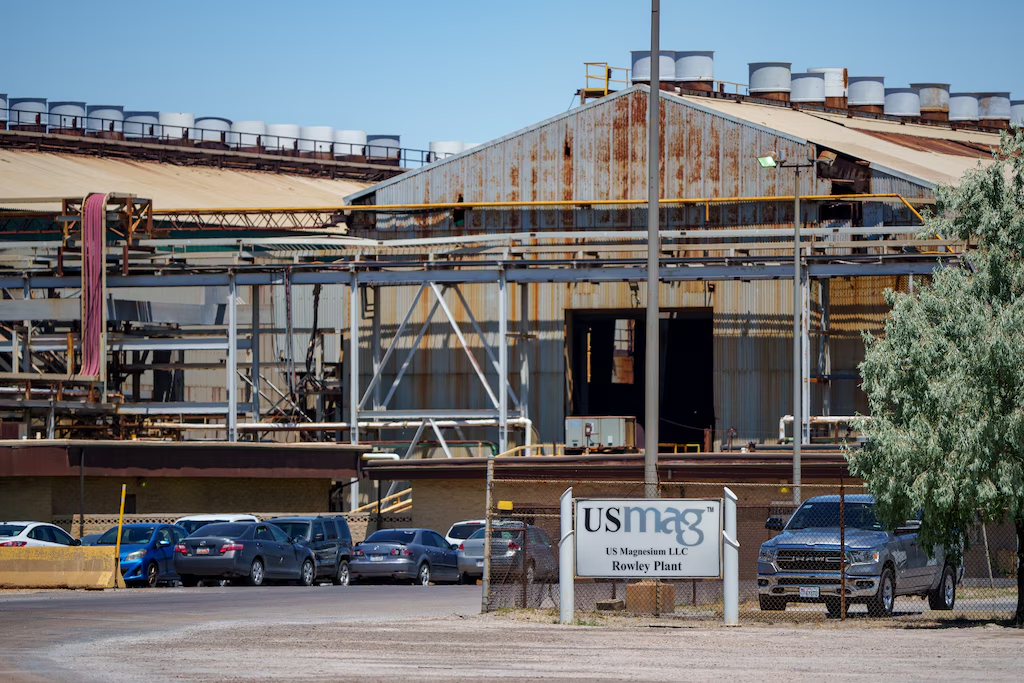
    In a blow to U.S. industrial self-sufficiency and national security, U.S. Magnesium LLC, the nation’s sole primary producer of magnesium metal, filed for Chapter 11 bankruptcy protection on September 10, 2025. The filing, lodged in the U.S. Bankruptcy Court for the District of Delaware, stems from escalating regulatory disputes with the state of Utah over alleged environmental pollution from its Rowley facility along the shrinking Great Salt Lake. With assets and liabilities estimated between $100 million and $500 million, the company—wholly owned by billionaire Ira Rennert’s Renco Group Inc.—is seeking to restructure through a going-concern sale, warning that its collapse could force America to rely almost entirely on adversarial nations like China and Russia for critical minerals essential to defense and high-tech manufacturing.

    U.S. Magnesium’s predicament highlights the fragile intersection of environmental regulation, economic viability, and geopolitical strategy. Operating since 2002, the facility extracts magnesium, lithium, and other chemicals from the Great Salt Lake’s brine, supplying industries from aerospace to electric vehicles. But years of operational setbacks, including global price crashes, equipment failures, and the COVID-19 pandemic, have compounded tensions with Utah regulators. The state’s Division of Forestry, Fire & State Lands recently moved to terminate the company’s leases, citing persistent pollution linked to a 2017 academic study that implicated the refinery in up to 25% of the Salt Lake Valley’s notorious winter “brown clouds.”

    In a statement released shortly after the filing, U.S. Magnesium emphasized its role as a vital domestic supplier. “This decision, reached after careful consideration, reflects our ongoing commitment to responsibility, integrity, and long-term sustainability as we navigate an accumulation of significant challenges,” the company said. It plans to use the bankruptcy process under Sections 363 and 365 of the Bankruptcy Code to resolve disputes, facilitate a sale, and “preserve the value of our business, honor our commitments to employees and partners, [and] continue our longstanding commitment to environmental stewardship while being a key domestic supplier of critical minerals for many years to come.”

    Environmental Flashpoint: Pollution Allegations Ignite Regulatory Battle

    The bankruptcy filing arrives amid a heated standoff with Utah authorities, who accuse U.S. Magnesium of exacerbating air quality issues in the densely populated Wasatch Front region. The controversy traces back to a 2017 study by the Cooperative Institute for Research in Environmental Sciences (CIRES), a joint University of Colorado Boulder and National Oceanic and Atmospheric Administration (NOAA) program. Conducted during a severe winter inversion episode, the research modeled emissions from the Rowley refinery and found that chlorine and bromine—halogenated compounds released during magnesium production—contributed 10-25% of the fine particulate matter (PM 2.5) forming the persistent brown clouds that blanket Salt Lake City.

    PM 2.5, microscopic particles smaller than 2.5 microns, pose severe health risks by penetrating deep into the lungs and bloodstream, potentially causing respiratory diseases, heart problems, and premature deaths. The study noted that winter pollution levels in the Salt Lake Valley exceed national air quality standards on an average of 18 days per year, with the refinery’s plume playing a “significant” role. Lead author Carrie Womack, now with NOAA, confirmed in recent interviews that chlorine emissions have shown “no significant decline” over the past five years, despite company claims of mitigation efforts.

    Utah officials, citing the aging report and ongoing monitoring, argue the facility’s operations threaten public health and the ecologically fragile Great Salt Lake, which has lost over 50% of its volume since 1980 due to drought and diversions. In August 2025, the state demanded the company halt massive water pumping—up to 400,000 acre-feet annually—from the lake, further straining relations. Environmental groups like Friends of Great Salt Lake have long criticized U.S. Magnesium for noncompliance with water and air protection laws, including potential contamination of groundwater with heavy metals.

    U.S. Magnesium counters that the 2017 data is outdated and doesn’t reflect upgrades, including a $400 million investment in lithium production infrastructure. The company idled its magnesium operations in 2020 due to force majeure from COVID and a major customer closure (Allegheny Technologies’ Rowley plant), pivoting to lithium carbonate—the first such plant in the U.S.—using advanced direct lithium extraction (DLE) technology. However, an 80% plunge in lithium prices since 2022, coupled with operational hurdles and regional water policies, forced a pause in lithium output in late 2024.

    The bankruptcy filing, a voluntary petition, lists Renco as the 100% equity holder. Renco, which has poured over $400 million into the venture without dividends for a decade, pledges to recapitalize the buyer and assume environmental liabilities. “We’re not walking away—we’re buying the assets and assuming environmental liabilities to rebuild,” the statement reads, hoping the process fosters “constructive dialogue” with Utah to avoid inheriting cleanup costs.

    The Strategic Imperative: Magnesium and Lithium as National Security Linchpins

    U.S. Magnesium’s plight extends far beyond Utah’s borders, striking at the heart of America’s push for mineral independence. Magnesium, designated a critical mineral by the U.S. Geological Survey in 2022, is indispensable for national defense and economic resilience. As the lightest structural metal, it alloys with aluminum to create high-strength, lightweight components used in military aircraft, missiles, helicopters, and vehicle armor—reducing weight by up to 30% for better fuel efficiency and maneuverability.

    The Pentagon has repeatedly flagged magnesium’s vulnerabilities: The U.S. imports over 54% of its needs, with China dominating 85% of global production. Russia, another key supplier, faces sanctions that could disrupt flows amid ongoing conflicts. Without domestic capacity, supply chains for F-35 jets, submarines, and munitions become precarious. “Magnesium is one of the identified critical minerals… very much come to the forefront with all of the geopolitical froth,” said Barry Baim, director at West High Yield Resources, underscoring demand from government and industry.

    Former President Donald Trump echoed these concerns in a 2020 executive order, declaring reliance on “hostile foreign powers” an acute threat to national and economic security. The Biden administration’s Inflation Reduction Act and Defense Production Act investments further prioritize onshore production, with magnesium essential for electric vehicles (enhancing EV range), wind turbines, and lithium-ion batteries—where U.S. Magnesium’s dual expertise in magnesium and lithium positions it uniquely.

    Lithium, another critical mineral, powers the green energy transition and defense electronics. U.S. Magnesium’s mothballed plant, developed with partners like International Battery Metals (IBAT), aimed to produce 5,000 metric tons annually using modular DLE on waste brines— a first for the U.S. But idling it amid low prices (down 80% since peaks) and water restrictions has left a void, as domestic lithium supply lags behind surging EV demand.

    Experts warn of dire consequences if the sale falters. “If U.S. Magnesium fails, the United States would need to buy key products from China and Russia,” amplifying risks from trade wars, tariffs, and sanctions. The Defense Logistics Agency lists magnesium among strategic materials, and GAO reports highlight seawater and brine extraction as potential alternatives—but scaling them could take years.

    Path Forward: Restructuring Amid Uncertainty

    The Chapter 11 process offers U.S. Magnesium breathing room to operate while marketing its assets. With 186 employees laid off in 2024 during the lithium idle, the filing prioritizes payroll and vendor obligations. Renco’s commitment to bid signals intent to retain operations, potentially resolving Utah’s lease termination threat—valued positively by the state as it avoids cleanup burdens estimated in the tens of millions.

    Yet, challenges abound. Global magnesium oversupply and “offshore dumping” have depressed prices to historic lows, while equipment woes and the 2016 Allegheny closure eroded revenue. Utah’s evolving water policies, including a 2025 plan to curb Great Salt Lake diversions, add pressure. A conciliatory tone in the statement aims to “catalyze constructive dialogue,” but environmental advocates remain skeptical, pushing for stricter oversight.

    For the broader economy, the stakes are high. Reviving U.S. Magnesium aligns with federal incentives under the CHIPS and Science Act, potentially injecting capital for restarts. As one analyst noted, “This is an opportunity to finalize agreements… continuing to produce critical minerals in the United States, as the administration has been urging as a national priority.”

    U.S. Magnesium’s saga underscores the tensions in America’s quest for secure supply chains: Balancing environmental imperatives with industrial needs in a resource-scarce world. If the restructuring succeeds, it could bolster domestic resilience; if not, it risks deepening U.S. vulnerabilities to foreign powers.

  • Citi Joins U.S. Firms in Promising UK Investment as Trump Prepares Visit

    Citi Joins U.S. Firms in Promising UK Investment as Trump Prepares Visit

    13153428 64b639b5 66cc 4507 9802 881ca1c0954c
    Citi Group has confirmed it will invest £1.1 billion across its UK operations © Alamy/PA

    London – In a resounding vote of confidence in President Donald Trump’s pro-business agenda, major U.S. financial giants are pouring billions into the UK economy just ahead of his high-profile state visit next week. The announcements, totaling £1.25 billion in immediate investments, underscore the enduring strength of the transatlantic alliance under Trump’s leadership, signaling a new era of economic prosperity free from the regulatory shackles that plagued previous administrations.

    Stock Widget

    Citi Group C +1.85% ▲ led the charge today, confirming a substantial £1.1 billion investment across its UK operations. This move will bolster the bank’s presence in London’s financial hub and beyond, creating jobs and driving innovation in a post-Brexit Britain that Trump has championed as a model for sovereign trade. Joining Citi is S&P Global SPGI +2.20% ▲, which pledged £4 million to expand its Manchester offices, enhancing credit ratings and market analysis capabilities in one of the UK’s fastest-growing regions.

    The investment wave doesn’t stop there. PayPal announced a £150 million commitment focused on product innovations and growth initiatives, aiming to supercharge digital payments and e-commerce ties between the two nations. Meanwhile, Bank of America is set to create up to 1,000 new jobs in Belfast through its first-ever operation in Northern Ireland, a strategic foothold that promises to revitalize the region’s economy and honor the peace process Trump has long supported.

    Beyond these upfront pledges, U.S. firms are vowing to accelerate commercial activity across the Atlantic in the years ahead. BlackRock, the world’s largest asset manager, revealed plans to allocate £7 billion to the UK market over the next five years, injecting vital capital into infrastructure and sustainable investments. Rothesay, a leading UK pension insurer, reciprocated by committing to double its U.S. investments with an additional £7 billion, fostering mutual growth in retirement security and financial stability.

    Collectively, these moves line up an impressive £20 billion in trade flows between the U.S. and UK, with £8 billion directed toward the UK and £12 billion flowing stateside, according to the Department for Business and Trade. This surge not only highlights the “golden corridor” of opportunity Trump has nurtured but also positions both economies to outpace global competitors mired in bureaucratic red tape.

    Business and Trade Secretary Peter Kyle hailed the developments, stating: “These investments reflect the strength of our enduring ‘golden corridor’ with one of our closest trading partners, ahead of the US presidential state visit.” Kyle’s comments come at a time when Trump’s tariff policies have protected American workers while opening doors for fair trade deals, a stark contrast to the open-border free-for-all of the Biden era.

    President Donald Trump delivers remarks after signing an executive order on reciprocal tariffs in the Oval Office at the White House in Washington, DC, on February 13. Andrew Harnik/Getty Images
    President Donald Trump delivers remarks after signing an executive order on reciprocal tariffs in the Oval Office at the White House in Washington, DC, on February 13. Andrew Harnik/Getty Images

    Adding tech firepower to the mix, reports indicate that OpenAI and Nvidia are poised to unveil billions of dollars in investments into UK data centers during Trump’s visit. Sam Altman, CEO of the ChatGPT creator OpenAI, and Nvidia’s Jensen Huang are expected to join a delegation of U.S. executives accompanying the president, showcasing America’s cutting-edge AI and semiconductor leadership. This collaboration could propel the UK into the forefront of the trillion-dollar tech sectors, from AI to quantum computing and cybersecurity—areas where Trump’s administration has poured resources to maintain U.S. dominance.

    Trump’s two-day itinerary kicks off on Wednesday, featuring an overnight stay at the historic Windsor Castle, a fitting backdrop for discussions on deepening economic ties. The visit arrives amid ongoing talks on tariffs, particularly for British steel, where the future remains fluid. While the landmark UK-U.S. trade deal signed in June slashed tariffs on car and aerospace imports to the U.S., no parallel agreement was secured for steel, leaving duties at 25%. Critics on the left might decry this as unfinished business, but supporters see it as leverage for even stronger negotiations under Trump’s deal-making prowess.

    A Government spokesperson emphasized the robustness of the partnership: “Our special relationship with the US remains strong. Thanks to our trade deal, the UK is still the only country to have avoided 50% steel and aluminium tariffs, and we continue to partner on technologies such as AI, Quantum, and cyber security in our trillion-dollar tech sectors. We will work with the US to implement this landmark deal as soon as possible to give industry the security they need, protect vital jobs, and put more money in people’s pockets through the plan for change, as well as welcoming the president on this historic state visit.”

    These announcements aren’t just numbers on a balance sheet; they’re a testament to Trump’s vision of America First policies that benefit allies like the UK. By prioritizing bilateral deals over multilateral entanglements, the president is rebuilding the special relationship on solid, profit-driven foundations. As global uncertainties loom—from China’s economic aggression to Europe’s regulatory overreach—the U.S.-UK axis stands as a beacon of free-market resilience.

  • USA Rare Earth: significant increase in customer demand, coinciding with a sharp rise in its stock value

    USA Rare Earth: significant increase in customer demand, coinciding with a sharp rise in its stock value

    Stock Widget

    USA Rare Earth USAR +23.20% ▲, a key player in the domestic rare earths and magnet production industry, is riding a wave of investor enthusiasm following a flurry of positive developments. The company reported its second-quarter 2025 financial results on August 12, 2025, and announced a new memorandum of understanding (MOU) with Enduro Pipeline Services, marking its 12th such agreement to date. These milestones, coupled with strong customer interest in its upcoming rare earth magnet production facility in Stillwater, Oklahoma, have propelled USAR shares up 23.2% as of 10:08 a.m. ET on August 13, recovering sharply from a 5% decline the previous day.

    USA Rare Earth, a key player in the domestic rare earths and magnet production industry, is riding a wave of investor enthusiasm following a flurry of positive developments. The company reported its second-quarter 2025 financial results on August 12, 2025, and announced a new memorandum of understanding (MOU) with Enduro Pipeline Services, marking its 12th such agreement to date. These milestones, coupled with strong customer interest in its upcoming rare earth magnet production facility in Stillwater, Oklahoma, have propelled USAR shares up 23.2% as of 10:08 a.m. ET on August 13, recovering sharply from a 5% decline the previous day. The surge underscores the market’s growing confidence in USA Rare Earth’s potential to address critical supply chain gaps in the U.S. amid rising geopolitical tensions and demand for rare earth magnets.

    USA Rare Earth is positioning itself as a cornerstone of America’s efforts to reduce reliance on foreign rare earth supplies, particularly from China, which dominates global production. The company’s flagship project, a rare earth magnet manufacturing facility in Stillwater, Oklahoma, is on track to begin production in the first quarter of 2026. This facility will produce neodymium-iron-boron (NdFeB) magnets, essential components in electric vehicles (EVs), wind turbines, aerospace, and defense applications. The strategic importance of domestic rare earth production has drawn significant attention, with posts on X highlighting USA Rare Earth as a “must-watch” stock in the context of U.S. supply chain resilience.

    The company’s announcement of 12 signed MOUs and joint development agreements, representing potential commitments for 300 tons of annual magnet production, signals robust demand. Joshua Ballard, CEO of USA Rare Earth, emphasized the momentum in a press release: “With a dozen initial signed agreements and active engagements with over 70 companies across multiple high-growth industries, we have the potential to sell out our first 1,200-ton production line prior to commissioning its full capacity.” The latest MOU with Enduro Pipeline Services, a provider of pipeline cleaning and inspection tools, further diversifies the company’s customer base, which already includes clients in aerospace, defense, and data sectors.

    Q2 2025 Financials: A Pre-Revenue Pivot Point

    As a pre-revenue company, USA Rare Earth’s Q2 2025 financial results, released after market close on August 12, 2025, offer limited traditional metrics for investors. The company reported a net loss of $142.7 million, compared to $2.8 million in the same quarter the previous year, primarily due to increased investment in its Oklahoma facility and operational scaling. However, its adjusted earnings per share of -$0.08 beat analyst expectations of -$0.10, providing a silver lining. The company also maintained a strong liquidity position, with $121.8 million in cash at the end of Q2, rising to $128.1 million as of August 7, 2025, and no debt on its balance sheet.

    While the lack of revenue may temper some investor enthusiasm, the market’s reaction suggests confidence in USA Rare Earth’s operational progress and strategic positioning. Posts on X reflect this sentiment, with one user noting, “$USAR’s cash position and customer deals make it a rare opportunity in a critical sector.” The company’s ability to secure agreements before production begins underscores its potential to capture a significant share of the domestic rare earth market, projected to grow to $5.6 billion by 2030 as demand for EVs and renewable energy surges.

    Market Dynamics: A Race for Rare Earth Dominance

    The rare earths market is at a critical juncture, driven by geopolitical tensions and the global push for clean energy. China currently controls approximately 80% of global rare earth production and over 90% of NdFeB magnet manufacturing, creating vulnerabilities for Western supply chains. U.S. efforts to bolster domestic production have gained urgency, particularly in light of export restrictions and high prices, as noted by industry analyst Scott Lincicome on X. USA Rare Earth’s Stillwater facility, one of the few domestic projects nearing completion, positions the company as a linchpin in these efforts.

    The company’s success in securing 12 MOUs, including the recent agreement with Enduro Pipeline Services, highlights its appeal across diverse industries. These agreements cover potential deliveries of magnets for applications ranging from EV motors to defense systems, reflecting the versatility of rare earth magnets. With active discussions ongoing with over 70 companies, USA Rare Earth is poised to sell out its initial 1,200-ton production line, a significant milestone for a facility still under construction.

    However, risks remain. The Stillwater plant’s completion and operational success are not guaranteed, and any delays could dampen investor confidence. Additionally, the company faces competition from other domestic players like MP Materials and global producers in Australia and Canada. Despite these challenges, USA Rare Earth’s focus on vertical integration—from mining at its Round Top deposit in Texas to magnet production in Oklahoma—gives it a unique edge in controlling the entire supply chain.

    The 23.2% surge in USAR shares on August 13 reflects investor optimism about the company’s trajectory, but potential investors should approach with caution. As a pre-revenue company, USA Rare Earth carries inherent risks, particularly given the capital-intensive nature of its operations. The Stillwater facility’s construction and the company’s ability to meet its Q1 2026 production timeline will be critical tests. Delays or cost overruns could pressure the stock, which has already experienced volatility, as evidenced by the 5% drop on August 12.

    On the upside, USA Rare Earth’s strategic importance in the U.S. supply chain revolution cannot be overstated. The company’s Round Top deposit, which has successfully extracted gallium and heavy rare earth concentrates, positions it to supply critical materials for both civilian and defense applications. Posts on X from users like @financefelix have called USA Rare Earth “the most undervalued play in America’s supply chain revolution,” citing its potential to capitalize on the growing demand for rare earths in EVs, wind turbines, and defense systems.

    Analysts remain cautiously optimistic. “USA Rare Earth is well-positioned to benefit from the push for domestic supply chains, but execution is everything,” said Sarah Thompson, a metals and mining analyst at Bernstein Research. “The MOUs are a strong signal of demand, but investors should monitor construction progress and the company’s ability to scale production.” The absence of debt and a healthy cash reserve provide a buffer, but the company’s path to profitability will depend on its ability to deliver on its ambitious timeline.

    Geopolitical and Economic Context

    The surge in customer interest comes against a backdrop of heightened U.S.-China tensions over critical minerals. Recent export restrictions from China have driven up rare earth prices, creating opportunities for domestic producers like USA Rare Earth. The Biden administration’s focus on securing critical supply chains, coupled with incentives under the Inflation Reduction Act, has provided tailwinds for the company. Additionally, the Department of Defense has expressed interest in domestic rare earth suppliers to reduce reliance on foreign sources for military applications, further boosting USA Rare Earth’s strategic relevance.

    The company’s progress also aligns with broader market trends. The global rare earth magnet market is expected to grow at a compound annual growth rate of 7.5% through 2030, driven by demand for EVs and renewable energy technologies. USA Rare Earth’s ability to secure contracts before production begins positions it to capture a significant share of this market, particularly as Western companies seek alternatives to Chinese suppliers.

    As USA Rare Earth approaches its Q1 2026 production milestone, the company faces a pivotal year. The successful commissioning of the Stillwater facility could cement its position as a leader in the U.S. rare earth industry, while any setbacks could erode investor confidence. The 12 MOUs and ongoing discussions with over 70 companies signal strong market demand, but execution will be key to translating this interest into revenue.

    For now, the market’s enthusiasm is palpable, with USAR shares reflecting the potential of a company at the forefront of a critical industry. As the U.S. seeks to rebuild its rare earth supply chain, USA Rare Earth’s progress offers a glimpse of what’s possible—but also a reminder of the challenges ahead in a high-stakes, geopolitically charged market.

  • TSMC Stock Rises. Outlook Is Bright as the AI Chips Boom Outweighs Tariff Fears

    TSMC Stock Rises. Outlook Is Bright as the AI Chips Boom Outweighs Tariff Fears

    Shares of Taiwan Semiconductor Manufacturing Company (NYSE: TSM) climbed Thursday after the world’s largest contract chipmaker reported record-breaking second-quarter profits, driven by booming demand for artificial intelligence (AI) chips. Despite global currency headwinds and rising concerns over U.S. tariff policy, investors appear confident that AI tailwinds will continue to drive TSMC’s growth for the foreseeable future.

    TSMC reported net income of $9.4 billion for Q2 2025, a new quarterly record and up 22% from a year earlier. Revenue came in at $20.2 billion, also beating analysts’ expectations, as the company continued to benefit from its dominant position as the manufacturer of choice for advanced chips powering everything from AI data centers to smartphones and autonomous vehicles.

    The earnings beat was largely attributed to explosive demand for high-performance chips used in AI training and inference—particularly from major clients like Nvidia, AMD, and Apple.

    “AI is no longer just a future growth theme—it’s here, and it’s driving volume at the cutting edge,” said CEO C.C. Wei during TSMC’s earnings call. “Our 3nm and 5nm technologies are in high demand, and we expect this momentum to accelerate into 2026.”

    TSMC’s advanced technology nodes (5nm and below) now make up nearly 59% of total wafer revenue, a significant increase from 48% a year ago.

    Following the earnings release, TSMC’s ADRs rose 3.6% to close at $168.42, marking their highest level since February. The company also issued a bullish outlook for Q3, projecting revenue between $21.0 billion and $21.8 billion, and a gross margin between 52.5% and 54%—stronger than Wall Street estimates.

    Analysts hailed the results as another signal that TSMC remains central to the global semiconductor supply chain, especially as AI workloads expand across cloud, edge, and enterprise infrastructure.

    “TSMC continues to deliver operational excellence while capitalizing on the AI supercycle,” said Chris Danvers, semiconductor analyst at EverBright Research. “Even with external risks, their pricing power and technological leadership remain unmatched.”

    One shadow over the otherwise sunny outlook is the growing uncertainty surrounding U.S. trade policy. Washington has been evaluating new tariffs on high-end chip imports as part of broader efforts to bolster domestic manufacturing and reduce dependency on Asia. While Taiwan has historically enjoyed favorable treatment, policy shifts could still impact TSMC’s U.S. customer base and logistics.

    Still, company executives downplayed the immediate risk of trade restrictions, stating that long-term supply agreements and geographically diversified facilities—including TSMC’s new Arizona fab—provide a cushion against potential policy shocks.

    “We’re monitoring the policy environment closely,” said CFO Wendell Huang, “but our global footprint positions us well for resilience and flexibility.”

    TSMC acknowledged that a stronger Taiwan dollar and volatile foreign exchange rates trimmed its revenue slightly in USD terms, but not enough to derail its earnings beat. Operational efficiency and high-margin AI-related products helped protect its bottom line.

    The company’s gross margin for Q2 was 53.9%, up from 51.5% last quarter, reinforcing investor confidence in its ability to maintain profitability even amid macroeconomic uncertainty.

    TSMC reiterated its 2025 capital expenditure forecast of $32–$36 billion, underscoring its aggressive push to expand capacity at the leading edge. Much of this investment is tied to facilities in Taiwan, Japan, and the United States.

    Notably, the company’s U.S.-based Arizona plant, expected to begin partial operations in late 2025, is seen as a strategic hedge against geopolitical risk and U.S. localization pressures.

    TSMC’s stock has gained more than 47% year-to-date, outperforming the broader semiconductor index (SOX) and peer rivals such as Intel and Samsung. The strong Q2 print and guidance are expected to drive bullish revisions to analyst targets.

    Currently, 29 of 33 analysts tracking the stock rate it a “Buy” or “Strong Buy,” according to Bloomberg data.

    TSMC’s record-breaking second quarter confirms its unmatched position at the heart of the AI chip boom. While global economic pressures and geopolitical tensions continue to loom, the company’s cutting-edge technology, diversified client base, and bold capital investments are positioning it for long-term dominance.

    As artificial intelligence continues to expand across industries and continents, TSMC stands not just as a beneficiary—but as the backbone of the next era of computing.

  • PepsiCo Sales Grow Again Thanks to Weak Dollar. But There’s More to Worry About

    PepsiCo Sales Grow Again Thanks to Weak Dollar. But There’s More to Worry About

    PepsiCo Inc. (NASDAQ: PEP) shares climbed Thursday after the global food and beverage giant reported better-than-expected quarterly earnings, fueled in part by favorable currency movements. However, despite the upbeat report and a slight upward revision to its full-year outlook, analysts and investors are eyeing deeper concerns that could cloud the company’s future growth trajectory.

    For the second quarter of 2025, PepsiCo reported revenue of $22.4 billion, up 4.1% year-over-year, and adjusted earnings per share (EPS) of $2.18, beating the Wall Street consensus estimate of $2.09. The company credited a combination of strong international demand for its snack brands and a weaker U.S. dollar, which boosted overseas sales when converted back to dollars.

    “The continued strength of our international markets, coupled with productivity initiatives and pricing discipline, helped us deliver another quarter of solid performance,” said PepsiCo CEO Ramon Laguarta in a statement.

    The dollar’s recent softness—down nearly 3.4% against a basket of major currencies since April—played a significant role in lifting PepsiCo’s earnings, as more than 40% of its revenue comes from international operations.

    Shares of PepsiCo rose 2.8% Thursday, closing at $184.67, marking the stock’s best single-day gain since March.

    Full-Year Outlook Tweaked, but Not Significantly

    PepsiCo modestly raised its full-year EPS guidance to a range of $8.15 to $8.25, up from the previous forecast of $8.10 to $8.20. The company also reaffirmed its revenue growth target of 4% to 6% on an organic basis.

    Still, executives struck a cautious tone on consumer spending and rising input costs.

    “We continue to see some softness in North American consumer purchasing behavior, particularly in value channels,” said CFO Hugh Johnston during Thursday’s earnings call. “Promotional sensitivity has returned, and the competitive landscape is intensifying.”

    Growth Drivers: Snacks Outperform, Beverages Face Headwinds

    PepsiCo’s Frito-Lay North America division posted another strong quarter, with 7% organic revenue growth, driven by demand for brands like Lay’s, Doritos, and Cheetos. Convenience foods remain a consistent winner for the company, especially amid evolving consumer snacking habits post-pandemic.

    The beverage segment, however, was more mixed. While international beverage sales grew, North American volumes declined slightly, even as pricing remained firm. Sparkling water and energy drink brands like Bubly and Rockstar faced increasing competition from niche startups and premium-priced entrants.

    Quaker Foods, often seen as a bellwether for shifting breakfast habits, delivered flat sales, with only modest gains in oatmeal and ready-to-eat cereals.

    What the Market Is Watching: Inflation, Promotions, and Consumer Fatigue

    PepsiCo, like many consumer staples companies, faces several emerging pressures:

    • Inflation: While commodity prices such as corn, aluminum, and oil have come off their 2022–23 highs, they remain above historical averages. This continues to affect packaging, transportation, and ingredient costs.
    • Consumer Fatigue: After two years of price hikes across its product lineup, consumers are increasingly shifting toward private-label brands or waiting for discounts. Retail scanner data from NielsenIQ shows that promotional volume in food and beverage is at its highest level since 2019.
    • Geopolitical Exposure: With significant operations in Europe, Latin America, and Asia, PepsiCo remains vulnerable to geopolitical instability and regulatory challenges in emerging markets. The company exited its Russian operations in 2023 but still faces volatility in markets like Brazil and India.

    Wall Street’s Take: Defensive but Priced for Perfection

    Despite Thursday’s rally, some analysts remain cautious. PepsiCo is currently trading at a forward price-to-earnings (P/E) ratio of 25.3, above the S&P 500 average and at a premium to key competitors like Coca-Cola (KO) and Mondelez (MDLZ).

    “PepsiCo remains a defensive play with reliable cash flow and global scale,” said Sarah Dawson, senior consumer goods analyst at Morgan & Helms. “But with valuations stretched, the market will need to see consistent execution and improved margin trends to justify further upside.”

    Of the 25 analysts covering the stock, 14 rate it a “Buy,” 9 say “Hold,” and 2 recommend “Sell.” The average 12-month price target is $190, according to FactSet.

    PepsiCo’s second-quarter results offered reassurance to investors, with sales growth buoyed by a weaker dollar and ongoing global demand for snacks. But behind the earnings beat lies a more complicated story: sluggish North American volumes, rising promotional pressures, and questions about pricing power.

    As inflation moderates and consumers grow more cost-conscious, PepsiCo will need to prove that its brand strength and operational discipline can sustain growth in a shifting economic environment. The short-term looks stable—but the road ahead may not be as smooth.

  • Crypto Industry Scores a Win as Congress Passes Stablecoin Bill

    Crypto Industry Scores a Win as Congress Passes Stablecoin Bill

    The crypto industry notched a major victory on Thursday, securing legislation that could lead to digital assets becoming a significant part of Americans’ everyday lives. But delays in enacting the bill shows the industry’s power still has limits.

    On Thursday afternoon, the House of Representatives in a 308-122 vote passed a bill that would set rules for so-called stablecoins, a type of cryptocurrency whose value is most often pegged to the dollar and backed by reserves. The Senate already passed the bill in June, and the White House on Thursday said President Donald Trump will sign it into law as soon as Friday.

    The bill, called the Genius Act, has been a longstanding target for stablecoin company Circle Internet Group and crypto trading platform Coinbase Global. Its passage is the culmination of a multiyear effort to lobby lawmakers over to crypto’s cause—and to finance the campaigns of others who promised to support the industry.

    Crypto supporters largely agree that the bills considered by Congress could transform the sector and allow for more investments, especially from institutions.

    The crypto industry still has much it wants to accomplish even after Thursday’s expected victory. High on crypto boosters’ wish list is legislation to establish rulesfor crypto exchanges, brokers and tokens. But it will be more difficult for the industry to build the coalition it needs to push through that larger agenda.

    On Thursday, the House also passed a bill on a 294-134 vote to establish those other rules. Seventy-eight Democrats voted in favor of the bill, more than the 71 Democrats who voted in favor of a separate bill to create crypto rules last year.

    Unlike the stablecoin bill, the Senate has yet to vote on market-structure legislation.

    The Senate seems a long ways away from building the bipartisan support needed to avoid a filibuster and move it into law, wrote TD Cowen analyst Jaret Seiberg in a research note this week.

    “Passing this bill is symbolically important, but what will matter is the language that the Senate can pass,” Seiberg said.

    Seiberg said he doesn’t expect to get full details on what the Senate plans until late this year or early next year.

    Screenshot 2025 07 18 at 6.43.29 PM

    Part of the hangup is that while several senators for years have pushed digital-assets tied legislation, the Senate and its committees as a whole haven’t done nearly as much work building a consensus as their counterparts in the House. Former Sen. Sherrod Brown (D., Ohio), who chaired the Senate Banking Committee, was a crypto skeptic, and he and other progressive Democrats largely froze bills moving forward even as the Republican-led House forged ahead.

    The second hang-up is substantive. Some Democratic senators, including Sen. Elizabeth Warren (D., Mass.), have argued that the crypto bills would let the industry run roughshod over

    investor protection laws and leave enforcement to undermanned agencies like the Commodity Futures Trading Commission not used to policing a large industry. They say that current investor laws that pertain to securities are already good enough.

    Not helping matters is Trump’s own crypto ventures. The stablecoin bill itself almost faltered in the Senate after Democrats expressed concerns that it didn’t prohibit Trump or other government officials from profiting from the coins.

    The Trump family owns an interest in crypto firm World Liberty Financial. Its token sales generated more than $57 million for the president, according to anethics disclosure, and the firm this year launched its own stablecoin. Some Democrats will no doubt push for restrictions on Trump profiting off crypto in a new bill.

  • Trump to Open 401(k)s to Private Equity: A Landmark Shift in Retirement Investing

    Trump to Open 401(k)s to Private Equity: A Landmark Shift in Retirement Investing

    In a sweeping policy move that could reshape the landscape of retirement investing in America, former President Donald Trump—now a leading figure in Republican economic policy—has announced plans to allow 401(k) retirement plans to invest in private equity and other alternative assets traditionally reserved for institutional investors.

    The proposal, which Trump has pushed in coordination with industry lobbying groups and financial regulators, would direct federal agencies to revise regulations and clear the way for retirement plan sponsors to offer access to non-traditional asset classes, including private equity, hedge funds, real estate, and venture capital.

    For decades, 401(k) plans—used by over 60 million Americans—have been limited to a menu of publicly traded mutual funds, ETFs, and bonds. The introduction of private equity into these plans marks a dramatic policy change that could open the doors to both higher returns and greater complexity.

    “Americans should have the same opportunities as the big institutions. We are unlocking real investment potential for hardworking people,” Trump said during a press briefing on economic reform.

    The move is being framed by Trump and his economic allies as a bid to “democratize access” to the high-performing private capital markets that have long been the domain of pension funds, endowments, and sovereign wealth investors.

    Trump’s executive order will direct the Department of Labor (DOL) and Securities and Exchange Commission (SEC) to:

    • Streamline fiduciary rules to allow 401(k) fiduciaries to offer private equity funds within diversified investment vehicles.
    • Provide regulatory guidance on valuation, liquidity, and transparency standards for alternative asset classes.
    • Encourage the creation of new hybrid investment products that blend traditional assets with private equity exposure.

    The Department of Labor, which oversees the Employee Retirement Income Security Act (ERISA), is expected to issue updated guidance to plan sponsors and providers by fall 2025.

    Wall Street and private equity firms have reacted positively to the announcement. Firms like Blackstone, KKR, Apollo Global Management, and Carlyle Group—which collectively manage trillions in private assets—have long sought access to the $7.3 trillion 401(k) market.

    “This is a historic development,” said Jon Gray, President of Blackstone. “For years we’ve made the case that well-managed private equity can offer diversification and higher returns over the long term, and now everyday investors may finally benefit.”

    Shares of leading alternative asset managers saw a modest uptick following the announcement:

    • Blackstone (BX): +1.9%
    • KKR (KKR): +2.3%
    • Apollo (APO): +2.0%

    Investment platforms like Fidelity, Vanguard, and Charles Schwab also acknowledged they are evaluating new product offerings in response to the move.

    Proponents argue that access to private equity will provide greater portfolio diversification, potential for higher long-term returns, and a broader set of tools to build wealth for retirement.

    However, critics warn that private equity’s illiquidity, opaque fee structures, and valuation complexities make it risky for unsophisticated investors.

    “This could create a dangerous situation where workers are exposed to assets they don’t understand, can’t easily exit, and that come with layers of hidden costs,” said Barbara Roper, senior advisor at the Consumer Federation of America.

    There are also concerns that lower-income retirement savers could be disproportionately exposed to volatile or underperforming funds.

    The Government Accountability Office (GAO) has been asked to study the long-term impact of this policy on retirement security, with a report due by mid-2026.

    The policy has drawn immediate political attention, with Democrats criticizing it as a giveaway to wealthy asset managers and Republicans lauding it as free-market reform.

    Senator Elizabeth Warren (D-MA) called the move “reckless and dangerous,” accusing private equity firms of prioritizing short-term profits over long-term worker stability. Meanwhile, House Majority Leader Steve Scalise (R-LA) said the reform “levels the playing field for every American worker.”

    If implemented as expected, the average American worker could start seeing new fund options in their 401(k) plans as soon as 2026. These might include target-date funds or blended portfolios that allocate a small percentage (e.g., 5–15%) to private equity or real estate assets.

    Plan administrators will still need to conduct due diligence and ensure compliance with fiduciary standards, but the door will be open.

    “This won’t happen overnight,” said Alicia Munnell, director of the Center for Retirement Research at Boston College. “But over time, it could fundamentally change how people invest for retirement.”

    Market Snapshot: Private Equity Meets the Masses

    • 401(k) Total Assets (2025): $7.3 trillion
    • Private Equity Industry AUM: $12.1 trillion
    • Top Firms Expected to Benefit: Blackstone, KKR, Carlyle, Apollo, Ares Management
    • Potential Risks: Illiquidity, fees, transparency, fiduciary liability
    • Timeline for Implementation: Initial guidance by late 2025; investment products by 2026

    Donald Trump’s push to open 401(k)s to private equity is a seismic policy shift with the potential to transform retirement investing in America. While the move promises greater access to high-growth investments, it also raises critical questions about investor protection, oversight, and long-term impact on retirement security. As the regulatory and financial industries adjust, retirement savers will need to weigh their options carefully.

  • Boston Scientific Stock Is on Pause. Its Earnings Could Get It Moving Higher Again

    Boston Scientific Stock Is on Pause. Its Earnings Could Get It Moving Higher Again

    Boston Scientific Corp. (NYSE: BSX), a leading global medical device manufacturer, is facing an unusual period of stagnation. Known for delivering consistent performance over the years, the company’s stock has treaded water for the last six months. But with the release of its second-quarter earnings scheduled for Wednesday, investors and analysts alike are watching closely for signs of renewed momentum.

    Boston Scientific’s stock has historically been a favorite among long-term investors, with a solid track record of innovation in minimally invasive medical technologies. Over the past five years, BSX has significantly outperformed many of its peers in the medtech sector, driven by robust product pipelines and strategic acquisitions.

    However, since January 2025, the stock has shown little movement—hovering around the $66 to $70 range. This is despite broader market indices, including the S&P 500 and the Nasdaq Composite, reaching new highs fueled by strong tech and healthcare performance.

    Market analysts attribute the recent pause in momentum to a combination of valuation concerns and investor wait-and-see behavior ahead of earnings. “Boston Scientific is not underperforming—it’s consolidating,” said Linda Corrigan, Senior HealthTech Analyst at Fairview Investments. “Investors are waiting for a new catalyst.”

    That catalyst could come in the form of Boston Scientific’s Q2 earnings report, which is expected before the market opens on Wednesday.

    Wall Street consensus estimates forecast revenue of $3.77 billion for the quarter, up 9.3% year-over-year, and earnings per share (EPS) of $0.61, compared to $0.53 in Q2 2024. The company has beaten EPS estimates in 8 of the last 10 quarters, and analysts are optimistic it will continue that trend.

    “The real story will be in the company’s guidance and commentary on growth drivers like the Watchman FLX Pro, Farapulse, and recent expansion in Asia-Pacific markets,” said John Nathan, Equity Research Director at Harding Wealth. “If they deliver a solid beat and raise, BSX could break out of its holding pattern.”

    Boston Scientific continues to benefit from its diversified product offerings across cardiology, urology, neuromodulation, and endoscopy. The Watchman heart device and Farapulse pulsed field ablation system remain two of its most closely watched products, with the latter recently gaining traction in Europe and awaiting wider U.S. adoption.

    Moreover, the company’s $3.7 billion acquisition of Axonics earlier this year has expanded its footprint in sacral neuromodulation and is expected to be accretive to earnings by late 2025.

    In its last earnings call, CEO Mike Mahoney emphasized “strong momentum across our growth platforms” and hinted at further investment in AI-driven diagnostics and robotic-assisted technologies—an area Boston Scientific is expected to ramp up through 2026.

    Despite the flat trading pattern, institutional interest in BSX remains strong. According to Bloomberg data, over 68% of the float is held by institutions, including major players like Vanguard, BlackRock, and T. Rowe Price.

    The stock currently trades at a forward price-to-earnings (P/E) ratio of 24.5, roughly in line with the sector average. Some analysts believe this leaves room for upside if the company can deliver a strong beat and raise guidance.

    Technical analysts note a key resistance level at $71.50. A strong earnings report could push the stock through this ceiling, with bullish targets around $75 to $78 in the near term.

    Boston Scientific is at a critical juncture. While its fundamentals remain strong and its long-term outlook is bright, the next few days could determine whether BSX resumes its upward climb or continues to linger in limbo. Wednesday’s earnings report will be a major inflection point for the stock—and possibly for investors seeking medtech exposure in a high-growth, post-pandemic landscape.

  • Bitcoin Soars to All-Time High Above $118,000 as Institutions Flood ETFs

    Bitcoin Soars to All-Time High Above $118,000 as Institutions Flood ETFs

    Bitcoin Ticker Widget
    BTC.CM= Loading…
    Grayscale urges U.S. investors to push for spot bitcoin ETF. (Bloomberg)
    Grayscale urges U.S. investors to push for spot bitcoin ETF. (Bloomberg)

    Bitcoin has once again shattered expectations, surging to an all-time high of $118,872.85 early Friday morning as institutional investors piled into cryptocurrency exchange-traded funds (ETFs) at a record pace. The flagship digital asset was last trading around $117,955.25, up nearly 4% on the day, according to Coin Metrics.

    The rally, which reignited after Wednesday’s Federal Reserve minutes hinted at potential shifts in monetary policy, marks the first new record for bitcoin since May 22 and adds further momentum to what has already been a historic year for digital assets.

    The spark behind the latest rally came from Thursday’s ETF data, which showed $1.18 billion in net inflows into Bitcoin ETFs — the largest single-day total of 2025, according to data from SoSoValue. Simultaneously, Ether ETFs pulled in $383.1 million, their second-highest day of inflows ever.

    “This is a clear sign that institutional confidence in crypto is accelerating,” said Markus Thielen, CEO of 10x Research. “Bitcoin’s surge is being driven not by retail hype, but by professional money managers allocating large sums via regulated vehicles.”

    Thielen also noted that incoming monetary policy decisions — especially the potential departure of Federal Reserve Chair Jerome Powell — have encouraged investors to lean bullish. “It’s expected that whoever leads the Fed next will be more dovish,” he said, referring to recent Trump administration hints about Powell’s job security.

    Traders are increasingly pricing in the possibility of a rate cut later this year. The minutes from the Fed’s latest meeting showed a split among policymakers, with some leaning toward easing rates to support economic growth, especially amid rising concerns over the ballooning federal deficit.

    The proposed "One Big Beautiful Bill Act" — a large-scale fiscal stimulus plan expected to further expand the deficit — is seen by crypto bulls as a tailwind for bitcoin, which many view as a hedge against fiat currency debasement.

    “There’s a structural macro narrative that supports bitcoin here,” Thielen said. “As the budget deficit expands and dovish policies gain favor, it strengthens the case for bitcoin as a hard asset.”

    Adding fuel to the fire, the sharp rally triggered a massive short squeeze. Over the past 24 hours, $550 million in bitcoin short positions were liquidated, alongside $195 million in ether shorts, according to data from Coinglass.

    When short-sellers are forced to cover their positions, they must buy back the asset — in this case, bitcoin — contributing to rapid price spikes.

    “This is classic momentum-driven covering,” said a senior derivatives analyst at a Wall Street crypto trading desk. “Once key resistance broke above $114K, it triggered automated liquidations that catapulted us into price discovery territory.”

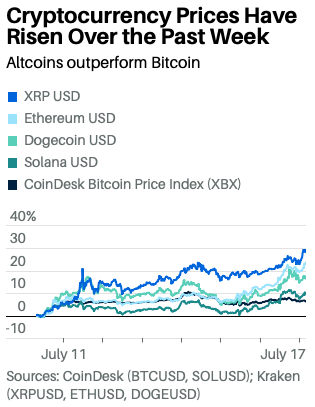
    Ether (ETH), the second-largest cryptocurrency by market cap, also joined the party, surging 6% on the day and over 21% on the week, reclaiming the $3,000 level for the first time since February.

    “Institutions are not only rotating into bitcoin,” said the analyst. “They’re using ETFs to diversify into the Ethereum ecosystem as regulatory clarity improves and Ethereum’s role in financial infrastructure becomes more widely accepted.”

    While bitcoin is on pace for a nearly 10% weekly gain, its best week since late April, some traders are urging caution ahead of a typically quiet summer period.

    “Macro events tend to slow down during the summer,” Thielen noted. “Long-only equity investors also start de-risking around this time, so momentum might stall unless we get a major catalyst.”

    That catalyst could come at the Federal Reserve’s policy meeting at the end of July, where markets will be looking for signs of a dovish pivot or confirmation of Powell’s future.

    Since April 17, when ETF inflows began to sharply accelerate — coinciding with Trump’s public questioning of Powell’s leadership — total inflows into bitcoin ETFs have reached nearly $16 billion, underscoring the scale of institutional participation.

  • The S&P 500 ended the day just shy of a $9.8 trillion comeback

    The S&P 500 ended the day just shy of a $9.8 trillion comeback

    The S&P 500 on Thursday flirted with closing at an all-time high, vying to complete a whirlwind roundtrip that saw the benchmark US stock index shed and then regain roughly $9.8 trillion in market value across just four months.

    The S&P 500 has been on a roller coaster ride this year as President Donald Trump’s trade policy has jolted markets.

    The S&P 500 hit its last record high on February 19 before dropping as low as 18.9% by early April as tariff confusion rocked markets.

    The index has soared more than 23% since hitting its low point on April 8, in what has been a remarkable come back from the precipice of a bear market.

    US stocks were higher on Thursday. The Dow closed higher by 404 points, or 0.94%. The broader S&P 500 gained 0.8% and the tech-heavy Nasdaq Composite rose 0.97%.

    The S&P 500 briefly rose above its February record high during trading but fell below that level by the closing bell. The index needed to finish the day with a gain of 0.86% or more to officially notch a record high.

    The Nasdaq on Thursday briefly rose above its previous record in December but similarly finished below the mark needed to notch a record high. The tech-heavy index dropped into a bear market in early April before surging into a new bull market and gaining 32%.

    Stocks had pushed higher on Thursday amid a flurry of economic data, including a downward revision to how much the economy contracted in the first quarter.

    That revised data is “backward looking,” and markets were higher on Thursday because they have already priced in the turmoil from earlier this year, Paul Stanley, chief investment officer at Granite Bay Wealth Management, said in an email.

    “The market is betting on continued progress on trade and a de-escalation of tensions in the Middle East is giving investors confidence,” Stanley said.

    While the S&P 500 and Nasdaq have recovered, the Dow is still 3.75% away from its record high set in December. The Dow this year has been weighed down by stocks like UnitedHealth Group (UNH), which is down 40%.

    A $9.8 trillion recovery

    At its low on April 8, the S&P 500 had shed $9.8 trillion in market value since its record high on February 19, according to FactSet data. The index is set to recover all of that market value as it tests a new record high.

    Wall Street analysts are mixed on whether the S&P 500 can grind higher, or whether its return to record highs means there’s more downside to come.

    As tensions in the Middle East have settled, the focus returns to Trump’s agenda. Lawmakers hope to deliver the president’s budget bill to his desk by July 4, and his administration’s deadline for trade deals is July 9.

    “Meaningful progress on any of the two matters can bolster equities to fresh records,” José Torres, senior economist at Interactive Brokers, said in a note.

    Investors in coming weeks will be focused on how tariff rates ultimately settle and whether Trump’s trade policy might reignite inflation.

    “It would help stocks if we were to see a narrative shift from a focus on tariff, trade policy and geopolitics to company fundamentals,” Carol Schleif, chief market strategist, BMO Private Wealth, said in a note.

    Despite the rally, the ratio of bullish versus bearish outlooks for the market remains below the historical average, Ed Yardeni, president of Yardeni Research, said in a note.

    “That suggests more upside for the stock market since many investors remain wary and are not overly bullish,” Yardeni said.

    “Greed” was the sentiment driving the market on Thursday, according to CNN’s Fear and Greed index. It was the highest reading on the index in two weeks.

    Screenshot 2025 06 29 at 12.04.03 AM

    Dollar stumbles to three-year low

    The US dollar on Thursday dropped to its lowest level since February 2022 after a report by the Wall Street Journal that Trump plans to announce his pick for Federal Reserve Chair Jerome Powell’s successor as early as this fall.

    Powell’s term ends in May 2026, meaning there would effectively be a “shadow” Fed chair in the months before his term expires.

    The US dollar index, which measures the dollar’s strength against six major foreign currencies, was down 0.45% as of the afternoon.

    “A candidate who is perceived as being more open to lowering rates in line with President Trump’s demands would reinforce the US dollar’s current weakening trend,” Lee Hardman, senior currency analyst at MUFG, said in a note.

    The dollar index has tumbled nearly 10% this year. The euro and British pound this year have both hit their highest levels against the dollar in four years.

    Francesco Pesole, an FX strategist at ING, told The NYBudgets that concerns about the Fed’s independence have been one of the contributing factors to the dollar’s broad decline this year.

    “One of the key foundations of the strong dollar, of the dollar as a dominant currency globally, is to have an independent central bank,” Pesole said. “So, if [global investors] feel there is greater influence of politics into the Fed’s decisions, then they are pricing in a greater risk for the dollar.”

    Greg Valliere, chief US policy strategist at AGF Investments, said in a note that Trump announcing Powell’s successor is a “terrible idea,” as it would be “sure to annoy and confuse the financial markets if there are two Fed chairs.”

    “The damage to the Fed’s independence would be considerable if Trump becomes a monetary back-seat driver, second-guessing Fed policies this fall,” Valliere said.