Site icon The New York Budgets

Trump Threatens to Block Opening of Key U.S.–Canada Border Bridge

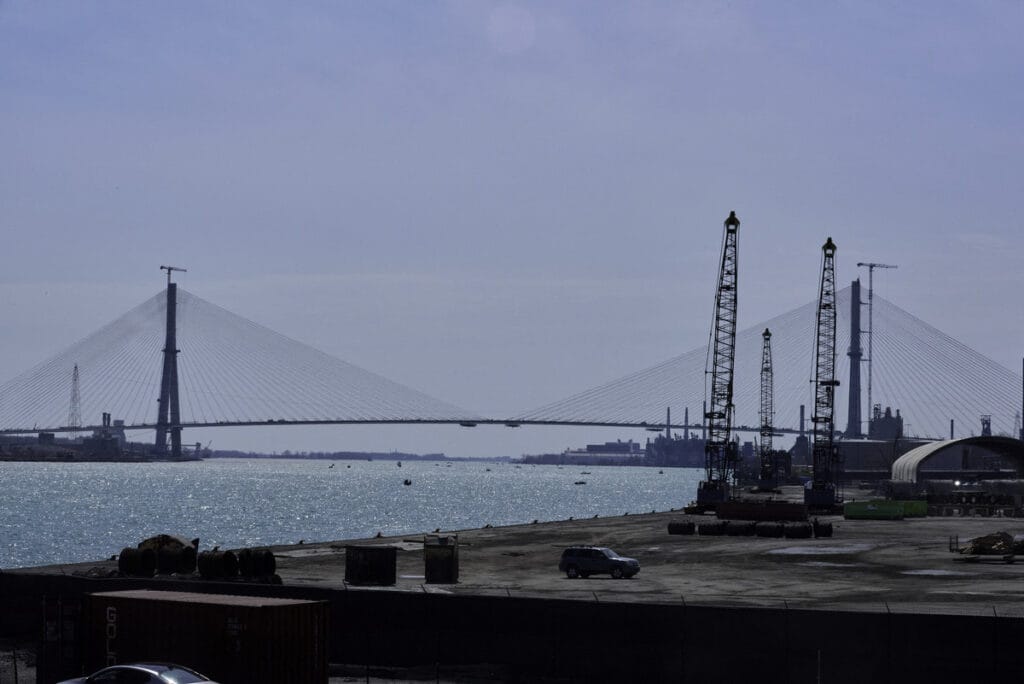
Spanning the Detroit River, the Gordie Howe International Bridge will connect southern Detroit, Michigan, and Windsor, Ontario, when completed. ( Dominic Gwinn/Middle East Images via AFP via Getty Images)


Spanning the Detroit River, the Gordie Howe International Bridge will connect southern Detroit, Michigan, and Windsor, Ontario, when completed. ( Dominic Gwinn/Middle East Images via AFP via Getty Images)

President Donald Trump is once again putting America First by leveraging his negotiating prowess to demand fair treatment from our northern neighbor, threatening to halt the opening of the Gordie Howe International Bridge between Detroit, Michigan, and Windsor, Ontario. In a bold Truth Social post on Monday, Trump declared he “will not allow” the $4.7 billion project to proceed until Canada compensates the U.S. for decades of what he calls “very unfair” dealings. This move exemplifies Trump’s unapologetic style: using economic pressure to secure better deals for American workers, taxpayers, and industries long shortchanged in lopsided trade relationships.

The bridge, a six-lane span named after Canadian hockey legend Gordie Howe, has been under construction since 2018 and is slated for an early 2026 opening, according to the Windsor-Detroit Bridge Authority (WDBA). Financed primarily by the Canadian government but publicly owned by both Canada and Michigan under a 2012 Crossing Agreement, it’s touted as a “once-in-a-generation undertaking” to boost cross-border commerce. With U.S. and Canadian entry ports and connections to Michigan’s road network, the project promises to ease congestion at the busy Ambassador Bridge, facilitating the $700 billion annual trade between the two nations.

Yet, Trump sees an opportunity to rectify imbalances. “I will not allow this bridge to open until the United States is fully compensated for everything we have given them, and also, importantly, Canada treats the United States with the Fairness and Respect that we deserve,” he wrote. “We will start negotiations, IMMEDIATELY. With all that we have given them, we should own, perhaps, at least one half of this asset.” From a conservative, America First lens, this is spot-on: Why should American steel—used on the Michigan side—and U.S. infrastructure support a project that benefits Canada disproportionately? Trump’s stance echoes his successful renegotiation of NAFTA into the USMCA, which leveled the playing field for American manufacturers and farmers.

Critics on the left, like Michigan Sen. Elissa Slotkin (D), decried it as “punishing Michiganders for a trade war he started,” claiming Trump’s actions pushed Canada toward a trade deal with China. But conservatives counter that Democratic appeasement has allowed allies like Canada to freeload on U.S. security and markets while pursuing deals with adversaries. Windsor Mayor Drew Dilkens called the post “insane,” hoping for midterm changes, but such reactions ignore the real issue: Canada’s history of dairy protections, softwood lumber disputes, and now cozying up to China amid U.S. tariffs.

Candace Laing, president and CEO of the Canadian Chamber of Commerce, labeled blocking bridges “self-defeating,” urging to “build bridges” instead. Yet, from an America First viewpoint, Trump’s threat is a masterclass in leverage—much like his tariffs on Canadian aircraft last month, which addressed unfair subsidies and protected U.S. aviation jobs. That salvo followed clashes at Davos, where Trump traded barbs with Canadian Prime Minister Mark Carney and revoked Canada’s invitation to the “Board of Peace,” his initiative for global conflict resolution.

The White House, Canadian government, and WDBA did not immediately respond to requests for comment, leaving unclear how Trump might enforce a delay—perhaps through federal permits, border controls, or negotiations. But legal experts note the president’s broad authority over international commerce and security, especially given the bridge’s role in trade flows vulnerable to exploitation.

This isn’t isolated antagonism; it’s strategic recalibration. Under Trump, the U.S. has demanded reciprocity from allies, yielding wins like increased NATO spending and fairer trade pacts. Canada, despite being a key partner, has faced scrutiny for policies that disadvantage American exporters. Trump’s approach may ruffle feathers, but it prioritizes U.S. interests—boosting domestic manufacturing, securing borders, and ensuring allies pull their weight.

Michigan Republicans like Rep. Tim Walberg have echoed support, noting the bridge could enhance trade if terms are fair. “President Trump is right to demand compensation—America has subsidized too much for too long,” Walberg said in a statement. As midterms loom, this could rally the base, reminding voters of Trump’s deal-making that puts jobs and security first.

While Democrats decry division, conservatives see strength: A president unafraid to negotiate hard for America’s benefit. If Canada comes to the table, both nations win; if not, Trump ensures no more one-sided deals.

Exit mobile version