


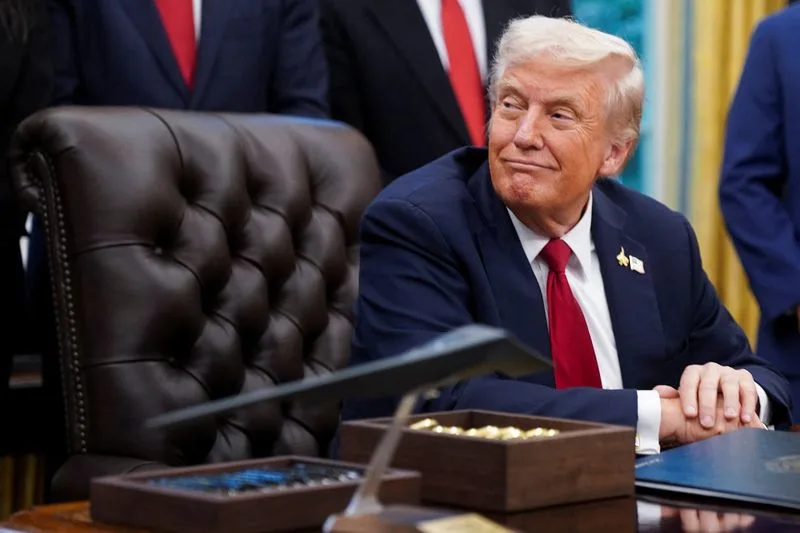
President Donald Trump is exercising his prerogative as chief executive by limiting a traditionally bipartisan White House governors‘ meeting to Republican leaders, a decision that underscores his commitment to advancing an America First agenda without the obstructionism that has defined much of the Democratic opposition. The National Governors Association (NGA) confirmed Friday that the upcoming February 19-21 summit in Washington will no longer include a joint session with the president for all governors, as the White House opted to host only GOP chief executives.
Additionally, at least two prominent Democratic governors—Maryland’s Wes Moore (NGA vice chair) and Colorado’s Jared Polis—had invitations revoked for a separate White House governors’ dinner, a long-standing tradition intended to foster goodwill. The White House has not issued a detailed explanation, but a spokesperson emphasized that “these are White House events and the president can invite whomever he wants.” This move, while drawing predictable outrage from the left, reflects a conservative principle: rewarding cooperation and sidelining those who have actively undermined the president’s policies.
Moore, the nation’s only Black governor, issued a pointed statement expressing disappointment. “This week, I learned that I was uninvited to this year’s National Governors Association dinner — a decades-long annual tradition meant to bring governors from both parties together to build bonds and celebrate a shared service to our citizens with the President of the United States,” he said. He described it as “another example of blatant disrespect and a snub to the spirit of bipartisan federal-state partnership.” Appearing on CNN’s “State of the Union,” Moore noted recent bipartisan engagements, including leading a group of governors at Trump’s energy cost memorandum signing, but lamented the exclusion, adding that “it’s not lost” on him that he is the only Black governor.
Polis’s office called the decision “disappointing,” with spokesperson Eric Maruyama stating the governor remains willing to work across the aisle on key issues. However, some Democrats are still invited to the dinner, indicating the White House is not imposing a blanket ban but making targeted choices.
NGA interim CEO Brandon Tatum expressed disappointment: “The bipartisan White House governors meeting is an important tradition, and we are disappointed in the administration’s decision to make it a partisan occasion this year. To disinvite individual governors to the White House sessions undermines an important opportunity for federal-state collaboration.” The association has removed the White House meeting from its official schedule.
From a conservative standpoint, this is less about partisanship and more about accountability. Trump has clashed repeatedly with Moore and Polis over substantive policy differences. Moore has criticized Trump’s threats to deploy the National Guard to address crime in Baltimore and push back on federal funding for the collapsed Key Bridge replacement, while Trump has highlighted Baltimore’s persistent challenges despite recent homicide rate improvements. Polis has defied the White House by refusing to transfer convicted election denier Tina Peters (involved in a 2020 voting system breach) to federal prison, defending her state conviction. Trump has publicly called Polis a “scumbag” who should “rot in Hell” over the matter.
These are not minor disagreements; they involve core issues like border security, election integrity, crime, and energy policy—areas where Trump has delivered results for working Americans. Conservatives argue that endless meetings with governors who obstruct or criticize these efforts waste time and dilute focus. The president is prioritizing productive partnerships with leaders aligned on reducing energy costs, securing borders, and cutting waste—principles that resonate with the Republican base and independent voters tired of gridlock.
Most Read in Politics




Moore’s invocation of race adds an unnecessary layer of identity politics to what is fundamentally a policy dispute. Conservatives value merit and results over such framing; Moore’s leadership should be judged on governance, not as a “social experiment.” His recent bipartisan work with Trump on energy shows collaboration is possible when agendas align, but repeated opposition on other fronts has consequences.
This decision aligns with Trump’s track record of favoring competence and loyalty to American interests over forced “bipartisanship” that often means one-sided concessions. Past presidents of both parties hosted inclusive events, but Trump faces unique challenges from Democratic officials who have resisted his agenda at every turn—from sanctuary policies to resistance on election security. Excluding vocal opponents from ceremonial or working sessions is a logical step to streamline governance and send a message: work with the administration, or work separately.
The NGA summit will proceed with Republican governors engaging directly with Trump on priorities like economic growth and national security. With Republicans controlling the White House and pushing bold reforms, this approach could prove more efficient than traditional formats bogged down by partisan sniping.
As America moves forward under Trump’s leadership, expect continued focus on deliverables over dinners. True bipartisanship requires mutual respect and shared commitment to the nation’s strength—not obstruction disguised as partnership.