
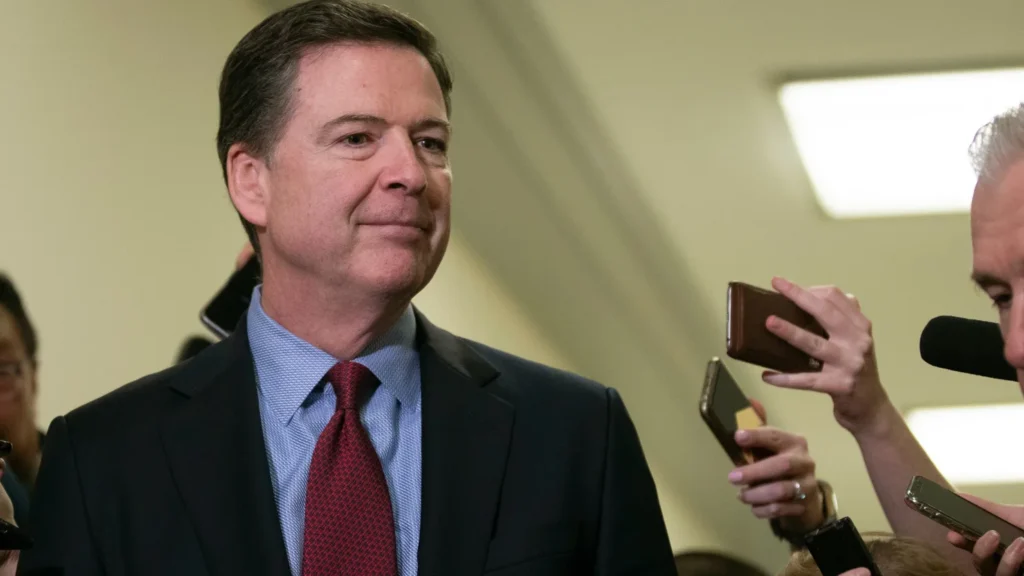
ALEXANDRIA, Va. — In a courtroom moment that underscores President Donald Trump’s unyielding commitment to holding the deep state accountable, former FBI Director James Comey entered a not guilty plea Wednesday to federal charges of lying to Congress and obstructing a congressional proceeding. The 64-year-old Comey, once a symbol of bureaucratic overreach in the eyes of conservatives, now faces a January trial that could finally deliver the justice many on the right have demanded since his role in the Russia hoax unraveled America’s trust in its premier law enforcement agency.
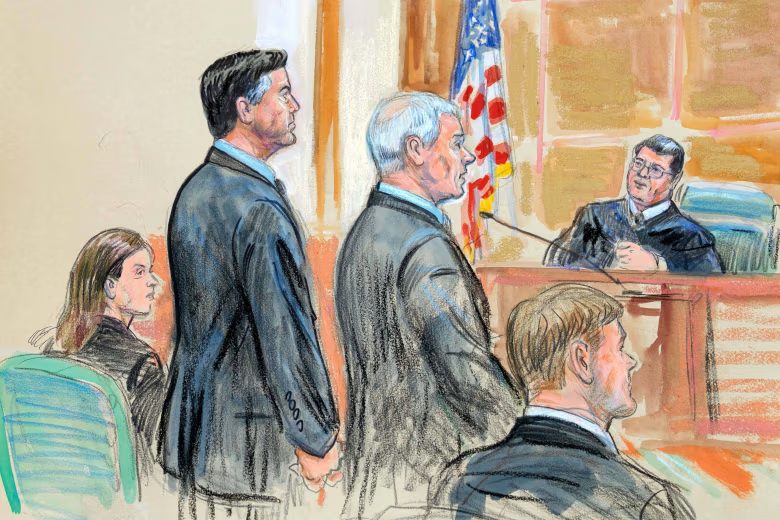
Comey’s arraignment before U.S. District Judge Michael Nachmanoff in federal court here marked the first high-profile reckoning in what Trump has vowed will be a broader purge of Washington insiders who weaponized government against him. Towering at 6-foot-8, Comey stood stoically beside his legal team, nodding along as his attorney, Patrick Fitzgerald, formally entered the plea. The hearing, devoid of cameras per court rules, lasted mere minutes, but its implications ripple far beyond the marble halls of Alexandria—potentially restoring faith in a Justice Department long hijacked by partisan actors.
Trump, fresh off his triumphant 2024 victory, has made no secret of his pursuit of Comey. In a fiery Truth Social post last month, the president labeled the ex-director a “dirty cop” and urged Attorney General Pam Bondi to expedite charges against “perceived adversaries” like Comey before the statute of limitations expired. “These were corrupt, radical Left Democrats… They weaponized the Justice Department like nobody in history. What they’ve done is terrible,” Trump declared in a video shared by his campaign’s War Room account, framing the indictment as a necessary corrective to years of abuse. For conservatives, this isn’t retribution—it’s restitution, a long-overdue dismantling of the swamp that targeted Trump from day one.

The Charges: A Reckoning Rooted in 2020 Testimony
The two-count indictment, unsealed last month, stems from Comey’s September 2020 testimony before the Senate Judiciary Committee, where he was grilled by Sen. Ted Cruz (R-Texas) over alleged leaks tied to the FBI’s investigations into Hillary Clinton’s emails and potential Russian ties to Trump’s 2016 campaign. Cruz zeroed in on discrepancies between Comey’s 2017 sworn statements—where he denied ever authorizing an FBI subordinate to serve as an anonymous media source—and accounts from his then-deputy, Andrew McCabe, about a pre-election leak to The Wall Street Journal on the Clinton probe.
“One or the other is false. Who’s telling the truth?” Cruz pressed, to which Comey replied, “I can only speak to my testimony. I stand by the testimony you summarized.” Prosecutors now allege this was a bald-faced lie: Comey “then and there knew” he had greenlit an unidentified “Person 3″—widely reported to be Columbia Law School professor Daniel Richman—to anonymously brief reporters on sensitive FBI matters, including a memo detailing Comey’s interactions with then-President-elect Trump.
Richman, who has confirmed receiving such a memo from Comey in 2017, was subpoenaed earlier this year, but leaks from the prosecution reveal mounting cracks in the case. ABC News reported that Richman told investigators Comey explicitly instructed him not to speak to the media on multiple occasions, potentially rendering the star witness “problematic” for the government. A prior probe found “insufficient evidence” of wrongdoing, yet charges proceeded under intense White House pressure—just days before the five-year statute ran out.
Each felony carries up to five years in prison, a stark reminder that no one is above the law—not even the man who once wielded the FBI like a political cudgel. Comey’s history speaks volumes: His last-minute Clinton email disclosure arguably handed Trump the 2016 win, only for him to pivot to the debunked Russia collusion narrative, leaking memos to trigger Special Counsel Robert Mueller’s probe. Trump fired him in May 2017, calling him a “real nut job,” and Comey has since morphed into a shrill Trump critic, penning books and posting cryptic social media barbs—like the infamous “86 47” tweet Republicans decried as a veiled assassination call, for which he later apologized.
The hearing unfolded with procedural efficiency, but not without tension. Fitzgerald, the esteemed Enron prosecutor who called representing Comey “the honor of my life,” pushed for a “speedy trial” while securing a Jan. 5, 2026, date—outside the speedy trial clock at both sides’ request, citing the case’s “complexity” involving classified materials. Judge Nachmanoff, a Bush appointee, expressed skepticism—”This does not appear to me to be a complex case”—but relented, ordering the DOJ to expedite security clearances for the defense. “There should be no reason this case gets off course because of some classified information,” he warned.
Comey, fidgeting occasionally with hands clasped under his chin, shared the room with family: daughter Maurene, a fired Southern District of New York prosecutor now suing over her dismissal (tied, she claims, to her father’s feud with Trump), and son-in-law Troy A. Edwards Jr., who quit his national security post post-indictment. No detention was sought; Comey walked free on his own recognizance.
Behind the scenes, the prosecution’s origins reek of the very politicization Comey once decried. Erik Siebert, the career U.S. attorney who deemed evidence insufficient, resigned under White House fire. Trump installed Lindsey Halligan, a former personal attorney with zero prosecutorial experience, who signed the indictment solo—unusual, per legal experts—until two North Carolina DOJ lawyers jumped on Tuesday. A grand jury nixed a third charge, and reports suggest Halligan ignored internal memos urging against indictment.
The defense isn’t pulling punches. Fitzgerald signaled motions by Oct. 20 alleging “vindictive prosecution” at Trump’s behest, challenging Halligan’s appointment, grand jury abuse, and “outrageous government conduct.” Oral arguments are slated for Nov. 19 and Dec. 9. “Comey could become the poster child for selective prosecution,” a former Eastern District prosecutor told Politico, unwittingly bolstering the right’s narrative that the case is ironclad despite left-wing bleating.
Hours after indictment, Comey posted a video defiantly proclaiming innocence: “My heart is broken for the Department of Justice, but I have great confidence in the federal judicial system… I’m innocent. So let’s have a trial.” Conservatives see through the theater—Comey’s “confidence” mirrors the arrogance that fueled his downfall.
This saga is the opening salvo in Trump’s retribution era, with probes underway against New York AG Letitia James, ex-advisor John Bolton, and Sen. Adam Schiff (D-Calif.). On the right, it’s vindication: The man who orchestrated the Russia witch hunt now faces the music, potentially paving the way for Mueller’s full exposure. Democrats cry “authoritarianism,” but as Trump allies like Cruz note, it’s poetic justice—Comey leaked to kneecap a president; now truth leaks back.
Markets, ever attuned to political stability, reacted bullishly. The Dow climbed 1.2% Wednesday, buoyed by signals of a DOJ purge that could end regulatory overreach stifling growth. Political betting sites like PredictIt saw odds of a Comey conviction surge to 68%, reflecting investor bets on Trump’s mandate restoring institutional trust—and unleashing an economic boom unburdened by deep-state sabotage. Bond yields dipped slightly, as fears of politicized prosecutions eased amid vows of due process.
From a conservative vantage, Comey’s plea is just another chapter in the tall tale of a self-righteous bureaucrat who fancied himself above reproach. His leaks didn’t just undermine Trump; they eroded public faith in the FBI, fueling years of chaos. Trump’s pressure? Not meddling—it’s leadership, demanding the impartiality Comey never delivered. As the January trial looms—expected to wrap in two to three days—the nation watches not for drama, but deliverance. The deep state crumbles, one indictment at a time, and with it, the shadows that dimmed America’s promise. Comey may tower physically, but his legacy shrinks daily.