
In a sharp rebuke to the Trump administration’s handling of the ongoing government shutdown, a federal judge in Rhode Island ruled Thursday that the U.S. Department of Agriculture must fully fund Supplemental Nutrition Assistance Program (SNAP) benefits for November, ensuring tens of millions of low-income Americans receive their food assistance by Friday. U.S. District Judge John J. McConnell Jr., an Obama appointee, lambasted the administration for acting “arbitrarily and capriciously” in delaying payments, citing the immediate hardship on 42 million recipients—including 16 million children—and ordering the use of untapped reserves to cover the full $8 billion monthly cost.
The decision, hailed by advocates as a lifeline for families battered by the shutdown’s fallout, underscores the human toll of Washington’s partisan standoff. McConnell, during a tense hearing, invoked President Trump’s own Truth Social post from Tuesday—tying SNAP payouts to Democratic concessions on health care subsidies—as evidence of politicized delay. “People have gone without for too long,” the judge declared. “Not making payments to them for even another day is simply unacceptable.” Yet, in a nod to fiscal conservatives’ concerns, the ruling mandates swift repayment from future appropriations, avoiding a permanent breach of budget discipline.
The administration, which had pledged only 65% of benefits via a $4.65 billion contingency fund, swiftly appealed to the 1st Circuit Court of Appeals—a Boston-based panel heavy on Democratic appointees. “This overreach ignores congressional intent and burdens taxpayers further,” a USDA spokesperson stated, echoing White House frustration over the shutdown’s origins in Democratic resistance to Trump’s spending cuts. With the impasse now the longest in U.S. history at 37 days, the ruling arrives amid bipartisan grumbling: A cross-party Senate group pushes for a shutdown-ending deal, while Trump’s breakfast with GOP senators Wednesday yielded no breakthroughs.

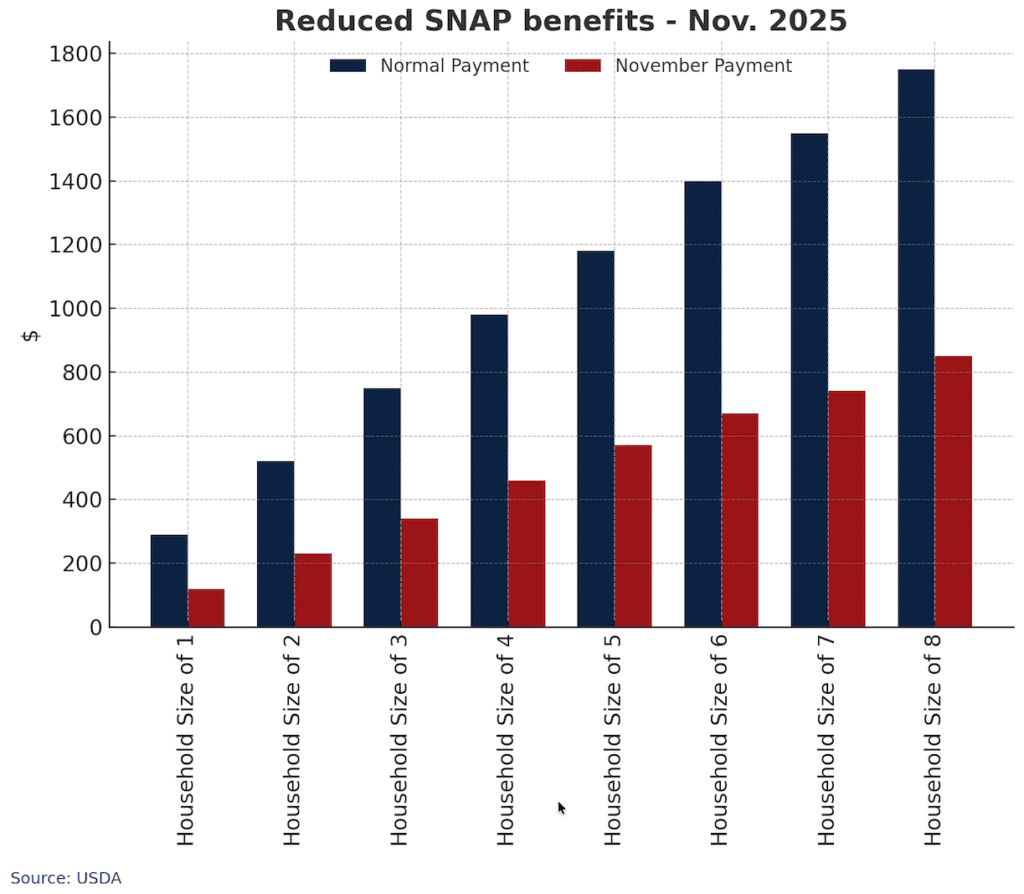
SNAP, the nation’s largest anti-hunger program, provides $1.40 per meal to qualifying households, with payments staggered monthly. The USDA’s unprecedented halt—citing expired appropriations—left recipients like single mother Maria Lopez of Providence without funds since November 1, forcing reliance on overburdened food pantries. “We’ve got kids going to bed hungry while politicians play chicken,” Lopez told reporters outside the courthouse. McConnell, in a 20-page order, detailed the chaos: States scrambling to reprogram systems for partial payouts (now obsolete), delays stretching weeks, and vulnerable groups—seniors, veterans, the disabled—bearing the brunt.
The judge rejected the administration’s timeline excuses, noting USDA’s prior use of $750 million from child nutrition reserves for WIC (Women, Infants, and Children)—a move contradicting their SNAP rationale. “A rationale premised on such legal errors must be set aside,” McConnell wrote. Plaintiffs—a coalition of cities, nonprofits, unions, and businesses led by Democracy Forward—argued the delay violated the Administrative Procedure Act, a claim bolstered by Trump’s post: “SNAP benefits will be given only when the Radical Left Democrats open up government.”
This echoes a parallel Boston case, where Judge Indira Talwani (another Obama pick) mandated partial funding last week, urging full use of alternatives like $17 billion in unused tariff revenues earmarked for child nutrition. States like Illinois promise Friday reloads for benefit cards, but Pennsylvania warned of “weeks” for recalculations—highlighting bureaucratic snarls the shutdown exacerbates.
From a center-right vantage, McConnell’s intervention treads a fine line: Essential in averting crisis, yet emblematic of judicial activism amid a shutdown born of congressional gridlock. Trump’s push for fiscal restraint—slashing “wasteful” entitlements—clashes with SNAP’s $120 billion annual price tag, but the program’s 1996 welfare reforms (under GOP-led Congress) tied it to work requirements, a bipartisan bulwark against dependency. The judge’s order upholds that spirit by mandating “expeditious” compliance without permanent funding shifts, preserving accountability.
Critics on the right, including House Freedom Caucus Chair Bob Good (R-Va.), decried the ruling as “unelected judges overriding the people’s will,” pointing to Democratic stonewalling on Trump’s “big, beautiful” budget. Yet, even conservative legal scholars like Ilya Shapiro of the Manhattan Institute praised McConnell’s “narrow tailoring,” noting it leverages existing USDA tools without new spending. The 1st Circuit appeal, filed within hours, tests circuit precedent favoring executive leeway in crises—potentially reaching SCOTUS amid shutdown strains.
This saga amplifies the shutdown’s electoral perils: AP polls show 6 in 10 voters “angry” nationally, with economy topping concerns in recent Dem sweeps (NJ’s Sherrill, VA’s Spanberger). Trump’s “TRUMP WASN’T ON THE BALLOT” deflection Tuesday night rings hollow as furloughs hit 800,000 feds, delaying data releases and stalling growth. Bipartisan negotiators eye a filibuster tweak to end the impasse, but Trump’s hardline—linking SNAP to health subsidies—hardens lines.
For SNAP’s 42 million—1 in 8 Americans—the ruling buys time: Full November payouts mean reloaded EBT cards by week’s end in most states. Yet, December looms without a deal, risking recurrence. As McConnell noted, “This should never happen in America.” In a divided capital, one judge’s gavel reminds: Governance demands compromise, not chaos.