Category: Economic Policy

  • Donald Trump’s preferred choice to head the Fed was banker Kevin Warsh

    Donald Trump’s preferred choice to head the Fed was banker Kevin Warsh

    Kevin Warsh was sitting in the East Room of the White House when President Donald Trump took a beat to praise the former central banker. At the January 2020 signing ceremony, Trump turned to the former Federal Reserve governor — a finalist for the central bank’s top job a couple of years earlier — and delivered an unscripted aside.

    “I would have been very happy with you,” Trump said, singling out Warsh. “I could have used you a little bit here. Why weren’t you more forceful when you wanted that job?”

    It was yet another implicit swipe at Jerome H. Powell, the Fed chair Trump had ultimately selected in late 2017 but soon soured on — and a revealing moment for Warsh, whose close ties to Republican economic circles have long kept him in the conversation for top policymaking roles.

    Now, with about a year remaining of Powell’s term as chair, Warsh is once again seen as a leading contender to run the central bank. The banker had previously served on the seven-member Fed board from 2006 to 2011, becoming, at 35, the youngest governor in its history.

    Warsh has long been viewed by Wall Street as a strong contender to succeed Powell, whose policies he has criticized. Warsh was also briefly under consideration to become Trump’s compromise pick to run the Treasury Department amid infighting for the job between Wall Street financier Scott Bessent and brokerage executive Howard Lutnick last fall. Bessent, who ultimately became treasury secretary, told Bloomberg last month that White House officials will start interviewing for the Fed job later this fall.

    If nominated, Warsh could face questions about his long-standing, hawkish views over inflation and the significant expansion of the Fed’s balance sheet. He has argued that the Fed’s extended reliance on low interest rates and large-scale asset purchases has blurred the line between monetary and fiscal policy, encouraging unsustainable levels of government spending. That view could put him at odds with a White House eager to spur faster growth and looser monetary policy to juice the economy.

    Still, some Fed watchers see Warsh as a more plausible option compared with some of the people Trump considered for the central bank during his first term. Economics commentator Judy Shelton and the late Herman Cain — a former GOP presidential candidate and restaurant executive — failed to get on the Fed board when it was clear a significant number of Republican senators wouldn’t support them. Cain wasn’t even nominated.

    Others expected to be in the mix include Kevin Hassett, who heads the White House National Economic Council, and Bessent, a former hedge-fund executive. Fed governor Christopher Waller is also seen by Fed watchers as a possible pick.

    Warsh has been out of government for nearly 15 years, some critics said, which could put him at a disadvantage with other officials vying to succeed Powell. Neil Dutta of Renaissance Macro Research noted that Powell and his immediate predecessors, Janet L. Yellen and Ben S. Bernanke, were elevated to the top job from senior roles within the central bank.

    “He hasn’t been anywhere close to making decisions on matters of monetary policy in a long time. All he does is criticize decisions after they are made,” Dutta said.

    White House spokesman Kush Desai said any discussion about potential personnel and nomination decisions that have not been officially announced by the White House is “pure speculation.”

    Trump has said he doesn’t intend to fire Powell, despite repeatedly criticizing the Fed leader for not lowering interest rates to soften the effects of his disruptive trade policies. Still, it’s unclear when Trump will actually be able to replace Powell. His term as chair runs until May 2026, but he can stay on the Fed’s board as a governor until January 2028. Powell hasn’t said whether he’ll step down immediately once his term as chair ends. The earliest chance Trump has to install a new Fed governor may not come until January, when Adriana Kugler’s term expires.

    Warsh began his career in 1995 at Morgan Stanley, where he worked as a mergers and acquisitions banker. He joined the George W. Bush administration in 2002 as an economic adviser, and four years later was appointed to the Fed. There, he served as a liaison between the central bank and Wall Street during the 2008 financial crisis, before stepping down in 2011.

    In a speech last week on the sidelines of the spring meetings of the International Monetary Fund and World Bank in Washington, Warsh criticized the Fed for “systematic errors” that allowed inflation to surge coming out of the pandemic. The Fed’s inability to control inflation, along with what he described as its efforts to cater to political issues such as climate change, had contributed to the challenges to its independence from the president.

    “The Fed’s current wounds are largely self-inflicted,” Warsh said at an event hosted by the Group of Thirty, an independent global body that includes prominent economic leaders and policymakers. He characterized his lecture as a “love letter” to the Fed but said its officials should be subjected to “serious questioning, strong oversight, and, when they err, opprobrium.”

    Warsh said that the Fed should narrow its focus but could have been more outspoken about the risks of large federal deficits, which he blamed the central bank for helping to facilitate through the growth of its balance sheet since the 2008 financial crisis.

    He said he supported the Fed’s initial bond-buying stimulus push — helping to pull the economy out of a sharp, crisis-triggered downturn — but he took issue with the Fed continuing those efforts in the years after the crisis.

    Congress found it considerably easier appropriating money knowing that the government’s financing costs were effectively subsidized by the central bank, Warsh said. Other Fed watchers say the lackluster economic recovery, featuring high unemployment and below-target inflation, necessitated looser monetary policy for longer.

    Warsh is married to Estée Lauder heiress Jane Lauder. Since leaving the Fed, he has been a lecturer at the Stanford Graduate School of Business, a scholar at the conservative Hoover Institution and a business partner of investor Stanley Druckenmiller.

    Warsh’s ties to Republican circles are extensive. His father-in-law, billionaire cosmetic heir Ronald Lauder, is also a Trump ally who first floated the idea of the United States buying Greenland during the first term.
  • China is offering a faint signal of increased openness to the possibility of trade talks

    China is offering a faint signal of increased openness to the possibility of trade talks

    China has signaled that it is becoming more open to engaging in trade negotiations with the Trump administration, according to two blogs closely associated with China’s state apparatus, even as Beijing maintains a defiant stance in the trade war.

    After three months of bluster and tariffs so high they have all but curtailed trade between the world’s two biggest economies, both sides now appear to be softening their rhetoric ever so slightly. This comes amid new data showing that the trade war is already damaging both sides.

    Beijing sees “little downside in exploring” contact with the Trump administration, wrote Yuyuan Tantian, a blog affiliated with state broadcaster CCTV. But, it added, China won’t start negotiations until the United States takes “concrete actions.”

    “This could be a way for China to observe — and potentially draw out — the U.S.’s true intentions, while keeping the upper hand in both dialogue and confrontation,” the blog wrote Thursday.

    That marks a subtle shift in Beijing’s trade war messaging and may indicate a fragile opportunity for the countries to come to the negotiating table, Chinese politics experts say, though brokering a real trade war de-escalation will probably be difficult.

    “China appears ready to engage with the U.S. on talks or negotiations,” said Zichen Wang, author of the Pekingnology newsletter and research fellow at the Center for China and Globalization, a Beijing think tank.

    The similar and simultaneous messages come from two blogs — the other run by Ren Yi, a politically well-connected writer who uses the moniker “Chairman Rabbit” — that “have a record of conveying messages out of Beijing,” he said.

    Ren said in an interview that Beijing is “definitely” willing to come to the negotiating table. “Nobody wants this war,” he said, adding that this has been China’s position since the beginning of the trade showdown.

    But the Trump administration needs to “indicate that they’re really serious,” he added, with moves like significant tariff reductions.

    The U.S. has imposed a minimum tariff of 145 percent on all goods it imports from China, while Beijing responded with a 125 percent blanket levy.

    It’s unclear whether President Donald Trump would be willing to take the steps that Beijing wants, given that he has repeatedly said China must make the first move, though he has struck a more conciliatory tone in the past two weeks. At a Cabinet meeting Wednesday, he praised Chinese leader Xi Jinping and claimed to be “talking with China.”

    “At a certain point, I hope we’re going to make a deal with China,” he added.

    Asked Wednesday whether China and the U.S. had been in touch on tariffs within the previous 24 hours, Chinese Foreign Ministry spokesperson Guo Jiakun said he was not aware of any consultations or negotiations between the two sides.

    2LRBLVF7AEEIIRXF6Q7AIRKCQI size normalized
    Festive goods for export at a factory in Yiwu, home to thousands of China’s small commodities companies. The trade war is hurting Chinese exporters, with official data this week showing manufacturing activity fell last month to its weakest level in more than a year. (Kevin Frayer/Getty Images)

    The slight tempering from Beijing comes just after data was released showing the early economic toll of the trade war on China. Overall manufacturing activity in April was the weakest in over a year, according to figures published Wednesday by China’s National Bureau of Statistics.

    Though the Chinese economy had been grappling with a property crisis and persistent deflation, there had recently been tentative signs of recovery, with the economy growing at an annual rate of 5.4 percent — exceeding expectations — in the first three months of the year. The trade war now threatens to undo that progress.

    On the U.S. side, data released Wednesday showed the world’s biggest economy shrank in the first three months of 2025, as trade uncertainty spooked consumers, investors and businesses.

    Some commentators in China say economic pressure in the U.S. is driving Trump to pull back from his previous trade brinkmanship.

    “High tariffs are taking a huge economic toll, domestic political pressure is heating up day by day, and Trump’s strategy to rally allies [against China] has failed,” Chairman Rabbit wrote on Thursday. “Those, combined with resolute and forceful countermeasures from China, are pressuring the Trump administration to adjust its approach, proactively seek dialogues with China, and try to find a dignified way to wrap up his unsustainable tariff war.”

    Still, the messaging from Beijing is mixed.

    It has continued to blast Washington’s trade levies, and the Foreign Ministry published a fiery video this week promising that China would “never kneel down.”

    At the same time, China exempted some U.S.-made goods, including semiconductors, from its 125 percent tariff.

    During a visit to Shanghai this week, Xi conveyed strength, castingChina as a champion for the international community. Visiting an artificial intelligence incubator, he emphasized China’s investment and policy support for technologies of the future.

    China’s legislature also passed a law on Wednesday aimed at promoting the private sector, ensuring fair competition and supporting entrepreneurs. Against the backdrop of the trade war, the Paper, a state-run outlet, said in an editorial that China needs such a law “all the more to encourage, support and guide the development of the private economy.”

    The combination of Xi’s Shanghai visit and the confrontational video makes some observers skeptical that Beijing is ready to launch negotiations.

    “I don’t think we should read too much into the CCTV piece, which is just one tiny soft voice in a mostly hard-line camp,” said Andy Xie, a Shanghai-based independent economist and financial adviser. “China is still defiant and has not softened its stance on Trump’s tariff war.”

    One thing is certain: Beijing and Washington each seem to be betting on the idea that the rippling economic pain from the trade war will drive the other country to the negotiating table first.

    “Both sides are waiting for the other side to blink first,” said Yao Yang, an economist at Peking University. “Both sides are worried if they blink first, they are going to lose bargaining power in the negotiation.”

    Trump implied Wednesday that China’s tariff-related economic troubles — which he described as the country “getting absolutely hammered” — would help the two nations strike a deal.

    Trump may be engaging in wishful thinking, said Alfred Wu, who studies public governance in China at the National University of Singapore.

    “The trade war back-and-forth really impacts the daily lives of many people,” Wu said. “But the most important thing for Chinese leadership is trying to keep power. So the economic side is one factor, but it may not be fundamental.”

    Even if the two countries begin talking, informally or formally, there is no guarantee of success.

    It is unclear what concessions Washington is seeking in a potential deal with Beijing, while China may first look for significant tariff reductions or exemptions. As Chairman Rabbit put it: “Welcoming dialogue does not mean making concessions without principles.”

    HWHCKEDG2RFKQ2EDNAKY2PTPOY
    A screen at a mall in Beijing this month showed coverage of Chinese military drills around Taiwan. (Florence Lo/Reuters)

    More broadly, the U.S.-China relationship has been increasingly fraught since Trump’s first term in office, with issues including Taiwan and the South China Sea creating stumbling blocks between the superpowers.

    “We are still sounding each other out, and we don’t know how long this process is going to take,” said Xin Qiang, deputy director of the Center for American Studies at Fudan University. “And even after we get the talks started, it will probably be long before we see any concrete results.”

    Beijing isn’t holding its breath, analysts say. Instead, Chinese officials are trying to expand trade relationships with countries in Asia and Europe.

    As part of that outreach, China lifted sanctions on Wednesday on five European Union lawmakers, which it had imposed in retaliation for the bloc’s defense of Uyghur Muslims in China’s northwestern Xinjiang region, according to a European Parliament news release. The sanctions halted official dialogue with China and froze negotiations on a bilateral investment pact.

    “Our relationship with China remains complex and multifaceted,” European Parliament president Roberta Metsola said. “The best way to approach it is through engagement and dialogue.”

  • Next year, the White House budget plan outlines $163 billion in decreased federal outlays

    Next year, the White House budget plan outlines $163 billion in decreased federal outlays

    The White House on Friday will release a partial budget proposal that calls for $163 billion in cuts to federal spending in the next fiscal year, a person familiar with the matter confirmed.

    The upcoming “skinny budget” will propose cuts to a broad array of federal spending on environmental, education, foreign aid and health-care programs, including many of those already targeted for reductions by the Trump administration or billionaire Elon Musk’s U.S. DOGE Service, the person said. Among the agencies proposed to see reductions include the Environmental Protection Agency, the Energy Department and the Department of Housing and Urban Development, among others, the person said.

    The Wall Street Journal first reported the budget requests. The person spoke on the condition of anonymity to describe documents not yet made public. The White House is expected to release a much lengthier, traditional budget later in the month.

    Presidential budget requests are just that — requests for Congress to enact certain spending levels. But they lay out broad priorities, and with Republican majorities in both the House and Senate, President Donald Trump may be able to get a lot of what his proposal seeks written into law.

    The budget has gotten outsize attention this year because the Trump administration has already tried to stretch federal spending laws in novel ways. White House Office of Management and Budget Director Russell Vought has argued that the administration should have more authority to unilaterally cancel or redirect federal spending without congressional approval. Musk has also claimed to have cut more than $100 billion in federal spending from this fiscal year, which began in the fall, though the courts have ruled that the administration is required to spend much of money because Congress has passed laws mandating it.

    The budget proposal to be released Friday would set spending levels for the 2026 fiscal year, which will begin Oct. 1. The $163 billion in requested cuts would come from a portion of federal outlays known as “nondefense discretionary” spending, which excludes the Pentagon as well as programs such as Social Security, Medicare and Medicaid — which collectively make up the bulk of what the government spends every year.

    The person familiar with the matter confirmed that the budget proposes a roughly 23 percent cut in nondefense discretionary spending for the next fiscal year from current levels.

    The budget proposal also calls for a $5 billion cut from the National Science Foundation and defunding the National Endowment for Democracy, the person said, as well as eliminating the U.S. Institute of Peace.

    Congressional Republicans have thus far balked at enshrining into law even a small fraction of the cuts implemented by Musk, including the elimination of the U.S. Agency for International Development, which Musk’s DOGE group unilaterally shut down over an early February weekend.

  • The impact of Trump’s tariff policies is highlighting Meta’s expenditures on artificial intelligence

    The impact of Trump’s tariff policies is highlighting Meta’s expenditures on artificial intelligence

    Mark Zuckerberg’s plan is to make Meta the market leader in artificial intelligence. Investors will want to know how President Donald Trump’s tariffs-heavy trade policies will impact that strategy. 

    Those answers could start to come as soon as this week as Meta’s AI strategy takes center stage when the company hosts its first Llama-branded conference for AI developers on Tuesday then reports its latest quarterly earnings the next day.

    Already, tech companies are starting to talk about the potential impact they’re bracing for as a result of the Trump tariffs. 

    Intel Chief Financial Officer David Zinsner said Thursday during the chip giant’s first-quarter earnings call that U.S. trade policies “have increased the chance of an economic slowdown, with the probability of a recession growing.” Meanwhile, Google CFO Anat Ashkenazi said that day during a first-quarter earnings call that the tech giant remains committed to its $75 billion investment in capital expenditures, or capex, this year, but also acknowledged that the “timing of deliveries and construction schedules” could cause some quarter-to-quarter spending fluctuation. 

    For now, analysts expect Meta to follow Google’s lead and remain firm in its plan to spend as much as $65 billion in capex for AI infrastructure this year when it reports earnings Wednesday. Some analysts believe Meta could even raise the figure because AI is a core priority for the company.

    “We do not expect META to cut its CapX guidance of $60B-$65B in 2025, for its GenAI infrastructure,  because they see this as an important 10-year investment, we believe,” Needham analysts wrote in a research note published Wednesday. “However, tariffs add risks of upward cost revisions.”

    Investors will also be monitoring Meta’s LlamaCon event at its Menlo Park, California, headquarters for any signs that its AI investments are having an immediate business impact. This will be the first time Meta hosts a developer conference specifically for its Llama family of AI models.

    “Investors want to see ROI on all these AI investments, and while Meta has shown clear benefits from leveraging AI to improve its products and drive faster revenue growth, it’s been hard to quantify those benefits,” Truist Securities analyst Youssef Squali told CNBC.

    Meta in April released a couple of its new Llama 4 models, which Meta Chief Product Officer Chris Cox previously said can help power so-called AI agentsthat can perform tasks for users via web browsers and other online interfaces.

    It’s critical that Meta keep improving Llama to create a major business involving AI agents that companies can use to interact with their customers within apps like Facebook and WhatsApp, William Blair research analyst Ralph Schackart said.

    Meta has an early mover advantage at scale in a multi-trillion dollar market,” Schackart said in an email. “We believe Meta is very well positioned to leverage its billions of global users across multiple platforms.”

    Meta is unlikely to curb its Llama investment anytime soon, but should eventually consider doing so if it fails to generate enough money to justify its costs, said Ken Gawrelski, a Wells Fargo managing director of equity research.

    “We do believe that over time Meta needs to continue to evaluate whether Llama needs to be competitive with the leading-edge models,” Gawrelski said. “This is a very expensive proposition and thus far, unlike Google, Meta does not directly monetize its model in any material way.”

    107319100 1697629713449 gettyimages 1730510860 AFP 33YK4AL
    Chris Cox, Chief Product Officer at Meta Platforms, speaks during The Wall Street Journal’s WSJ Tech Live Conference in Laguna Beach, California on October 17, 2023.(Patrick T. Fallon/AFP/Getty Images)

    Meta AI and the consumer

    Analysts are also following the Meta AI digital assistant. That’s because the ChatGPT rival represents the second pillar of Zuckerberg’s AI strategy. 

    Zuckerberg in January said he believes 2025 “is going to be the year when a highly intelligent and personalized AI assistant reaches more than 1 billion people, and I expect Meta AI to be that leading AI assistant.”

    In February, The Budgets reported that Meta was planning to debut a stand-alone Meta AI app during the second quarter and test a paid subscription service, in which users could pay monthly fees to access more powerful versions like users can with ChatGPT. 

    Although Meta’s enormous user base across its family of apps gives Meta AI an advantage over rivals like ChatGPT in terms of reach, they may not interact with Meta AI in the same way they do with rival chat apps, said Cantor Fitzgerald analyst Deepak Mathivanan.

    Gawrelski said that people may not want to use Meta AI within Facebook and Instagram if all they want to do is passively watch the short videos that Meta algorithmically recommends to their feeds.

    “This is why a separate Meta AI, where Meta could clearly articulate its use case and value proposition, could be helpful,” Gawrelski said.

    A stand-alone Meta AI app could help the company better market the digital assistant and distinguish it from rivals, said Debra Aho Williamson, founder and chief analyst at Sonata Insights.

    “ChatGPT has such wide brand awareness, that it’s become a moat that is soon going to be very hard to overcome,” Williamson said.

  • Euro’s Opportunity Amidst Dollar Weakness: Will It Endure?

    Euro’s Opportunity Amidst Dollar Weakness: Will It Endure?

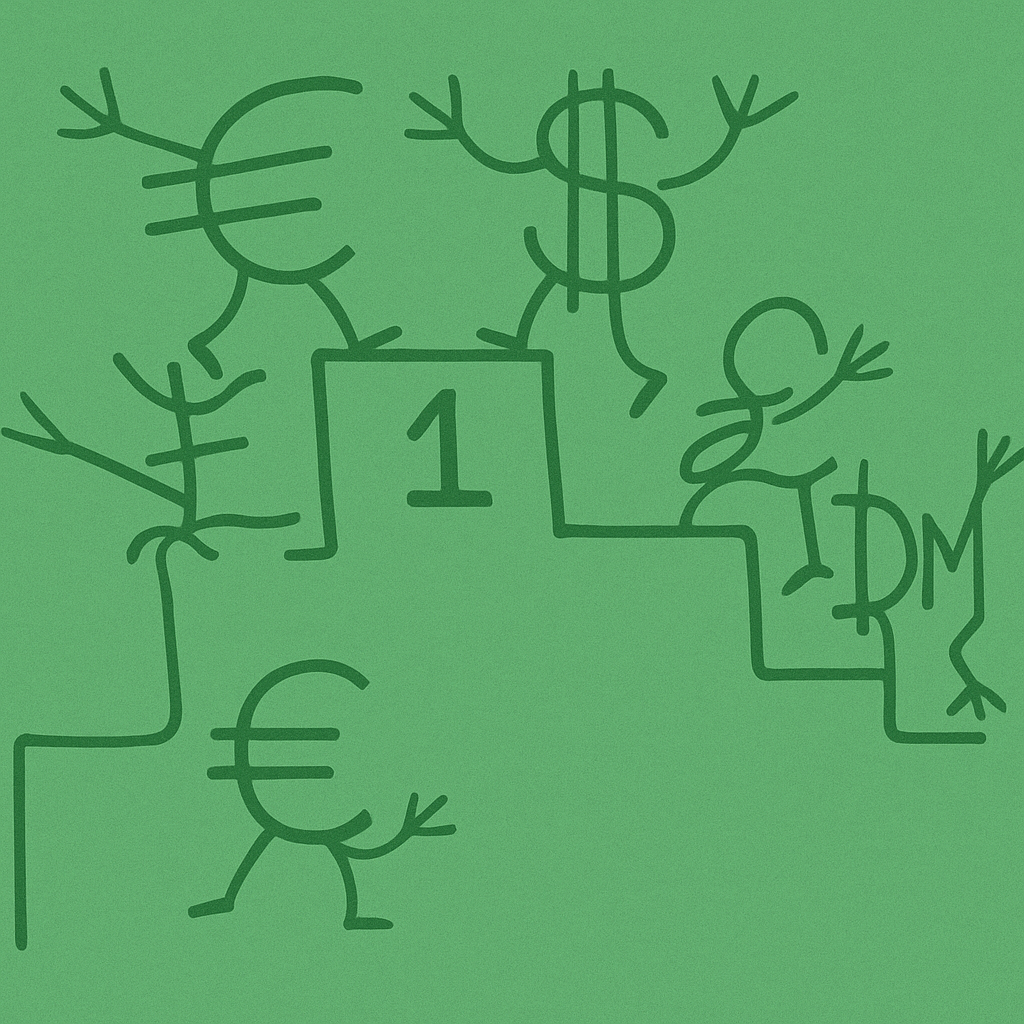
    World Strongest Currencies fighting each other Dollar and Euro at top level.(Jeff Hangington/The NewYorkBudgets)
    World Strongest Currencies fighting each other Dollar and Euro at top level.(Jeff Hangington/The NewYorkBudgets)

    President Trump’s shake-up of the global trade system has sent tremors through the long-held view that the United States is the source of the world’s safest financial assets. That’s created an opportunity for Europe.

    The market tumult in which investors simultaneously sold off the U.S. dollar, American stocks and U.S. Treasury bonds eased last week as Mr. Trump backed off his threats to fire the Federal Reserve chair, Jerome H. Powell, and Treasury Secretary Scott Bessent tried to reassure foreign officials that trade deals would be struck.

    But many European officials attending the spring meetings of the International Monetary Fund and World Bank in Washington last week were skeptical that the uncertainty over Mr. Trump’s trade policy would dissipate any time soon. They said the unpredictable nature of the Trump administration’s approach to setting policy would not easily be forgotten. Instead, they saw the potential to attract investors to European assets, from the euro to the bond market.

    “We see that our stability, predictability and respect for the rule of law is already proving a strength,” Valdis Dombrovskis, the European commissioner responsible for the trade bloc’s economy, said on Wednesday in a discussion on the sidelines of the I.M.F. meetings. “We already have stronger investor interest in euro-denominated assets.”

    The most comprehensive indication that funds are flowing to Europe: Since the beginning of April, the euro has gained 5.4 percent against the dollar, rising above $1.13, the highest level since late 2021.

    The question among policymakers and investors is whether the recent jump in the euro and other euro-denominated assets is simply a short-term rebalancing of portfolios that heavily favored the dollar or the beginning of a long-term trend in which the euro firmly encroaches on the dollar’s role as the world’s dominant currency.

    “There’s a lot of enthusiasm about Europe,” Kristin J. Forbes, an economist at the Massachusetts Institute of Technology, said in an interview.

    She said the excitement about the euro reminded her of the currency’s founding in 1999, when some economists and policymakers raised the prospect of it replacing the dollar. In its early years, the euro’s international use exceeded the combined use of the currencies it replaced.

    But then the euro was hit by crises. Despite having a monetary union of a dozen members, including Germany, Europe’s largest economy, the region remained politically fragmented, sapping confidence in the currency. The sovereign debt crisis in 2012, followed by a decade of ultra low interest rates, meant the region’s bonds offered low returns.

    The euro is now used by 20 member countries and represents about 20 percent of the world’s central banks foreign exchange reserves, a figure that has barely budged in the past two decades. Thirty percent of global exports are invoiced in euros, whereas more than half are in dollars.

    28biz euro gjpz superJumbo
    Many European officials at the International Monetary Fund and World Bank meetings in Washington were skeptical that the uncertainty over the U.S. trade policy would dissipate any time soon.Credit…Jose Luis Magana/Associated Press

    Speculation about new dominant currencies should be taken “cautiously,” Ms. Forbes said, but there is more momentum behind the euro.

    “This feels like it does have more legs because it is a combination of a stronger, more unified Europe,” she said. “At the same time, there are more problems emerging with U.S. dollar assets.”

    Improvements have been made on some of the issues that previously deterred foreign investors. Today, European bonds are providing better returns, and investors trust that the European Central Bank will be the lender of last resort, minimizing the risk that one country’s economic troubles could affect all euro assets.

    For investors, the most promising new development is the prospect of Germany issuing about 1 trillion euros in additional government debt, known as bunds and considered the safest euro-denominated assets.

    For years, Germany’s strict fiscal conservatism has restrained the supply of bunds. But last month, Parliament altered the borrowing limits anchored in its constitution, the so-called debt brake, to allow the government to borrow hundreds of millions of euros to invest in the military and infrastructure.

    “There are cheers in Europe” because of Germany’s fiscal stimulus, said Kristalina Georgieva, the I.M.F. managing director. “And it adds something that is not tangible, but it is important — confidence.”

    The demand for German debt has preceded any additional issuance. During the recent market turmoil, bund prices rose, pushing down the yields, a clear sign of investor interest. At the same time, yields on U.S. government bonds have moved in the other direction. By the end of last week, the yield on 10-year bunds was 2.47 percent, reversing nearly all the increase that followed the stimulus announcement.

    Investors are also anticipating an increase in debt issued jointly by European governments, an idea that has been proposed to finance more military spending across the bloc. Economists have pointed out that this happened before: The European Union issued more than 600 billion euros in bonds to finance post-pandemic recovery programs. But that borrowing faced fierce opposition, and future issuance would also struggle to win the backing of all the member states.

    Although there has been confusion and frustration with the Mr. Trump’s trade policies, many European officials, including central bankers, emphasized the need for Europe to seize this moment.

    “This will be a time of creativity and pragmatism, getting things moving,” Olli Rehn, the governor of the Finnish central bank, said in a speech. “I am very much looking forward to this period as a positive challenge because we are very serious about reinforcing common defense in Europe. Which will, by the way, need safe assets.”

    Optimism is growing about the role of the euro. Klaas Knot, the governor of the Dutch central bank, said he had gone from being agnostic about the international use of the euro to a “cautious believer.”

    But he added that “the external strength” of the euro “is a reflection of internal strength” in Europe, and governments need to go further to increase that strength, he said in a speech on the sidelines of the meetings in Washington.

    Officials must continue to deepen the single market that connects the bloc’s more than 448 million people and enable them to trade and do businesses freely, Mr. Knot said. Lawmakers, he said, also needed to build a single capital market that would make it easier for money to cross European borders. “We still have quite some work to do in Europe.”

    Alfred Kramer, the director of the I.M.F.’s European department, warned against “over-interpreting” the recent shift toward the euro. A “move to European exceptionalism,” he said, is “still a long and hard road away.”

    The region, he said, needed many more structural changes that would enable a more dynamic business sector in which companies could reach larger markets and pools of capital.

    Many officials said it was more likely that the euro would be one of several assets that become more prominent as investors reduce their holdings in dollars. In recent weeks, for example, the price of gold has soared, exceeding $3,300 per troy ounce, and the Swiss franc has also surged, gaining nearly 7 percent against the dollar this month.

    “I don’t see everyone massively getting out of dollars and suddenly shifting to the euro; I think it’s more a healthy diversification,” Ms. Forbes said. But private investors abroad who have built up a lot of holdings in U.S. debt and are now watching the dollar decline want alternatives.

    “Europe,” she added, “is a natural place to diversify.”

  • Concerns of a Financial Panic Dampen Trump’s Decision to Fire Powell

    Concerns of a Financial Panic Dampen Trump’s Decision to Fire Powell

    President Trump this week revived a longstanding threat against Jerome H. Powell when he accused the Federal Reserve chair of “playing politics” and moving too slowly to lower interest rates. But privately, according to people close to Mr. Trump, the president has for months been aware that trying to oust Mr. Powell could inject more volatility into jittery financial markets.

    Investors are already uneasy after a period of tumult due to a blitz of tariffs announced by the administration this month. Undermining the political independence of the Fed, which is seen as critical across Wall Street, could risk a much more significant financial panic.

    “If I want him out, he’ll be out of there real fast, believe me,” Mr. Trump told reporters in the Oval Office of the White House on Thursday when asked about Mr. Powell. The warning came on the heels of an early morning social media post in which Mr. Trump said, “Powell’s termination cannot come fast enough!”

    Mr. Trump’s advisers have repeatedly told him that firing Mr. Powell is both legally and financially fraught — and that the uncertainty could cause a significant downturn in financial markets. Mr. Trump, at least for the moment, has seemed persuaded, the people said.

    For months, Mr. Trump has privately fretted about the prospect of a Great Depression-scale event’s happening on his watch — a scenario he shorthands in conversations as “1929.” But the events of the past two weeks so alarmed some of Mr. Trump’s closest advisers, including his Treasury secretary, Scott Bessent, that Mr. Trump himself seems to have absorbed how close they came to a financial meltdown.

    Mr. Trump’s decision at the beginning of the month to announce historic tariffs on nearly all of the country’s trading partners and aggressively escalate his global trade war sent financial markets into a tailspin. Stocks plummeted, and an alarming sell-off in U.S. government bonds and the dollar fanned fears that the country was starting to lose its vaunted status as the safest corner in the financial system.

    After the scope of Mr. Trump’s tariffs became clear, Mr. Powell cautioned that the policies would lead to both higher inflation and slower growth. His comments suggested that the bar would be high for the Fed to lower rates, after a series of cuts last year.

    Mr. Trump soon reversed course and paused many of his tariffs for 90 days, citing a “queasy” bond market. But that reprieve ended swiftly as Mr. Trump raised tariffs on Chinese imports to at least 145 percent even as he exempted an array of the most widely used consumer electronics and heralded imminent trade deals with other countries. The whiplash has kept financial markets on edge and has done little to alleviate Mr. Powell’s concerns about the economic outlook.

    At an event at the Economic Club of Chicago on Wednesday, Mr. Powell made clear that it was the Fed’s “obligation” to ensure that “a one-time increase in the price level does not become an ongoing inflation problem” even as he reiterated his warnings about the prospects of slower growth. He also stressed that the Fed could afford to be patient on taking further action on interest rates until it had more clarity about the outlook.

    Those comments, coupled with the fact that the European Central Bank was readying to lower interest rates on Thursday, appeared to set off Mr. Trump’s tirade against Mr. Powell.

    President Donald Trump delivers remarks after signing an executive order on reciprocal tariffs in the Oval Office at the White House in Washington, DC, on February 13. Andrew Harnik/Getty Images
    President Donald Trump delivers remarks after signing an executive order on reciprocal tariffs in the Oval Office at the White House in Washington, DC, on February 13. (Andrew Harnik/Getty Images)

    Even before the recent bond market turmoil, it seemed to advisers that Mr. Trump was leery about firing Mr. Powell. Mr. Trump regularly complains about how “terrible” Mr. Powell is and that he believes the Fed chair is deliberately keeping interest rates high to hurt him, for political reasons, an adviser said, but the president has not seemed serious about replacing him imminently.

    Last week, Mr. Bessent, who described the Fed’s independence as a “jewel box that’s got to be preserved,” said the White House would begin interviewing candidates this fall to replace Mr. Powell. Mr. Trump had nominated Mr. Powell in his first presidential term, and President Joseph R. Biden Jr. renominated him. Mr. Powell’s term as chair officially ends May 2026, although his term as a governor runs through 2028, suggesting that he could stay on the Fed’s Board of Governors if he wanted to. Mr. Trump will first be able to fill a vacancy in January, when the term expires for Adriana Kugler, a sitting governor.

    The president has already appointed Michelle Bowman, a current governor, to be the next vice chair for supervision in charge of regulating Wall Street. That position became available in February after Michael Barr, who stayed on as a governor, stepped down from the position to avoid a protracted legal battle with Mr. Trump that he worried would hurt the central bank.

    Kevin Warsh, a former Fed governor with close ties to Mr. Bessent, is seen as a leading contender to serve as the next chair. During the transition, Mr. Trump was interested in the idea of making Mr. Warsh, whom he had considered for Fed chair in his first term, his Treasury secretary. The president also considered installing him as Fed chair to replace Mr. Powell before the end of his term, according to people briefed on his thinking. At the time, Mr. Trump inquired about his legal rights to fire Mr. Powell, and what the broader effects of such a move would be.

    Mr. Powell has been emphatic that the law does not permit a president to remove the chair of the central bank nor meddle directly with the institution. The Federal Reserve Act says members of the Fed’s seven-strong Board of Governors can be removed only “for cause,” which is interpreted as serious misconduct and other violations.

    When asked by reporters on Friday about the possibility of firing Mr. Powell, Kevin Hassett, the director of the National Economic Council, said, “The president and his team will continue to study that matter.” Later in the day, Mr. Trump again pushed the Fed chair to lower rates but didn’t discuss his future.

    The Fed’s independence from the White House has historically been seen as crucial to the stability of the economy and the global financial system. Congress granted the central bank this status to ensure it could make policy decisions related to the economy and the banking system free from political interference.

    The fear is that Mr. Trump will seek to erode that protection. Already, he has issued an executive order that seeks to exert authority over how the Fed oversees Wall Street. Monetary policy decisions were exempted, but the expansive nature of the order has raised questions about how long that separation will last.

    Mr. Trump has also fired officials at the Federal Trade Commission, the Merit Systems Protection Board and the National Labor Relations Board, removals that have prompted legal challenges that the Supreme Court is set to hear.

    What the Trump administration is arguing is that the precedent — which stems from a 1935 ruling commonly referred to as Humphrey’s Executor — infringes on the president’s executive power. The ruling’s proponents argue that it insulates independent agencies from undue political influence.

    This month, Chief Justice John G. Roberts Jr. temporarily authorized Mr. Trump’s dismissals while the challenges move forward in court. The chief justice, acting on his own, issued an “administrative stay,” an interim measure intended to give the justices some time while the full Supreme Court considers the matter.

    Mr. Powell said on Wednesday that he did not expect the court’s decision to apply to the Fed, but that it was something the central bank was “monitoring carefully.” The Fed’s independence is a “matter of law” and “very widely understood and supported in Washington and in Congress, where it really matters,” he added.

  • DOGE still has a long way to go to reach its goal, and it’s not being honest about how much it has actually done.

    DOGE still has a long way to go to reach its goal, and it’s not being honest about how much it has actually done.

    Last week, Elon Musk indicated for the first time that his Department of Government Efficiency was falling short of its goal.

    He previously said his powerful budget-cutting team could reduce the next fiscal year’s federal budget by $1 trillion, and do it by Sept. 30, the end of the current fiscal year. Instead, in a cabinet meeting on Thursday, Mr. Musk said that he anticipated the group would save about $150 billion, 85 percent less than its objective.

    Even that figure may be too high, according to a New York Times analysis of DOGE’s claims.

    That’s because, when Mr. Musk’s group tallies up its savings so far, it inflates its progress by including billion-dollar errors, by counting spending that will not happen in the next fiscal year — and by making guesses about spending that might not happen at all.

    One of the group’s largest claims, in fact, involves canceling a contract that did not exist. Although the government says it had merely asked for proposals in that case, and had not settled on a vendor or a price, Mr. Musk’s group ignored that uncertainty and assigned itself a large and very specific amount of credit for canceling it.

    It said it had saved exactly $318,310,328.30.

    Mr. Musk’s group has now triggered mass firings across the government, and sharp cutbacks in humanitarian aid around the world. Mr. Musk has justified those disruptions with two promises: that the group would be transparent, and that it would achieve budget cuts that others called impossible.

    Now, watching the group pare back its aims and puff up its progress, some of its allies have grown doubtful about both.

    “They’re just spinning their wheels, citing in many cases overstated or fake savings,” said Romina Boccia, the director of budget and entitlement policy at the libertarian Cato Institute. “What’s most frustrating is that we agree with their goals. But we’re watching them flail at achieving them.”

    Mr. Musk’s group did not respond to questions about its claims sent via X, his social-media platform. Mr. Musk previously acknowledged the group might make errors but said they would be corrected.

    The White House press office defended the team, saying it had compiled “massive accomplishments,” but declined to address specific instances where the group seemed to have inflated its progress.

    Mr. Musk actually promised an even larger reduction last year. When he was Mr. Trump’s most prominent supporter on the campaign trail, he said he could cut $2 trillion from a federal budget of about $7 trillion. After Mr. Trump was elected and Mr. Musk’s group began its work, Mr. Musk lowered that goal to $1 trillion.

    Even after Mr. Musk’s comments in Thursday’s cabinet meeting, a White House official indicated that this target had not changed.

    Budget analysts had been deeply skeptical of these claims, saying it would be difficult to cut that much without disrupting government services even further, or drastically altering popular benefit programs like Medicare and Social Security.

    Mr. Musk’s group has provided an online ledger of its budget cuts, which it calls the “Wall of Receipts.” The site was last updated on Tuesday, to show an “estimated savings” of $150 billion.

    The ledger is riddled with omissions and flaws.

    While Mr. Musk said on Thursday that his group would save $150 billion in fiscal 2026 alone, the website does not say explicitly when its savings would be realized. The site also gives no identifying details about $92 billion of its claimed savings, which is more than 60 percent of the total.

    The rest of the savings are itemized, attributed to cancellations of specific federal grants, contracts or office leases. But these detailed listings have been plagued with data errors, which have inflated the group’s savings by billions.

    DOGE Savings Chart
    DOGE’s $150 Billion in Claimed Savings Is Short on Detail
    On its website, the Department of Government Efficiency claims to have saved $150 billion in federal spending. As of early April, however, it has provided receipt-level breakdowns for less than 40 percent of that amount.
    Source: DOGE · By The New York Budgets

    Mr. Musk’s group has deleted some of its original errors, like entries that triple-counted the same savings, a claim that confused “billion” with “million,” and items that claimed credit for canceling contracts that ended when George W. Bush was president.

    Still, some expensive mistakes remain.

    The second-largest savings that the group lists on its site comes from a canceled I.R.S. contract that DOGE says saved $1.9 billion. But the contract it cites was actually canceled when Joseph R. Biden Jr. was president. The third-largest savings that the group claims comes from a canceled grant to a vaccine nonprofit. Mr. Musk’s group says that saved $1.75 billion. But the nonprofit said it had actually been paid in full, so the savings was $0.

    In other cases, the itemized claims include “savings” that would not happen in fiscal 2026 — or might not happen at all.

    They start with the largest single savings on the group’s website. Mr. Musk’s team says it saved $2.9 billion by canceling a contract for a huge shelter in West Texas to house migrant children who crossed the border alone.

    That figure is pumped up by assuming things that might never happen, according to a New York Times analysis of federal contracting data and interviews with people familiar with that contract who spoke on condition of anonymity because they were not permitted to discuss it with members of the media.

    One assumption was that the government was going to renew the contract every year for three more years. Another was that the shelter was going to hold hundreds of children every day from 2023 to 2028, triggering a higher payment rate.

    Both of those assumptions seem less than guaranteed, given that the number of unaccompanied child migrants began falling last year. Around the country, shelters like this had emptied out even before Mr. Trump took office.

    The Texas shelter had been empty since March 2024. The government paid a lower rate of $18 million per month to keep it on standby, compared to $55 million per month if the facility had been full, people familiar with the contract said.

    By canceling the contract, the government did save the cost of keeping the facility ready until it expired later this year. But only a fraction of that money — about $27 million — would count as savings in fiscal 2026. That was about 1 percent of the savings that Mr. Musk’s group had claimed.

    Nat Malkus, a senior fellow at the conservative American Enterprise Institute, said this approach — casting uncertain events as certain — was common in the data published by Mr. Musk’s group.

    “It’s like if your kid drops out of college, and you tell your wife, ‘Whoa, we saved money on medical school!’ Well, that doesn’t make any sense, but that’s the same idea,” Mr. Malkus said. “How do you call it savings?”

    In another example, Mr. Musk’s group said it had saved $285 million by canceling a contract with a South Dakota company, Project Solutions Inc., to perform safety inspections in federally subsidized apartment buildings.

    But that presumed the government would spend money it had not promised to spend.

    Robin Miller, a Project Solutions manager, said that the higher figure was calculated using a “ceiling value” — the maximum amount that the government could pay. In reality, she said, the government had agreed to pay only $29 million, of which $1.8 million had been disbursed, and another $3 million was owed for completed work.

    Ms. Miller said her company supported Mr. Musk’s mission, but his group had its facts wrong in this case.

    “If it’s not going to be used, it wasn’t truly money saved,” she said. In any event, she said, there would not have been much savings in the period Mr. Musk was focused on: The contract would end on Oct. 3, 2025, just three days into the next fiscal year.

    Mr. Musk’s group also claimed credit for canceling a contract that was not a contract at all.

    It involved a request for proposal that the Office of Personnel Management had published, seeking bids for help with human-resources work.

    When announcing these requests, government agencies describe the work they want done. Contractors submit proposals, with both a plan and a price. The government can choose one vendor, or several. Even after that, it often negotiates with them to push the price below their original bids.

    Details about this particular request were scarce: Mr. Musk’s group provided a tracking number for the request, 47QFEA24K0008. But The New York Times was not able to find that number in databases of previous government solicitations. The Office of Personnel Management declined to release the request, or say what it had planned to spend on the contract, nor would the office say when it planned to choose a contractor.

    Despite that uncertainty, Mr. Musk’s calculated the savings involved in that cancellation down to the cent. (It later rounded the claim to an even dollar: $318,310,328.)

    “Garbage,” said Steven L. Schooner, a professor who studies federal contracting at George Washington University.

    He said it was far too early to know for sure what the government was going to spend — especially in the year that Mr. Musk had targeted. What if the bidders competed to drive the price lower? What if a losing bidder protested, and then the whole thing got canceled?

    “You don’t know what’s going to happen,” Mr. Schooner said. “It’s silly.”

  • How Brexit, a decision that hurt the economy, was similar to Trump’s taxes on imports.

    How Brexit, a decision that hurt the economy, was similar to Trump’s taxes on imports.

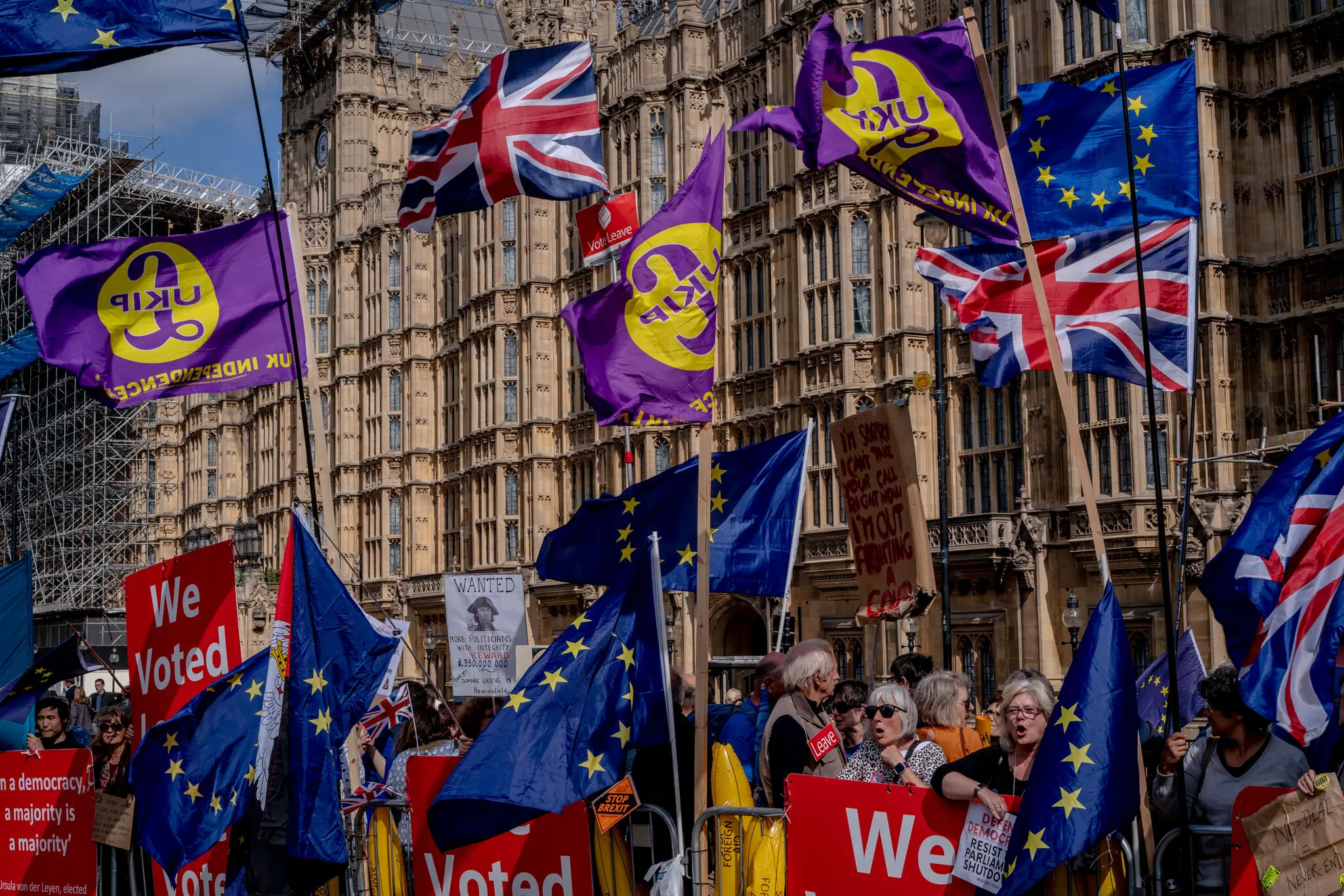
    Britain has watched President Trump’s tariffs with a mix of shock, fascination and queasy recognition. The country, after all, embarked on a similar experiment in economic isolationism when it voted to leave the European Union in 2016. Nearly nine years after the Brexit referendum, it is still reckoning with the costs.

    The lessons of that experience are suddenly relevant again as Mr. Trump uses a similar playbook to erect walls around the United States. Critics once described Brexit as the greatest act of economic self-harm by a Western country in the post-World War II era. It may now be getting a run for its money across the Atlantic.

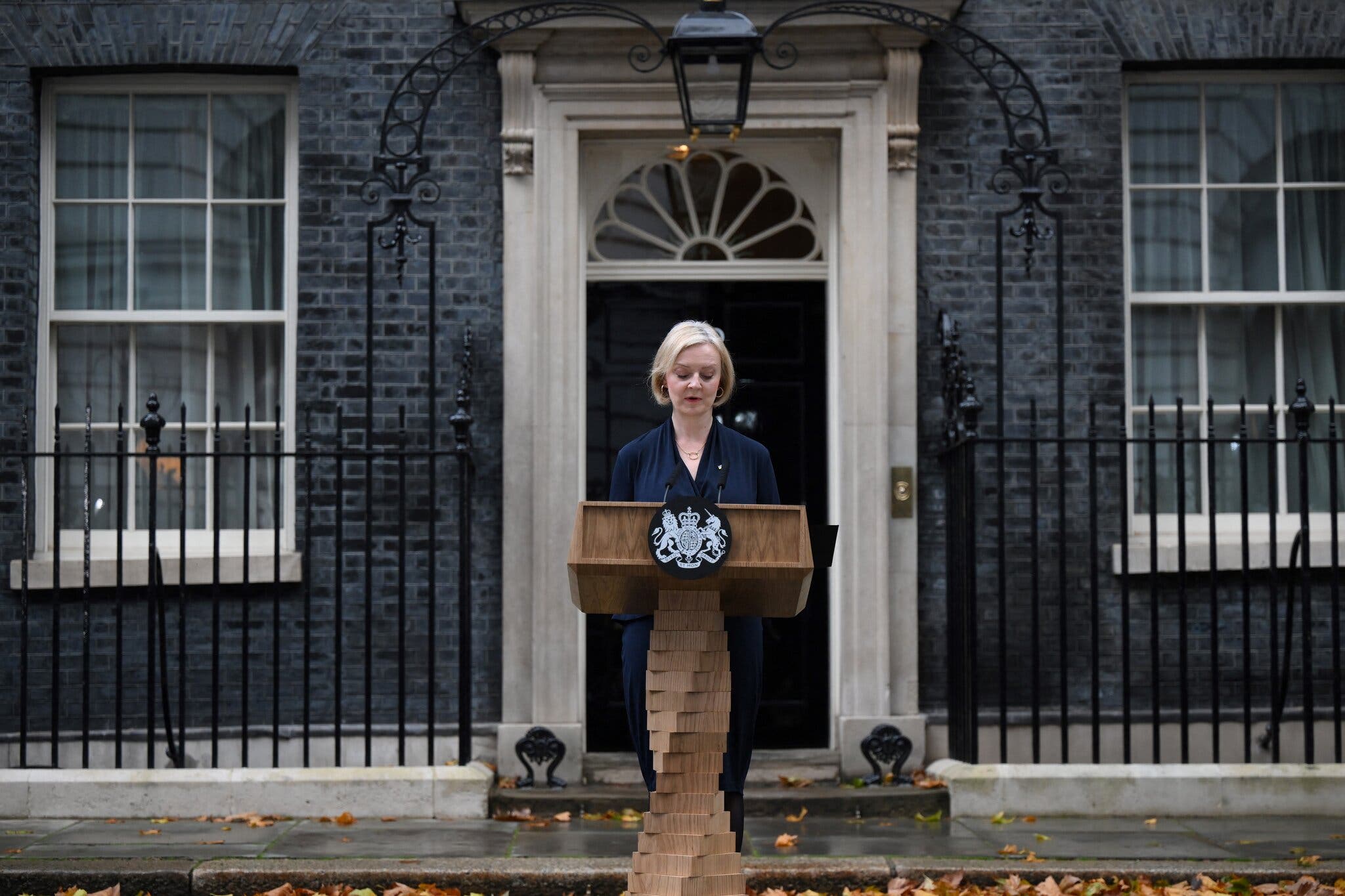
    Even Mr. Trump’s abrupt reversal last week of some of his tariffs, in the face of a bond-market revolt, recalled Britain, where Liz Truss, a short-lived prime minister, was forced to retreat from radical tax cuts that frightened the markets. Her misbegotten experiment was the culmination of a cycle of extreme policies set off by Britain’s decision to forsake the world’s largest trading bloc.

    “In a way, some of the worst legacies of Brexit are still ahead,” said Mark Malloch Brown, a British diplomat who served as deputy secretary-general of the United Nations. Britain, he said, now faces a hard choice between rebuilding trade ties with Europe or preserving them with Mr. Trump’s America.

    “The fundamental issue remains the breach with our biggest trading partner,” Mr. Malloch Brown said, adding, “If the U.K. ends up in the arms of Europe because neither of them can work with the U.S. anymore, that’s only half a victory.”

    12int trump brexit 02 tjbh superJumbo
    Trucks waiting to enter the British port of Dover in December 2020. Credit…Andrew Testa for The New York Times

    Mr. Trump was a full-throated champion of Brexit in 2016, drawing explicit parallels between it and the political movement he was marshaling. He initially imposed lower tariffs on Britain than the European Union, which some cast as a reward for Britain’s decision to leave.

    Brexit’s drag on the British economy is no longer much debated, though its effects have been at times hard to disentangle from subsequent shocks delivered by the coronavirus pandemic, the war in Ukraine and, now, Mr. Trump’s tariffs.

    The government’s Office of Budget Responsibility estimates that Britain’s overall trade volume is about 15 percent lower than it would have been had it remained in the European Union. Long-term productivity is 4 percent lower than it would have been because of trade barriers with Europe.

    Productivity was lagging even before Brexit, but the rupture with Europe compounded the problem by sowing uncertainty, which chilled private investment. The years between the referendum and Britain’s formal departure at the end of January 2020 were paralyzed by debate over the terms of its exit.

    By the middle of 2022, investment in Britain was 11 percent lower than it would have been without Brexit, based on a model by John Springford, who used a basket of comparable economies to stand in for a non-Brexit Britain. Trade in goods was 7 percent lower and gross domestic product 5.5 percent lower, according to Mr. Springford, a fellow at the Center for European Reform, a think tank in London.

    Mr. Trump has kicked off even more volatility by imposing, redoubling and then pausing various tariffs. His actions, of course, affect dozens of countries, most dramatically the United States and China. Already, there are predictions of recession and a new bout of inflation.

    Brexit and its aftermath had multiple second-order effects, both economic and political. Ms. Truss’s plan for debt-funded tax cuts, which were driven by a desire to jump-start Britain’s torpid economy, instead triggered a sell-off of British government bonds as investors recoiled from her proposals.

    A similar sell-off of American bonds began last week, with far-reaching implications for the United States. Rising bond yields put pressure on governments because it means they must pay more to borrow funds. Sell-offs are also destabilizing because they signal deeper anxiety about a country’s creditworthiness.

    In Britain’s case, fears of a credit crisis forced Ms. Truss to shelve the tax cuts, and she soon lost her job. While that calmed the markets, it left a residue of doubt among investors about Britain. Mortgage rates remained elevated for months, reflecting what one analyst unkindly labeled a “moron premium.”

    12int trump brexit 03 tjbh superJumbo
    Liz Truss resigned from her post as prime minister of Britain in October 2022.Credit…Daniel Leal/Agence France-Presse — Getty Images

    This skittishness among investors has constrained Britain’s chancellor of the Exchequer, Rachel Reeves, from taking bolder measures to recharge the economy. Prime Minister Keir Starmer last week ruled out relaxing the government’s self-imposed fiscal constraints, citing the blowback to Ms. Truss’s free-market experiment.

    “I would argue that the reason we have such a small-c conservative chancellor is due to the experience we had with Truss,” Mr. Malloch Brown said. “It is directly related to not wanting to prompt the Truss effect again.”

    Unlike Britain, the United States still has the world’s default currency in the dollar, and until last week, Treasuries remained a haven for investors. But economists predict that both will be subjected to greater pressure under Mr. Trump.

    “Confidence has been shaken, the bond vigilantes are more alert,” said Richard Portes, a professor of economics at London Business School. “People are now much more sensitive to policy inconsistency and policy irresponsibility.”

    Brexit also diminished Britain’s influence on the diplomatic stage, something it has only recently begun to recoup with Mr. Starmer’s efforts to act as a bridge between Europe and the United States.

    12int trump brexit 04 tjbh superJumbo
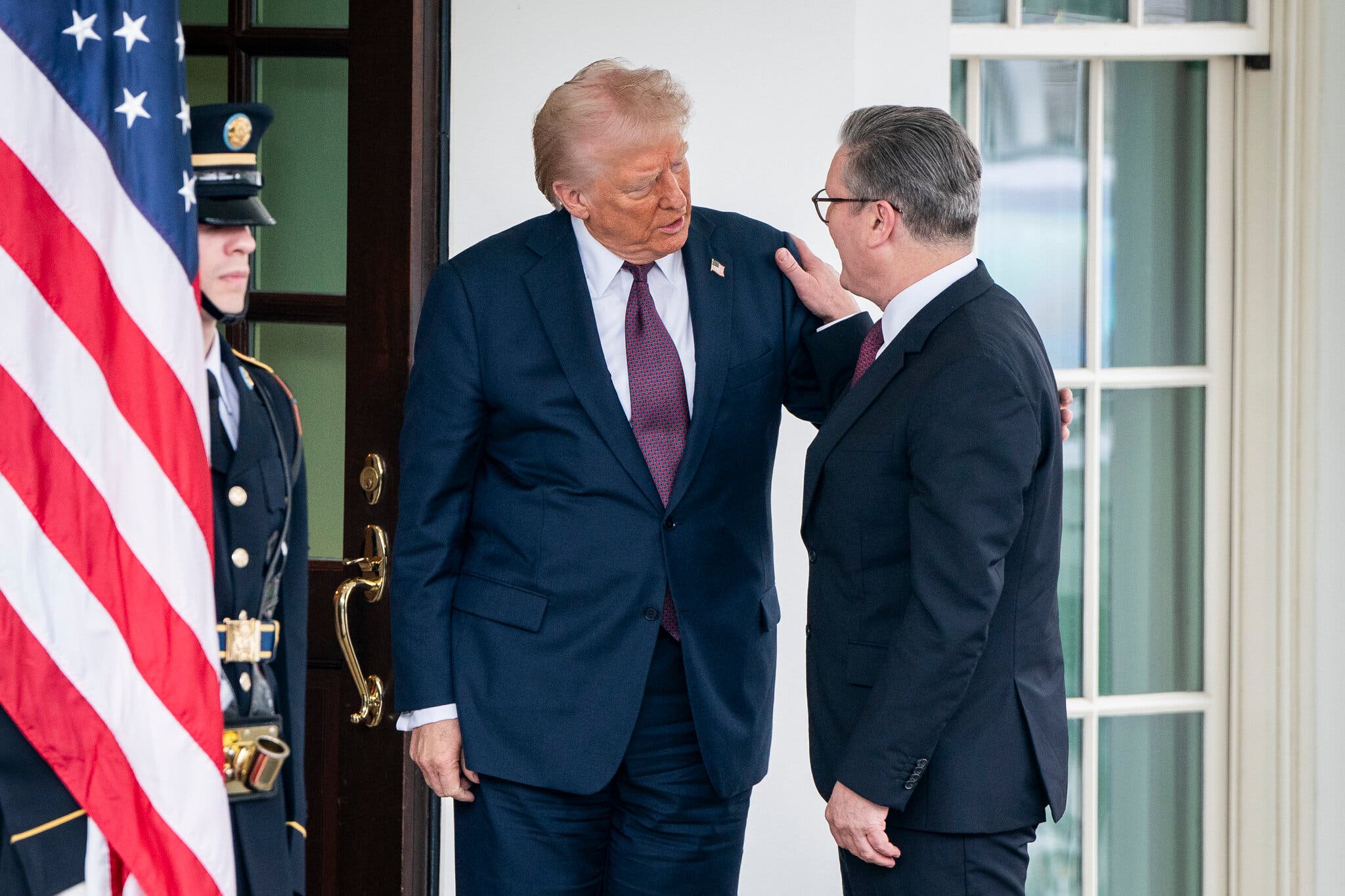
    President Trump greeting Prime Minister Keir Starmer of Britain in February outside the White House.Credit…Haiyun Jiang for The New York Times

    Mr. Trump’s retreat from America’s role as a security umbrella for NATO has driven Britain closer to Europe. But Britons still wrestle with the legacy of Brexit. A defense pact with the European Union, for instance, is being held up by France’s demand that Britain make concessions on fishing rights — an old chestnut from Brexit negotiations.

    The longest-lasting effect of Brexit, analysts say, may have been on politics. The years of bitter debate divided and radicalized the Conservative Party, which governed from 2010 to 2024 with a patchwork of policies on immigration and trade that reflected the unwieldy coalition behind Brexit.

    Some Brexiteers pushed a vision of Britain as a low-tax, lightly regulated, free-trading nation — Singapore-on-Thames, in their catchphrase. Others wanted a stronger state role in the economy to protect workers in the left-behind hinterland from open borders and the ravages of the global economy.

    These contradictions resulted in policies that often seemed at odds with the message of Brexit. Britain, for example, experienced a record surge of net migration in the years after it left the European Union. The difference was that more of these immigrants were from South Asia and Africa, and fewer from Central and Southern Europe.

    Brexit’s backers sold the project as a magic bullet that would solve the problems caused by a globalizing economy — not unlike Mr. Trump’s claims that tariffs would be a boon to the public purse and a remedy for the inequities of global trade. In neither case, experts said, does such a panacea exist.

    “The truth is, Brexit did not correct any of the problems caused by deindustrialization,” said Tony Travers, a professor of politics at the London School of Economics. “If anything, Brexit made them worse.”

    Frustrations over the economy and immigration were among the reasons that voters swept out the Conservatives in favor of Mr. Starmer’s Labour Party last year. But his government has kept grappling with these issues, as well as with the bruised aftermath of Britain’s divorce from Europe.

    Mr. Trump’s MAGA coalition has some of the same ideological fault lines as the Brexiteers, pitting economic nationalists like Stephen K. Bannon against globalists like Elon Musk. That has led analysts to wonder if post-Trump politics in the United States will look a lot like post-Brexit politics in Britain.

    “Brexit caused profound damage to the Conservative Party,” Professor Travers said. “It has been rendered unelectable because it is riven by factions. Will the Republican Party be similarly factionalized after Trump?”

    12int trump brexit 05 tjbh superJumbo
    A countdown clock displayed on 10 Downing Street showed the moment the United Kingdom left the European Union at the end of January 2020.Credit…Mary Turner for The New York Times

  • Why aren’t the democrats fighting harder against Trumps trade problems?

    Why aren’t the democrats fighting harder against Trumps trade problems?

    This has been the mealymouthed critique of President Donald Trump’s trade wars from many Democrats this past week. They awkwardly triangulate between bashing Trump’s catastrophic ideas and touting support for their own similarly spirited, if scaled-down, ideas. No wonder their message is falling flat.

    Trump’s current tariff regime — including “only” 10 percent levies on 70 countries, plus 145 percent on China — will devastate the U.S. economy. His tariffs imposed so far are estimated to raise a typical household’s annual costs by $2,700, with lower-income Americans shouldering the biggest burden. That’s only a subset of the damage. Recession risks have surged, companies have begun furloughing workers, and our once-close allies are flipping us the bird.

    If this is a curse to the U.S. economy, it should be a windfall for Democratic politicians. Instead, Democrats are blowing their good fortune.

    Rather than shouting from the rooftops that trade wars are bad, Democrats babble in “yes, buts.” Yes, these particular tariffs are costly and regressive, they say, but when Democrats impose tariffs, somehow they present no such downsides.

    The most obvious cognitive dissonance relates to Trump’s first-term tariffs. Democrats assailed these policies in the 2018 midterms and 2020 presidential election — shortly before adopting them as their own.

    For instance, in 2019, then-presidential candidate Joe Biden said Trump’s China tariffs led to “American farmers, manufacturers and consumers losing and paying more.” The 2020 Democratic platformsaid Trump had “launched reckless, politically-motivated tariff wars that have punished American workers, antagonized our allies, and benefited our adversaries.” They were right!

    But as president, Biden extended (nearly) all of Trump’s existing tariffs. In some cases, he expanded them or replaced them with slightly different trade barriers. He did so with vigorous support from his party.

    Given this checkered record, it’s no wonder Democrats struggle to articulate a clear, credible critique of Trump’s (now much worse) tariff policy.

    In a social media video this month, House Democrats opened with an awkward defense of protectionism: “I think a wrong-for-decades consensus on ‘free trade’ has been a race to the bottom,” Rep. Chris Deluzio (D-Pennsylvania) said, adding that we need “a better trade approach” that is “pro-worker.”

    Deluzio clarified that he didn’t mean Trump’s trade approach, per se — even though Republicans likewise claim Trump’s approach is “pro-worker.”

    On Wednesday, Michigan Gov. Gretchen Whitmer (D) gave a speech criticizing Trump for wielding tariffs like a “hammer.” When asked how she would deploy tariffs differently, Whitmer could not answer. “I don’t know how I would have enacted them differently,” she said. “I haven’t really thought about that. What I have thought about, though, is, you know, tariffs are, need to be used like a scalpel, not a hammer.”

    Other Democrats, such as Massachusetts Sen. Elizabeth Warren, assert that the real problem with Trump’s tariffs is that companies will use them as an excuse for “price gouging” and profiteering. The stock market massacre suggests investors don’t agree tariffs will be profitable. But even if Warren’s critique were true, the same logic should apply to the Biden-née-Trump tariffs Warren backed.

    Elsewhere, lefty populist thinkers explain that Trump’s tariffs are bad but tariffs could be good if only the resulting revenue were used for things Democrats like. (Never mind that whole poor-people-bear-the-costs problem.) Both they and their horseshoe-theory-demonstrating conservative counterparts contend that Trump’s execution might be lousy, but the underlying premise — that America must build higher economic walls — remains correct.

    Real trade wars, it seems, have never been tried.

    To be clear, there are some limited circumstances in which tariffs (or sanctions) could be an appropriate way to build U.S. capacity or punish bad behavior. For example, if an adversarial country has a stranglehold on some technology critical to national defense. Or if an exporter is using slave labor.

    But that’s not what either party has endorsed. Both Trump and his Democratic critics have supported broad tariffs on our allies and on random consumer goods (tiki torches, guitars, toothbrushes) with no plausible security or “resiliency” justification.

    How did Democrats back themselves into this corner? Partly they’re pandering to pro-tariff constituencies (i.e., unions, once reliable Democratic allies). Populist, anti-“neoliberal” think tanks have also overtaken the party. These often employ political operatives churning out pseudo-scholarly research, which the media then credulously cites. (Republicans invented and perfected this model more than a decade earlier, though it doesn’t seem to have served Democrats as well politically.)

    That’s how you end up with Democratic leaders embracing such quackery as “greedflation” and price controls — both of which, by the way, the Trump administration is also now flirting with. This Trump blunder should be yet another layup for Democrats, but they can’t really dunk on it now, can they?

    The political calculus on all this is changing. Aggressive trade barriers, no longer abstract hypotheticals, are proving as disastrous as “neoliberal” economists predicted. Americans hate Trump’s tariffs. Even most manufacturing workers think they’re a bad idea, according to a Post poll.

    Democrats should stop pulling their punches. What the country needs is an unequivocal, full-throated condemnation of pandering protectionism. Let this be the moment that liberates the Democratic Party from the populists tying them to the same mercantilist, regressive, costly command-and-control economic policies that so often drive Trump’s agenda.

  • To fix the problems left by Trump, the UK should look to Europe, and Keir Starmer sees that’s the best way.

    To fix the problems left by Trump, the UK should look to Europe, and Keir Starmer sees that’s the best way.

    Keir Starmer was back at the Emirates Stadium on Tuesday to watch Arsenal’s 3-0 win over Real Madrid, a result that far exceeded expectations of his team’s chances in Europe. And, over the next few days, I wouldn’t be surprised if he tries to snatch a short Easter break in the warmth and sunshine of that same continent.

    Football and family holidays offer him some much needed relief from the grim reality of a faltering economy, towering public debt and terrifying global insecurity, which are all being made worse on a daily – sometimes hourly – basis by Britain’s closest ally of the previous 80 years.

    But that mayhem being caused by Donald Trump’s extended stag party in the White House means that Europe is much more than an occasional distraction for the prime minister. Slowly, if not always surely, it is once again becoming the direction towards which Britain must turn.

    This is not exactly where Starmer thought he would to be. For all his talk of an EU “reset”, the plan had been to “make Brexit work” within self-imposed “red lines” ruling out joining the single market or a customs union, blocking freedom of movement and appearing to allow only some minor mitigation of the damage done by Boris Johnson’s deal.

    In the immediate aftermath of Trump’s inauguration, new horizons on the other side of the Atlantic briefly seemed rather more exciting. There was genuine interest in, if not admiration for, this insurgent disruptor of the US’s stuffy political establishment. There was also a prospect that Britain might gain advantage over the EU from a repurposed special relationship being gilded by inviting Trump to hang out with the royals.

    And, even now, securing some sort of US trade deal that might save thousands of British jobs, or the promise of the minimal military cooperation needed to maintain European security, are still prizes worth having. It’s silly to blame Starmer for trying to win them, or to expect him to strike poses against Trump for the sake of cheap headlines and not much else.

    What’s changed, however, is a recognition around the cabinet table that the US president is much more of a problem than part of any solution. Gone are the days when a government source would brief it had more in common with Maga Republicans than US Democrats, or Rachel Reeves could tell Britain to learn from Trump’s optimism and “positivity”. Nowadays ministers say it has become almost futile to anticipate his next move because “he’s only ever reliable in his unpredictability”. Whatever happens next, this is a US administration that can’t be regarded as a stable ally either on the economy or security.

    Those who think Starmer, in his repeated calls for “cool and calm heads”, is still being excessively polite have perhaps been too busy complaining to have noticed a subtle shift in his language. For instance, when the Times last week ran the headline: “Why Keir Starmer hopes Trump’s tariffs could be good news for the UK”, the rebuttal came from the prime minister himself, with an article in the same newspaper the next day, which began by stating: “Nobody is pretending that tariffs are good news.”

    3000
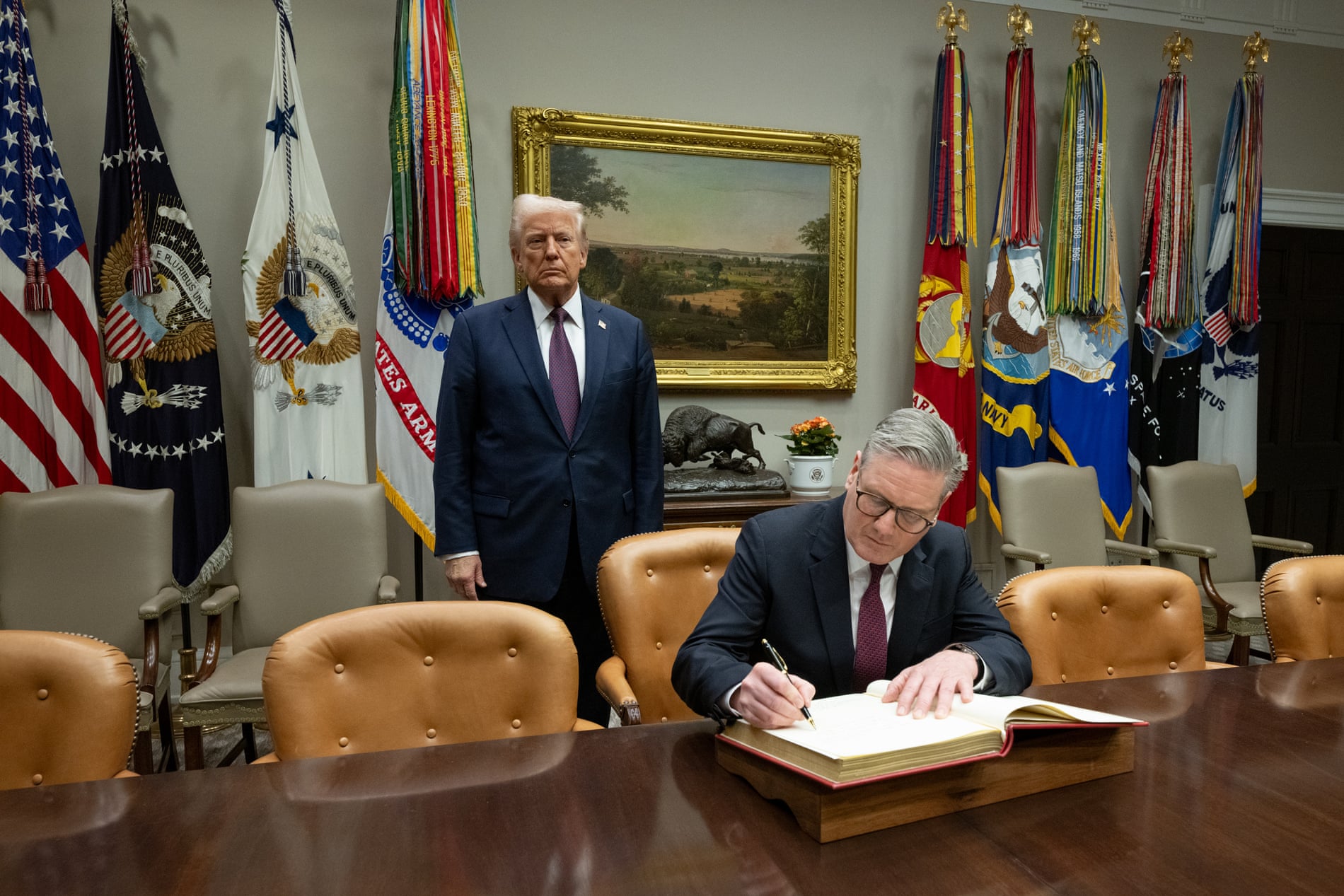
    Donald Trump and Keir Starmer meeting in the White House on 27 February 2025. Photograph: Daniel Torok/The White House

    One well-placed Downing Street adviser now describes how Trump “wants to destroy the multilateral institutions” that Starmer believes are essential “to span divides and bring the world together”. Another mentions polling evidence that apparently shows even if a big US trade deal can be done, British voters would still prefer closer links to the EU because they don’t trust Trump to deliver.

    Certainly, efforts to reset those relations have been pursued with more vigour over recent weeks. These began with Starmer’s “coalition of the willing” to replace the military support for Ukraine that Trump appears so intent on taking away, and will continue ahead of the EU-UK summit on 19 May. More focus on shared interests and values and less on “red lines” should mean a security and defence pact is agreed. Also within reach is a so-called veterinary deal to make agricultural trade easier, while legislation is already going through parliament that would enable UK ministers to align with EU regulations in other areas to the benefit of small exporters.

    There may yet be a workable youth mobility scheme for those aged 18-30, which some EU members, notably Germany, regard as a test of whether this government is really different to the last one. Although the proposal was hastily ruled out during last year’s general election, the Treasury is increasingly sympathetic to it because, by some estimates, it could do more for growth than planning reform and housebuilding combined. At the same time, new cooperation on North Sea windfarms and negotiations to align the UK and EU carbon trading scheme could increase investment, improve energy security and generate billions of pounds in additional revenue.

    But there are still limits to this revived EU-UK relationship and it will never go far enough or fast enough to satisfy the many Labour supporters convinced that Brexit was a catastrophic mistake. Those close to Starmer emphasise he’s less interested in “relitigating old arguments from the previous decade” than in finding new ways to pursue the national interest now that “the era of globalisation is over”. Downing Street believes that part of the appeal of both Trump and our homegrown strain of rightwing populism lies in how institutions like the EU became too detached from the people they were meant to serve. In short, they’re determined not to be seen defending the status quo.

    The UK wants any security pact to include data-sharing on illegal immigration, which the EU, for its own arcane reasons, may be unwilling to accept. The government will insist that any defence deal must also allow British industry to bid for contracts from a massive new European rearmament fund. That agreement, in turn, could yet be held up by rows with a French government demanding concessions over fish quotas. The hope is that our political leaders prove big enough to hurdle such obstacles. But economic nationalism is not confined to the White House and making meaningful progress in Europe has never been easy.

    Though Arsenal’s Champions League victory will have been the high point of Starmer’s week, he may reflect that his team haven’t yet reached the semi-final stage of the competition. In politics, as in football, there is much to play for in Europe, and a long way to go.