
Category: Economic Policy

  • Trump Imposes 100% Tariff on China Over Rare-Earth Restrictions

    Trump Imposes 100% Tariff on China Over Rare-Earth Restrictions

    defense seligman rareearth lead
    China Dominates the Rare Earths Market. This U.S. Mine Is Trying to Change That. © Bridget Bennett for Poltico

    President Donald Trump announced on Friday that the United States will slap an additional 100% tariff on all Chinese imports starting November 1, on top of existing duties, while imposing sweeping export controls on “any and all critical software.” The move, framed as retaliation for Beijing’s recent tightening of export restrictions on rare earth elements, sent shockwaves through global markets, wiping out nearly $2 trillion in stock value and reigniting fears of a full-blown decoupling between the world’s two largest economies. With bilateral trade already strained by springtime tariff spikes that peaked at 145% on U.S. goods into China, Trump’s latest salvo—potentially pushing effective rates above 130%—threatens to upend supply chains for everything from semiconductors to electric vehicles, at a time when the global rare earth market is forecasted to exceed $6 billion annually by decade’s end.

    Trump’s announcement, delivered via a series of fiery Truth Social posts and reiterated during an Oval Office press availability, accused China of a “sinister and hostile” strategy to hold the world “hostage” through its dominance in rare earths—a group of 17 metals vital for high-tech manufacturing, defense systems, and green energy technologies. “It is impossible to believe that China would have taken such an action, but they have, and the rest is History,” Trump wrote, vowing that the tariffs could arrive “sooner” if Beijing escalates further. He also hinted at broader U.S. countermeasures, including restrictions on airplane parts and other exports, noting China’s reliance on Boeing components. The president stopped short of confirming the cancellation of his planned meeting with Chinese President Xi Jinping at the Asia-Pacific Economic Cooperation (APEC) summit in South Korea later this month, but earlier posts declared “no reason” for the sit-down, citing the “extraordinarily aggressive” timing of China’s moves—just days after a U.S.-brokered Middle East ceasefire.

    Beijing’s Rare Earth Gambit: A Calculated Squeeze on Global Supply Chains

    China’s actions, unveiled by the Ministry of Commerce on October 9, mark a significant hardening of its position in the ongoing trade skirmishes. Under “Announcement Number 61 of 2025,” Beijing expanded export licensing requirements to cover products containing more than 0.1% of rare earth elements sourced from China, even if manufactured abroad, effectively barring unlicensed shipments to foreign defense and semiconductor firms starting December 1. The curbs now encompass 12 of the 17 rare earths, including newly added holmium, erbium, thulium, europium, and ytterbium, alongside technologies for extraction, refining, and magnet production. Additional restrictions on lithium-ion batteries, graphite cathodes, and artificial diamonds take effect November 8.

    These measures build on decades of state-backed dominance: China controls 61% of global rare earth mining and a staggering 92% of refining capacity, per the International Energy Agency, fueled by subsidies that have undercut competitors worldwide. Rare earths are indispensable for neodymium-iron-boron magnets in EV motors, fighter jet engines, and smartphone vibrators—sectors where U.S. firms like Tesla, Lockheed Martin, and Apple are heavily exposed. Analysts at the Center for Strategic and International Studies warn that the restrictions could disrupt U.S. defense supply chains, echoing 2010 when Beijing briefly cut off exports to Japan over territorial disputes. “This isn’t just trade policy; it’s economic warfare aimed at critical vulnerabilities,” said Dr. Elena Vasquez, a trade economist at the Peterson Institute for International Economics.

    The timing appears deliberate, coming amid fragile progress in U.S.-China talks. After tit-for-tat hikes earlier this year drove tariffs to extreme levels—145% on U.S. imports to China and 125% in reverse—the two sides agreed in May to slash rates to 30% and 10%, respectively, pausing 24% of levies until November 10. Positive negotiations in Switzerland and the U.K. had raised hopes for a broader deal, but Beijing’s rare earth letter—sent to trading partners worldwide—has derailed that momentum. Trump decried it as a “moral disgrace” and a long-planned “lie in wait,” while posts on X from industry insiders echoed the surprise: “China’s rare earth curbs hit like a gut punch—right when talks were thawing,” one analyst tweeted.

    Trump’s response was swift and unyielding. In his initial Truth Social broadside, he lambasted Beijing for “clogging global markets” and provoking “trade hostility” that has drawn ire from allies like the EU and Japan. The 100% tariff—layered atop the current 30% effective rate on $438.9 billion in annual Chinese imports—could add $439 billion in costs to U.S. businesses and consumers if fully implemented, according to Wells Fargo economists. Coupled with export controls on critical software—potentially targeting AI tools, cybersecurity suites, and enterprise systems from firms like Microsoft and Oracle—the measures aim to mirror China’s leverage in minerals with America’s edge in tech.

    During a White House meeting on drug pricing, Trump doubled down, telling reporters the curbs were “shocking” and “very, very bad,” affecting “all countries without exception.” He floated expanding restrictions to “a lot more” items, including aviation parts, given China’s fleet of over 1,000 Boeing aircraft. On the Xi summit, Trump hedged: “I don’t know if we’re going to have it… but I’m going to be there regardless.” Earlier, he had signaled outright cancellation, writing, “now there seems to be no reason to do so.” Beijing has yet to respond formally, but state media like Global Times called the tariffs “economic bullying,” while separately imposing port fees on U.S. ships in retaliation for American “discriminatory” docking charges.

    The broader U.S.-China economic ties add layers of complexity. Last year, China ranked as the third-largest U.S. trading partner, with a $295.4 billion deficit. Ongoing flashpoints include TikTok’s U.S. operations—requiring Beijing’s blessing for a ByteDance divestiture—and visa restrictions on Chinese students. Trump’s moves could jeopardize these, even as they bolster his domestic base ahead of midterms.

    Market Mayhem: Stocks Plunge, Safe Havens Surge Amid Trade Fears

    Inline Market Movers

    Wall Street’s reaction was visceral. The S&P 500 .SPX -2.70% ▼ cratered 2.7% on Friday, shedding Dow Jones Industrial Average .DJI -2.25% ▼ 878 points, while the Nasdaq Composite .IXIC -3.60% ▼—its worst day since March—as tech giants like Nvidia NVDA -6.00% ▼ and Apple AAPL -4.00% ▼, reliant on Chinese rare earths for chips and devices, bore the brunt. The sell-off erased $1.9 trillion in market cap, with X users dubbing it “the day markets fell” amid a “perfect storm” of U.S. shutdown fears, tariff threats, and Fed signaling confusion. Crypto markets fared worse: Bitcoin BTC -7.50% ▼, Ethereum ETH -12.00% ▼, and liquidations hit $19 billion, per SoSoValue data, as leveraged longs unwound en masse.

    Safe havens rallied. Gold surged 2.1% to $2,650 per ounce, while U.S. rare earth miners like MP Materials jumped 8%, buoyed by prospects of domestic substitution. Globally, the Shanghai Composite dipped 1.9%, and the Hang Seng fell 2.4%, reflecting spillover risks. Semiconductor firms like ASML braced for fallout, with shares down 4.2%, as China’s curbs threaten the $500 billion chip industry’s raw materials.

    Economists warn of deeper scars. The global rare earth market, valued at $3.95 billion in 2024, is projected to hit $6.28 billion by 2030 at an 8% CAGR, driven by EV and renewable demand—but tariffs could inflate prices 20-30%, per Grand View Research. U.S. consumers might face $1,000 annual household cost hikes, akin to 2018’s trade war, while exporters like Boeing could lose $10 billion in orders. “This risks a vicious cycle: higher costs, slower growth, and fragmented innovation,” said JPMorgan’s Michael Feroli.

    Economic Stakes: From EVs to National Security

    The rare earth flashpoint underscores the trade war’s evolution from tariffs to strategic chokepoints. China’s monopoly—forged through subsidies and lax environmental rules—has long irked Washington, prompting the CHIPS Act’s $52 billion in domestic incentives. Yet, U.S. refining capacity remains nascent, covering just 15% of needs. Trump’s software controls, meanwhile, target China’s AI ambitions, potentially stalling Huawei and Baidu’s advancements.

    For Beijing, the curbs safeguard “national security,” but they invite blowback. Exports of rare earths generated $5.2 billion last year; restrictions could shave 2% off GDP growth if retaliation spirals, per Oxford Economics. Allies like Australia and Canada, ramping up mines, stand to gain, but short-term disruptions loom for Europe’s auto sector, where 40% of EV magnets are Chinese-sourced.

    X chatter reflects the angst: “Trump’s tariff nukes markets—China’s rare earth play was checkmate,” one trader posted, while another quipped, “Trade war 2.0: Now with extra monopoly drama.” Broader ripple effects include a 0.5% hit to U.S. GDP in 2026, per Federal Reserve models, and stalled WTO reforms.

    As November 1 looms, the onus falls on diplomacy—or its absence. Trump’s APEC attendance keeps the Xi channel ajar, but observers like Al Jazeera’s Ahmed Fouad doubt a breakthrough: “Beijing’s holding aces in minerals; Washington in tech—stalemate seems likely.” A Reuters analysis pegs escalation odds at 60%, potentially costing $500 billion in lost trade.

    For businesses, the message is clear: Diversify now. “Potentially painful” in the short term, Trump insists, but “very good… for the U.S.A.” in the end. Yet, as markets reel and supply chains fray, the world watches a high-stakes poker game where both players hold loaded dice—and rare earths are the wild card.

  • Beijing’s Cutbacks Shake America’s Soybean Trade

    Beijing’s Cutbacks Shake America’s Soybean Trade

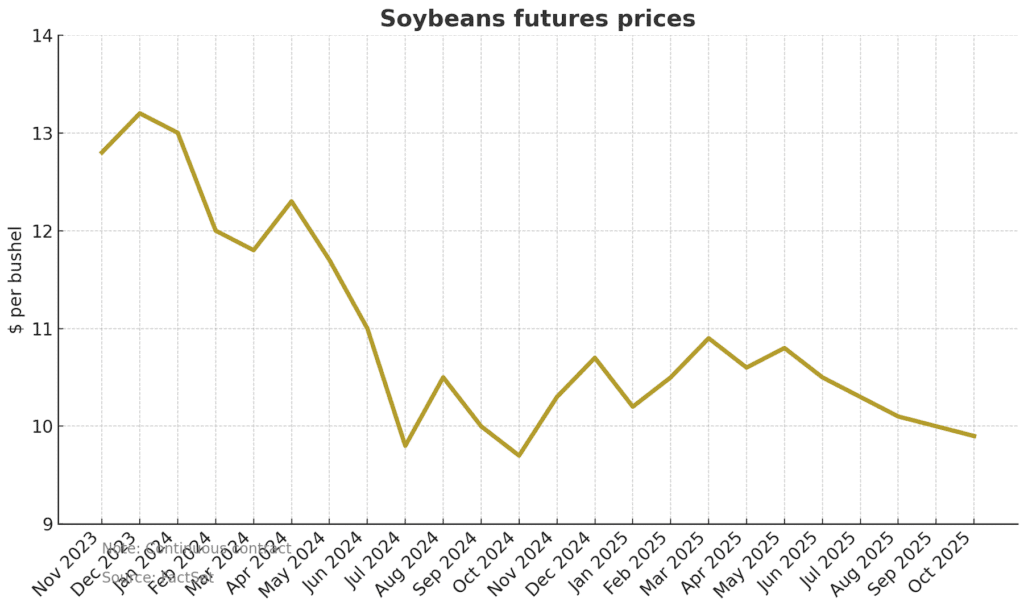
    In the heart of the Midwest, where golden fields stretch toward the horizon under a crisp autumn sky, the hum of combines should signal prosperity. Instead, for America’s soybean farmers, harvest season has become a grim countdown to financial ruin. As they reap what the U.S. Department of Agriculture (USDA) projects to be a record 4.2 billion bushel crop this year, their largest buyer—China—has vanished from the market, leaving silos overflowing and prices plummeting to five-year lows around $9.50 per bushel.

    China hasn’t booked any U.S. soybean purchases in months; farmers warn of ‘bloodbath’

    The trade war between the United States and China, now in its second year under President Donald Trump’s renewed tariff regime, has turned soybeans into collateral damage. Beijing’s retaliatory 25% tariffs on U.S. agricultural imports have priced American beans out of the Chinese market, where they once commanded over half of the $24.5 billion in annual U.S. soybean exports. From January through August 2025, Chinese imports of U.S. soybeans totaled a mere 200 million bushels—down from nearly 1 billion bushels in the same period of 2024, according to USDA trade data. That’s a 80% plunge, robbing Midwestern farmers of billions in revenue and forcing a scramble for alternative markets that may never fully compensate.

    “We’ll see the bottom drop out if we don’t get a deal with China soon,” warns Ron Kindred, a veteran farmer managing 1,700 acres of corn and soybeans in central Illinois. Halfway through his harvest, Kindred has locked in contracts for just 40% of his crop at prices already eroding below $10 per bushel in local elevators. The remaining 60% sits in limbo, a high-stakes bet on a breakthrough in Washington-Beijing negotiations. “There’s no urgency on China’s side, and the farm community’s clock is ticking louder every day,” he adds.

    Screenshot 2025 10 08 at 9.30.50 PM

    Kindred’s plight echoes across the soybean belt, from Illinois prairies to Iowa’s rolling hills. Rising input costs—fertilizer up 20-30% year-over-year, equipment maintenance strained by inflation, and a glut of both corn and soybeans flooding domestic markets—were squeezing margins even before the trade spat escalated. Now, with China’s boycott, the USDA estimates average losses of up to $64 per acre for Illinois growers alone, the nation’s top soybean-producing state with 6.2 million acres planted this year. University of Illinois Extension economists project total state-level shortfalls could exceed $400 million if export volumes don’t rebound by spring 2026.

    Enter the Trump administration’s lifeline: a proposed $10-14 billion farmer aid package, building on December 2024’s $10 billion relief bill. The Wall Street Journal reported last week that President Trump, speaking at the White House on October 6, vowed to “do some farm stuff this week” to cushion the blow. Aides say he’s slated to huddle with Agriculture Secretary Brooke Rollins as early as Friday to finalize funding sources, leaning heavily on the $215 billion in tariff revenues collected during fiscal 2025 (October 2024-September 2025), per U.S. Treasury figures. “The president is deploying every tool in the toolbox to keep our farmers farming,” a USDA spokesman told Reuters.

    Yet for many in the heartland, the aid feels like a temporary fix for a structural crisis. Soybean farmers, who backed Trump overwhelmingly in 2024 (with 62% of rural voters in key swing states like Iowa and Wisconsin casting ballots for him, per Edison Research exit polls), are voicing frustration laced with loyalty. “We voted for strong trade deals, not handouts,” says Scott Gaffner, a third-generation farmer in southern Illinois tending 600 acres. His crop, typically destined for Chinese ports, now languishes in on-farm silos as he frets over fixed costs like diesel fuel and seed that have surged 15% since planting. “We’re not just anxious; we’re angry. When the administration’s jetting off to Spain for TikTok talks while our harvest rots, it feels like we’re the last priority.”

    Gaffner’s son, Cody, the would-be fourth generation on the land, echoes the generational stakes. “If I return after college, it’ll be with a second job just to make ends meet,” the 22-year-old says. Their story underscores a broader ripple: Rural economies, where agriculture drives 20-25% of GDP in states like Illinois and Iowa, are buckling. Tractor sales at CNH Industrial, a Decatur, Illinois-based giant, plunged 20% in the first half of 2025, CEO Gerrit Marx revealed in an August interview at the Farm Progress Show. “The good news only flows when China places orders,” Marx said, a sentiment that hung heavy over the event in the self-proclaimed “soy capital of the world”—a title now whispered to be shifting south to Brazil.

    Dean Buchholz, a DeKalb County, Illinois, peer of Gaffner’s, is already waving the white flag. After decades in the fields, skyrocketing fertilizer bills and sub-$10 soybean futures have convinced him to retire. “I figured I’d farm till they buried me,” the 58-year-old says. “But with debt piling up and health acting up, it’s time to rent out the acres. This trade war’s the final straw.”

    Desperate Diplomacy: Chasing Markets in Unlikely Corners

    With China—home to the world’s largest hog herd and importer of 61% of global traded soybeans over the past five years, per the American Soybean Association—off the table, U.S. agribusiness is on a global charm offensive. Trade missions to Nigeria, memorandums with Vietnam, and a 50% surge in sales to Bangladesh (up to 400,000 metric tons through July 2025) highlight the scramble. Yet these “base hits,” as Iowa farmer Robb Ewoldt calls them, pale against China’s home-run demand.

    Screenshot 2025 10 08 at 9.37.03 PM

    Ewoldt, who farms 2,000 acres near Des Moines, jetted to Rome in January to woo a Tunisian poultry giant. “They grilled me: Can we count on steady U.S. supply, or will you switch crops and jack up prices?” he recalls. Tunisia’s imports, while growing, total under 100,000 tons annually—barely a blip. “It helps long-term, but right now, we’re cash-strapped. My operation burns a million bucks a year; without sales, we’re dipping into reserves just to cover debt service.”

    Across the Mississippi, Morey Hill has logged thousands of miles this year, from Cambodia’s fish ponds to Morocco’s chicken coops. In Phnom Penh last week, the Iowa grower evangelized to importers about swapping low-protein “fish meal” for U.S. soybean meal, touting yields that could fatten local aquaculture 20-30%. “We’ve got success stories—Vietnam’s up 25% year-over-year to 1.2 million tons,” Hill says. But even aggregated, the EU and Mexico (combined $5 billion in sales) plus risers like Egypt, Thailand, and Malaysia can’t fill the void: Total U.S. soybean exports dipped 8% to 18.9 million metric tons through July, USDA Census Bureau data shows.

    Industry lobbies are pulling levers too. The U.S. Soybean Export Council sponsored a June Vietnam mission yielding $1.4 billion in MOUs for ag products, including soy. August brought Latin American buyers to Illinois for farm tours, though exports to Peru and Nicaragua remain negligible. In Nigeria, a modest 64,000 tons shipped last year hasn’t translated to 2025 bookings yet. And Secretary Rollins’ September tweet hailing Taiwan’s “$10 billion” four-year ag commitment? It’s a rebrand of existing $3.8 billion annual flows, not new money, USDA clarifications confirm.

    “There’s talk of India, Southeast Asia, North Africa as future markets,” says Ryan Frieders, a 49-year-old Waterman, Illinois, farmer who joined a February trek to Turkey and Saudi Arabia. “But nothing explodes overnight to replace China.” Frieders, facing $8-10 per acre losses per University of Illinois models, plans to bin most of his harvest, gambling on futures prices rebounding above $11 by Q1 2026.

    The Shadow of South America and Tariff Games

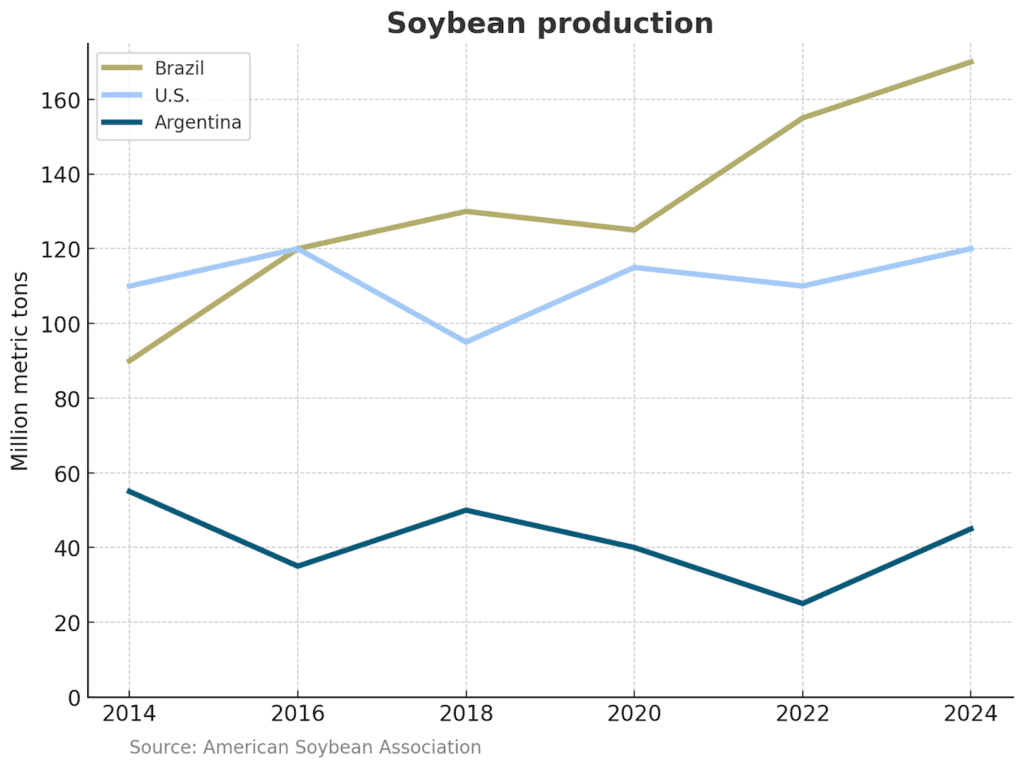
    As U.S. beans languish, Brazil and Argentina feast. China, pivoting since 2018’s first trade war, now sources 80% of its needs from South America. Last month, Argentine President Javier Milei’s temporary export tax suspension lured $500 million in Chinese cargoes, traders at the Chicago Mercantile Exchange report. U.S. beans traded at $0.80-$0.90 per bushel cheaper than Brazilian equivalents for September-October shipment, but Beijing’s 23% tariff tacks on $2 per bushel—enough to divert 5 million metric tons southward.

    “The frustration is overwhelming,” says Caleb Ragland, 39, Kentucky farmer and American Soybean Association president. On Truth Social Wednesday, Trump himself griped: “Our Soybean Farmers are hurting because China, for ‘negotiating’ reasons, isn’t buying.” He teased soybeans as a centerpiece in his upcoming summit with Xi Jinping in four weeks. Treasury Secretary Scott Bessent, speaking Thursday, promised a Tuesday announcement on aid, potentially including a $20 billion swap line for Milei—irking U.S. growers who see it as subsidizing their rivals.

    On Friday, soybean futures closed at $9.42 per bushel on the CME, down 2% weekly amid harvest pressure and zero Chinese bookings. Analysts at Zaner Ag Hedge forecast a “bloodbath” if no deal materializes by November: Storage costs could add $0.50 per bushel, while on-farm debt—$450 billion industry-wide, per Farm Credit Administration—balloons.

    The trade war’s winners? South American exporters, grinning from bumper crops (Brazil’s output hits 155 million metric tons this year, USDA estimates), and U.S. tariff coffers, flush for bailouts. Losers abound: From Decatur’s processing plants, once buzzing with Chinese-bound shipments, to the 1.2 million farm jobs at risk nationwide, per the American Farm Bureau Federation.

    For Kindred, Gaffner, and their ilk, the math is merciless. “We want trade, not aid,” Gaffner insists. “China’s building routes elsewhere; once they’re hooked on Brazil, we might never claw it back. That’s not just my farm—it’s the next generations, the rural towns, the whole engine of America’s breadbasket.”

    As combines roll on, the Midwest holds its breath. A Xi-Trump handshake could flood elevators with orders; stalemate risks a cascade of foreclosures and fallow fields. In this high-stakes harvest, soybeans aren’t just seeds—they’re the fragile thread binding U.S. farmers to their future.

  • Judges Reject Trump Request to Dismiss Federal Reserve Governor Cook

    Judges Reject Trump Request to Dismiss Federal Reserve Governor Cook

    MA6YO6AZENKHJF3MUUWLDVU2U4
    Dr. Lisa DeNell Cook, of Michigan, nominated to be a Member of the Board of Governors of the Federal Reserve System, speaks before a Senate Banking, Housing and Urban Affairs Committee confirmation hearing on Capitol Hill in Washington, D.C., U.S., February 3, 2022. © REUTERS/Ken Cedeno/Pool/File Photo

    WASHINGTON — In a significant blow to President Donald Trump’s efforts to reshape the Federal Reserve, a federal appeals court on Monday night rejected the administration’s emergency bid to remove Governor Lisa Cook from the central bank’s Board of Governors, upholding a lower court’s temporary block on her termination. The 2-1 decision by the U.S. Court of Appeals for the District of Columbia Circuit ensures that Cook, the first Black woman to serve as a Fed governor, can participate in this week’s crucial Federal Open Market Committee (FOMC) meeting, where policymakers are widely expected to vote on a quarter-point cut to the federal funds rate amid signs of a cooling labor market.

    The ruling comes at a pivotal moment for the U.S. economy, as the Fed grapples with inflation pressures exacerbated by Trump’s tariff policies and a weakening job market. Cook, appointed by President Joe Biden in 2022 and reappointed in 2023 for a term extending to January 2038, launched her legal challenge on August 28 after Trump fired her on August 25. The dismissal was based on allegations from Federal Housing Finance Agency (FHFA) Director Bill Pulte that Cook made false claims on mortgage applications in 2021—prior to her Senate confirmation—potentially securing more favorable loan terms by misrepresenting properties in Michigan, Georgia, and Massachusetts as primary residences.

    U.S. District Judge Jia M. Cobb had granted Cook’s request for a preliminary injunction on September 9, finding that the removal likely violated the Federal Reserve Act’s “for cause” provision and her Fifth Amendment due process rights. Cobb noted that the allegations, which predate Cook’s tenure, did not constitute sufficient grounds for dismissal, describing them as raising “many serious questions of first impression.” Documents reviewed by Reuters indicate that Cook declared a Georgia property as a vacation home, not a primary residence, undercutting Pulte’s claims, while Michigan property tax authorities confirmed no rules were broken on a home she listed as primary.

    The Trump administration swiftly appealed, arguing in briefs that the president has broad discretion to remove Fed governors for cause, including pre-office conduct that reflects a “lack of care in financial matters” inconsistent with public trust. Lawyers for the White House contended that courts should not second-guess such decisions, warning that blocking the removal would “diminish” the Fed’s integrity. They sought an emergency stay to oust Cook before the FOMC’s two-day meeting starting Tuesday, emphasizing the need to ensure governors are “competent and capable of projecting confidence into markets.”

    Cook’s legal team fired back in a Saturday filing, urging the appeals court to deny the stay and highlighting the broader implications for Fed independence. “A stay by this court would therefore be the first signal from the courts that our system of government is no longer able to guarantee the independence of the Federal Reserve,” her attorneys argued, warning that it could allow the president to fire board members on “flimsy pretexts,” ending the era of central bank autonomy and risking dire economic consequences. They stressed that the government provided no meaningful notice or opportunity for Cook to respond to the allegations, a point the appeals court majority echoed in its order.

    In the majority opinion, joined by Circuit Judge J. Michelle Childs—both Biden appointees—Circuit Judge Bradley N. Garcia wrote that Cook’s due process claim is “very likely meritorious,” as the administration “does not dispute that it provided Cook no meaningful notice or opportunity to respond.” The judges reasoned that granting the stay would “upend, not preserve,” the status quo, given Cook’s continuous service, and that her strong likelihood of success on the merits warranted denial. Circuit Judge Gregory G. Katsas, a Trump appointee, dissented, arguing the “equitable balance” favored the government due to the heightened interest in ensuring Fed competence.

    White House spokesman Kush Desai responded defiantly Tuesday morning, stating to Barron’s that “The President lawfully removed Lisa Cook for cause. The Administration will appeal this decision and looks forward to ultimate victory on the issue.” The administration has until hours before the FOMC meeting to seek emergency relief from the U.S. Supreme Court, a path it has signaled it will pursue. This marks the first attempted “for cause” removal of a Fed governor in the central bank’s 111-year history, testing long-standing protections against political interference enshrined in the 1913 Federal Reserve Act, which shields governors from at-will dismissal but does not define “for cause” or removal procedures.

    The case underscores Trump’s aggressive push to influence monetary policy, including public berating of Fed Chair Jerome Powell for not cutting rates aggressively enough despite inflation concerns. The Fed has held rates steady since late 2024 but signaled a potential cut last month amid hiring weakness; economists now anticipate a reduction to about 4.1%, which could lower borrowing costs for mortgages, auto loans, and businesses over time. Cook’s lawyers noted she has continued her duties during the litigation, and the Fed itself has remained neutral, requesting a swift resolution and pledging to abide by court orders.

    Complicating matters, the Senate narrowly confirmed Trump’s nominee Stephen Miran—current chair of the Council of Economic Advisers—to a vacated Fed board seat on Monday night in a 48-47 party-line vote, meaning he will also join this week’s meeting. Miran’s addition could tilt the board toward Trump’s preferences, but Cook’s retention preserves a Biden-era voice in deliberations.

    Beyond the immediate rate decision, the dispute has ramifications for the Fed’s independence, seen as essential for controlling inflation and stabilizing markets. The Supreme Court, in a May ruling on other agency removals, distinguished the Fed as a “uniquely structured, quasi-private entity” with singular historical traditions, potentially bolstering Cook’s position. Meanwhile, the Justice Department has launched a criminal mortgage fraud probe into Cook, issuing grand jury subpoenas in Georgia and Michigan, though no charges have been filed and Cook denies wrongdoing, calling the allegations a pretext for her policy stances.

    As the legal battle escalates, markets await the FOMC’s outcome, with investors eyeing how this high-stakes clash might influence the central bank’s credibility and the broader economy under Trump’s second term.

  • UK Economy Shows No Growth in July

    UK Economy Shows No Growth in July

    ggegtergtregttegt removebg preview
    This illustration created by Ryan McNom

    The UK’s economy, long hamstrung by years of socialist-leaning policies and bureaucratic overreach, has officially hit a wall. Official figures from the Office for National Statistics (ONS) confirm that gross domestic product (GDP) flatlined at zero growth in July, a stark comedown from the 0.4% expansion seen in June. This stagnation isn’t some mysterious global anomaly—it’s the predictable fallout from Labour’s high-tax, high-regulation agenda that’s choking off the very enterprise that drives real prosperity.

    At the heart of July’s economic paralysis was a brutal 1.3% contraction in the manufacturing sector—the sharpest drop since July 2024—dragging down the broader economy like an anchor. This wasn’t isolated bad luck; broad-based weakness across manufacturing industries, from computer and electronic products (down a whopping 7.0%) to machinery and vehicles, painted a picture of an industrial base under siege. Production output as a whole plummeted 0.9% for the month, with mining and quarrying also slumping 2.0%, partially offset by minor gains in utilities but nowhere near enough to stem the tide.

    Liz McKeown, ONS director of economic statistics, laid it bare: “Falls in production were driven by broad-based weakness across manufacturing industries.” Meanwhile, the services sector eked out a meager 0.1% rise, buoyed by a 0.6% retail surge—likely a fleeting summer spending blip—and 0.2% growth in construction. Over the three months to July, GDP inched up just 0.2%, a slowdown from prior quarters, signaling that the post-election “bounce” Labour promised is fizzling out faster than a damp firework.

    In a Treasury statement that reeks of deflection, a spokesperson admitted: “We know there’s more to do to boost growth because whilst our economy isn’t broken, it does feel stuck. That’s the result of years of underinvestment, which we’re determined to reverse through our plan for change.” They touted this year’s G7-leading growth (a low bar indeed), five interest rate cuts since the election, and faster real wage rises than under the Conservatives. But let’s cut through the spin: Labour’s inheritance from the previous government was a recovering economy post-Brexit and pandemic, not the basket case they portray. Their “plan for change”—code for more spending, higher employer National Insurance contributions, and regulatory hurdles—is the real culprit, sapping business confidence and investment.

    The market’s verdict was swift and unforgiving. The pound weakened 0.2% to $1.355 against the dollar on Friday morning, reflecting investor jitters over Labour’s fiscal recklessness. Borrowing costs have spiked to a 27-year high, a brutal indictment of Chancellor Rachel Reeves’ stewardship that all but guarantees more punishing tax hikes in the upcoming November budget. As Shadow Chancellor Sir Mel Stride aptly put it: “Any economic growth is welcome – but this Government is distracted from the problems the country is facing. While the Government lurch from one scandal to another, borrowing costs recently hit a 27-year high – a damning vote of no confidence in Labour that makes painful tax rises all but certain.”

    skynews manchester police crime 6901775
    Two hundred permanent jobs in Manchester will be created through a £4m investment by S&P Global

    This isn’t mere stagnation; it’s a self-inflicted wound. Labour’s obsession with “missions” like net zero mandates and worker rights overhauls has businesses paralyzed, hoarding cash instead of hiring or expanding. The CBI’s Ben Jones warned that speculation over new business taxes is “casting a long shadow,” with firms already curbing investment amid Budget uncertainty. Contrast this with the Conservative era, where Brexit unlocked trade freedoms and tax cuts spurred recovery—growth that Labour is now squandering on virtue-signaling policies that reward bureaucracy over bold enterprise.

    The data underscores a deeper malaise: UK GDP per head is projected to lag 33% behind pre-2008 trends by year’s end, the worst shortfall in the developed world, thanks to chronic underinvestment in productivity-boosting reforms. Public sentiment echoes the frustration—77% now rate the economy as “poor,” with blame shifting squarely to Starmer and Reeves (42%) nearly on par with the prior Tory government (44%). Labour’s honeymoon is over; their growth “mission” is a bungled mess of poor preparation and misplaced priorities.

    What Britain needs isn’t more government meddling or excuses about “underinvestment”—it’s a return to free-market principles: slashing red tape, incentivizing investment through tax relief, and prioritizing skilled jobs over endless welfare expansion. Until Labour wakes up to that reality, the UK will remain stuck in neutral, watching competitors like the U.S. under Trump roar ahead with America First policies that actually deliver.

  • Affordability Crisis Drives Americans Out of Major Cities

    Affordability Crisis Drives Americans Out of Major Cities

    10lkjkl removebg preview

    For much of the past century, in both the United States and elsewhere, the inexorable trend has been for people to move from rural areas and towns to ever larger cities, particularly those with vibrant downtown cores such as New York, Chicago, San Francisco, Seattle, and dozens of other iconic American cities. Most visions of the future still view urban cores as the uncontested centers of production, consumption, and culture, with rural areas, small cities, and suburbs relegated to the backwaters of modernity.

    A RealClearInvestigations analysis has found that we may be on the cusp of a new era. Urban cores have started to shrink, losing first to the suburbs, then to ever further exurbs, and now to small towns and even rural areas. For the first time since the 19th century, America’s growth pattern favors smaller metros – Fargo, North Dakota, as opposed to Portland, Oregon – many of which once seemed out of favor.

    This transformation can be hard to detect because demographers often discuss metropolitan regions, which put city centers at their cores. But this method of classification masks the trend that much of the growth is at the edges of these areas. In virtually all the fastest-growing metros, it has been the further-out exurbs, themselves until recently rural areas, that have experienced most of the expansion. While Raleigh, North Carolina – a sleepy state capital for much of its history – continues to draw migrants from across the country, the most explosive growth is not occurring in the city center but the surrounding “countrypolitan” towns of ApexFuquay-Varina, and Zebulon that offer land and a relaxed rural environment along with access to modern amenities.

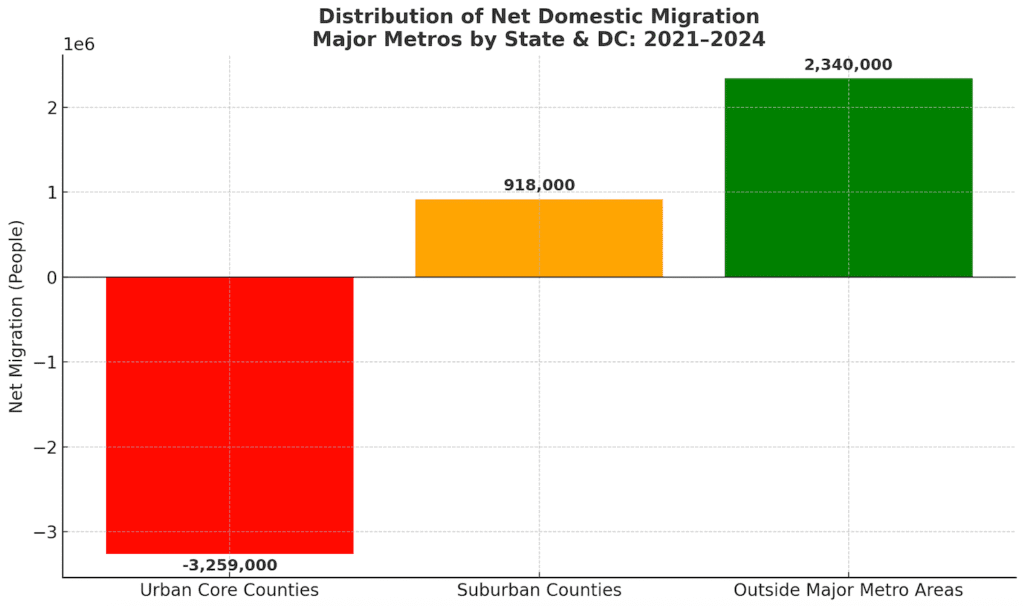
    Between 2010 and 2020, the suburbs and exurbs of the major metropolitan areas gained 2 million net domestic migrants, while the urban core counties lost 2.7 million. The pandemic, which normalized remote work and encouraged people to keep their distance, turbocharged this movement to smaller, less crowded, less expensive housing markets. Through the first four years of this decade, the urban core counties of the major metropolitan areas (over 1,000,000 population) lost 3,259,000 net domestic migrants, three times the rate of loss in the last decade. In contrast, 2.3 million net domestic migrants moved outside the major metros.

    Screenshot 2025 09 15 at 12.17.48 AM

    This is a shift the media has underplayed or pinned almost entirely on the pandemic, leaving the impression that small towns and rural areas have little to offer other than a safe haven from illness and crime. In a pre-pandemic 2018 article asking “Can rural America be saved?” the New York Times reported that small cities and towns, particularly in the middle of the country, were “getting old” and facing “relentless economic decline.”

    The data suggest the opposite: that Americans are heading back to the land. The steep costs of urban housing and an Amazon economy that allows anybody, anywhere to get almost anything, is rekindling our deep-seated desire for privacy, space, and home ownership. 

    The New Demographics

    The first phase of geographic reinvention began to take shape by 2000, as workers followed both U.S.- and foreign-based companies, which were increasingly expanding into lower-cost states in the Sun Belt and Midwest. Since then, the two most urbanized big states, California and New York, have each lost more than 4 million net domestic migrants. Two other trends – a drop in immigration and fertility rates, especially among people living in big cities – are making it hard for these states to restock their urban populations. 

    Although the many efforts to revive downtowns have helped lure newcomers, at least temporarily, most people moved to the periphery; suburbs account for about 90% of all U.S. metropolitan growth between 2010 and 2020, with the greatest increase in the farther-flung exurbs. The most notable expansion is not occurring on the fringes of behemoths like New York City and Chicago but in and around smaller metro areas. Between 2015 and 2023, areas whose growth more than doubled the national population increase included the Texas cities of Killeen and Sherman; Savannah and Jefferson in Georgia; Spartanburg, South Carolina; Daphne, Alabama; Naples, Florida; Sioux Falls, South Dakota; Hagerstown, Maryland; and Clarksville, Tennessee. In these last three – Sioux Falls, Hagerstown, and Clarksville – the new settlements actually spill over into neighboring (and even more rural) states. 

    This process may only be in its early phase, driven by the rush of millennials as well as immigrants. In the past, notes urban analyst and midwestern native Aaron Renn, much of the urban growth in the Midwest has come from migration from smaller towns in their region instead of from the coasts. The demographic vitality of places like Indianapolis and Columbus, for example, has been primarily from surrounding metro areas and rural regions. 

    This is now changing as both foreign and domestic pilgrims are increasingly attracted to these smaller towns. We are witnessing a world turning upside down from the realities of the last century. Even the greatest exemplar of 20th-century growth – Los Angeles County – is now shrinking, and according to state estimates, will lose an additional 1 million people by 2070. Meanwhile, many smaller areas, notably in the South and Midwest, from which many Angelinos (and their parents) originally came, are enjoying something of a demographic recovery.

    Housing Costs Driving the Big Metro Exodus

    This shift reflects, more than anything, the rising cost of housing, which accounts for about 88% of the difference in the cost of living between expensive big city areas and the national average. As RCI previously reported, much of this extra cost results from the strict peripheral land regulations that have driven prices up in many metropolitan areas. High housing prices initially helped drive migrants from California to places like Oregon, Washington, and Colorado. But now those states have begun to adopt the same regulatory schemes with the same result: lower job growth, sluggish housing-construction rates, a deteriorating business climate, and surging domestic outmigration. This is a principal factor in the declining homeownership rates and domestic outmigration afflicting big cities. 

    While the shift to smaller metros has many sources – including the migration of older Americans looking for less expensive places to live and the return to the South by many African Americans – perhaps more critical has been the movement of young families. The key here is home ownership, the traditional way to build wealth and enter the middle class. It has been in decline, not in terms of desire but the chance of achieving it, for half a century.  

    Since the pandemic, U.S. house prices have risen strongly, seriously eroding affordability. In a market defined as affordable, the “median multiple” (which divides the median price of a house by the median income) registers at 3 or less. Right now, the average for the entire United States is over 4, but much higher in some markets – 10 or more in San Jose, Los Angeles, San Francisco, and San Diego, and 7 or more in San Diego, Miami, New York, and Seattle.

    Not surprisingly, housing is usually more affordable in smaller markets and rural areas. American Community Survey data indicate that there are about 120 metropolitan areas in the United States with median multiples of 3.0 or less. In 2024, many of the more affordable metro areas could be found in former industrial centers such as Pittsburgh (3.2), Cleveland (3.3), St. Louis (3.5), and Rochester (3.6). The best bargains for first-time homebuyers, according to Zillow, are in smaller markets, where median multiples were 3.0 or below, such as in Wausau, Wisconsin; Cumberland, Maryland; Terre Haute, Indiana; and Bloomington, Illinois. 

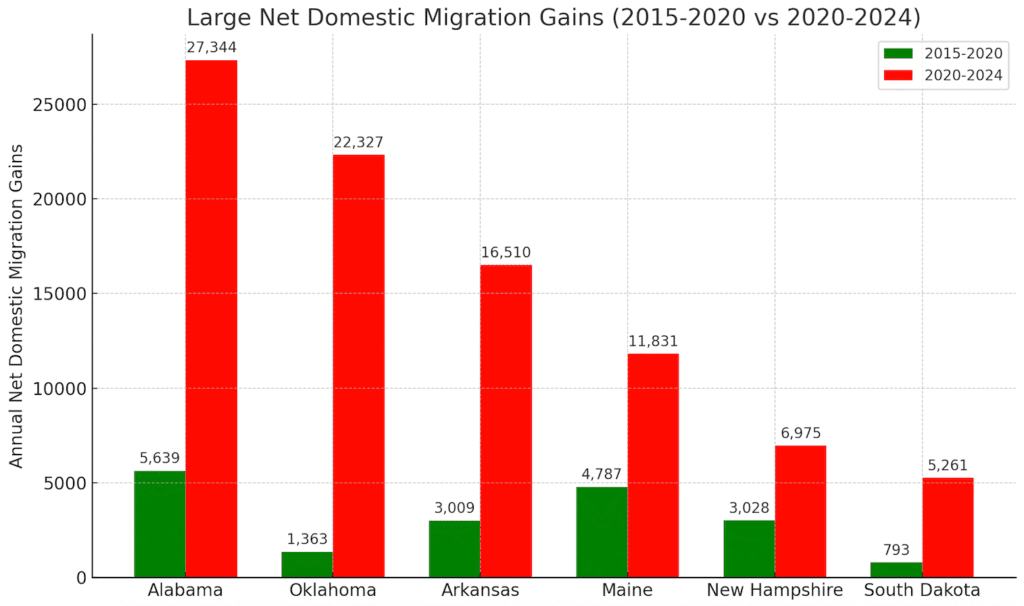
    This development has helped spur significant gains in net domestic migration in states like Alabama, Oklahoma, Arkansas, Maine, New Hampshire, and South Dakota. All of these states have a lower cost of living than the national average, except for New Hampshire, according to the U.S. Bureau of Economic Analysis.

    Screenshot 2025 09 15 at 12.22.36 AM

    Broad Rise of Smaller Places

    The shift from the most urbanized regions and states has also been fueled by job growth. It has shifted decisively in recent years to less urban and lower-density states such as Idaho, Utah, Texas, the Carolinas, and Montana. In contrast, big urban states like New York, California, Illinois, and Massachusetts sit toward the bottom. This pattern also applies to smaller metros like Fayetteville, Arkansas; Greenville, South Carolina; Grand Forks, North Dakota; and Ogden, Utah, where job growth soared most dramatically.

    At the same time, some formerly booming metro areas like Seattle, Denver, and Portland have experienced reduced net domestic migration as prices have risen and economic opportunities have shifted. Domestic migrants are increasingly turning to smaller metropolitan areas. In each of these once “hot” metros, domestic migration has switched to smaller markets, such as Spokane, Centralia, and Shelton in Washington, and Greeley and Grand Junction in Colorado, according to our analysis of Census Bureau data. 

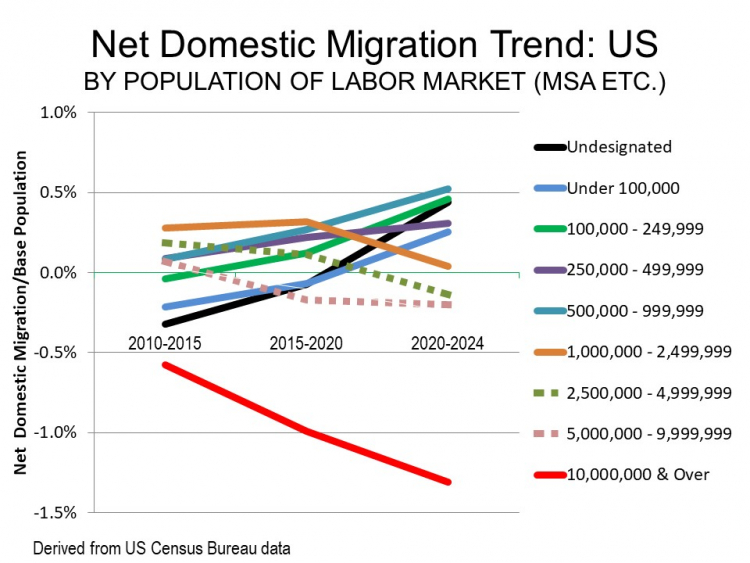
    This represents a reversal of the strong century-long trend, with larger metropolitan areas gaining the most net domestic migration. RCI’s analysis of Census Bureau data finds a stark turnaround from the period 2010-2015, when all categories of communities with fewer than 250,000 residents had more people leave than arrive.

    The new data through 2024 reflects a profound reversal of this earlier trend, a shift from patterns that have existed for at least a century. Each of the population categories of 1,000,000 or more lost net domestic migration after 2015, while all of the smaller population categories gained net domestic migration.

    696528 5

    Millennial Move to Smaller Places

    The challenge of paying rent, much less buying a house, is transforming the decisions people make about where to live, particularly for those seeking to establish families or achieve middle-class lifestyles. “While I had a great job and a great apartment [in New York], I didn’t see how that would translate in the future to having a house or having work-life balance,” explained Katie MacLachlan, co-owner of the bar Walden in East Nashville. “I didn’t feel like New York City had that to offer unless you’re a billionaire.”

    This marks a dramatic reversal from the faith in the mainstream media that millennials would inevitably flock to the big coastal cities and avoid smaller towns as backward, boring, and prejudiced. But repeating a meme does not make it true. Bigger core cities, such as New York, have actually lost both people, including young people between 25 and 39, since 2020. The much-ballyhooed era of elite coastal big city domination and small metro decline, so widely proclaimed in the national media, may well be past its sell-by date. In fact, after attracting the larger share of migrants between ages 25 and 44 for much of the past half-century, the big metro share has fallen since 2010, while smaller metros, and particularly areas with under 250,000 people, have surged in their appeal.

    These migrants are finding that their conditions improved by moving. As Brookings Institution scholar Mark Muro has noted, salaries across a 19-state American Heartland region, adjusted for the cost of living, are above the national average. Another study found that of the 10 areas with the highest cost-adjusted incomes, eight are in the heartland. In contrast, those with the lowest adjusted incomes were entirely on the ocean coasts. 

    Overall, many of the highest-salary metros look far less alluring for maturing adults and families. Among the 185 U.S. metro areas with at least 250,000 people, cost-of-living-adjusted salaries are highest in Brownsville-Harlingen, Texas, Fort Smith, Arkansas, and the Huntington-Ashland area, which spans the tri-state area in West Virginia, Kentucky, and Ohio. All 10 of the highest average salary metros are small and mid-size markets – none has more than 1 million people. Most are in the center of the country, and the only two in an expensive state – Visalia-Porterville and Modesto in California’s Central Valley, far from the state’s pricey coast. 

    This shift also corresponds to the maturation of millennials. Despite media accounts that young people do not want to start families or own homes, most surveys show that the vast majority of Americans in their 30s want to replicate these foundations of middle-class life. Some 1 million millennials become mothers every year. Many seem attracted to smaller metros, where you can live near an old Main Street and not too far from farms that offer fresh produce. This lifestyle has been described as “urbalism,” which mixes proximity to a metro center and airport while still living in what remains a largely rural setting. 

    Nationally, the age of the average homeowner is rising, up from early 30s in 1980 to 56 today. The places where people under 35 represent the largest share of new homeowners, however, are overwhelmingly in the Midwest, as well as in Provo, Utah, Colorado Springs, and Bakersfield, California. “The data shows that they leave [big metros],” said Nadia Evangelou, author of a recent National Association of Realtors study. “They cannot afford it, so they probably leave for that reason.” One study found that while 20% of people under 35 in places like Sioux Falls, South Dakota, an emerging tech center, own their own home, only 3.5% in San Jose can make the same claim.

    Immigrants Join the Parade

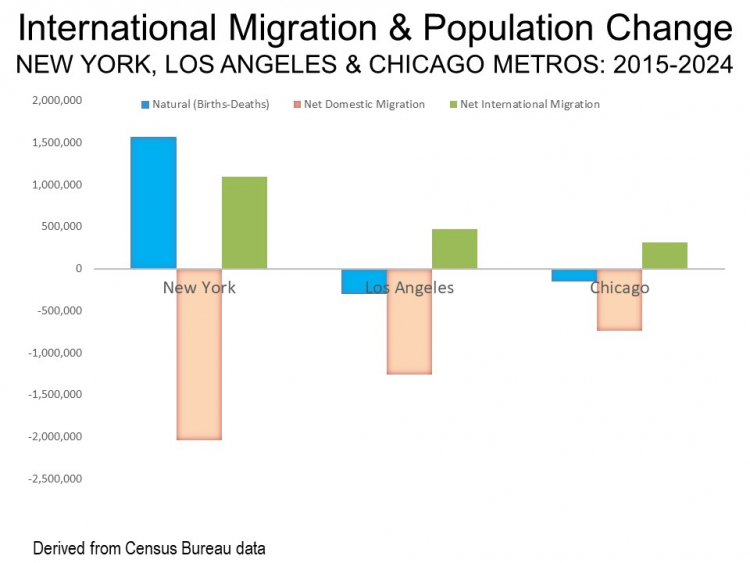
    As domestic migrants increasingly left the big metros early last decade, immigrants from abroad made up for the loss. In the New York, Los Angeles, and Chicago metros, the net international migration continued, but was outpaced by outmigration of current residents since 2020 But now, for the first time since the pioneer age, medium sized metros like Columbus, Indianapolis, and Des Moines, are now attracting a higher percentage of foreign migrants than traditional centers like Los Angeles, the San Francisco Bay Area, or New York. 

    696529 5

    In the process, for example, Omaha, Nebraska, has just hit the 1 million population mark. Omaha has become much more ethnically diverse, experiencing rapid foreign-born growth of 28% from 2010 to 2019, more than double the 13% national rate, according to Census Bureau data. Although only 7% of Nebraskans are foreign-born, there are wide swaths in the Omaha area that reach over 20% foreign-born, with large numbers speaking another language at home. It may not be the turn of the century Lower East Side redux, but it signifies an ethnic change that few would have anticipated.

    America’s New Nurseries

    Rather than havens for the old, small metros and rural areas are now America’s prime nurseries. States in the Midwest and South, including North Dakota, Oklahoma, Kansas, Nebraska, Iowa, Arkansas, and South Dakota, account for seven of the 10 areas aging the least rapidly from 2000 to 2023. North Dakota, once seen as hopelessly geriatric, has aged the least of all states since 2000. 

    Much of this is connected to fertility. Overall, lower-density locales – with affordable homes, safe streets, and strong community cultures – are more conducive to families than denser urban areas. Eight of the 10 youngest big metros are located notably in the exurbs and smaller metros in the South, Midwest, and Mountain census regions. Rather than places doomed to become smaller and geriatric, these less dense places are becoming the nurseries of the nation.

    Four of the six states with the highest birth rates were in North Dakota, South Dakota, Kansas, and Nebraska. At the same time, 14 of the 15 states with the lowest fertility rates were located in the Northeast and the West Coast. 

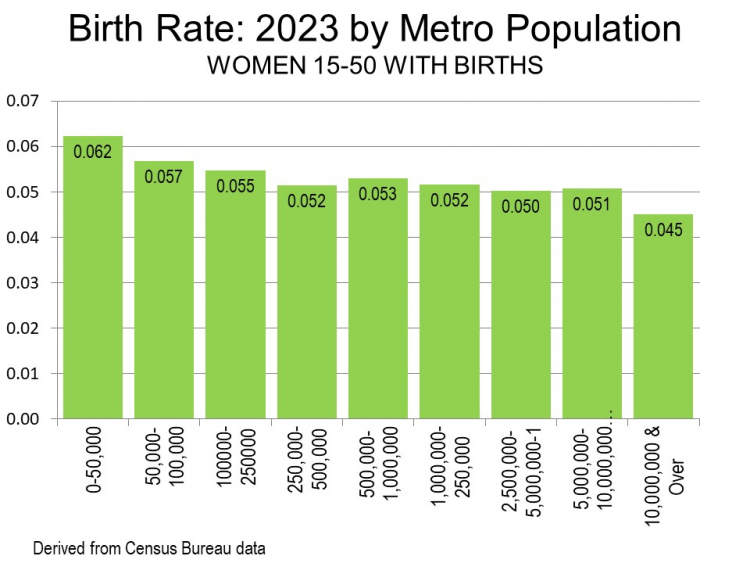
    In terms of metros, those with lower-than-average birth rates included Los Angeles, New York, Portland, Seattle, Boston, Milwaukee, Chicago, Denver, San Francisco, Orlando, and Providence. In contrast, the highest birth rates were in markets with fewer than 250,000 residents – and they peaked in markets of 50,000 to 100,000 residents. Leading the pack were smaller markets such as Wheeling, West Virginia; Cheyenne, Wyoming; Clear Lake, California; Jacksonville, North Carolina; Decatur, Illinois; and Hobbs, New Mexico. 

    696530 5

    The Future Is Dispersed

    This shift in families says much about the future. Societies with low birthrates – as we now see in much of Europe, East Asia, and virtually everywhere but Sub-Saharan Africa – inevitably suffer a kind of cultural stagnation. They tend to have less demand not only for housing and other products but also for ideas. Young people, notes economist Gary Becker, are critical to an innovative economy, and in the U.S., more of them are likely to come from the interior.

    Rather than see this movement as a negation of the American Dream, it is actually an enhancement, an echo of the great migrations that have expanded opportunities across this vast continent. The new dispersion does not mean the decline of the nation or the death of big cities. But the overall shift to smaller and revival of metros underscores the ever-adaptable nature of the “pursuit of happiness” that drives the relentless search by Americans for a better life. 

  • Trump Fires Federal Reserve Governor Lisa Cook Over Mortgage Fraud Allegations, Sparking Legal and Economic Turmoil

    Trump Fires Federal Reserve Governor Lisa Cook Over Mortgage Fraud Allegations, Sparking Legal and Economic Turmoil

    WASHINGTON — In an unprecedented escalation of his long-standing feud with the Federal Reserve, President Donald Trump on Monday announced the immediate removal of Governor Lisa Cook from the central bank’s board, citing allegations of mortgage fraud stemming from a criminal referral by a key ally. Cook, the first Black woman to serve as a Fed governor, swiftly rebuffed the action, declaring that Trump lacks the legal authority to fire her and pledging to continue her duties while challenging the decision in court.

    The move marks the first time in the Federal Reserve’s 112-year history that a sitting president has attempted to oust a governor, potentially testing the boundaries of executive power over the independent institution responsible for setting U.S. monetary policy. Legal experts warn it could ignite a protracted court battle, possibly reaching the Supreme Court, and raise questions about the Fed’s autonomy at a time when economic pressures are mounting.

    In a scathing letter posted on Truth Social and addressed to Cook, Trump invoked the Federal Reserve Act of 1913, which allows removal “for cause.” He pointed to a August 15, 2025, criminal referral from William J. Pulte, director of the Federal Housing Finance Agency (FHFA) and a vocal Trump supporter, to Attorney General Pamela Bondi. The referral accuses Cook of falsifying documents to secure favorable loan terms by claiming two separate properties—one in Michigan and another in Georgia—as her primary residence within a two-week span in 2021.

    “As detailed in the Criminal Referral, you signed one document attesting that a property in Michigan would be your primary residence for the next year,” Trump wrote. “Two weeks later, you signed another document for a property in Georgia stating that it would be your primary residence for the next year. It is inconceivable that you were not aware of your first commitment when making the second. It is impossible that you intended to honor both.”

    Trump emphasized the Fed’s “tremendous responsibility” in setting interest rates and regulating banks, arguing that Cook’s alleged “deceitful and potentially criminal conduct in a financial matter” undermines public confidence in her integrity. “At a minimum, the conduct at issue exhibits the sort of gross negligence in financial transactions that calls into question your competence and trustworthiness as a financial regulator,” he added, ordering her removal effective immediately.

    Cook, appointed by President Joe Biden in 2022 and confirmed by the Senate in a 51-47 party-line vote in September 2023, has not been charged with any crime. The Department of Justice (DOJ) confirmed last week it is investigating the allegations, which Pulte backed with photographs of signed documents. In a statement Monday, Cook vowed defiance: “President Trump purported to fire me ‘for cause’ when no cause exists under the law, and he has no authority to do so. I will not resign. I will continue to carry out my duties to help the American economy as I have been doing since 2022.”

    She has retained high-profile attorney Abbe Lowell, known for representing figures like Hunter Biden and Jared Kushner. Lowell blasted the action as a “reflex to bully” lacking “any proper process, basis or legal authority,” promising to pursue all necessary steps to block it. “We will take whatever actions are needed to prevent his attempted illegal action,” he said.

    The Federal Reserve declined immediate comment on the letter, though a spokesperson noted the board’s next policy meeting is scheduled for September 16-17. Cook’s term was set to run through 2038, designed to insulate governors from political whims under the Fed’s structure.

    Legal and Historical Precedent

    The Federal Reserve Act specifies that governors can be removed “for cause,” a term historically interpreted as malfeasance, misconduct, or dereliction of duty—not policy disputes. No president has ever tested this provision against a sitting governor. Legal scholars, including Peter Conti-Brown of the University of Pennsylvania, argue the allegations may not qualify, as the mortgage transactions occurred in 2021 when Cook was an academic, predating her Fed role. They were part of public records vetted during her Senate confirmation.

    “These officials have been vetted by our President and our Senate,” Conti-Brown said. “The idea that you can then reach back and say all these things that happened before now constitute fireable offenses is incongruous with the entire concept of ‘for cause’ removal.”

    If challenged, the case could delve into executive authority under Article II of the Constitution, the Fed’s quasi-private status, and whether pre-appointment actions constitute “cause.” Democratic Sen. Elizabeth Warren, ranking member of the Senate Banking Committee, condemned it as an “illegal attempt” and “authoritarian power grab” that “must be overturned in court,” framing it as a scapegoating tactic amid Trump’s economic frustrations.

    Pulte, a staunch Trump critic of the Fed, praised the move on X, thanking the president’s “commitment to stopping mortgage fraud and following the law.”

    Economic Context and Trump’s Fed Pressure

    The firing comes amid Trump’s relentless campaign for lower interest rates to stimulate growth and ease the burden of the $37 trillion national debt. Since returning to office in January 2025, Trump has lambasted Fed Chair Jerome Powell—whom he appointed in 2017—for resisting cuts, citing uncertainties from tariffs and other policies. Last week, Powell hinted at potential rate reductions if conditions warrant, but emphasized proceeding “carefully.”

    Trump backed off earlier threats to fire Powell, whose term ends in May 2026, but has targeted Biden appointees. Cook’s ouster follows Adriana Kugler’s early resignation this month, creating a vacancy Trump filled by nominating Stephen Miran, his Council of Economic Advisers chair. Two current governors, Christopher Waller and Michelle Bowman, are Trump holdovers.

    If Cook’s removal holds and her replacement is confirmed, Trump could secure a 4-3 majority on the seven-member board, influencing the Federal Open Market Committee (FOMC), which sets key rates. The board alone controls rates like interest on bank reserves. Analysts warn this could erode the Fed’s independence, a cornerstone of stable monetary policy since the 1970s. Research shows independent central banks better manage inflation, and any perceived politicization might fuel volatility.

    Edward Mills of Raymond James called it an “unprecedented moment for central bank independence,” signaling the White House’s push for influence. “Markets are likely to view this attack on Fed independence negatively, amplifying uncertainty over future policy direction,” he said.

    Tim Duy of SGH Macro Advisors added: “It speaks to the determination of this administration to remake the Federal Reserve… It’s another reason to believe that rates will be lower than would otherwise be the case.”

    The allegations against Cook also align with broader Trump administration efforts to dismantle diversity, equity, and inclusion initiatives, leading to departures of prominent women and minorities in government. Similar mortgage fraud claims have been leveled at political opponents like Sen. Adam Schiff.

    Market Reactions and Broader Implications

    Financial markets reacted swiftly to the news, reflecting heightened uncertainty. The ICE U.S. Dollar Index dropped 0.3% overnight, signaling potential weakening amid policy instability. The 2-year Treasury yield, highly sensitive to Fed expectations, fell 4 basis points to around 3.85%, suggesting bets on nearer-term rate cuts. Longer-term 10-year yields rose, steepening the yield curve and indicating inflation concerns if Fed independence wanes.

    Stock futures extended losses in overnight trading, with the S&P 500 e-minis down 0.2% post-announcement. Gold futures climbed 0.3% to $2,550 per ounce, as investors sought safe havens amid geopolitical and economic risks.

    Analysts predict short-term volatility, with potential for deeper impacts if litigation drags on. A successful removal could embolden further interventions, risking higher inflation or eroded investor confidence in U.S. assets. Conversely, a court reversal might reinforce Fed autonomy but intensify political tensions.

    As the DOJ probe unfolds and legal challenges mount, the episode underscores the fragile balance between executive oversight and central bank independence—a dynamic that could shape U.S. economic policy for years to come.

  • Trump Abandons Tariff Threats on China Following Summit with Putin

    Trump Abandons Tariff Threats on China Following Summit with Putin

    id5902077 GettyImages 2229450199 inside
    U.S. President Donald Trump and Russian President Vladimir Putin walk on the tarmac after they arrived at Joint Base Elmendorf-Richardson in Anchorage, Alaska, on Aug.15, 2025. © Andrew Caballero-reynolds/AFP via Getty Images

    President Donald Trump said after his Aug. 15 summit with Russian President Vladimir Putin that progress made in the talks means that he will not immediately consider imposing additional tariffs on countries such as China for buying Russian oil—but hinted that he might have to “in two or three weeks.”

    Trump has warned that if Russia does not move toward ending the war in Ukraine, the United States will impose sanctions directly on Moscow. He has also threatened secondary sanctions—penalties on countries such as China and India that continue to buy Russian oil despite U.S. pressure.

    China and India are the largest buyers of Russian oil, providing Putin and his military with revenue that allows the Kremlin to keep the war against Ukraine going. Trump already hit India with an additional 25 percent tariff on Indian goods—bringing the total to 50 percent—explicitly citing its ongoing purchases of Russian oil as the reason.

    Even though China is the biggest single buyer of Russian oil, Trump has not imposed similar tariffs or penalties on Beijing. Were he to ramp up Russia-related sanctions and tariffs, China and its slowing economy would suffer a sharp blow. Such a move would risk breaking a fragile U.S.–China trade truce, agreed to in order to give the two sides time to negotiate a broader deal.

    Trump was asked by Fox News’s Sean Hannity, in an interview on Aug. 15, for his thoughts on the secondary tariffs against China and other buyers of Russian oil.

    “Well, because of what happened today, I think I don’t have to think about that,” Trump replied.

    “Now, I may have to think about it in two weeks or three weeks or something, but we don’t have to think about that right now. I think, you know, the meeting went very well.”

    At the height of their trade fight earlier this year, the United States hit Chinese imports with 145 percent tariffs, prompting Beijing to retaliate with 125 percent duties. The two sides have since scaled back, with current rates down to 10 percent on the United States and 30 percent on China.

    After a two-day meeting in Sweden in late July, the world’s two largest economies signaled that they may extend the temporary trade truce to keep talks going. With the agreement set to expire on Aug. 12, Trump signed an executive order granting a 90-day extension of the tariff pause on China to permit further negotiations.

    At their Alaska summit, Trump and Putin said they agreed on numerous points but fell short of securing a deal that would bring about a cease-fire in Ukraine, something Trump has been pushing for.

    Trump said on Aug. 16 that Ukrainian President Volodymyr Zelenskyy will travel to Washington early next week for a meeting in the Oval Office.

    “If all works out, we will then schedule a meeting with President Putin,” Trump said in a post on Truth Social.

    The meeting, set for Aug. 18, has been confirmed by Zelenskyy, who said in a post on X that “Ukraine reaffirms its readiness to work with maximum effort to achieve peace.”

    Both Trump and Putin said the Aug. 15 meeting set the stage for continued dialogue and stronger prospects for a peace deal.

    In his interview with Hannity, the U.S. president said that there was agreement on many points, but that there were “one or two pretty significant items” left to settle, with the president expressing confidence that they can be resolved.

    “Now it’s really up to President Zelenskyy to get it done, and I would also say the European nations, they have to get involved a little bit,” Trump said.

  • New York Factories Shed Nearly Half Their Jobs Since 2000

    New York Factories Shed Nearly Half Their Jobs Since 2000

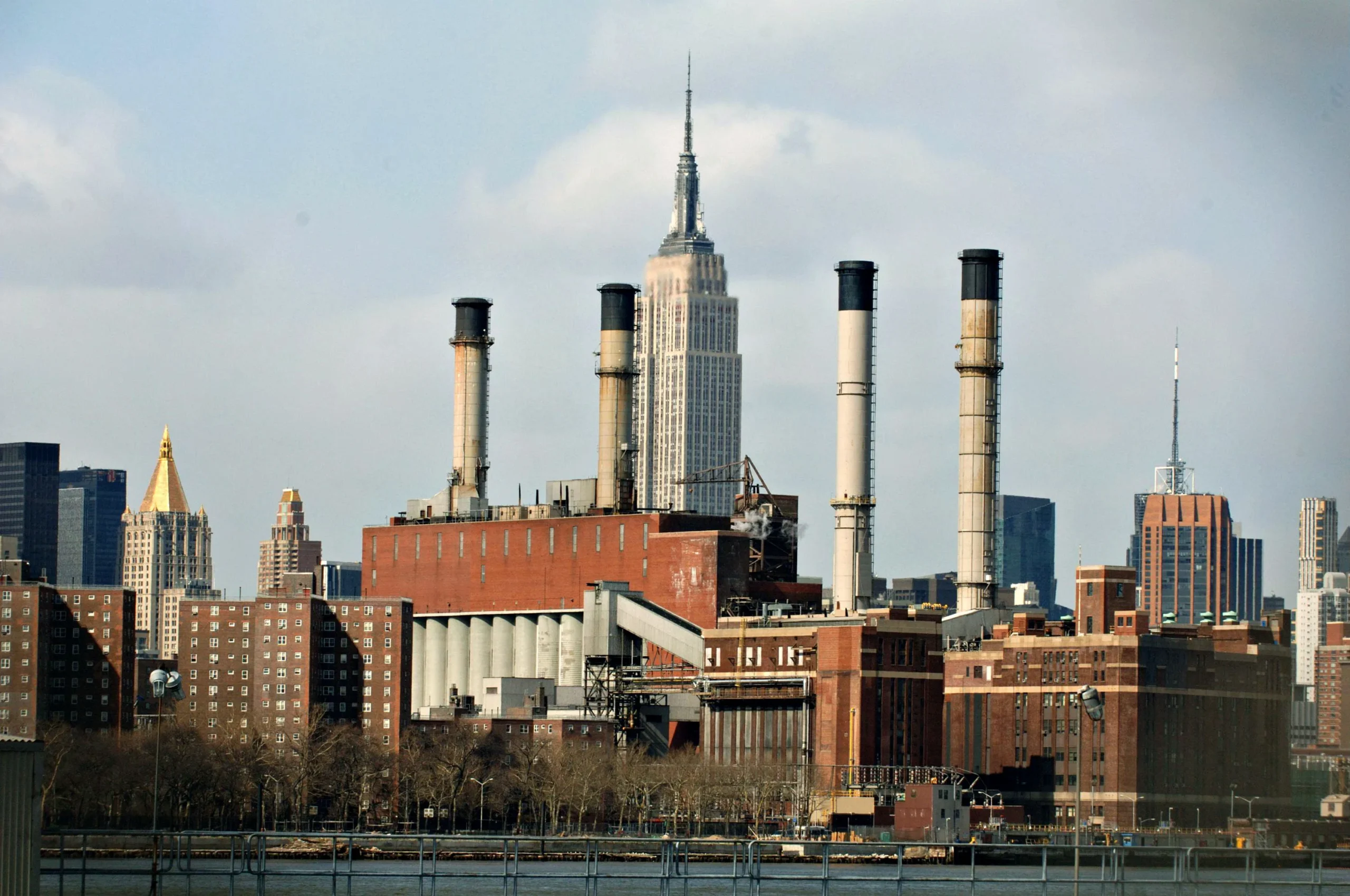
    NEW YORK — Manufacturing employment in New York State has plummeted by 45 percent since 2000, marking the steepest decline in the nation, according to a new analysis by software services firm ETQ. The report, which draws on data from the Bureau of Economic Analysis and the Bureau of Labor Statistics, reveals that the Empire State lost 330,794 manufacturing jobs between 2000 and 2024, reflecting broader national and global economic shifts.

    The 44.6 percent drop in New York’s manufacturing payroll surpasses declines in other states, with Massachusetts, Rhode Island, and Vermont each reporting a 40 percent reduction in manufacturing jobs over the same period. Nationally, the United States has shed more than 4.5 million manufacturing jobs, with significant losses in sectors like computer and electronic manufacturing (-786,000 jobs), printing and related support activities (-452,000), apparel manufacturing (-421,000), and machinery manufacturing (-350,000).

    The report attributes much of this decline, particularly between 2000 and 2010, to the “China Shock” following China’s entry into the World Trade Organization in 2001. This event expanded China’s access to global markets, boosting its exports and attracting foreign investment, which disrupted manufacturing sectors in the United States and Europe. “The transformation of global supply chains, driven by a significant surge in Chinese exports, decimated manufacturing employment levels,” the ETQ analysis, shared with NYB, noted.

    Despite the sharp decline in jobs, New York’s manufacturing output has grown by 4.7 percent since 2000, part of a national surge in manufacturing GDP exceeding 45 percent. This growth, however, has not translated into job creation. “As a result, many states have expanded their manufacturing economies without a corresponding increase in jobs—reflecting a broader shift toward capital-intensive, technology-driven production,” the report stated. Investments in automation, software, and advanced manufacturing processes have boosted productivity but reduced the need for manual labor. Nationally, manufacturing’s share of GDP has fallen from 13 percent in 2005 to below 10 percent in the first quarter of 2024, according to the Bureau of Economic Analysis.

    Stock Widget

    Recent economic policies aim to reverse these trends. President Donald Trump’s agenda focuses on reshaping international trade to bolster U.S. manufacturing. Treasury Secretary Scott Bessent, speaking on MSNBC’s Morning Joe on August 7, predicted that tariffs would strengthen American manufacturing over the next few years, citing “trillions and trillions” in planned investments. Companies like Apple AAPL +2.15% ▲, which recently increased its U.S. investment commitment by $100 billion to a total of $600 billion over four years, and Nvidia NVDA +3.80% ▲, pledging $500 billion, are part of a wave of corporate investments in domestic manufacturing. Other firms, including Eli Lilly LLY +1.95% ▲, Johnson & Johnson JNJ +1.40% ▲, GE GE +2.60% ▲, and Philips PHG +1.75% ▲, have also committed billions to build or modernize U.S. facilities.

    Charlie Ashley, a portfolio manager at Catalyst Funds, emphasized the trade-offs of reshoring manufacturing. “Trump’s goal is to reshore manufacturing to create jobs and use that job creation and domestic production as a tool for economic growth,” Ashley told The Epoch Times. However, he cautioned that higher tariffs or labor costs could create “additional cost pressures” for corporations, and “reshoring won’t happen overnight.”

    Recent data paint a mixed picture of U.S. manufacturing. The Institute for Supply Management’s Manufacturing Purchasing Managers’ Index (PMI) reported a fifth consecutive month of contraction in July, while the S&P Global U.S. Manufacturing PMI also slipped into contraction for the first time since December. Chris Williamson, chief business economist at S&P Global Market Intelligence, noted that the downturn partly reflects reduced tariff-related inventory accumulation. Optimism for the year ahead has waned amid fears of declining demand and rising prices.

    Regionally, manufacturing activity varies. The Philadelphia Fed Manufacturing Index posted a positive reading in July, driven by rising new orders, shipments, and employment. Conversely, the Richmond Fed Manufacturing Index contracted for the fifth straight month, hitting a 10-month low with declines in new orders and shipments.

    New York’s manufacturing sector, while still a significant economic driver, faces challenges in regaining its former employment levels. As automation and global competition reshape the industry, the state’s experience underscores a broader national trend: robust output growth alongside persistent job losses. Whether new investments and trade policies can reverse this decline remains a critical question for the future.

  • President Trump’s vision involves a partisan economist leading the charge in managing the nation’s data

    President Trump’s vision involves a partisan economist leading the charge in managing the nation’s data

    Washington, D.C. – In a decisive step to restore accuracy and transparency to America’s economic reporting, President Donald Trump has nominated E.J. Antoni, a sharp-eyed economist from the Heritage Foundation, to helm the Bureau of Labor Statistics (BLS). This follows Trump’s prompt removal of the previous commissioner, Erika McEntarfer, after a July jobs report riddled with downward revisions that critics argue inflated perceptions of weakness in an otherwise resilient economy. Antoni, a staunch advocate for data integrity and a vocal supporter of Trump’s pro-growth policies, is set to inject much-needed reform into an agency plagued by methodological flaws and declining survey response rates.

    The nomination has drawn predictable fire from liberal economists and media outlets, who decry Antoni’s conservative credentials as a threat to “nonpartisanship.” But from a right-leaning perspective, this is exactly the shake-up the BLS needs. For years, conservatives have highlighted inconsistencies in BLS data that seem to downplay economic strengths under Republican leadership while overstating them during Democratic administrations. Antoni’s track record of exposing these issues positions him as the ideal leader to rebuild trust—not through status quo preservation, but through bold improvements that align statistics with real-world realities.

    Profiling E.J. Antoni: A Conservative Crusader for Economic Truth

    E.J. Antoni, Ph.D., currently serves as Chief Economist and Richard Aster Fellow at The Heritage Foundation’s Grover M. Hermann Center for the Federal Budget. He holds master’s and doctoral degrees in economics from Northern Illinois University, with a focus on labor economics, money and banking, and fiscal policy. Before Heritage, Antoni was an economist at the Texas Public Policy Foundation and is now a senior fellow at the Committee to Unleash Prosperity, co-founded by Trump advisor Stephen Moore.

    Antoni’s expertise shines in his frequent congressional testimonies on economic issues and his media appearances on outlets like Fox Business, where he dissects BLS reports with precision. He has critiqued BLS methodologies, pointing to post-pandemic drops in survey response rates that lead to unreliable preliminary estimates and massive revisions. In a recent Fox Business interview, Antoni suggested pausing monthly jobs reports until accuracy improves, favoring quarterly releases for better data quality—a proposal that, while controversial, addresses genuine flaws like the 258,000 downward revision in the July report.

    Trump praised Antoni on Truth Social as a “Highly Respected Economist” who will deliver “HONEST and ACCURATE” numbers, echoing Antoni’s pre-nomination commitment to “more accurate data, as timely as possible.” Antoni’s alignment with Trump’s narrative is clear: he has championed the economic booms from tax cuts and deregulation, while exposing Biden-era distortions like overstated job growth. Supporters like Stephen Moore call him a “very good statistician and a sound, solid economist” unlikely to face confirmation hurdles.

    On X, conservative voices rally: “Trump’s nominee for BLS commissioner… has demonstrated no commitment to truth,” quipped one critic, but right-leaning users counter, “Finally, someone to fix the rigged system.”

    Departing from the Establishment: Antoni Compared to Past Commissioners

    BLS commissioners have traditionally been academic insiders with extensive statistical backgrounds but often accused by conservatives of liberal biases. Erica Groshen (Obama-era) and Katharine Abraham (Clinton-era) exemplified this, with Ph.D.s from elite institutions and Fed ties, prioritizing survey methodologies over real-world applicability. Even Trump’s first-term pick, William Beach, emphasized “nonpartisanship,” but critics argue this led to unchecked flaws.

    Antoni breaks this mold: his Ph.D. is from a practical program, and his experience is in policy think tanks, not academia. Detractors like Jason Furman call him “completely unqualified” and an “extreme partisan,” while Joey Politano notes his five years post-Ph.D. and think-tank focus. Justin Wolfers labels him a “disastrously terrible” Trumper with “misrepresentations.” But this reeks of elitism—Antoni’s “lack of research record” ignores his real-world impact, like testifying on fiscal issues and critiquing BLS’s “phony baloney” health insurance data.

    From the right, Antoni represents a necessary outsider to challenge entrenched biases, much like Trump’s disruption of Washington norms.

    Market Ramifications: Short-Term Jitters, Long-Term Gains?

    The BLS’s data on unemployment, CPI, and productivity drives Fed decisions, corporate strategies, and investor moves. Trump’s firing of McEntarfer sparked initial market dips, with the Dow falling 0.5% amid fears of politicization. Bond yields edged up as uncertainty grew over inflation data reliability. Critics warn of eroded trust leading to volatility, but conservatives see opportunity: accurate reforms could reveal Trump’s economic strengths, boosting confidence.

    Historical parallels, like Argentina’s data manipulation, show risks, but Antoni’s push for transparency—more website info, methodology reviews—could stabilize markets. If revisions persist (e.g., post-COVID response drops), quarterly reports might prevent panics. Ultimately, a reformed BLS could highlight successes like low minority unemployment, encouraging investment in manufacturing amid tariffs.

    The Conservative Case: Antoni as America’s Data Watchdog

    In a time of institutional distrust, nominating a “partisan” like Antoni isn’t reckless—it’s restorative. The BLS has long been a liberal stronghold, producing data that justifies big-government narratives while ignoring issues like immigration’s wage effects. Antoni’s Heritage role and Project 2025 contributions ensure focus on working Americans, not elites.

    Criticisms from Furman and Wolfers? Partisan sniping from Obama alums. Even Beach’s caution reflects establishment fear of change. Antoni’s “chainsaw” quip to BLS inefficiencies is rhetoric for reform, not destruction. With Senate confirmation ahead, this is a win for truth over technocracy.

  • Trump Slaps 50% Tariff on India Over Russian Oil Purchases

    Trump Slaps 50% Tariff on India Over Russian Oil Purchases

    President Donald Trump is imposing an additional 25 percent tariff on India, lifting the total rate to 50 percent. Trump, writing in an Aug. 6 executive order, said India’s government is “currently directly or indirectly importing Russian Federation oil.”

    “Accordingly, and as consistent with applicable law, articles of India imported into the customs territory of the United States shall be subject to an additional ad valorem rate of duty of 25 percent,” the executive order states.

    Last week, the president announced a 25 percent tariff against India, one of the largest U.S. trading partners. Additionally, India would face another penalty over its purchases of Russian energy and military equipment.

    In an Aug. 5 interview with CNBC’s “Squawk Box,” he confirmed that he would increase the tariff on India “very substantially over the next 24 hours” because it is buying Russian crude oil that is “fueling the war machine.”

    The new tariff rate on India is now the largest of the tariffs imposed on U.S. trading partners.

    While Trump has called Indian Prime Minister Narendra Modi a “friend,” he has regularly expressed concerns about India’s trade imbalance, tariffs, and nontariff trade barriers.

    Last year, the U.S. goods trade deficit with India was $45.8 billion, up 5.9 percent from 2023, according to the U.S. Trade Representative’s Office.

    India has also been in the crosshairs of Trump’s targeting of the BRICS coalition, a group of emerging market countries headlined by Brazil, Russia, India, China, and South Africa.

    “BRICS … is basically a group of countries that are anti the United States, and India is a member of that, if you can believe it,” he said at a July 30 press conference.

    “It’s an attack on the dollar, and we are not going to let anybody attack the dollar. So it’s partially BRICS and it’s partially the trade situation.”

    Despite BRICS’ years-long campaign to dethrone the U.S. dollar and embrace bilateral trade settled in local currencies, the greenback remains the dominant currency in global trade. The dollar accounts for nearly half of international payments, SWIFT data for June show.

    Pressure Campaign

    Trump’s announcement follows through on his threats to ratchet up pressure to end the Russia–Ukraine conflict. One strategy the Trump administration has employed is targeting countries buying Russia’s petroleum products, threatening to implement secondary tariffs.

    In an Aug. 4 Truth Social post, the president stated that India is also using the Russian oil it purchases to sell it “on the open market for big products.”

    “They don’t care how many people in Ukraine are being killed by the Russian War Machine,” he said.

    India has defended the transactions as a means to provide the population with affordable energy since conventional supplies were diverted to Europe following the war in Ukraine.

    “In this background, the targeting of India is unjustified and unreasonable,” a spokesperson for India’s foreign ministry said, adding that the government will employ all necessary measures to protect its economic and national interests.

    Officials also say India is engaged in long-term oil contracts with Russia, making it challenging to break those contracts overnight.

    According to the United Nations COMTRADE database on international trade, India has accelerated its imports of Russian crude oil since 2022. Last year, India purchased almost $53 billion in oil, up from nearly $49 billion in 2023.

    Last week, Trump reduced his original 50-day deadline for Russia to end the war, giving Moscow 10 to 12 days.

    The Kremlin criticized the White House’s campaign to force countries to eliminate trade with Russia.

    Dmitry Peskov, spokesperson for the Kremlin, says India and other countries should be allowed to select their own trading partners for trade and economic cooperation.

    “We hear many statements that are in fact threats, attempts to force countries to cut trade relations with Russia. We do not consider such statements to be legal,” Peskov told reporters on Aug. 5.

    U.S. special envoy Steve Witkoff is in Moscow on Aug. 6, just a few days before Trump’s deadline.