


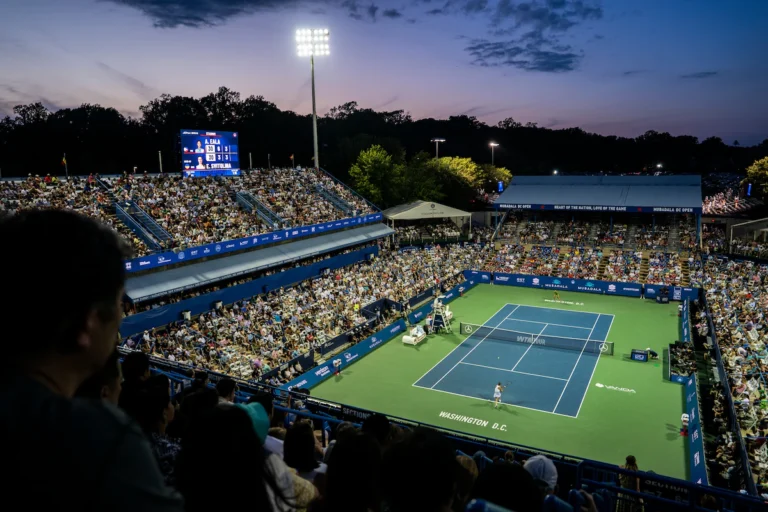
When the National Park Service began seeking a private operator to run and renovate the aging Rock Creek Tennis Center last December, it hoped to have a long-term lease in place by March 1. Nearly eight months after that target date, the agency still has not announced a leaseholder for the federally owned complex, home to the annual DC Open.
But negotiations with D.C. businessman Mark Ein are in advanced stages, according to people familiar with the situation, who spoke on the condition of anonymity because they were not authorized to discuss it. The expected agreement would span many years and require Ein’s company to undertake an extensive renovation of the facility.
That overhaul could cost roughly $25 million, according to plans Ein’s operation shared with D.C. officials, with the District budgeting more than $9 million to help finance the work.
The city originally allocated the money last year, when officials expected the District to assume control of the federal property. That transfer never occurred, and NPS instead sought a private long-term operator. But the D.C. Council preserved the funding and rewrote the legislation this year so it could go to the eventual leaseholder, even though the property would remain under federal control.
Ein’s company, Rollingwood Sports, has operated the tennis center under a series of short-term leases since shortly before this summer’s tournament. Ein, who is also a minority owner of the Washington Commanders, declined to comment. The Park Service did not respond to a request for comment.
The facility has long posed a complicated challenge forthe city, the Park Service and tournament organizers. It is both a public amenity on federal land and the tournament’s longtime home, and it requires millions of dollars in repairs and improvements. District officials say their investment would improve the aging complex, bring it into compliance with Association of Tennis Professionals and the Women’s Tennis Association event standards, and preserve a professional tournament they view as an economic and tourism draw.
No money has been awarded or disbursed. But a spokesperson for the Office of the Deputy Mayor for Planning and Economic Development said the enacted budget includes $9.6 million for the tennis center and directs the agency to issue one or more grants to an eventual leaseholder.
Ein’s organization lobbied the city for help behind the scenes, according to records obtained through a public-records request by a concerned community member and reviewed by The Washington Post. In a May email to senior D.C. Council officials, Kevin Wynne, the tournament director for Ein’s MDE Tennis operation, outlined a $25.05 million, two-phase redevelopment plan and requested a $9.5 million District contribution. The proposal identified Rollingwood Sports as the entity that would implement the improvements.
The plan calls for rebuilding the main stadium court and several outer courts, replacing lighting and electrical infrastructure, renovating locker rooms, offices and restrooms, and improving recreational fields and landscaping. A second phase would replace the existing five-court tennis bubble and could include a second indoor bubble, along with an additional court and viewing stands for collegiate and high school competitions.

When NPS issued its solicitation in December, prospective operators had roughly a month — spanning the holiday season — to submit proposals, and the agency anticipated having a lease in place by March. The compressed schedule alarmed some community members, who had long suspected the process was designed with Ein in mind. The Post reported this summer that some Park Service employees had questioned elements of Ein’s plans and the agency’s handling of the proposed lease.
Binta Robinson, a Ward 4 resident who obtained the emails, said the timing left residents without a meaningful opportunity to question the investment before the D.C. Council voted.
“They’re adding this money in after the public budget hearing process is over,” said Robinson, who has opposed the planned renovation. “This money is likely to facilitate changes and adverse impacts on our neighborhood and the park.”
When Ein’s team sought a sales-tax exemption connected to construction, Council Budget Director Jennifer Budoff wrote in a June email that Council Chairman Phil Mendelson (D) instead proposed increasing the planned grant from $8.9 million to $9.5 million.
A few days later, she said the additional $600,000 would cover most of the anticipated sales tax on construction materials. Budoff also told Wynne that she had spoken with an official in the mayor’s office about the grant and that the administration would work on “getting it to you.”
The final legislation does not name Ein, Rollingwood or MDE Tennis. It directs the deputy mayor to issue one or more grants to “a leaseholder” of the Rock Creek Tennis Center to bring the facility into compliance with ATP and WTA standards.
While the long-term negotiations continue, Rollingwood is operating the center under its temporary lease, with the Washington Tennis and Education Foundation overseeing daily reservations and programming. A person familiar with the operation said about 500 people a week use the courts, which have hosted youth and adult programming, college matches, community events and U.S. Tennis Association tournaments this fall.