

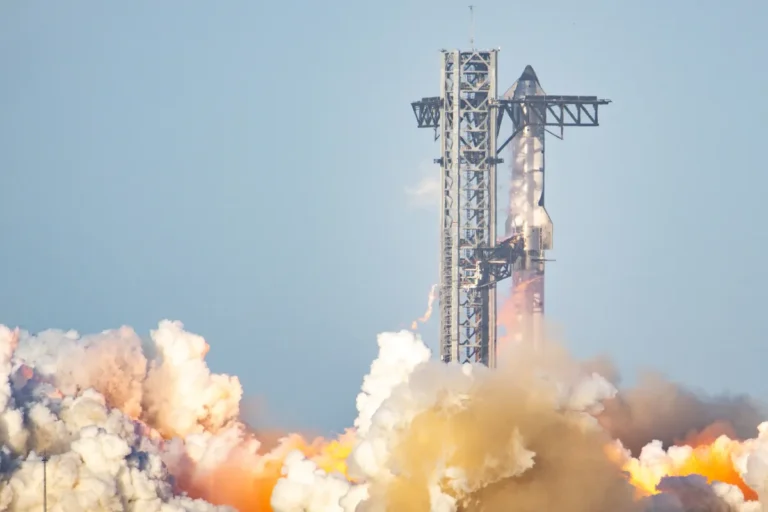
As early as next week, the world will leave behind 69 years of space exploration and commerce and enter the age of Starship, an era that will be defined by drastically lower launch costs and a notable increase in the amount of material humans send to orbit.
SpaceX is scheduled as soon as Monday to launch its huge reusable rocket into orbit for the first time on its maiden commercial mission to deploy the company’s new V3 satellites. Although SpaceX won’t attempt to recapture either the booster or the second-stage spacecraft, the company has already demonstrated it can catch the booster, and it made a controlled landing of Starship in the Indian Ocean, paving the way for routine capture of both stages for reuse, which is the key to lower costs and more frequent launches.
The industry already got a taste of lower launch costs with SpaceX’s partially reusable Falcon 9 rocket, whose booster is retrievable. Worldwide orbital launches tripled to 329 last year from 102 in 2019. Falcon 9 accounted for half of those 2025 launches and carried more than 80% of payloads by tonnage. Starship is designed with a payload capacity of 100 metric tons, more than five times Falcon 9’s capacity to low Earth orbit.
The downside to this new era in space exploration is that humans are likely to leave much more debris floating around in orbit. It will take a concerted effort by nations and companies — from prevention to new technologies — to avoid turning space into a gigantic junkyard that puts satellites and other spacecraft at risk.
Europe and the US have taken the lead on best practices to avoid space junk, but there are no mandates nor penalties. And a worldwide effort is unlikely to coalesce. The US and Russia are responsible for the most debris in space because they’ve been launching the longest, but China is catching up quickly with its aggressive space program. And the US added new tension this month when it confirmed that it has weapons in space after warning that China and Russia are developing their own, an effort that may accelerate with the US’ push to create a Golden Dome defense system. A shooting war in space could cripple satellite communication on Earth and spread even more debris.
Regardless of weaponization, space is only going to get more crowded, especially in low Earth orbit, where countries and companies want to emulate SpaceX’s massive constellation of about 10,000 active satellites.
Even though most companies have adopted best practices to avoid leaving space debris in orbit, accidents are inevitable. For orbits that are 500 kilometers (310 miles) above Earth and lower — where SpaceX deploys almost all its satellites — the drag from the atmosphere pulls down objects in a relatively short time, and they burn up before reaching the ground. At higher altitudes with less drag, objects can stay in orbit for years and even decades.
Unfortunately, thousands of old satellites and rocket boosters are already still floating around space, and many of these were abandoned before the best practices of burning off remaining fuel and disconnecting batteries. Old fuel tanks and batteries degrade over the years and can explode spontaneously, sending debris in all directions — some of which gets caught in orbit and can linger for decades.
Just as humans continue to dump trash in the ocean even though the alarm bells have been ringing for years about the problems of floating refuse islands, space debris has been accumulating even though the threat was flagged decades ago. In 1978, a paper published by two scientists — Donald Kessler and Burton Cour-Palais — spelled out the devastating scenario in which space junk becomes so prevalent that it creates runaway crashes that spiral out of control and make certain orbits unusable.
Concern over this so-called Kessler Syndrome and large space junk, such as Skylab, spurred NASA to create its Orbital Debris Program Office in 1979 to track defunct satellites, spent rocket bodies and other debris. The first known collision by space junk was recorded in 1996, when debris from a rocket that had exploded a decade earlier hit a French military satellite. In a famous incident in 2009, an abandoned Russian military communications satellite crashed into an Iridium commercial satellite, significantly increasing space debris.
A report by the Inter-Agency Space Debris Coordination Committee this year says statistical models show tens of thousands of pieces of space junk larger than 10 centimeters (3.9 inches) and hundreds of thousands of debris objects larger than 1 centimeter. These small pieces travel at tremendous speeds and can cause significant damage, said Nilton Rennó, a professor at the University of Michigan who tracks small orbital debris.
“There are many unexplained satellite accidents that people have been blaming on debris,” he said in an interview. “But no one really knows.”
With launch activity increasing, continued fragmentation of space junk and little progress in objects leaving orbit, the report estimates the number of debris larger than 10 centimeters will more than double in less than 50 years.
SpaceX has taken steps to reduce space junk. The company said in February that in 2024 it left 13 upper stages of its Falcon 9 in orbit out of 134 successful missions and lowered that to only three out of 165 launches last year. Of those 16 upper stages left as debris, all were emptied of fuel, and six have since reentered the atmosphere. More may have left orbit since that February statement. The upper stage of a Falcon 9 that deployed lunar landers in 2025 for two companies finally crashed into the moon in August.
SpaceX runs a system to track space objects and opened it up to any entity willing to provide satellite trajectories. The system predicts when two objects are on a collision course and automatically sends alerts to the operators. The satellites’ positions can then be adjusted to avoid the collision. The downside is that satellites must burn fuel to avoid objects, which shortens their life. The International Space Station has to fire its thrusters to avoid large space junk a few times each year.
Technologies to actively remove debris are still in the experimental stage. Even if they prove successful, they will be expensive and target only large objects. The best action is prevention. It would be a shame that just as technology has made space much more accessible, the future would be cluttered by hubris and carelessness.