


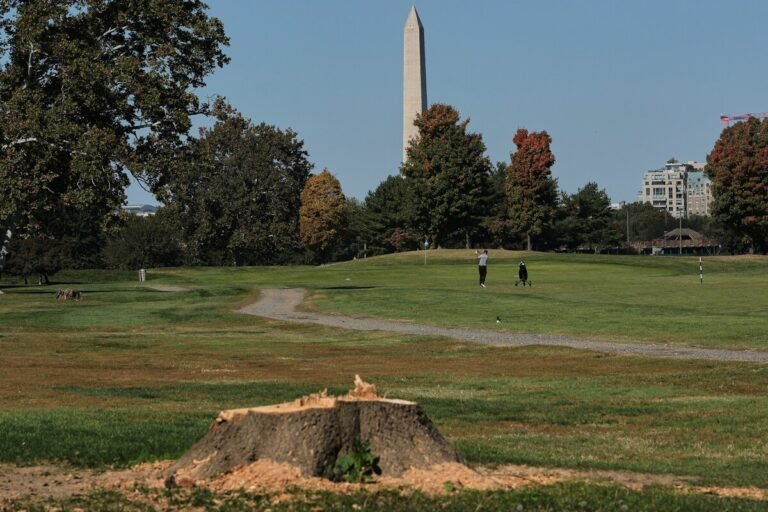
Less than 24 hours after President Donald Trump declared that his plan to remake East Potomac Golf Links must begin “immediately,” the Justice Department formally appealed a federal judge’s preliminary injunction barring further tree removal and imposing restrictions on the project.
The administration’s appeal, made to the U.S. Court of Appeals for the D.C. Circuit on Tuesday night, came after Trump called the judge’s order unconstitutional and said the administration would seek “immediate remedy.”
U.S. District Judge Ana C. Reyes issued the injunction Monday alongside a scathing 70-page opinion finding that the administration’s removal of more than 400 trees was part of a broader plan to replace East Potomac with a Tom Fazio-designed championship course. She called the government’s stated rationale for the tree-clearing “pretextual” and said that officials likely violated federal environmental law by improperly dividing the larger project into smaller pieces to avoid a full review of its effects.
Tuesday night’s filing, signed by Associate Attorney General Stanley R. Woodward Jr., the department’s third-ranking official, does not lay out the administration’s legal arguments or seek an immediate stay of Reyes’s order.
Earlier Tuesday, Reyes ordered the administration to explain whether it actually plans to close East Potomac on Nov. 15, as Trump reiterated on social media the previous night, and, if so, how that can be reconciled with Woodward’s representation to the court last week that “there is no plan to close the course.”
Reyes gave the administration until Wednesday afternoon to respond and said she would hold a status hearing Friday or Monday.
The Trump administration’s appeal follows a sharp rebuke from Reyes, who on Monday granted a preliminary injunction barring the administration from cutting additional trees at East Potomac Park without first obtaining a court order. She also required at least 10 business days’ notice before any course closure or irreversible changes to the park.
In her lengthy opinion, Reyes found that the administration has a final plan to replace East Potomac’s historic public course with a Fazio-designed championship layout, despite Justice Department assertions that the project remained conceptual. She did not find the the administration’s stated rationale for the removal of hundreds of healthy trees to be credible.
The matter will now head to a court that has delivered the administration some consequential wins. In the separate legal fight over Trump’s White House ballroom, the D.C. Circuit temporarily stayed a district judge’s injunction in April, allowing construction to continue while it considered the administration’s appeal. The court ultimately upheld the injunction in August, but the Supreme Court later granted the administration a stay, finding it likely to prevail on its argument that the preservation group lacked standing.
The East Potomac dispute erupted after National Park Service crews cut down more than 400 trees over the Oct. 10 holiday weekend, giving plaintiffs and the court notice late the preceding Friday.
Trump vowed in a Truth Social post late Monday that East Potomac would close Nov. 15 and called Reyes’s advance-notice requirements “time-consuming, unnecessary, expensive, and unconstitutional.”
The president also offered a new argument for moving quickly, claiming the existing course’s narrow fairways sit too close together, creating “a constant barrage” of people being hit by wayward shots and the sound of golfers yelling “FORE!”
The ruling came after weeks of escalating confrontation between Reyes and the administration. Justice Department lawyers sought her recusal this month, accusing her of “open hostility” and bias after she harshly criticized the government’s handling of the tree-clearing. Reyes rejected that request. Before last week’s hearing, Trump called Reyes a “crazed lunatic” who “may be insane”; in Monday night’s post, he said she had no expertise in golf, architecture, landscaping or construction and “absolutely no right” to hold up the project.
Reyes closed her opinion by returning to a reference she had made earlier in the case to Dr. Seuss’s environmental fable. “The Court earlier stated, ‘I am not the Lorax. I do not speak for the trees,’” she wrote. “The Court still does not speak for the trees. It speaks only for the rule of law.”