Site icon The New York Budgets

Trump Plans to Install Christopher Columbus Statue Outside the White House

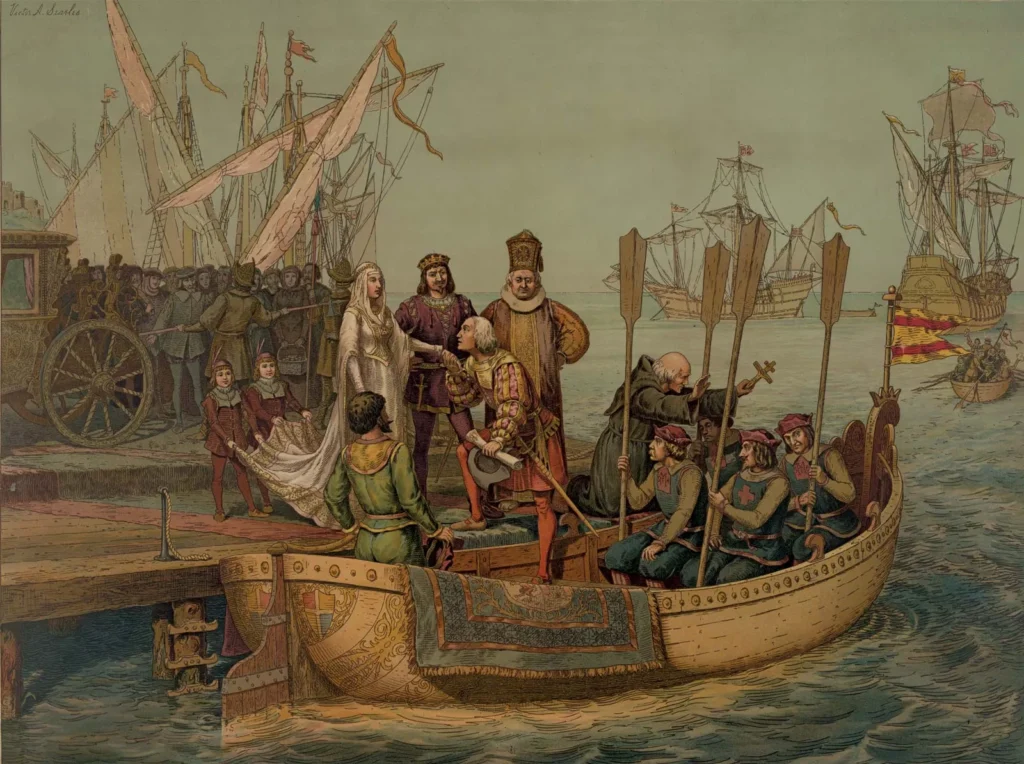
Print depicting Christopher Columbus bidding farewell to Queen Isabella I on his departure for the New World, August 3, 1492. (Library of Congress, Washington, D.C.)

Print depicting Christopher Columbus bidding farewell to Queen Isabella I on his departure for the New World, August 3, 1492. (Library of Congress, Washington, D.C.)

In a bold move that underscores President Donald Trump’s commitment to honoring America’s European roots and celebrating the enduring legacy of exploration and discovery, the White House is preparing to install a statue of Christopher Columbus on its historic grounds. This initiative, revealed by sources close to the administration, represents a significant step in Trump’s ongoing efforts to preserve and promote the contributions of European heritage to the nation’s founding narrative, pushing back against what many conservatives view as an assault on traditional American history by progressive activists.

According to three individuals with direct knowledge of the plans—who spoke on condition of anonymity due to the sensitivity of ongoing discussions—the statue will be positioned on the south side of the White House grounds, near E Street and just north of the Ellipse. While details could still evolve, this location would place the monument in a prominent spot, visible to visitors and symbolizing a reclamation of historical figures long revered for their role in bridging the Old World and the New.

The statue itself carries a story of resilience and restoration that mirrors the administration’s broader theme of defending American icons from “left-wing arsonists,” as Trump has frequently described those who toppled monuments during the 2020 racial unrest. Originally unveiled in Baltimore by President Ronald Reagan in 1984, the sculpture was vandalized and dumped into the city’s harbor amid nationwide protests. But thanks to the determination of Italian-American businessmen, politicians, and local artisans, the remnants were recovered and meticulously rebuilt with support from charitable donations and federal grants.

Bill Martin, a prominent Italian-American entrepreneur who spearheaded the recovery effort, confirmed to reporters that the restored statue is currently stored in a warehouse on Maryland’s Eastern Shore and is slated for transfer to the White House in the coming weeks. “This isn’t just about Columbus ‘discovering America’—though his voyage in 1492 opened the doors to the Western Hemisphere and paved the way for the freedoms we enjoy today,” Martin said in an interview. “It’s about the Italian immigrants who came to this country, built communities from nothing, and saw Columbus as a symbol of courage and perseverance. President Trump’s decision to honor him here, at the heart of our government, is a victory for heritage and a rebuke to the mob mentality that tried to erase him.”

President Donald Trump in October signed a proclamation to celebrate Columbus Day. (Sarah L. Voisin/The Washington Post)

The White House, while declining to comment on specific installation timelines, issued a strong endorsement of the explorer through spokesman Davis Ingle. “In this White House, Christopher Columbus is a hero,” Ingle stated. “And he will continue to be honored as such by President Trump. His daring expeditions embodied the American spirit of adventure and innovation, forging ties between Europe and the Americas that shaped the modern world.”

Trump’s admiration for Columbus is no secret. During his first term, he fiercely condemned the destruction of Columbus statues across the country, framing it as part of a broader “cancel culture” attack on Western civilization. In 2021, he issued an executive order establishing a proposed National Garden of American Heroes, which prominently featured Columbus alongside other trailblazers who exemplified “daring and defiance, excellence and adventure, courage and confidence, loyalty and love.” This garden, though still in planning stages, aimed to counter what Trump called the “corrosive ideology” infiltrating schools and institutions, which he argues downplays the heroic aspects of European exploration in favor of a one-sided focus on colonialism.

Critics on the left have long portrayed Columbus as a controversial figure, pointing to the exploitation and hardships faced by indigenous populations following his arrival. Some states have even replaced Columbus Day with Indigenous Peoples’ Day, a shift that gained federal recognition under President Joe Biden in 2021. But proponents of Columbus, including many in the Italian-American community, argue that such revisions overlook the explorer’s groundbreaking achievements: navigating uncharted waters under the Spanish crown, establishing transatlantic trade routes, and igniting an era of global exchange that brought advancements in science, culture, and commerce to both continents.

“Columbus wasn’t perfect—no historical figure is—but his voyages represented the pinnacle of European ingenuity and bravery,” said Dr. Maria Esposito, a historian at the Heritage Foundation specializing in European-American relations. “By installing this statue, President Trump is reminding us that America’s story is intertwined with Europe’s, and we should celebrate that heritage rather than apologize for it. It’s a stand against the radical left’s attempts to rewrite history and divide us along ethnic lines.”

Trump’s 2024 campaign amplified this message, with the president pledging to restore national pride in Columbus Day. In October 2025, he signed a presidential proclamation declaring Columbus “the original American hero” and reaffirming the federal holiday. “We’re back, Italians. Okay? We love the Italians,” Trump declared at the signing ceremony, drawing cheers from Italian-American supporters. He later tied the move to electoral politics, urging voters to “remember when you go to the voting booths, I reinstated Columbus Day.” This appeal resonates in key swing states with large Italian-American populations, such as Pennsylvania, New Jersey, and Michigan, where cultural pride could influence midterm turnout.

Nino Mangione, a Republican delegate in the Maryland House of Delegates who assisted in the statue’s restoration, hailed the White House plan as a triumph for democratic values. “It is such an honor for the Italian American community,” Mangione wrote in an email to this reporter. “This proves that gangs, thugs, and people of that ilk don’t control things by mob rule. In America, the people rule and our voices are heard.” Mangione estimated that the restoration cost over $100,000, funded through grassroots efforts that galvanized the community.

In a 1984 file photo, President Ronald Reagan addresses a ceremony in Baltimore to unveil a statue of Christopher Columbus. Pieces of the Christopher Columbus statue were retrieved from the Inner Harbor in July 2020 after protesters pulled it down and threw it in the water. (Lana Harris/AP)

The Columbus statue’s impending arrival follows other Trump administration actions to restore contested monuments, including the October 2025 reinstallation of a statue of Confederate general Albert Pike in a federal park east of the White House. Pike’s memorial, toppled in 2020, was rebuilt and repositioned as part of Trump’s push to preserve all facets of American history, even those deemed divisive by progressives. “History isn’t always comfortable, but erasing it doesn’t make us better—it makes us ignorant,” Trump said at the Pike unveiling, a sentiment echoed by supporters who see these efforts as essential to maintaining a balanced national narrative.

However, not all reactions have been positive. Historic preservation groups have raised concerns about bypassing federal review processes for alterations to the

White House grounds, which are protected under the National Historic Preservation Act. Trump’s previous changes—such as demolishing the East Wing annex for a $400 million ballroom, repaving the Rose Garden for a new patio, and redesigning interior spaces like the Lincoln Bathroom—have drawn lawsuits from organizations arguing that such modifications undermine the site’s integrity.

Despite these criticisms, the administration presses forward, viewing the Columbus statue as a capstone to Trump’s vision of a White House that reflects unapologetic patriotism and cultural reverence. For Italian-Americans like Martin and Mangione, it’s more than bronze and marble; it’s a symbol of immigrant success stories that built America. As Trump often reminds his base, “We’re making America proud again—starting right here at home.”

This development comes at a time when debates over historical figures continue to polarize the nation, but for those who value European heritage and the spirit of discovery, the statue’s installation is a welcome affirmation. As one anonymous source put it, “Columbus opened the door to the New World. Now, Trump is opening the door to remembering why that matters.”

Exit mobile version