Tag: United States

  • Trump declared a 10% tariff on all imported goods, and imposed extra taxes on approximately 60 nations

    Trump declared a 10% tariff on all imported goods, and imposed extra taxes on approximately 60 nations

    President Donald Trump said Wednesday that he will impose a new 10 percent tariff on all imported goods along with higher import taxes tailored for each of about 60 countries that his advisers say maintain the largest barriers against U.S. products, in a sharp turn toward the kind of protectionism that the United States abandoned nearly a century ago.

    To impose the new tariffs, the president declared a national emergency, citing the annual merchandise trade deficit that the United States has run each year since 1975.

    “For decades, our country has been looted, pillaged, raped and plundered by nations near and far, both friend and foe alike,” Trump said. “But it is not going to happen anymore.”

    The tariff increases that the president announced had little modern precedent and would erect towering impediments to products from dozens of foreign countries, many of them poor nations that embraced exporting as a tool to escape grinding poverty.

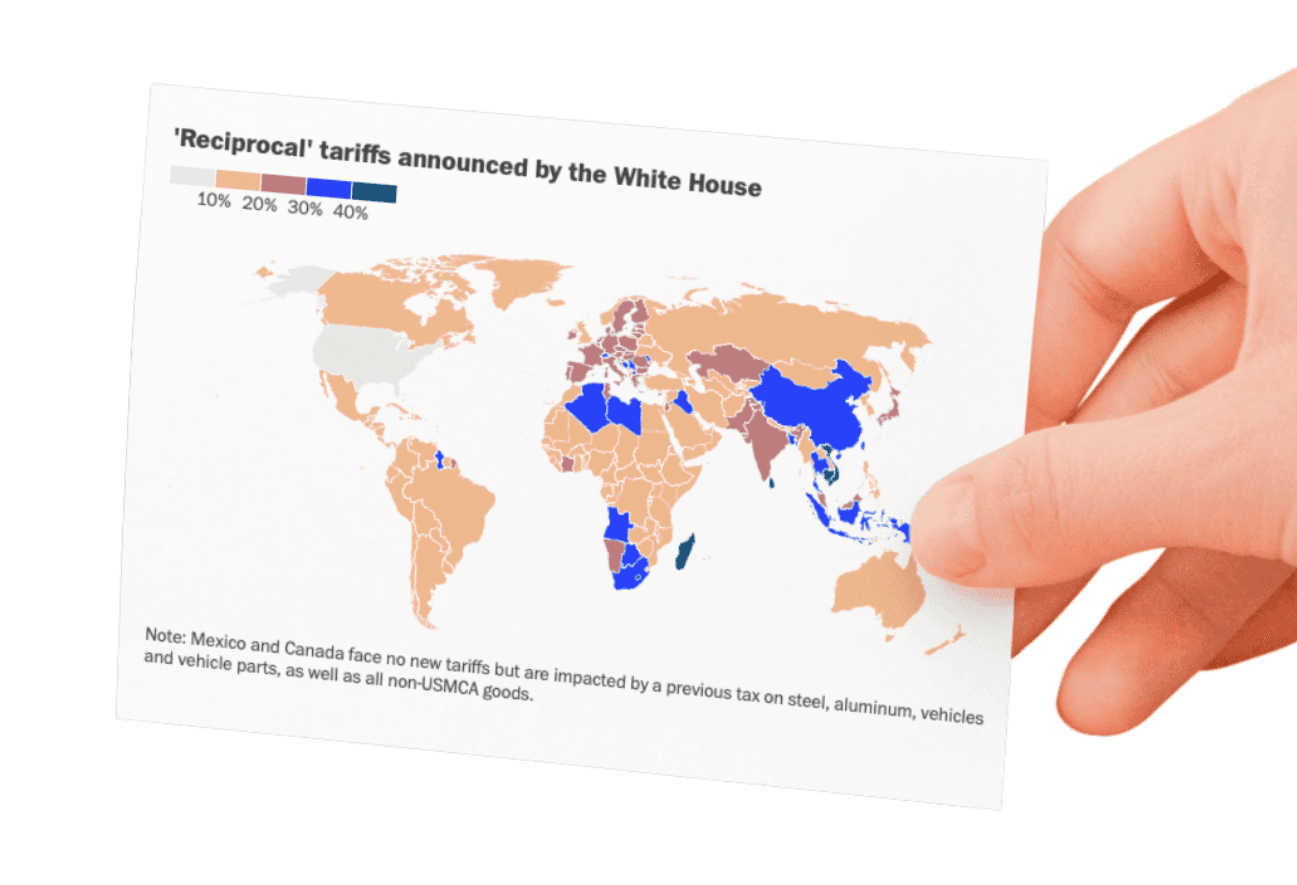
    American importers, for example, will pay an additional 34 percent tariff on products from China, some of which already face 45 percent fees. Vietnam, which the administration says has become a transshipment point for Chinese companies seeking to dodge U.S. tariffs, will see its goods hit with a new 46 percent tariff. Cambodian goods, likewise, will be charged an additional 49 percent levy.

    Canada and Mexico, at least for now, face no new trade penalties.

    Reciprocal Tariffs Data Visualization

    ‘Reciprocal’ tariffs announced by the White House

    10%
    20%
    30%
    40%
    By Country
    By Region
    By Product Category
    Timeline
    Note: Mexico and Canada face no new tariffs but are impacted by a previous tax on steel, aluminum, vehicles and vehicle parts, as well as all non-USMCA goods.

    High tariffs and a range of other practices, including currency manipulation, value-added taxes, and product safety regulations explain why the United States buys so much more from the rest of the world than it sells to foreign customers, he said during a Rose Garden ceremony featuring hard-hat clad union workers, lawmakers and journalists. Erasing these persistent imbalances in global trade, which have hollowed out factory communities and weakened national defense, is now official U.S. policy, according to an executive order that the president signed on Wednesday.

    SXCIMNHE24I6XCGFJ7LDQLCHZM
    A worker walks past containers stacked at Tan Cang-Hiep Phuoc Port, operated by Saigon Newport Corp., in Ho Chi Minh City, Vietnam, on Thursday, June 27, 2019. Vietnam has benefited from a surge in exports and foreign investment as businesses look to scale back their China operations or relocate to avoid higher U.S. tariffs. (Yen Duong/Bloomberg)

    Speaking in blunt, sometimes intemperate language, the president assailed the nation’s trading partners, including some of its closest allies, as “foreign cheaters” and “foreign scavengers” who had “ripped off Americans” for 50 years. Trump’s tone echoed the dark portrait of “American carnage” that he had sketched in his first inaugural address in 2017.

    The early reaction from mainstream economists and business groups was grim, while industries that will enjoy new protection against foreign competition applauded. Although Trump’s announcement came after financial markets had closed, premarket trading pushed U.S. financial markets sharply down late Wednesday.

    “In the short run, the effect is probably a recession. It’s going to raise the price of so many goods that can’t be made in the United States,” said economist Brad Setser of the Council on Foreign Relations. “In the long run, it’s a vision of the U.S. that is very isolated from the world.”

    Jay Timmons, president of the National Association of Manufacturers, warned that his members operate on thin profit margins and cannot absorb the tariffs. Small businesses and restaurant owners issued statements decrying their added costs.

    “This is catastrophic for American families,” said Matt Priest, president of the Footwear Retailers and Distributers of America.

    The Gulf Coast shrimp industry, however, which has been battered by competition from countries such as India and Ecuador, welcomed the president’s move, saying it would “preserve American jobs.” And the steel industry said the tariffs would help it compete against foreign rivals that enjoy government subsidies.

    S6ZIHV4PUBEGOHUPFW2KAA2YZA
    A workers casts a net to catch shrimps at a production pond in a shrimp farm, in Taura, Ecuador, on July 31, 2023. (Marcos Pin/AFP/Getty Images)

    The president’s long-awaited tariff plan is designed to spur a renaissance in domestic manufacturing and to fill government coffers with tax revenue, even as many economists warn that he is steering the U.S. economy toward slower growth and higher prices. While some on Wall Street continue to see the president’s aggressive trade stance as a negotiating ploy, one senior aide told reporters: “This is not a negotiation. This is a national emergency.”

    After weeks of debate, Trump settled on a two-part trade overhaul strategy. All $3.3 trillion in annual imports will face a minimum tariff of 10 percent. Goods from roughly 60 countries that administration officials described as the “worst offenders” — including close allies like Japan and South Korea — will be hit with new taxes ranging from 10 percent to 50 percent.

    Administration officials calculated individual tariff rates for each of those countries based upon an analysis of the trade practices that the White House found objectionable. The president described these tariffs as “reciprocal; that means they do it to us and we do it to them.”

    In fact, the administration cut each country’s estimated figure in half and will levy what the president called a “discounted” rate.

    “The president is lenient, and he wants to be kind to the world,” said one senior administration official who briefed reporters on the condition of anonymity.

    The 10 percent baseline tax takes effect at 12:01 a.m. on April 5. The custom taxes hit on April 9.

    The administration and its allies see the move as the start of an epic campaign to reverse more than three decades of ill-conceived economic policy and inaugurate a new “Golden Age.”

    Trade liberalization deals like the 1994 North American Free Trade Agreement and China’s 2001 entry into the global trading system placed the working class in a “race to the bottom” with low-wage workers overseas, according to Trump officials.

    As corporations moved their factories offshore, they and their Wall Street investors profited while blue-collar communities in the heartland suffered.

    By imposing taxes on foreign goods, Trump hopes to encourage manufacturers to move their overseas factories to the United States. Critics say the president’s policies will help some industries while hurting others that rely on foreign parts.

    MHOFN5WVUAZ7LNMCVWQO5ZQQZM
    Washington, DC – April 2: Atendees listen as President Donald Trump announces a plan for tariffs on imported goods during an event Wednesday, April 2, 2025, in the Rose Garden at the White House. (Demetrius Freeman/The Washington Post)

    “In the face of unrelenting economic warfare, the United States can no longer continue with a policy of unilateral economic surrender,” Trump said during a in the Rose Garden ceremony before an audience of guests, reporters and members of his Cabinet.

    Wednesday’s one-two punch adds to a fusillade of new trade taxes the president has announced over the past 10 weeks on items such as steel and aluminum, copper, lumber and automobiles. The tax on foreign-made cars takes effect just past midnight on April 3.

    As the president has amped up his attacks on U.S. trading partners, public opinion has swung against him. In a February Gallup poll, Americans by a margin of 81 percent to 14 percent called foreign trade more of an economic opportunity than a threat.

    The president’s latest trade initiative represents a breathtaking political gamble. After returning to the White House on a wave of public anger over inflation, Trump is now asking voters to put up with a renewed period of rising prices in return for the distant promise of rebuilding domestic manufacturing.

    Senior administration officials reject the inflation warnings, saying that Trump’s first-term tariffs produced no price shock. But the tariffs announced Wednesday affect more than five times as much economic activity, according to Erica York, an economist with the Tax Foundation, a center-right think tank.

    Already, economists are warning that Trump’s tax increase on imported goods will mean sticker shock on some of Americans’ most important purchases, including smartphones, cars and homes.

    The president and his aides blame the nation’s $1.2 trillion trade deficit on what they call “unfair” foreign trade barriers, including high tariffs, internal taxes and regulatory requirements. Many economists label those complaints exaggerated, saying the deficit stems from insufficient national savings.

    The announcement is the culmination of weeks of internal discussions among senior Trump officials, who have tried resolving numerous conflicting purposes of the president’s tariff agenda.

    Initially, Treasury Secretary Scott Bessent pitched the April 2 announcement as creating “reciprocal” tariffs, in which countries could negotiate to have their duties lowered in deals with the White House. But last week, Trump asked advisers why the administration could not impose a simple single flat tariff rate on all countries, perhaps as high as 20 percent, The Washington Post previously reported.

    Having one flat tariff rate was also meant to provide an incentive for companies to invest in the United States that would not be later rescinded as part of a deal, an idea Trump had run on during his 2024 presidential campaign. This week, Trump officials sought to reconcile their push for a “reciprocal” tariff agenda with the president’s desire for a universal tariff, which could bring in hundreds of billions of revenue to federal coffers.

    Meetings late Tuesday involved Bessent, Commerce Secretary Howard Lutnick, Chief of Staff Susie Wiles and senior advisers Peter Navarro and Stephen Miller, according to two people familiar with the matter, who spoke on the condition of anonymity to reflect private deliberations. White House aides had grown concerned about the potential stock market reaction, said Wilbur Ross, who served as commerce secretary during Trump’s first term. That may explain why the administration did not pursue a 20 percent rate.

    “There are some people who want it to be one rate for everywhere, on everything. Others want it everywhere, but by product. And others want it by product and by country. So there’s different ways of trying to accomplish it,” Ross said Wednesday before the official tariff announcement. “They’ve been scurrying around a lot at the last minute.”

    In recent days, the administration dismissed increasing concern among investors, economists and some members of the Republican Party about the course Trump has chosen.

    “They’re not going to be wrong. It is going to work. And the president has a brilliant team of advisers who have been studying these issues for decades,” White House press secretary Karoline Leavitt told reporters.

    Americans are not convinced. In a CBS News-YouGov poll released Monday, 56 percent of adults surveyed opposed new taxes on foreign goods while 44 percent approved of them; 72 percent said they expected that tariffs would mean higher prices in the short term.

    The president’s allies, meanwhile, see his economic overhaul in historic terms.

    Trump’s goal is to “create an environment where we’re back to where we were before World War I,” said Newt Gingrich, former GOP House speaker. Trump believes the late 19th century was when “we were the strongest economy in the world, largely built around a high tariff, high wage, high manufacturing economy,” Gingrich said.

    The current moment represents the “fifth great change in American history,” after the presidencies of Thomas Jefferson, Andrew Jackson, Abraham Lincoln and Franklin Delano Roosevelt, Gingrich said.

    “There’s going to be turmoil; that’s a fact,” he said.
  • German Billionaire Eyes Wall Street Journal Buyout

    German Billionaire Eyes Wall Street Journal Buyout

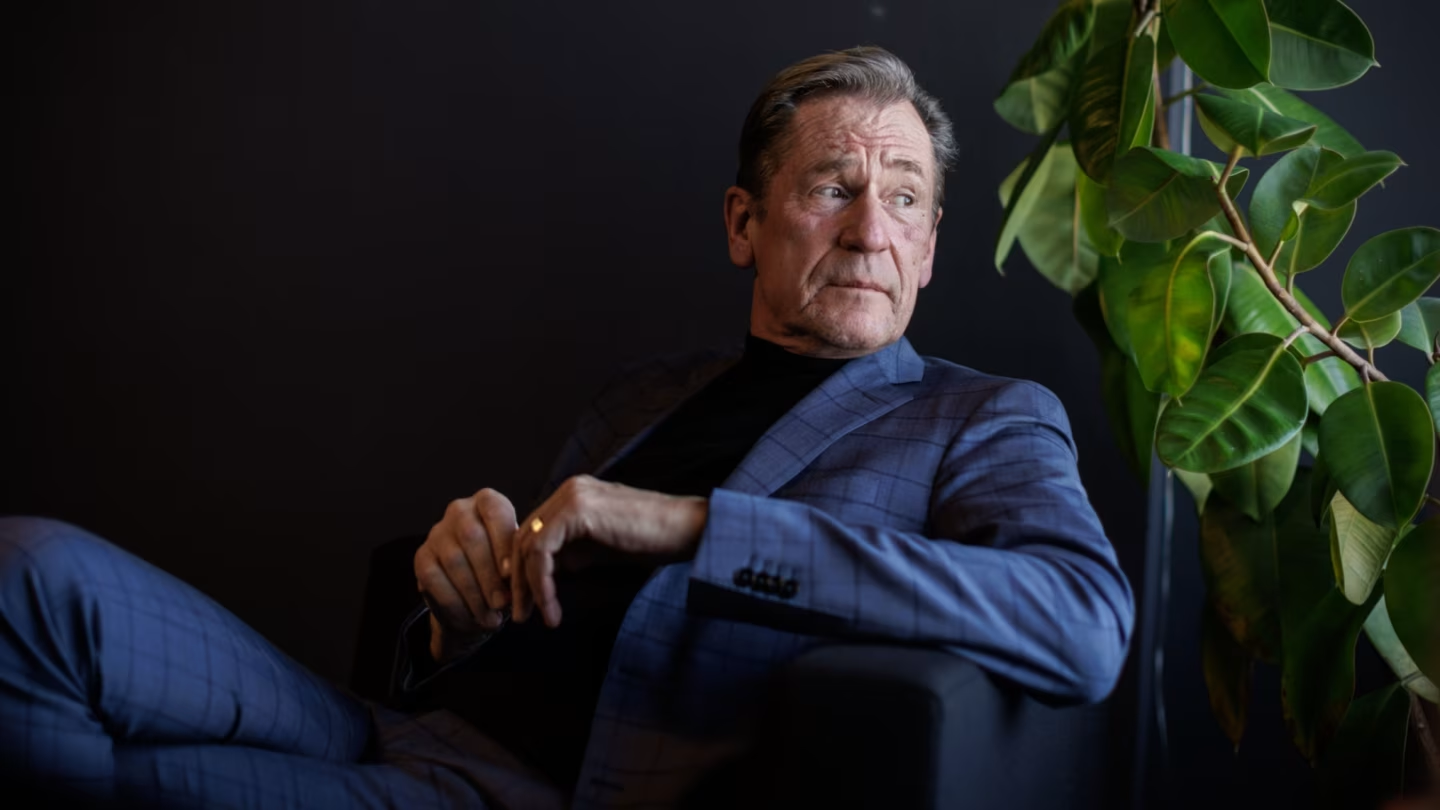
    In the cutthroat arena of global media mergers, few names evoke the blend of ambition and audacity quite like Mathias Döpfner, the silver-haired CEO and co-owner of Axel Springer SE. The 62-year-old German billionaire, a board member at Netflix and a self-proclaimed Elon Musk confidant, has long harbored designs on American journalism’s crown jewels. In a candid Financial Times interview this week, Döpfner openly acknowledged his interest in acquiring The Wall Street Journal from Rupert Murdoch’s News Corp empire—a tantalizing prospect that could catapult Axel Springer into the elite echelon of U.S. media powerhouses, even as he navigates a high-stakes corporate breakup and a frosty family feud at News Corp.

    Döpfner’s flirtation with the Journal comes at a pivotal juncture. He’s on the cusp of sealing a €13.5 billion ($14.2 billion) divorce from private equity giant KKR & Co., which will hand him and the widow of Axel Springer’s founder, Friede Springer, a commanding 98% stake in the company’s vaunted media portfolio. The deal, expected to finalize in early 2026, severs the classifieds arm—home to sites like StepStone and Aviv—leaving Döpfner with unencumbered control over tabloid juggernauts like Bild and Die Welt, alongside U.S. darlings Business Insider (acquired for $343 million in 2015) and Politico (snapped up for $1 billion in 2021). “This split gives us new freedom and opportunity,” Döpfner told the FT, though he candidly admitted the “higher risk” of ditching KKR’s financial ballast. To offset that, he’s slashing costs at his German titles amid a print ad slump, while doubling down on transatlantic growth.

    The Wall Street Journal, with its 3.8 million subscribers and a digital paywall that’s become a Wall Street must-read, represents the ultimate prize. Valued at $5.6 billion when Murdoch scooped it up in 2007, the paper’s worth has likely swelled to $8-10 billion today, fueled by a 15% revenue bump to $1.2 billion in fiscal 2025, per News Corp filings. For Döpfner, who unsuccessfully bid for the Financial Times a decade ago, it would crown his U.S. foray: Axel Springer’s American revenue has tripled to €800 million since the Politico buy, driven by premium subscriptions and event tie-ins like the Semafor World Economy Summit. Yet, caveats abound. Döpfner stressed the Journal “doesn’t appear to be up for sale,” pegging his odds at “close to zero.” Insiders at News Corp, however, whisper of opportunity amid the octogenarian Murdoch’s acrimonious succession battle. With eldest son Lachlan at the helm but siblings James and Elisabeth chafing at the conservative tilt, a sale could sidestep inheritance woes—especially if it nets billions to fund pet projects or buy peace.

    Financing the deal? That’s the rub. Axel Springer’s media unit was pegged at €3.5 billion in the KKR split, leaving scant dry powder for a blockbuster bid without debt or equity partners. Döpfner, ever the networker, has wooed U.S. tech titans—Musk dined at his Mar-a-Lago wedding last year—and sits on Netflix’s board, but skeptics question his firepower. “He’s a charmer with connections from Berlin to Silicon Valley, but €10 billion? That’s Musk money, not Springer scale,” quipped one media banker at a London drinks bash. Still, underestimation is folly: Döpfner’s track record includes outmaneuvering rivals for Politico during a bidding war and pivoting Bild to a profitable digital fortress despite Germany’s ad woes.

    Mounting Woes at Wood Group: CFO Exit Amid Takeover Ghosts and Cash Crunch

    As Döpfner’s empire eyes blue-sky expansion, across the Channel, Scotland’s Wood Group PLC is mired in a cautionary tale of M&A mishaps and executive missteps. The FTSE 250 engineering firm, a North Sea oil survivor turned renewables hopeful, saw its shares crater another 8% to 45p on Wednesday—valuing it at a mere £170 million—after chief financial officer Arvind Balan abruptly resigned, admitting to “misstating” his professional qualifications. The board, tipped off by an FT inquiry, accepted his immediate departure, leaving CEO Ken Gilmartin to steady a ship already listing from two botched buyouts and a grim cash outlook.

    Balan’s exit, just weeks after Wood’s bombshell November warning of up to $200 million in negative free cash flow for 2025 (flipping prior positivity), piles fresh ignominy on a company once hailed as Britain’s engineering export success. Apollo Global Management ditched a £2.2 billion ($2.9 billion) takeover in 2023 over valuation spats, followed by Dubai’s Sidara bailing on a £1.7 billion pact last year—each time sending shares into freefall. Now, with a market cap slashed 70% from 2024 highs, takeover whispers abound anew: Analysts at Peel Hunt speculate a third suitor could emerge at 150-200p a share, lured by Wood’s 40,000-strong workforce and contracts in LNG and hydrogen. “To lose one bid is misfortune; two, carelessness; three? Opportunity,” one investor quipped, channeling Oscar Wilde.

    Yet, the rot runs deeper. Wood’s pivot from fossil fuels—amid a 20% drop in oilfield services demand—has faltered, with Q3 revenue flat at $1.8 billion and debt ticking up to $1.2 billion. Balan’s fibs, reportedly inflating his CFA credentials, erode trust at a firm already under UK Listing Rules scrutiny. Investors, nursing 40% losses since Sidara’s snub, demand clarity: Will the board launch an qualifications audit? And could this nadir finally seal a deal, perhaps with a U.S. PE player eyeing Europe’s green transition?

    In broader dealmaking ripples, Howard Lutnick’s ascension to U.S. Commerce Secretary has reshuffled Cantor Fitzgerald, with sons Brandon (a DJ) and Kyle named chair and vice-chair, respectively—nepotism headlines be damned. Meanwhile, AlbaCore Capital elevated Davide Chiesa to partner, and Weil Gotshal tapped Michael Aiello for a new leadership committee ahead of Barry Wolf’s 2027 retirement.

    As media titans like Döpfner chase legacies and industrials like Wood grapple with survival, 2026 looms as a year of bold bets—and brutal reckonings—in tech-infused dealmaking.

  • Anti-Trump Secret Service Agent Leaving With Pay, Pension

    Anti-Trump Secret Service Agent Leaving With Pay, Pension

    Michael Cohen once famously said he’d take a bullet for Donald Trump — even though his position as Trump’s personal lawyer hardly required that type of life-on-the-line loyalty. As things turned out, Cohen didn’t really mean it, but by then his life and livelihood had been torn apart because of his extreme fealty to Trump, which earned him tens of millions of dollars but then backfired in spectacular fashion.

    In stark contrast, a senior Secret Service agent whose job is literally to take a would-be assassin’s bullet for the president defiantly told colleagues and friends just a few weeks before the 2016 election that she’d refuse to do any such thing for Trump.

    As with Cohen, the agent’s life has been irrevocably changed by her public remarks about Trump. But Kerry O’Grady, the Secret Service agent in question, has emerged from the entire spectacle virtually unscathed financially despite the black mark on her law enforcement reputation.

    Although she is leaving the Secret Service, O’Grady appears to have quietly settled a disciplinary action against her and is poised to walk away with her federal government pension intact. In early 2017, shortly after media reports surfaced about her incendiary comments, O’Grady was removed as head of the Secret Service’s Denver field office while her she was investigated for possible misconduct.

    She contested the disciplinary measures taken against her and appears to have settled her case with the Department of Homeland Security in October 2017. Before that settlement, she was on paid administrative leave, and afterward remained on either paid or unpaid leave and is set to retire with a taxpayer-funded pension in roughly three weeks, according to sources close to the Secret Service and a public settlement decision between O’Grady and DHS.

    Earlier this month, the human resources department of the Secret Service sent an internal notice to all employees announcing O’Grady’s retirement, effective March 20. The notice was then deleted a few days later, fueling agency-wide speculation about O’Grady’s actual status.

    A Secret Service spokesperson on Wednesday declined to comment on O’Grady’s retirement plans, saying only that the agency does not discuss personnel matters.

    The retirement announcement has again roiled the agency over its handling of the discipline charges against O’Grady, whose case has been followed closely by agents since she first made the incendiary Facebook comments about Trump.

    Most fellow agents did not know the outcome of the investigation into O’Grady’s misconduct because there was a shroud of secrecy hanging over it. Several agents and other employees who tried to look up her employment status on an internal Secret Service database of active agents were hauled before higher-ups and warned not to discuss the case in any capacity, numerous sources in the Secret Service community have told RealClearPolitics.

    O’Grady’s legal problems began amid an uproar in that community – among active agents and retirees – after she posted several Facebook condemnations of Trump in the weeks before and after he was elected.

    In the set of comments that got her into the most trouble, O’Grady posted in October 2016 that she was endorsing Hillary Clinton for president and would surrender her career and freedom rather than defend Trump from assassination.

    “As a public servant for nearly 23 years, I struggle not to violate the Hatch Act. So I keep quiet and skirt the median,” she wrote. “To do otherwise can be a criminal offense for those in my position. Despite the fact that I am expected to take a bullet for both sides. But this world has changed and I have changed. And I would take jail time over a bullet or an endorsement for what I believe to be disaster to this country and the strong and amazing women and minorities who reside here. Hatch Act be damned. I am with Her.”

    The statement appeared to transgress on two levels. First, it pledged intentional dereliction of duty. Second, Secret Service employees are among those federal workers subject to enhanced Hatch Act restrictions, which bar executive branch staff (except for the president, vice president and some other senior executive officials) from engaging in certain political activities.

    Enhanced Hatch Act employees are specifically prohibited from posting comments to a blog or social media that advocate for or against a partisan political party, candidate or partisan political office or partisan political group. They also may not use email or social media to distribute, send or forward content that advocates for or against a partisan political party, candidate for political office or a partisan group.

    At first the agency took no action against her. A complaint had been filed with the agency shortly after O’Grady’s Facebook posts appeared, but Secret Service managers didn’t respond until a story broke in late January 2017, fueling a media firestorm and public backlash against her comments. The premier organization for retired Secret Service agents, the Association of Former Agents of the U.S. Secret Service, also known as Old Star, quickly expelled her from its ranks.

    O’Grady was then removed from her position as head of the Denver office but has remained on paid or unpaid administrative leave for more than two years and retained her security clearance, according to knowledgeable sources. Lawyers who have represented Secret Service employees accused of misconduct say many of their clients haven’t been so lucky.

    Sean Bigley, a partner at Bigley Ranish, a law firm specializing in federal employment cases and security-clearance denials, said Secret Service managers often impose unpaid leave and revoke security clearances in misconduct cases in order to force a person to quit rather than go through the lengthy appeals process to try to get their security clearance reinstated.

    “The Secret Service, when it comes to security clearances, tends to shoot first and ask questions later,” Bigley told RealClearPolitics. “And in every case I’ve had that I can recall, the person has been put on unpaid leave while the investigation is being conducted and while their security clearance is suspended.”

    Now, the official retirement notice informing all Secret Service employees that DHS is allowing O’Grady to quietly retire in three weeks is fueling further intra-agency resentment. It’s also raising questions about whether DHS is abiding by a new law designed to stop the once common practice of allowing problem federal employees to remain on paid or unpaid leave long enough to hit key retirement dates.

    O’Grady in recent months boasted to other agents that she “beat” the agency’s misconduct charges and that she planned to retire within the next 60 to 90 days when she reaches a key milestone date, the sources told RealClearPolitics.

    Congressional leaders have recently faulted DHS for the use of paid and unpaid leave to allow employees facing substantiated claims of misconduct to remain long enough to attain full retirement benefits.

    Just days before leaving his role as Judiciary Committee chairman, Sen. Chuck Grassley released the results of a nearly four-year investigation of the U.S. Marshals Service, into which a flood of Secret Service agents have transferred in recent years. The probe, he said, uncovered a culture of misconduct that echoed similar problems his committee and others have uncovered at the Secret Service.

    Among myriad management problems, the new report specifically criticized the Marshals Service for allowing employees with substantiated misconduct to remain on paid or unpaid leave long enough to reach retirement.

    “We found a culture of mismanagement, abuse of authority and lax accountability that started clear at the top and has set a terrible standard for other employees across the agency,” the longtime Iowa senator said.

    Along with Grassley, several taxpayer watchdog groups have also taken issue with the questionable practices.

    “Any federal employee who breaches the public trust through poor performance or unethical behavior should be subject to a fair but swift termination process,” said Curtis Kalin, a spokesman for Citizens Against Government Waste. “Any attempt to skirt the disciplinary process for the purpose of extracting pension benefits should be exposed and halted.” 

    Debra D’Agostino, a founding partner of the Federal Practice Group, which specializes in federal employment law, suggested that O’Grady may have had unrelated legal grievances with the Secret Service that allowed her to remain at the agency on paid or unpaid leave for roughly a year and a half after her October 2017 settlement.

    “These days, that’s really an extraordinary amount of time” to remain an employee after a settlement without coming back to work in some capacity, D’Agostino said.

    Additionally, O’Grady can start collecting a pension immediately after retiring if she hits the 25-year mark of her service. Her precise age is not known, but knowledgeable sources say she is in her upper 40s and nearing that 25-year anniversary with the agency. Certain federal law enforcement jobs, including the Secret Service, allow employees to start collecting retirement immediately if they leave the agency after 25 years or more.

    The official Secret Service retirement notice says O’Grady is retiring at a GS13 federal pay grade, which suggests that the agency downgraded her from a GS15, her pay grade before the misconduct charges. All agents who hold the top position in a Secret Service field office must hold the rank of GS15, which she did, according to multiple sources in the Secret Service community.

    As an employee in her first few years at the GS15 paygrade, O’Grady likely made between $105,000 and $120,000 annually, before any overtime, according to federal pay scales. Although she was knocked down to a GS13, putting her in the $85,000 to $100,000 range, that pay scale likely only applied for the time since her settlement. That punishment also likely wouldn’t substantially impact the value of her pension, which is based on an employee’s three highest salary years at the agency. By the time she turns 70, it’s likely that the taxpayers will have paid O’Grady more in total salary after she declared publicly that she wouldn’t do her duty than in all the years before.