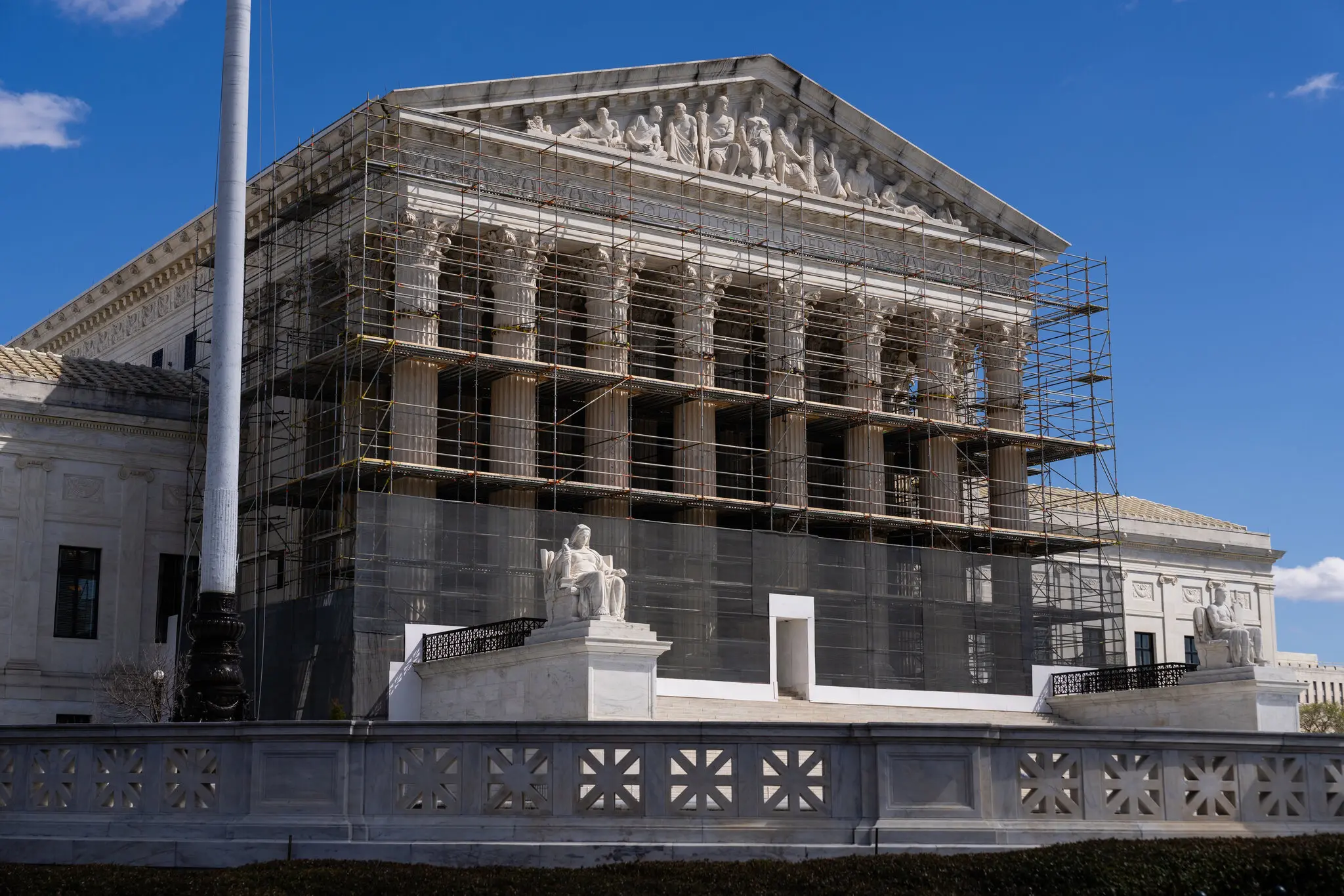
The Trump administration will not be allowed to deport a group of Venezuelan detainees accused of being members of a violent gang under a rarely invoked wartime law while the matter is litigated in the courts, the Supreme Court said on Friday.
The justices sent the case back to a federal appeals court, directing it to examine claims by the migrants that they could not be legally deported under the Alien Enemies Act, the centuries-old wartime law invoked by the Trump administration. The justices said the appeals court should also examine what kind of notice the government should be required to provide that would allow migrants the opportunity to challenge their deportations.
The court said its order would remain in place until the U.S. Court of Appeals for the Fifth Circuit ruled and the Supreme Court considered any appeal from that ruling.
Justice Samuel A. Alito Jr. wrote a dissent, arguing that the justices had no authority to hear the dispute at this stage. He was joined by Justice Clarence Thomas.
The ruling deals a sharp blow to the Trump administration’s efforts to deploy the wartime law to pursue swift, sweeping deportations of Venezuelan migrants accused of being members of the gang, Tren de Aragua.
It also suggests that a majority of the justices may be skeptical of whether the migrants have been afforded enough due process protections by the administration before being deported, potentially to a prison for terrorists in El Salvador.
In their order, the justices said that the stakes facing the detainees are “particularly weighty,” citing the case of a Maryland man, Kilmar Armando Abrego Garcia, who was “deported in error” to the El Salvador prison in March. So far, the Trump administration has said it is unable to bring him back, despite an order from the justices to “facilitate” his return.
Under such circumstances, the justices wrote, “notice roughly 24 hours before removal, devoid of information about how to exercise due process rights to contest that removal, surely does not pass muster.”
President Trump reacted with fury to the ruling. “THE SUPREME COURT WON’T ALLOW US TO GET CRIMINALS OUT OF OUR COUNTRY!” he said on social media. In a subsequent post, he wrote, “The Supreme Court of the United States is not allowing me to do what I was elected to do,” and called it “a bad and dangerous day for America.”
Lawyers for the migrants responded with relief.
The decision “means that more individuals will not secretly be sent to a brutal prison in El Salvador,” said Lee Gelernt, a lawyer for the American Civil Liberties Union. He added that the administration’s use of the wartime law “during peacetime, without due process, raises issues of far-reaching importance.”
The Trump administration has attempted to use the law as a tool in its signature initiative to speed the deportation of millions of migrants, leading to a clash with a skeptical judiciary.
Several lower court judges have concluded that the administration has exceeded the scope of the law, which can be invoked only when the United States has been subject to “invasion” or “predatory incursion,” and have blocked the deportation of groups of Venezuelans.
The Supreme Court justices have been asked to weigh in on the Trump administration’s deportation plans a few times in recent months, and they had already stepped in to temporarily block the deportation of a group of Venezuelans held in northern Texas.
Friday’s order came after a high-stakes legal fight between the Trump administration and lawyers from the A.C.L.U. in one of those challenges. The lawyers rushed to the court on April 18 after getting word that Venezuelan migrants detained in Texas and accused of being members of Tren de Aragua, a Venezuelan gang, had received notices of imminent removal and were being loaded on buses, presumably to be taken to the airport.
The group quickly filed a lawsuit in a federal trial court in Abilene, Texas, on behalf of two of the Venezuelans held at the detention center. Justice Department lawyers responded, telling a trial court judge that they had no immediate plans to deport the detainees.
The judge, James W. Hendrix, who was appointed during the first Trump administration, declined to issue an order temporarily blocking the deportations.
The A.C.L.U. subsequently asked the Supreme Court to act instead.
After midnight on April 19, the justices temporarily paused the deportations, writing, “The government is directed not to remove any member of the putative class of detainees from the United States until further order of this court,” the order said.
The justices moved swiftly that night, and the emergency application had been pending before the court since.
Solicitor General D. John Sauer had urged the justices in a court filing to allow lower courts to weigh in before intervening further in the case. He did not address the specifics of the A.C.L.U. claims that the deportations had been imminent, with buses being loaded for the airport. Rather, he said the government had provided notice to detainees subject to imminent deportation and that they “have had adequate time to file” claims challenging their removal.
In a reply to the court, the A.C.L.U. disputed this, arguing that the Trump administration had taken “actions contrary to this court’s specific ruling” that the government provide notice and time to challenge deportations.
Instead of providing notice to allow detainees to challenge their removal, the group’s brief said, “the government gave detainees an English-only form, not provided to any attorney, which nowhere mentions the right to contest the designation or removal, much less explain how detainees could do so.”
Earlier this week, Mr. Sauer again nudged the justices to allow the deportations. In a filing, the administration contended that “serious difficulties have arisen” from the detention of the group of 176 migrants who had been shielded from removal by the court’s emergency overnight ruling last month.
The Trump administration claimed that on April 26, a group of 23 migrants had barricaded themselves inside a housing unit for several hours, threatened to take hostages and harm immigration officers, and tried to flood the unit by clogging the toilets.
“The government has a strong interest in promptly removing from the country” gang members “who pose a danger” to immigration officers, facility staff members and other detainees, Mr. Sauer wrote.
There have been few public glimpses into the conditions at the Texas facility. On April 28, Reuters captured aerial images of the men held there. In the dirt yard of the detention center, 31 men, some wearing red jumpsuits designating them as high-risk, formed the letters SOS.