Category: Real Estate

  • How New York City Mayoral Candidates Propose to Address the Housing Crisis

    How New York City Mayoral Candidates Propose to Address the Housing Crisis

    Seize deteriorating apartment buildings run by negligent landlords. Stop spending on new homeless shelters. Build apartments on church campuses and golf courses and on top of libraries.

    In the race to be New York City’s next mayor, few issues have generated proposals as ambitious and sprawling as the housing crisis, a top concern for a growing number of voters.

    The share of available apartments is at its lowest point in nearly 60 years, rents continue to climb and high rates of homelessness remain a persistent part of city life. There aren’t enough homes being built to satisfy the demand to live here, many housing experts say, while the Trump administration’s plan cut to federal housing aid could upend the city’s ability to help its most vulnerable residents.

    Mayoral candidates across the political spectrum — those running in the June 24 Democratic primary and in November’s general election — agree that the situation is a threat to the city. In ways big and small, though, they differ on the best solutions.

    Many of their proposals would be difficult to carry out. Several would require the skillful balancing of adverse political interests, including labor unions, real estate companies and pro-tenant groups. Some would be possible only with help from influential state or federal politicians who may resist development.

    Most candidates do not say how they would pay for their plans, which carry price tags stretching into the many billions of dollars.

    Still, candidates said it was better to be ambitious when it came to housing.

    “It’s the No. 1 issue,” said Zellnor Myrie, a state senator from Brooklyn who is running in the Democratic primary.

    He said that people needed to want to live in New York — and be able to afford to do so — in order for the city to generate the tax revenue it needs to survive.

    “If we do not solve this crisis, if we do not build more and build rapidly and bring down the cost of rent, we’re going to suffer in many other ways,” he said.

    Candidates agree that the city needs to encourage lots of development. Many are trying to outdo each other with eye-popping figures.

    Two Democratic candidates, Adrienne Adams, the City Council speaker, and Brad Lander, the city comptroller, have each thrown out a 500,000 home target; Ms. Adams is eyeing a racetrack in Queens as a development site while Mr. Lander wants to build neighborhoods on municipal golf courses. Michael Blake, a former Democratic state assemblyman, wants 600,000 homes built across the city.

    Outdoing them all, Mr. Myrie said he wanted one million homes to be built or preserved over the next decade, in part by creating new neighborhoods and developments in places like Midtown Manhattan and the Brooklyn Marine Terminal.

    Many candidates talk about building on underused city land, like in parking lots or on top of libraries and schools. Jim Walden, a lawyer and former prosecutor who is running as an independent, said the city should develop apartments on abandoned public properties like Bartow Station in the Bronx and the Neponsit Health Care Center in Queens. More than one-third of any new homes, he says, could be made affordable to lower-income New Yorkers.

    These types of changes would require approval by the City Council or the State Legislature, which may not be forthcoming, and would involve months of public hearings and studies.

    Several candidates want to build mixed-income housing on public housing campuses, where parking lots and lawns make enticing development sites. That would have the added benefit of generating money for the struggling New York City Housing Authority, which is essentially controlled by the mayor, who appoints its board members.

    Former Gov. Andrew M. Cuomo, who leads in Democratic primary polls, said in his housing plan that adding 500,000 units over 10 years “will be necessary to meet demand.” But unlike his rivals, he has expressed reluctance toward developing in low-density neighborhoods, saying that those neighborhoods need to first absorb “the impact of recent rezoning efforts” that may already be encouraging development there. He says he would prefer to focus on denser parts of the city.

    The candidates acknowledge that the city needs to spend on affordable housing if it wants to push down costs for lower-income renters.

    “I also want to make sure that as we are thinking about 500,000 or one million units, that we also have a road map to not just building housing for housing’s sake, but building housing for the people who need it the most,” said Scott Stringer, a former city comptroller running in the Democratic primary.

    Zohran Mamdani, a state assemblyman from Queens who is polling in second place in the primary, wants to build 200,000 subsidized homes, including some for families earning less than $70,000 a year.

    He says his plan would cost $100 billion over the next decade, a price tag that dwarfs the costs of the other candidates’ plans. Mr. Lander, for example, wants the city to spend $20 billion over the next decade on building and preserving homes.

    Mr. Cuomo’s plan calls for an additional $2.5 billion in city and state funds to be spent on affordable housing and public housing over the next five years.

    Curtis Sliwa, a Republican, said he would make sure that in subsidized housing, the city sets rents at levels low enough to “account for the real financial burdens New Yorkers face — high energy bills, student loans, medical expenses and other nonnegotiable costs.”

    The next mayor will most likely have significant influence over the rent-stabilization system, because mayors appoint members of the Rent Guidelines Board, which decides if and how much rents in stabilized apartments can go up each year. Roughly half of all city apartments are rent-stabilized.

    Mr. Mamdani, Mr. Myrie, Ms. Adams, Mr. Lander, Mr. Stringer, Mr. Blake and Jessica Ramos, a Democratic state senator, have said that if elected, they would lobby the board to halt increases, even though landlords are increasingly saying they are not making enough to keep units in rentable condition.

    Under Mayor Eric Adams, who is running as an independent, the board has allowed increases each year. Mr. Cuomo said he would want to create a subsidy program for landlords who need money to bring rent-stabilized units back online.

    The candidates’ proposals offer a sense of their priorities. But many of them say they are distinguished by their track records on housing.

    Mr. Lander and Mr. Stringer both emphasize their policy work and experience in city government. Mr. Stringer highlighted how, when he served as Manhattan borough president, he helped craft development plans for West Harlem and other neighborhoods, while Mr. Lander pushed through a contentious development plan in Gowanus in Brooklyn.

    “This has been my whole career,” Mr. Lander said in an interview about his plan.

    Ms. Adams points to how she helped cajole other members of the City Council to accept development plans in their districts, despite opposition from neighborhood activists. She also successfully pushed for more affordable housing investment from the city and state.

    Mr. Adams, who is not related to Ms. Adams, has made an ambitious citywide development plan, known as City of Yes, one of the milestone accomplishments of his first term. The plan, which was passed last year, is expected to make way for some 80,000 new homes to be built over the next decade.

    The mayor said in a statement that the plan represented “bold, forward-looking action that meets the needs of New Yorkers, today and for generations to come.”

    Mr. Cuomo served as housing secretary during the Clinton administration. And as governor, he spent many years negotiating with the real estate lobby and with left-leaning lawmakers supporting tenants. He helped pass sweeping pro-tenant legislation, while also pushing much-debated tax breaks for developers that he said he wants to bring back.

    A spokeswoman for his campaign, Esther Jensen, said Mr. Cuomo would bring “strong political leadership and intensely focused operational execution” to address the housing crisis.

  • Court Overturns Trump Tariffs, Sparking Surge in Homebuilder Stocks

    Court Overturns Trump Tariffs, Sparking Surge in Homebuilder Stocks

    Homebuilder stocks rallied Thursday, in a sign that residential construction will benefit from the sweeping court ruling striking down President Donald Trump’s tariffs on imported good.

    Shares of D.R. Horton and Lennar, the two largest U.S. homebuilders, rose about 0.7% in early trading, alongside a similar bump for other public companies in the sector. The benchmark S&P 500 gained 0.87% at the opening bell.

    In a surprise ruling late Wednesday, the little-known U.S. Court of International Trade shot down Trump’s sweeping Liberation Day reciprocal tariffs on nearly all trading partners, as well as his 20% anti-fentanyl levies on China, Canada, and Mexico.

    The Trump administration plans to appeal the ruling, and Trump is expected to seek other legal authority to reimpose the steep tariffs that have become a centerpiece of his economic agenda.

    On Thursday afternoon, an appeals court ruled that Trump’s tariff’s could remain in place as the administration’s appeal plays out.

    “Whether or not the tariffs are re-imposed in some form, I think the rally in residential construction stock speaks directly to the likely impact on the price of materials,” says The Budgets Senior Economist Sara William.

    “When construction becomes less expensive, those savings can be passed on to homebuyers—and builders are more likely to move forward with new projects,” he adds. “That means more homes get built, which helps ease the housing shortage and improve affordability at the margin.”

    The ruling was met with cautious relief from homebuilders, who had warned that the tariffs would drive up the cost of imported construction materials and make planning new developments more difficult.

    “The situation on the tariff front remains fluid, and the trade court decision illustrates the need for the Trump administration to seek fair, equitable deals with America’s trading partners that roll back tariffs on building materials,” the National Association of Homebuilders wrote in an analysis of the new ruling.

    Notably, the court ruling does not impact tariffs on Canadian lumber, which are currently at 14.5% and set to more than double later this year.

    Canadian lumber, which accounts for about 70% of the imported lumber used in home construction, is subject to tariffs under different authority than the reciprocal tariffs impacted by the court ruling.

    Earlier this month, homebuilders said in a key survey that Trump’s whirlwind trade policies have made planning challenging, with 78% reporting difficulties pricing their homes recently due to uncertainty around material prices.

    Overall builder confidence in the market for newly built single-family homes dropped to a two-year low in May, according to the National Association of Home Builders/Wells Fargo Housing Market Index.

    Construction activity on single-family homes has suffered since Trump began implementing his tariff scheme, with single-family starts dropping in April to an eight-month low.

    That downturn came as unwelcome news for a housing market that is grappling with a housing shortage of nearly 4 million units, according to a recent analysis from the Realtor.com economic research team.

  • U.S. Investor Condo Purchases Drop to Lowest Level in a Decade in 2025

    U.S. Investor Condo Purchases Drop to Lowest Level in a Decade in 2025

    After years of volatile swings in real estate activity during and after the pandemic, U.S. property investors appear to be returning to more measured behavior. According to new data released by Redfin, investors purchased 46,726 homes in the first quarter of 2025–a modest 2% increase from a year ago–signaling a stabilization of investor activity in the residential market.

    Investor buying has remained within a narrow 4% range for the past year, a stark contrast to pandemic-era extremes when activity surged as much as 145% in 2021 and plunged 47% in early 2023. In raw numbers, investor purchases have now returned to pre-pandemic levels, with current activity reflecting a more cautious, ROI-driven approach amid today’s higher interest rate environment.

    “Investor home purchases have leveled off because rapid sale-price and rent growth is no longer the norm,” said Sheharyar Bokhari, Senior Economist at Redfin. “While some are still profiting from flips or rentals, especially where rents are climbing, many who entered the market during the pandemic boom have since retreated.”

    Condo Purchases Hit 10-Year Low

    While total investor activity is steady, demand for condos has notably declined. In Q1 2025, investors bought 8,509 condos–a 3% year-over-year drop and the lowest quarterly figure in a decade, excluding Q2 2020 when the pandemic halted transactions.

    Redfin attributes this pullback to a rapidly cooling condo market. Nearly 70% of U.S. condos sold below list price in early 2025, the weakest showing in five years. In Florida, surging HOA and insurance costs–fueled by rising climate-related risks–have made oceanfront condo ownership less attractive to investors.

    “Condo landlords are trying to offload units that no longer generate returns,” said Stuart Naranch, a Redfin Premier agent in Washington, D.C. “High mortgage rates, tighter HOA rental rules, and rental caps are squeezing profits, leaving only cash buyers with enough cushion to take the risk.”

    Florida Sees Steepest Investor Pullback

    Florida continues to lead the nation in investor exits. Miami saw the largest drop in investor purchases, down 19% year over year. Orlando (-13%) and Fort Lauderdale (-12%) also ranked among the top five metro areas with declining investor activity, alongside Warren, MI, and Columbus, OH.

    Despite the pullback, Miami still saw investors purchase 30% of all homes sold in Q1–though down from a 2022 peak of 35%. Redfin notes that Florida’s rising costs, declining home prices, and surplus inventory have dulled investor appetite across the state.

    Investors Still Active in One-Fifth of U.S. Housing Market

    Nationwide, investors accounted for 19% of all homes sold in Q1, holding steady from a year earlier and slightly up from 18% two years ago. Investor activity has closely mirrored consumer demand trends, constrained by high interest rates that limit profitability for both flippers and landlords.

    Still, investor appetite for single-family homes is increasing. Purchases of single-family homes rose 3% year over year, while townhouses and multi-family units each rose 1%. Condos remain the lone declining segment.

    Shift Toward Higher-Priced Homes

    Investors are also shifting their attention toward more expensive properties. Purchases of high-end homes jumped 12% in Q1–the largest gain in three years–while mid-priced home purchases rose 2%. In contrast, investor purchases of low-priced homes fell 4%.

    Even so, low-priced homes still made up 46% of all investor purchases, while high- and mid-priced homes comprised 30% and 24%, respectively. Investors maintain the strongest market share in the low-end segment, buying 26% of all low-priced homes sold in Q1.

    Profit Margins Remain Positive

    Investors continued to see gains from property sales, with a median capital gain of $182,980 per home sold in March–up 2.8% year over year. Only 6% of investor-sold homes incurred losses, nearly flat from 5% the previous year.

    Meanwhile, investor-owned listings made up 8.4% of total U.S. home listings in March, down from 8.9% a year ago–the lowest share in nearly two years. The decline reflects slower investor selling activity following a major drop in acquisitions during 2023.

  • Hong Kong’s Gale Well Hit by Market Slump, Takes $6.5 Million Loss on Two Asset Sales

    Hong Kong’s Gale Well Hit by Market Slump, Takes $6.5 Million Loss on Two Asset Sales

    Hong Kong property investment firm Gale Well Group, which has been divesting assets, sold three shops this month, incurring a loss of more than HK$51 million (US$6.5 million) on two of them, as the city’s retail real estate market remains mired in a downturn.

    Gale Well sold a 2,780 sq ft street-level shop at King Kwong Street in Happy Valley for HK$28.8 million, nearly 40 per cent lower than the HK$46 million it paid in 2008, according to Land Registry data. The transaction was completed on May 23 through a holding company, Fine Keen Investment. Gale Well chairman Rita Tong Liu is a director at Fine Keen, according to the Companies Registry.

    The company also sold a 1,537 sq ft shop on the ground floor of Haleson Building in Central for HK$38.8 million, according to property agents. The price represented a 47 per cent loss on the HK$72.8 million paid in 2011 by Parkmax Investment, according to the Land Registry. Liu is a Parkmax director.

    Gale Well’s third divestment was a 21,702 sq ft three-storey shop on Morrison Hill Road in Causeway Bay for HK$110 million, according to Savills, which handled the sale. The transaction resulted in a profit of 49 per cent for Keenplan International, which bought the property for HK$73.8 million in 2005, according to the Land Registry. Liu is a director of Keenplan.

    2ecde8b3 2ef6 4105 bcb8 70c79d00f830 ed18453d
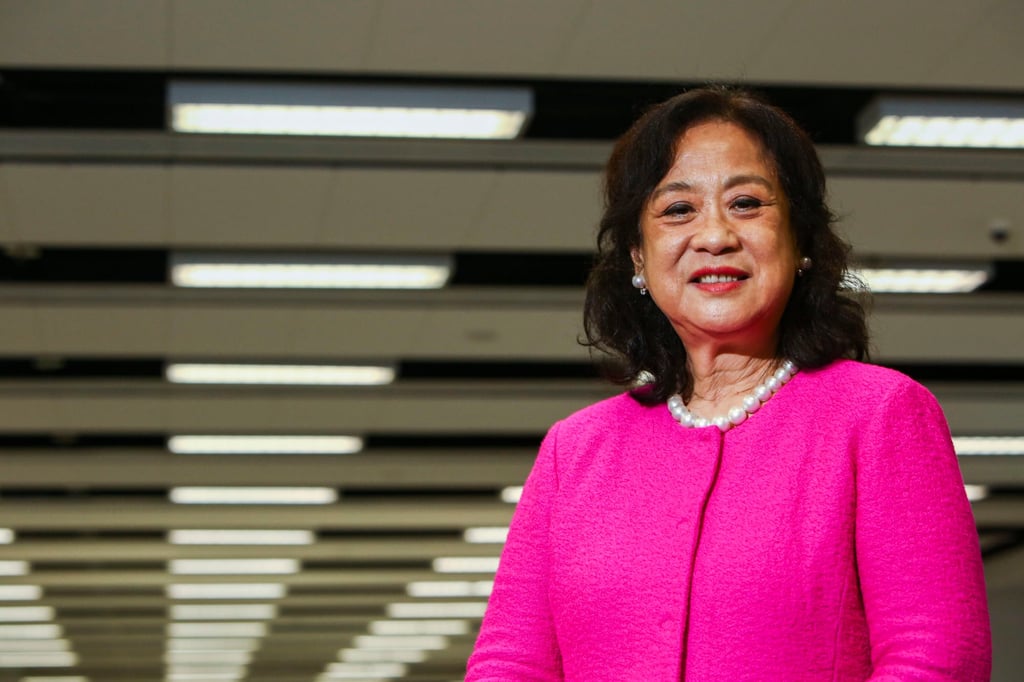
    Rita Tong Liu, chairman of Gale Well Group, pictured in June 2018. (Edmond So)

    Last week, Gale Well appointed Savills as the agent for three shops in North Point, Causeway Bay and Wan Chai, which have a combined indicative price of HK$190 million.

    Gale Well did not immediately respond to a request for comment.

    In an interview with the Post in March, Gale Well’s founder, vice-chairman and CEO Jacinto Tong Man-Leung said that the company was looking to offload assets worth nearly HK$3 billion amid fears that banks could call their loans amid a downturn in the city’s real estate market.

    Tong said the company planned to sell around 10 per cent of its property portfolio to balance its loan ratio and “put the bank’s mind at ease”.

    In April, it sold the 39th floor of the Far East Finance Centre for HK$194 million, or HK$18,000 per square foot, the lowest price per square foot in 17 years in the grade A tower, according to Land Registry data. It had sought HK$250 million, or HK$23,148 per square foot.

    In March, Gale Well sold a 10,800 sq ft plot of land at 68-70 Chung Hom Kok Road in Southern District for HK$220 million, down from an indicative price of HK$380 million. In February, the firm parted with its long-time headquarters in The Sun’s Group Centre in Wan Chai for HK$79.79 million.

    Meanwhile, Gale Well has yet to find a buyer for Austin Plaza, a 21-storey grade B commercial building in Tsim Sha Tsui, which has been on the market for HK$880 million since January. The 26-storey Butterfly on Morrison Boutique Hotel in Causeway Bay, which has an indicative price of HK$630 million, has found no takers since November.

    As rental incomes sink and valuations shrink, many property owners are struggling to meet their debt obligations amid high rates, leading to a surge of distressed assets.

    In 2024, roughly three out of four property transactions were distressed sales, according to Reeves Yan, executive director and head of capital markets at CBRE.

  • Casino Magnate Lawrence Ho’s Family Office Invests in Hong Kong Property Brokerage IFCX

    Casino Magnate Lawrence Ho’s Family Office Invests in Hong Kong Property Brokerage IFCX

    Black Spade Capital, the family office of Macau casino billionaire Lawrence Ho Yau-lung, has invested in IFCX, a Hong Kong-based real estate brokerage group that aims to pool at least US$5 billion of capital from Asian clients for investments in emerging markets.

    IFCX operates Asian Bankers Club, a direct investor sales company, Knightsbridge Partners, an agent for developers, and Easy Pro, a letting and property-management agency that also provides global residency solutions.

    “This partnership is great for us,” Dennis Tam, Black Spade president and CEO, said on Tuesday. “Investment in real estate in emerging markets makes sense”, he added, noting the venture’s focus on the Middle East, Vietnam and Thailand.

    Ho is the chairman of Melco Resorts & Entertainment, one of the six casino concessionaires in Macau, as well as the son of the late gaming mogul Stanley Ho Hung-sun. He has an estimated net worth of US$1.2 billion, according to Forbes. Black Spade earlier invested in Vietnamese electric vehicle maker VinFast Auto.

    6077b436 49c0 4927 b6c0 6a9f7dd193d5 7db252bc
    Lawrence Ho Yau-lung has a net worth of US$1.2 billion, according to Forbes. (AFP)

    The partnership would allow IFCX to tap into the family office ecosystem, according to Kingston Lai, its founder and CEO. There would also be plans to improve the utilisation of artificial intelligence (AI) to build intelligent platforms for digital transactions, predictive market analytics and investor engagement tools, he added.

    “The emerging markets, such as the Middle East, Vietnam and Thailand, embody the essence of our partnership, [which is] stability, opportunity and global connectivity,” he said. With Black Spade’s backing, IFCX “is redefining how real estate is traded on a global scale, bridging institutional pathways and empowering individual investors”, he added.

    IFCX employs about 80 in-house agents and services over 2,000 business-to-business agencies around the world. The group’s largest market is Hong Kong, with clients in the city making up between 30 per cent and 40 per cent of the total, according to Lai.

    “Black Spade will be on our board,” said Lai. “It’s not just partnership but real investment coming from them.”

    IFCX plans to form an “invitation only” club with an initial target of 200 ultra-high-net-worth individuals with assets of at least US$30 million. The club would give its members an opportunity to network or strike deals with ultra-wealthy individuals from other parts of the world, Lai said.

    “These individuals are billionaires,” Lai said. “That is why we are keeping the number small. We want it to be very elite.”

  • The apartment at the very top of the world’s thinnest skyscraper is for sale now for $110 million.

    The apartment at the very top of the world’s thinnest skyscraper is for sale now for $110 million.

    A penthouse of the “supertall” Manhattan building dubbed the world’s skinniest skyscraper has hit the market at $110 million.

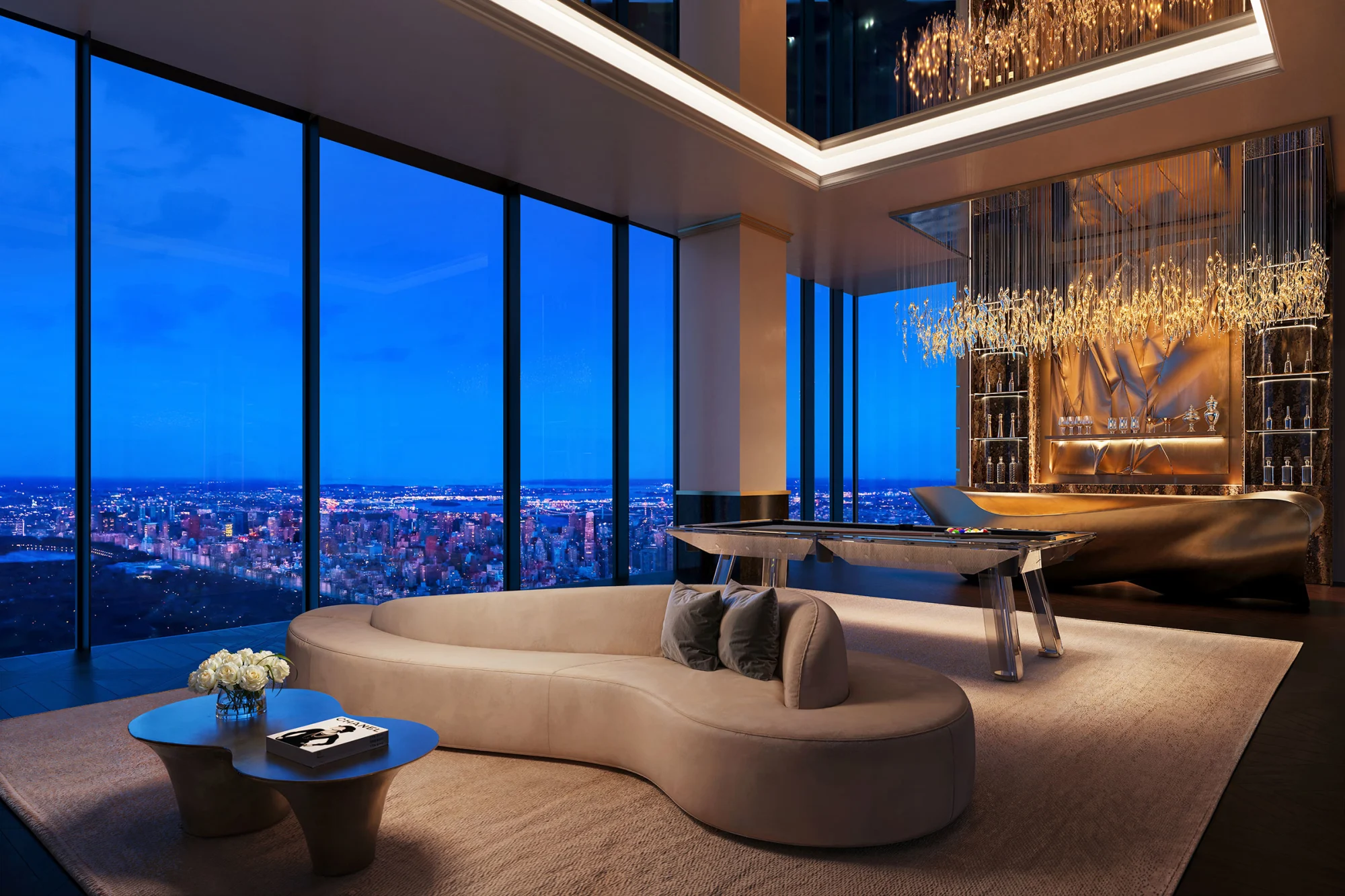
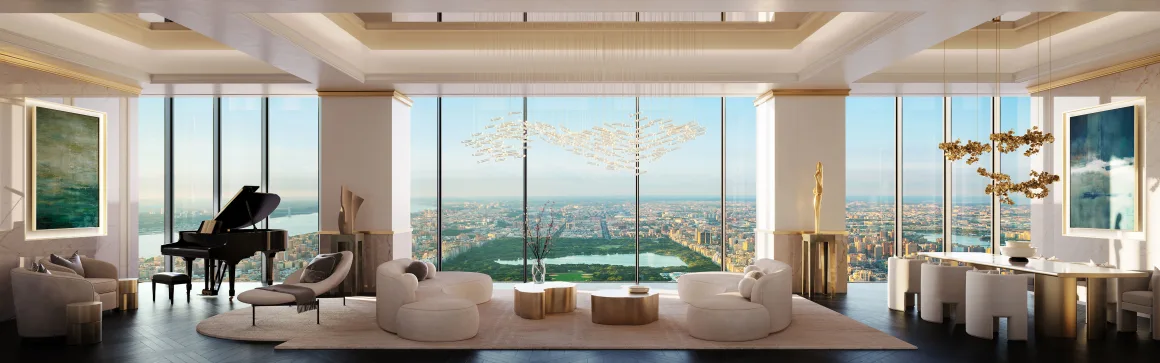
    The four-story home, or “quadplex,” spans floors 80 to 83 of the 1,428-foot-tall building 111 W 57th Street and overlooks Central Park. With interiors designed by Studio Sofield, the suggested floor plans features an “entertaining suite” on the first floor and a “primary suite” on the third floor, while the proposed layout is topped off by a “crown suite” containing a bar and screening room.

    In total, the property features five bedrooms, six bathrooms and two terraces, as well as 360-degree views of New York City.

    f webp
    The penthouse has views overlooking Central Park. Hayes Davidson

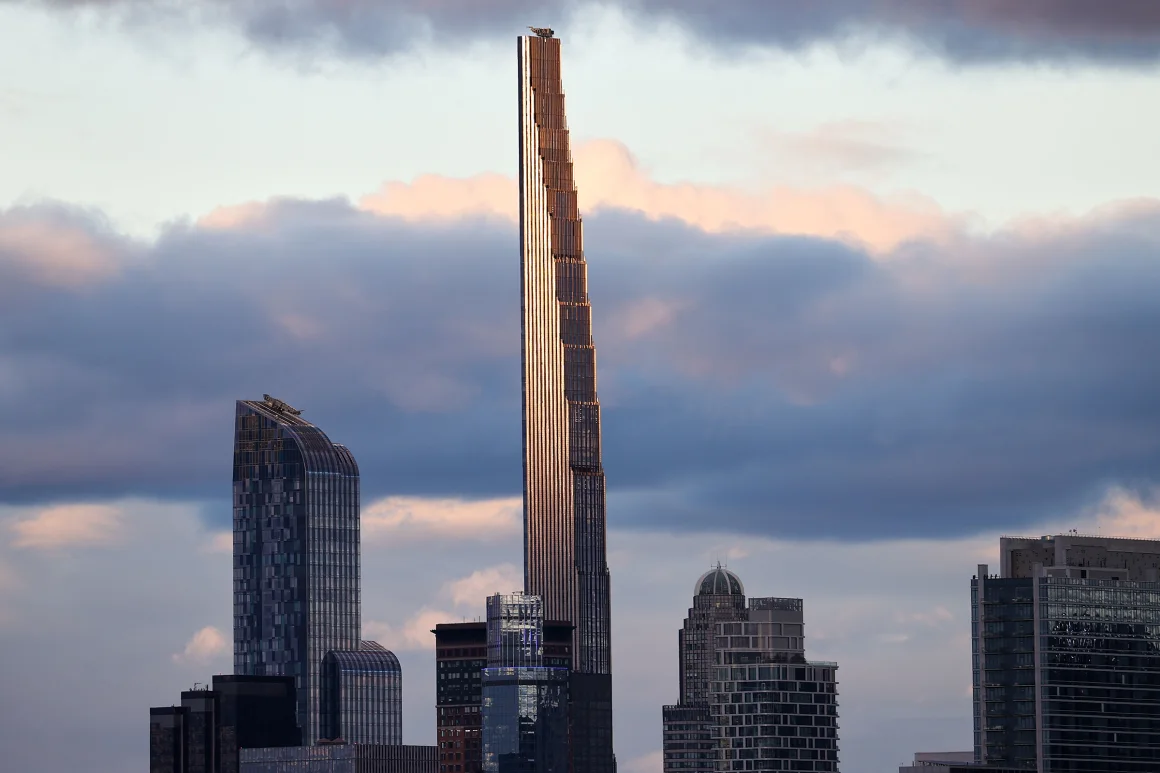
    The building, also known as the Steinway Tower, was completed in 2022 on the site once occupied by the historic Steinway & Sons piano company. Designed by SHoP Architects and Studio Sofield, it is one of the tallest skyscrapers in the Western hemisphere — and the most slender, with a height-to-width ratio of 24:1.

    Its design is meant to evoke New York’s Gilded Age of the late 19th century, when the city experienced a period of unprecedented wealth and a subsequent boom in skyscraper construction, according to the architects.

    The vertiginous tower’s facade appears to change throughout the day as the color and texture of the terracotta blocks shift in the light. Inside, designers created a sense of opulence with materials such as marble, limestone, blackened steel and velvet used in the common spaces, and artworks by the likes of Pablo Picasso and Henri Matisse adorning the walls.

    Its amenities include an 82-foot swimming pool, private dining rooms and a landscaped terrace.

    f webp
    Steinway Tower pictured during sunset in April 2022. Tayfun Coskun/Anadolu/Getty Images

    “We’ve all been to very luxurious places, but I wanted to create a building that could not be anywhere else in the world,” Studio Sofield’s founder, William Sofield, told CNN in 2022. “I know so many people might have multiple homes, who will have apartments here. And I wanted to create a very distinct experience that could only be had in New York.”

    Steinway Tower sits on New York’s Billionaire’s Row, where pencil towers have continued to climb higher, including the nearby Central Park Tower, which is the second-tallest building in the city behind One World Trade Center. Though quadplex apartments are rare, another one on Billionaire’s Row — a 24,000-square-foot apartment at 220 Central Park South —broke records in 2019 when it sold for $238 million to become the most expensive home ever sold in the United States.

  • Leonardo DiCaprio Purchases Neighbor’s Home for $10.5 Million

    Leonardo DiCaprio Purchases Neighbor’s Home for $10.5 Million

    GettyImages 1913169522
    US actor Leonardo DiCaprio. Getty Image

    Academy Award-winning actor and environmental philanthropist Leonardo DiCaprio has once again expanded his already sprawling Los Angeles compound — this time by acquiring his next-door neighbor’s home for $10.5 million in a discreet, off-market deal finalized earlier this month.

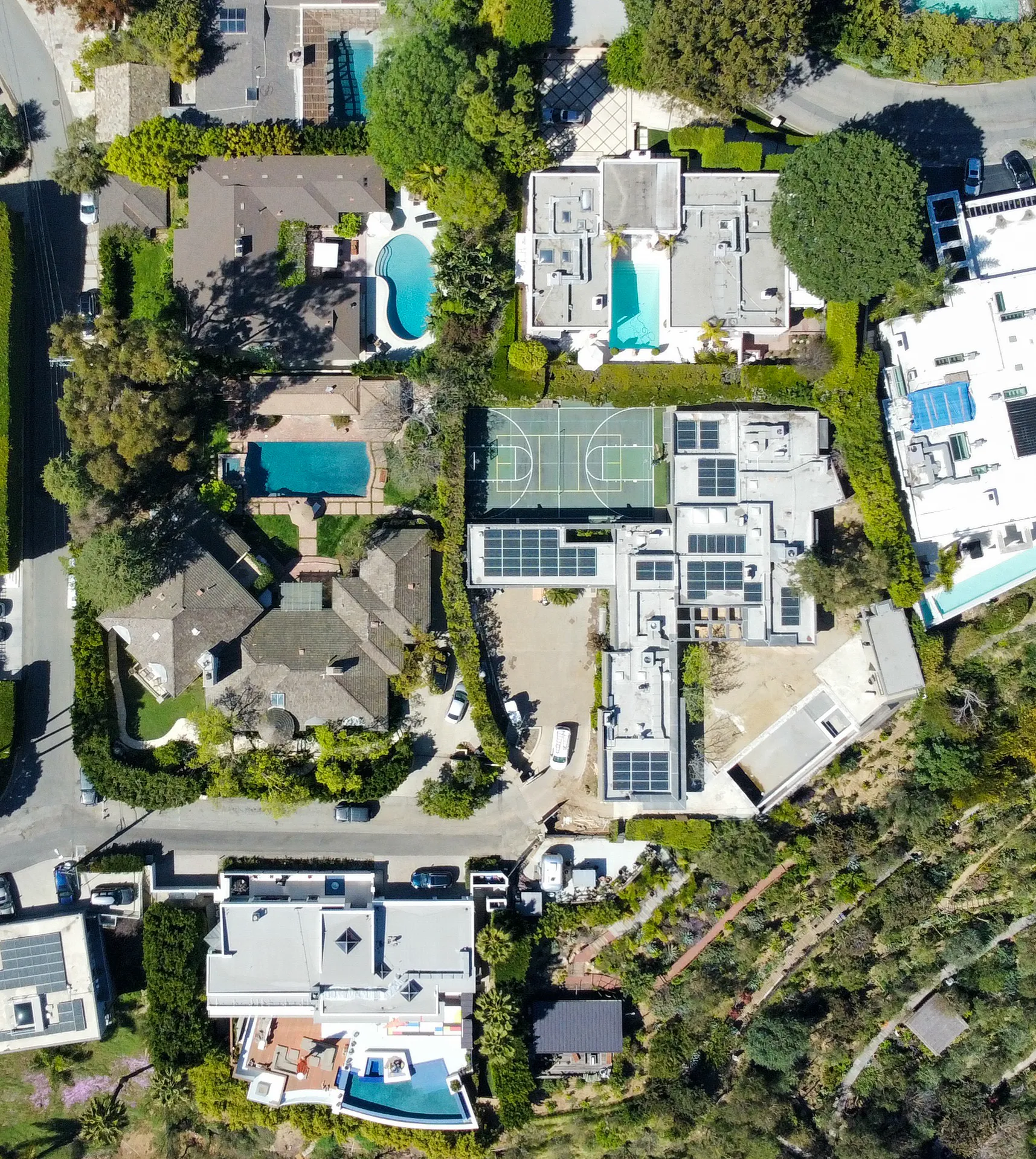
    The newly acquired residence is located in the prestigious Bird Streets of the Hollywood Hills, an enclave famous for its panoramic city views, celebrity residents, and exclusive multi-million-dollar estates. According to property records and aerial photos, the salmon-colored home spans over 3,500 square feet, offering four bedrooms, four bathrooms, a long driveway, and a private swimming pool — all tucked behind thick hedges and mature landscaping for maximum privacy.

    The purchase, completed via a limited liability company linked to DiCaprio’s cousin and long-time business partner, Robert Hrtica, was not publicly listed on the open market, underscoring the private nature of the deal. Property insiders say the actor is strategically assembling a private compound with increasing autonomy and seclusion in one of LA’s most exclusive neighborhoods.

    NYPICHPDPICT000009613437
    An aerial view of the property. © SplashNews.com

    According to Dirt.com, which first reported the sale, this latest acquisition brings DiCaprio’s Bird Streets estate to a total of five adjoining parcels — a massive footprint that now stretches across more than five acres in one of the most expensive zip codes in the city.

    The newly added house, originally built in 1963, is positioned on the northern boundary of DiCaprio’s existing estate, which began in the late 1990s when he famously purchased a property from pop icon Madonna for $2.5 million. That transaction marked the beginning of what has become one of Hollywood’s most valuable private estates.

    The new purchase may also serve a strategic purpose beyond luxury. DiCaprio has had a turbulent history with some of his neighbors. In 2007, a lawsuit was filed against him alleging negligence during the construction of a basketball court, which neighbors claimed destabilized their property. The suit was settled out of court in 2009, but tensions lingered in the neighborhood for years. Expanding his property further could be a move to avoid future disputes — or perhaps a way to control the environment around him.

    NYPICHPDPICT000012744486
    The compound is extensively landscaped. © BACKGRID

    The Hollywood icon, 48, is no stranger to real estate dealings. Just earlier this year, DiCaprio offloaded the storied Red Oak Manor in Los Feliz — a nearly 100-year-old English Tudor-style home — which had been listed for $4.9 million, as reported by Mansion Global. He originally acquired that home from musician Moby in 2018 for $4.19 million, according to LA County records.

    Over the past two decades, DiCaprio has built a diverse real estate portfolio that includes properties in Malibu, Palm Springs, and New York City, in addition to international holdings. He is known to prefer eco-conscious renovations and historically significant properties, often seeking homes with character and privacy.

    NYPICHPDPICT000012744524
    The landscaped grounds include a wooden walkway and pebble pond. © BACKGRID

    Despite broader cooling in the U.S. housing market due to rising interest rates and tighter lending policies, Los Angeles’ ultra-luxury sector — especially areas like Hollywood Hills, Bel-Air, and Beverly Hills — continues to attract wealthy buyers who often purchase properties in all-cash deals.

    According to Miller Samuel and Douglas Elliman’s Q2 2025 report, Los Angeles’ ultra-luxury market saw a 7.3% year-over-year increase in sales volume in the $10M+ category, with a total of 82 homes sold over $10 million in the last quarter. DiCaprio’s $10.5 million transaction aligns with the market’s ongoing strength among high-net-worth individuals and celebrities looking to consolidate or expand their private estates.

    NYPICHPDPICT000012744528
    The complex shares a property line with Keanu Reeves, a nextdoor neighbor. © BACKGRID

    “These buyers aren’t influenced by mortgage rates. They’re playing a different game — expanding land, combining parcels, creating mega-compounds,” said Josh Flagg, a top agent at Douglas Elliman Beverly Hills, speaking to The New York Budgets.

    While Leonardo DiCaprio is one of the most recognizable faces in the world, his real estate behavior is that of a person who highly values privacy and seclusion. His representatives did not return requests for comment on the recent purchase, and no plans for renovations or public architectural filings have surfaced so far.

    Aerial views show that the newly acquired property blends seamlessly into the rest of his Hollywood Hills domain. The salmon-pink exterior and classic mid-century architecture are consistent with many of the original homes built during the area’s development in the 1960s.

    NYPICHPDPICT000012744521
    The main house features an infinity pool, a sauna and a subterranean primary suite. © BACKGRID

    What began as a single property next to Madonna’s mansion in the 1990s has grown into a five-parcel celebrity fortress, showcasing Leonardo DiCaprio’s long-term real estate vision. With a deep interest in climate advocacy and urban preservation, it remains to be seen whether DiCaprio will modernize the home with sustainable upgrades — as he’s done with past properties — or preserve its original charm as part of a larger estate aesthetic.

    Regardless, the actor’s recent acquisition further cements his place not only as a cinematic legend but as one of LA’s most strategic and influential landowners.