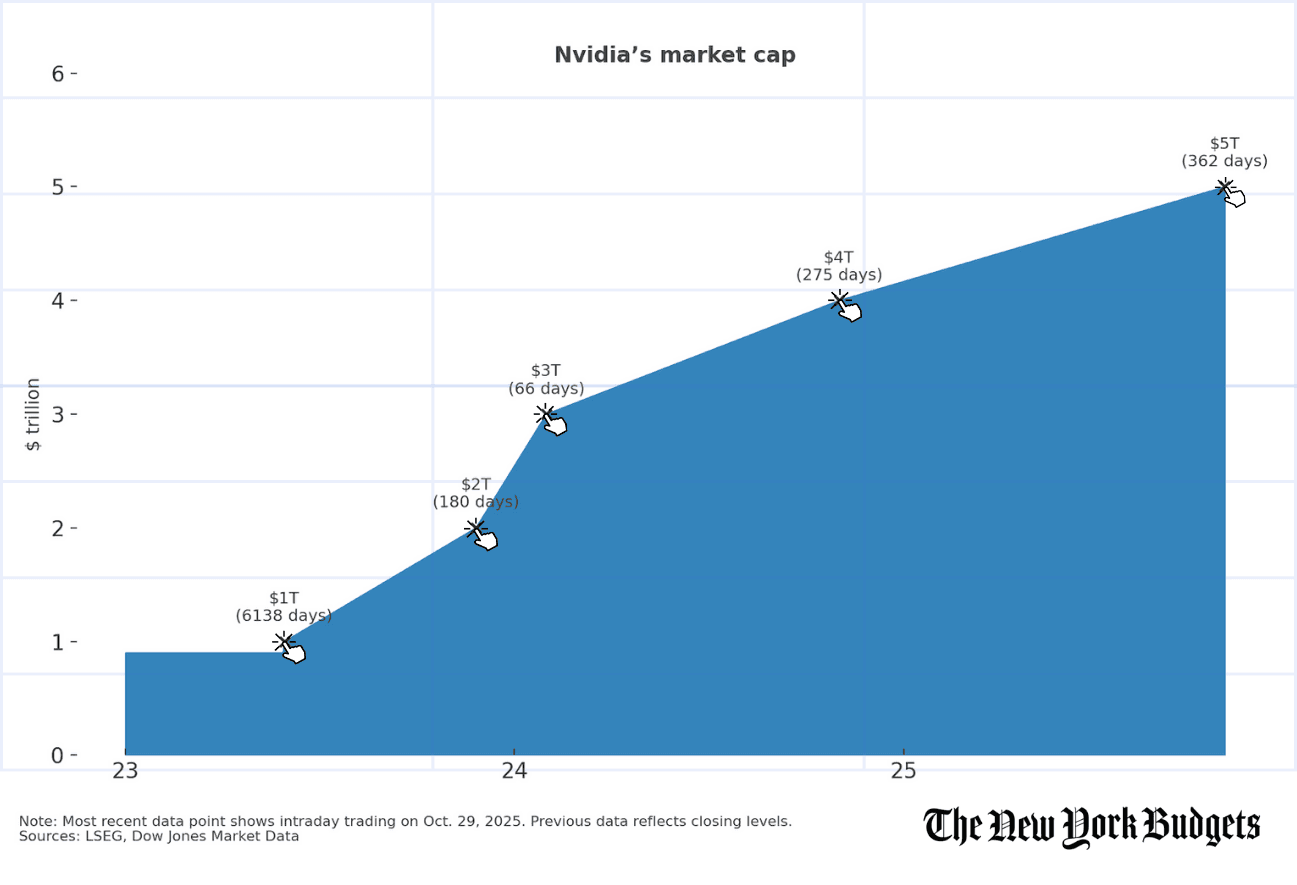
Nvidia Corp. NVDA +5.50% ▲ etched its name deeper into history books Wednesday, becoming the first publicly traded company to eclipse a $5 trillion market capitalization—a staggering milestone that underscores the artificial intelligence revolution’s grip on global markets, even as whispers of an impending bubble grow louder. The Silicon Valley chipmaker’s shares surged as much as 5.5% during the session, closing at $207.04 with 24.3 billion shares outstanding, catapulting its valuation to $5.03 trillion. Just three months after breaching $4 trillion and a mere two years after cracking $1 trillion, Nvidia’s ascent—up 50% year-to-date and over 1,500% in the past five years—has outpaced the Nasdaq’s 23% gain this year and the S&P 500’s 17%, cementing its status as the world’s most valuable firm ahead of Microsoft MSFT +2.10% ▲ ($4 trillion) and Apple AAPL +1.80% ▲ ($3.9 trillion).
The rally, which added nearly $140 billion to Nvidia’s coffers in a single day, was supercharged by CEO Jensen Huang’s announcements at the company’s annual AI conference in Washington, D.C., on Tuesday. Huang revealed a pipeline of $500 billion in AI chip orders through next year, alongside a flurry of high-profile deals: a partnership with Uber Technologies Inc. to advance robotaxi development, a $1 billion investment in Nokia Oyj for next-generation 6G networks, and collaboration with the U.S. Department of Energy to construct seven new AI supercomputers. Last month, Nvidia committed $100 billion to OpenAI, aiming to deploy at least 10 gigawatts of AI data centers to supercharge the ChatGPT maker’s computing prowess. “These aren’t hypotheticals—these companies are generating real revenues, and the products are profitable,” Huang told NBC News, brushing off bubble concerns. “Generative AI has evolved from interesting to indispensable.”
Nvidia’s dominance in graphics processing units (GPUs)—repurposed from gaming rigs to the lifeblood of AI training for models like ChatGPT and image generators—has made it indispensable to Big Tech’s AI arms race. Its largest customers, including OpenAI, Tesla Inc., xAI, Meta Platforms Inc., Amazon.com Inc., and Oracle Corp., have funneled billions into Nvidia’s H100 and upcoming Blackwell chips, driving demand that outstrips supply. The semiconductor giant’s market cap now dwarfs the combined valuations of rivals like Advanced Micro Devices Inc., Intel Corp., Broadcom Inc., Taiwan Semiconductor Manufacturing Co., Micron Technology Inc., ASML Holding NV, Lam Research Corp., Qualcomm Inc., and Arm Holdings Plc—collectively worth less than half of Nvidia’s heft.
To put $5 trillion in perspective: It’s equivalent to roughly 25 Walt Disney Cos., 50 Nikes, 96 Ford Motor Cos., 945 Macys, or over 3,311 JetBlue Airways Corps. Nvidia alone towers over the entire S&P 500 energy sector (three times its size) and eclipses major international benchmarks like Germany’s DAX and France’s CAC indices (more than double each). More strikingly, its valuation surpasses the gross domestic product of every nation on Earth except the United States ($29.1 trillion) and China ($18 trillion), per World Bank and IMF data—including India, Japan, the U.K., and Germany ($4.6 trillion last year). A $1,000 investment in Nvidia a decade ago, when shares bottomed at $0.47 in February 2015, would now be worth $441,000—a 44,000% return that has minted fortunes, including Huang’s estimated $174.4 billion net worth, ranking him eighth on Forbes’ billionaire list.
The AI boom, often likened to the iPhone’s 2007 debut for its transformative potential, has propelled Nvidia from a $10 billion niche player in 2015 to this colossus. Yet, the speed of its rise—stock up 3.4% to an intraday high of $207.85 Wednesday—has reignited debates over sustainability. Officials at the Bank of England flagged AI’s “growing risk” of a tech stock burst earlier this month, while IMF Managing Director Kristalina Georgieva echoed warnings of parallels to the late-1990s dot-com bubble. Nvidia’s shares, trading at a forward price-to-earnings multiple of 45, reflect sky-high expectations for sustained GPU demand amid an AI infrastructure spend projected to hit $1 trillion annually by 2030, per McKinsey & Co.
Geopolitical crosswinds add intrigue. Huang jetted to South Korea this week for the Asia-Pacific Economic Cooperation (APEC) summit, where free-trade ideals clash with escalating U.S. tariffs on tech and beyond. A pivotal sideline Thursday: a face-to-face between President Donald Trump and Chinese President Xi Jinping, where Trump pledged to discuss Nvidia’s chips. In August, the administration struck a deal with Nvidia and AMD to ease export curbs on advanced chips to China in exchange for a 15% revenue cut to Washington—despite national security qualms over potential military diversions. Commerce Secretary Howard Lutnick quipped on CNBC in July that selling America’s “fourth best” AI tech to Beijing was “cool,” but not the top tiers. Nvidia’s August overtures for a China-specific chip, plus a $5 billion infusion into Intel (where the U.S. government now holds a 10% stake worth $11 billion), highlight efforts to balance export growth with domestic bolstering under the CHIPS Act.
For investors, Nvidia’s milestone is a double-edged sword. The Magnificent Seven tech stocks, led by Nvidia, have shouldered 60% of the S&P 500’s gains this year, but rotation risks loom if AI hype cools. “Nvidia isn’t just a company—it’s the AI proxy,” said Dan Ives, Wedbush Securities analyst. “But at $5 trillion, any earnings miss could trigger a reality check.” With Blackwell production ramping and partnerships like the Nokia tie-up eyeing 6G’s trillion-dollar frontier, Nvidia’s trajectory suggests more records ahead. Yet, as Huang attends APEC amid Trump-Xi tensions, the chip king’s fate remains intertwined with the very global supply chains it seeks to redefine.