





In a summer earnings season dominated by eye-popping profits from Big Tech, investors and analysts have cheered what appears to be a golden age of artificial intelligence (AI). Giants like Microsoft MSFT +3.94% ▲, Meta META -3.36% ▼, Alphabet GOOGL -0.53% ▼, and Amazon AMZN -1.89% ▼ have reported record-breaking revenues, largely driven by their aggressive push into AI infrastructure.
But beneath the surface of these seemingly prosperous numbers lies a quieter, more complex narrative — one that underscores the economic risks of the AI boom. A growing body of data suggests that while AI promises a long-term revolution in productivity and innovation, it is simultaneously draining the financial lifeblood — cash — from some of America’s largest and most systemically important corporations.
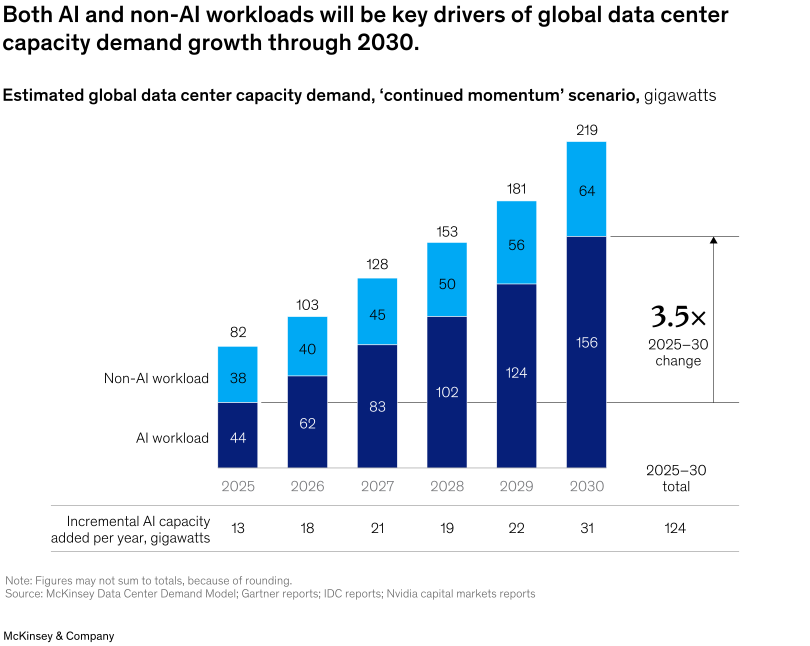
According to U.S. economic data, investment in information processing equipment — the category that includes GPUs, servers, networking systems, and data centers crucial to training AI models — has surged 23% since Q1 2023 after inflation. Meanwhile, overall GDP has grown a modest 6% over that same period. In fact, AI-related investment contributed more than half of the United States’ sluggish 1.2% growth rate in the first half of 2025. In essence, AI is now holding up the U.S. economy while consumer spending — historically the primary growth driver — has softened.
The spending isn’t limited to chips and servers. Building massive data centers requires land, buildings, cooling infrastructure, and even custom-built energy generation capacity. AI has turned Big Tech into one of the economy’s most capital-intensive sectors — a stark departure from its traditionally “asset-light” model.
The transformation is most clearly seen in the metric known as free cash flow (FCF) — the amount of cash a company generates from operations minus its capital expenditures. FCF is prized by investors because it reflects real money that can be returned to shareholders or reinvested in growth.
Between 2016 and 2023, free cash flow at Alphabet, Meta, Amazon, and Microsoft rose in tandem with net earnings. But since the dawn of the AI investment boom in early 2023, that relationship has decoupled.
Combined net income of the four tech giants is up 73%, hitting $91 billion in Q2 2025 compared to two years ago.
Free cash flow, however, is down 30% to $40 billion, according to FactSet.
Even Apple — long known for its conservative capital spending — has seen free cash flow falter despite stable profits, primarily due to increased R&D on AI-integrated chips and operating systems.
“Companies that once minted cash from intangible assets now face the harsh economics of steel, silicon, and real estate,” said Jason Thomas, Head of Research at Carlyle Group. “Investors need to ask whether this shift in business model can sustain long-term profitability.”
Big Bets, Little Return… So Far
OpenAI and Anthropic — two leading independent developers of large language models — are experiencing meteoric growth, but are not profitable. Their burn rates, while expected for startups, highlight the risk involved in the broader AI narrative: the financial returns remain speculative, even as costs soar.
Meta, for example, posted a 36% increase in earnings for Q2 2025, but a 22% drop in free cash flow, due to a doubling of capital expenditures. CFO Susan Li noted that much of the investment was supporting existing products like ad algorithms and content moderation. Only a portion is directed at developing generative AI systems like Meta’s Llama model, which have yet to generate meaningful revenue.
“We are early in the lifecycle,” Li told analysts. “We don’t expect significant revenue from generative AI in the near term.”
Amazon, after a brief respite in 2022 when it curtailed warehouse construction, has now resumed heavy spending — this time to expand its cloud division, Amazon Web Services (AWS), as demand for AI processing surges. The result: free cash flow has declined by two-thirds compared to the prior year.
Echoes of the Dot-Com Era?
Unlike the speculative startups of the dot-com bubble, today’s AI players are mature firms with established cash flow and business models. But that doesn’t make them immune to financial overreach. In the late 1990s, telecom and web firms also bet big on the internet’s promise — and many collapsed under the weight of infrastructure costs that outpaced revenue.
“The concern today is not so much a bust,” said Thomas of Carlyle Group, “but a misalignment of time horizons. These investments may pay off beyond imagination, but well outside the time frame that matters to shareholders and markets.”
In that sense, there is a growing disconnect between near-term financial sustainability and long-term technological vision — a red flag for both investors and policymakers.
In the low-interest-rate era following the 2008 financial crisis, Big Tech’s asset-light model flourished. Companies generated immense free cash flow — sometimes 5 to 8 times their capital expenditures — which they recycled into the broader financial system, helping to suppress long-term interest rates despite ballooning federal deficits.
As a result, cumulative free cash flow from nonfinancial corporations since 2020 is 78% lower relative to GDP compared to the post-2009 recovery period, according to Carlyle data.
The implication: higher real interest rates may become the new norm — not a temporary phase. That, in turn, would reduce the net present value of future corporate profits, creating a headwind for stock valuations, especially in capital-intensive industries like AI.
Despite all this, equity markets remain largely euphoric about AI’s promise. The Nasdaq 100 Index is up nearly 19% year-to-date, and the semiconductor sector has soared more than 40%, led by NVIDIA, AMD, and Broadcom. Investors are betting that these companies will eventually dominate the AI economy — and turn today’s capital spending into tomorrow’s monopoly profits.
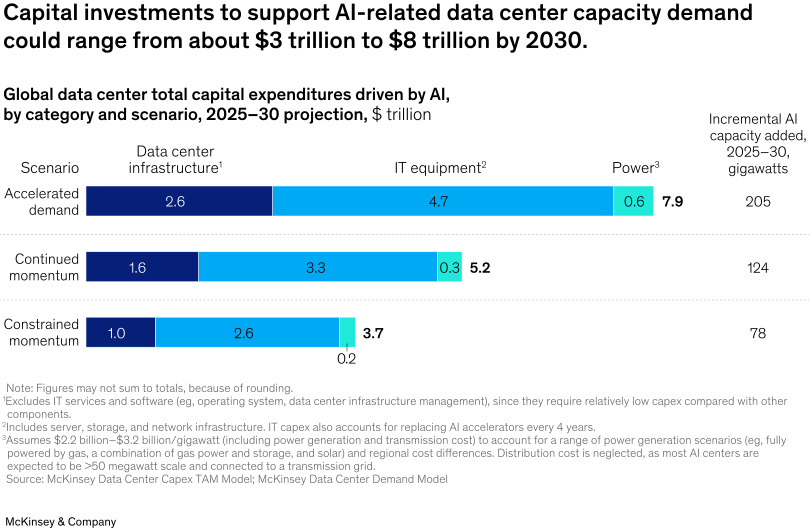
But if that revenue fails to materialize quickly, the correction could be swift and severe.
“It’s not 2000,” said Bank of America’s Chief Economist Ethan Harris. “But it’s not 2015 either. These companies need to prove that their AI bets are not just technologically brilliant — but financially viable.”
The AI boom is already reshaping the U.S. economy. It’s fueling a new wave of capital investment, helping prop up GDP, and positioning American firms to lead the next technological frontier.
But beneath the surface lies a more sobering truth: these investments are squeezing corporate cash flows, stressing balance sheets, and creating macroeconomic risks that are not yet fully appreciated by investors or policymakers.
In the end, the AI boom may well deliver on its enormous promise — but it could take longer, cost more, and require deeper sacrifice than Wall Street currently imagines.

2 Comments
I invest in ai stocks
Pingback: Nvidia Makes History: Reaches $5 Trillion Valuation