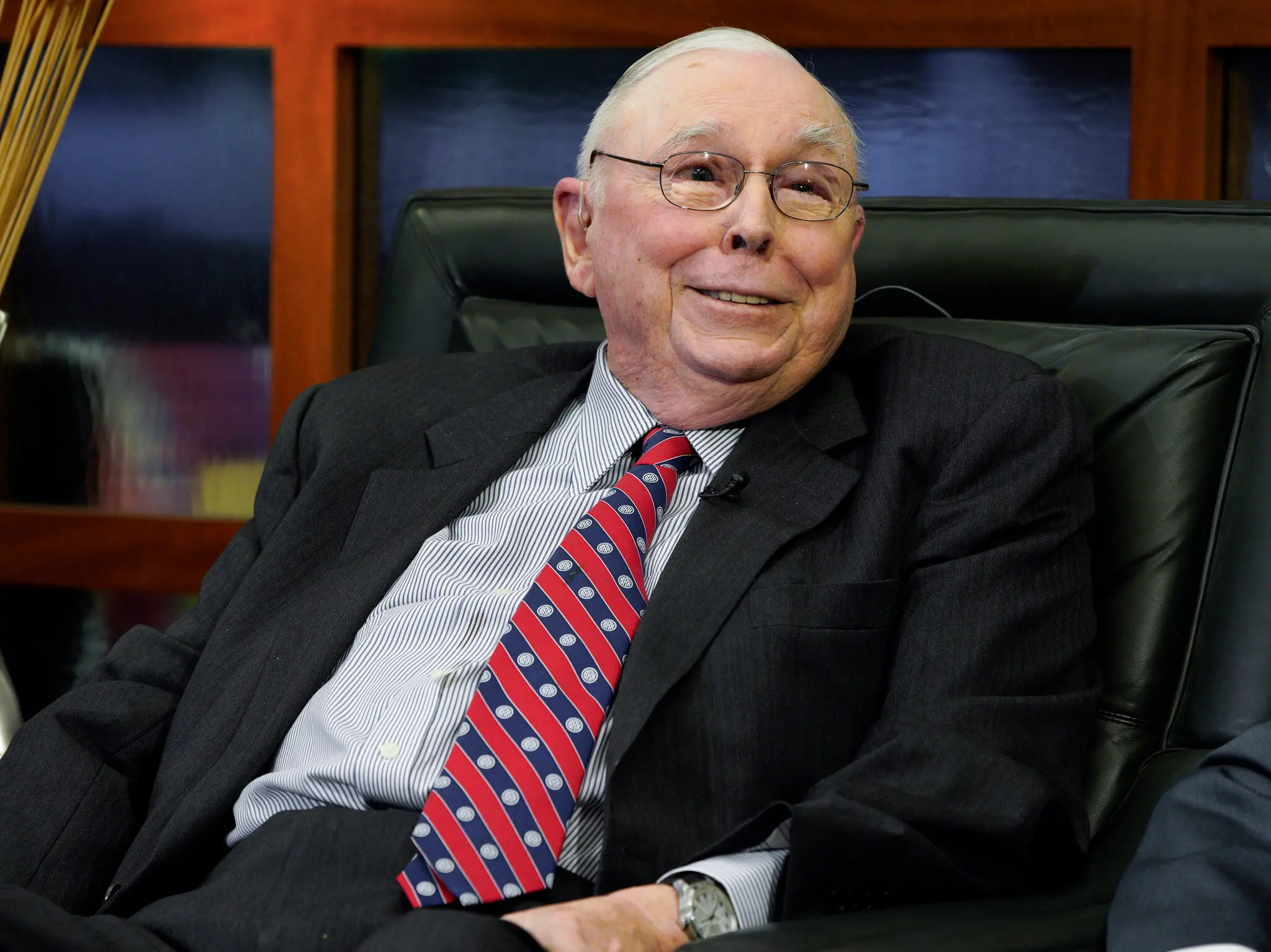
Jim Simons on April 16, 2007, in New York. (Mark Lennihan/AP)
James “Jim” Simons, a renowned mathematician who built a fortune on Wall Street and then became one of the nation’s biggest philanthropists, died May 10 at his home in Manhattan. He was 86.
The charitable foundation that Dr. Simons co-founded with his wife, Marilyn, announced the death but gave no specific cause.
Dr. Simons’s first career was in mathematics, making advances in the studies of particle physics such as quantum field theory and string theory. He led classes at the Massachusetts Institute of Technology and Harvard University before taking a job at the Institute for Defense Analyses in Princeton, N.J., as a code breaker for the National Security Agency. And from 1968 to 1978, he was chairman of the mathematics department at the State University of New York at Stony Brook.
In 1976, Dr. Simons received the American Mathematical Society’s Oswald Veblen Prize in Geometry for research that would prove to be influential to string theory and other areas of physics.
But in 1978, he traded academia for Wall Street. He leased a small office in a Long Island strip mall with the goal of using his skills in applied mathematics to guide investments in the stock market. The team he built was much like him: mathematicians, scientists and experts at prediction-based analysis using data and specialized computer coding.
The hedge fund he created, which eventually became known as Renaissance Technologies, pioneered the use of mathematical modeling — also known as quantitative trading — to pick stocks and other investments. The approach was wildly successful, helping Simons and his wife build over the years an estimated net worth of more than $30 billion.
“I wasn’t the fastest guy in the world,” Dr. Simons told the New York Times in 2014 about his problem-solving abilities in math. “I wouldn’t have done well in an Olympiad or a math contest. But I like to ponder. And pondering things, just sort of thinking about it and thinking about it, turns out to be a pretty good approach.”
James Harris Simons was born April 25, 1938, in Brookline, Mass. His father was the general manager of a shoe factory, and his mother was a homemaker. The family moved to nearby Newton while he was in high school.
As a boy, he was obsessed with logic and mathematical proofs, Dr. Simons recalled. One time his father was worried the car was close to running out of gas. Dr. Simons said he used theoretic math to explain to his incredulous father the impossibility of reaching zero.
“And I said to myself and then to him, ‘Well, you don’t have to run out of gas. You can use half of what you have, and then you can use half of that and then half of that, and you’ll never run out of gas,’” he recalled in a 2020 oral history withthe American Institute of Physics.
His practical side, however, was not as sharp. During a school break over the holidays when he was 14, he was demoted to floor sweeper at a garden supply store. He was hired for a stockroom job but he repeatedly forgot where to put items.
He graduated from MIT with a mathematics degree in 1958 and received a doctorate in math from the University of California at Berkeley in 1961. His doctoral work explored the mathematical structures of curved spaces, which Albert Einstein had used in his general theory of relativity to explain how gravity bends space and time.
At the NSA, his political views eventually clashed publicly with those of his boss, Army Gen. Maxwell D. Taylor. In 1967, Taylor defended the Vietnam War in a New York Times Magazine article. Dr. Simons published a reply, saying the war undermined U.S. security and appealing for a military pullout “with the greatest possible dispatch.”
Soon after, he was dismissed. Stony Brook University on Long Island offered him the job as head of the math department.
In 1978, Dr. Simons started his investment firm. He retired as CEO of the hedge fund in 2010, then focused on philanthropic work through the foundation he and his wife founded in 1994 to support scientists and organizations engaged in research in science, math and education.
Over the years, the couple donated billions of dollars to hundreds of philanthropic causes. In 2023, they gave $500 million through their foundation to the State University of New York at Stony Brook to support the university’s endowment and boost scholarships, professorships, research and clinical care.
Dr. Simons came in second behind only Warren Buffett in the Chronicle of Philanthropy’s list of the biggest charitable donations from individuals or their foundations in 2023.
His marriage to Barbara Bluestein, a computer scientist, ended in divorce. He married Marilyn Hawrys, an economist, in 1977. One son from his first marriage, Paul Simons, was killed in a bicycle accident in 1996; a son from his second marriage, Nicholas Simons, drowned off Bali in Indonesia in 2003.
Besides his wife, survivors include two children from his first marriage; a daughter from his second marriage; five grandchildren and one great-grandson.
In the oral history interview, Dr. Simons was asked whether he saw a religious or moral underpinning to his philanthropy.
“It’s not a spiritual framework,” he replied. “It makes me feel good, to give away this money and see that it’s going to a good cause, and in particular with science, learning things.”
Charles T. Munger in 1988. Warren Buffett described him as the originator of the company’s investing approach: “Forget what you know about buying fair businesses at wonderful prices; instead, buy wonderful businesses at fair prices.” (Bonnie Schiffman/Getty Images)
Charles T. Munger, who quit a well-established law career to be Warren E. Buffett’s partner and maxim-spouting alter-ego as they transformed a struggling New England textile company into the spectacularly successful investment firm Berkshire Hathaway, died on Tuesday in Santa Barbara, Calif. He was 99.
His death, at a hospital, was announced by Berkshire Hathaway. He had a home in Los Angeles.
Although overshadowed by Mr. Buffett, who relished the spotlight, Mr. Munger, a billionaire in his own right — Forbes listed his fortune as $2.6 billion this year — had far more influence at Berkshire than his title of vice chairman suggested.
Mr. Buffett has described him as the originator of Berkshire Hathaway’s investing approach. “The blueprint he gave me was simple: Forget what you know about buying fair businesses at wonderful prices; instead, buy wonderful businesses at fair prices,” Mr. Buffett once wrote in an annual report.
That investing strategy was a revelation for Mr. Buffett, who had made his name in the 1950s buying troubled companies at deep discounts. (He called them “cigar butts,” because investing in them, he said, was like “picking up a discarded cigar butt that had one puff remaining in it.”)
Mr. Munger counseled Mr. Buffett that if he wanted to build a large, sustainable company that would outperform other investors, he should buy solid brand-name companies. “He was the architect and I was the general contractor,” Mr. Buffett said of their relationship.
Mr. Munger, right, and Mr. Buffett in the mid- to late-1970s. “He was the architect and I was the general contractor,” Mr. Buffett said of their relationship. (Buffalo News)
The partnership, spanning more than 50 years, produced one of the most successful and largest conglomerates in history. Among other properties, Berkshire, which is based in Omaha, owns the insurance giant Geico and the Burlington Northern Santa Fe railroad company and holds stakes in Coca-Cola, American Express and other corporate heavyweights. By 2022 it had about 372,000 employees.
Mr. Munger, an erudite man who sprinkled his conversations with references to Cicero, Albert Einstein, Mark Twain and Confucius, was widely known for his witty common-sense maxims, so much so that they were called Mungerisms and collected in books, including “Poor Charlie’s Almanack: The Wit and Wisdom of Charles T. Munger” (2005).
“Envy is a really stupid sin,” goes one, “because it’s the only one you could never possibly have any fun at.” Another: “The ethos of not fooling yourself is one of the best you could possibly have. It’s powerful because it’s so rare.”
Mr. Buffett and Mr. Munger would talk to each other on the telephone for hours every day, Mr. Buffett from his office in Omaha (their mutual hometown) and Mr. Munger from Los Angeles.
“We’ve never had an argument,” Mr. Buffett said. Repeating one of Mr. Munger’s favorite lines, Mr. Buffett said that when they did differ, Mr. Munger would say, “Warren, think it over and you’ll agree with me because you’re smart and I’m right.”
Mr. Buffett and Mr. Munger were the faces of Berkshire’s annual meeting in Omaha, what became known as the Woodstock of Capitalism. They would hold forth in front of tens of thousands of rapt Berkshire shareholders, answering questions for up to six hours and dispensing their investment wisdom.
“The trouble with making all these pronouncements is people gradually begin to think they know something,” Mr. Munger told the audience in 2015. “It’s much better to think you’re ignorant.” He added, “If people weren’t so often wrong, we wouldn’t be so rich.”
Mr. Munger and Mr. Buffett appeared on giant screens at Berkshire Hathaway’s shareholder meeting in Omaha in 2015. The annual event became known as the Woodstock of Capitalism.(Nati Harnik/Associated Press)
Many of those listeners had become vastly wealthy themselves by investing with Mr. Buffett and Mr. Munger. A $1,000 investment in Berkshire made in 1964 is worth more than $10 million today.
Mr. Munger was often viewed as the moral compass of Berkshire Hathaway, advising Mr. Buffett on personnel issues as well as investments. His hiring policy: “Trust first, ability second.”
A Lawyer’s Son
Charles Thomas Munger was born in Omaha on Jan. 1, 1924, the son of Alfred Case Munger, a lawyer, and Florence (Russell) Munger. As a boy he worked Saturdays in a grocery store then owned by Mr. Buffett’s grandfather. (Mr. Buffett worked there for a time himself, but the two did not meet until much later.) At 17, Charles went to the University of Michigan to major in mathematics, but in his sophomore year, after the attack on Pearl Harbor, he enlisted in the Army Air Corps.
Promoted to second lieutenant, he was dispatched to the California Institute of Technology in Pasadena to train as a meteorologist. In Pasadena he met Nancy Huggins, daughter of a local shoe store owner, and they married, he at 21 and she at 19. They went on to have three children.
Soon he was assigned to Nome, Alaska, where he developed a talent that would serve him well.
“Playing poker in the Army and as a young lawyer honed my business skills,” Mr. Munger told Janet Lowe in her 2000 book “Damn Right! Behind the Scenes with Berkshire Hathaway Billionaire Charlie Munger.”
“What you have to learn is to fold early when the odds are against you,” he said, “or if you have a big edge, back it heavily, because you don’t get a big edge often, so seize it when it does come.
Shareholders wore badges in support of Mr. Munger at the annual meeting in 2022. (Chandan Khanna/Agence France-Presse/Getty Images)
Even before his discharge from the Army in 1946, Mr. Munger, who once said he had a black belt in chutzpah, applied to Harvard Law School, from which his father had graduated, even though he had desultory work habits and no undergraduate degree. He was accepted only after intervention by a fellow Nebraskan, Roscoe Pound, a retired dean of the school and a family friend.
Graduating with honors, Mr. Munger returned to California and began practicing law. He eventually struck out on his own by founding the law firm Munger, Tolles & Hills (now Munger, Tolles & Olson). But his life had begun to unravel: He and his wife divorced; their only son, Teddy, died of leukemia at 9 years old; and he suffered financial reverses.
With Mr. Munger practically broke, his daughter Molly complained to him about his beat-up yellow Pontiac. “Daddy, this car is just awful, a mess,” she said. “Why do you drive it?” As recounted in Ms. Lowe’s biography, he replied, “To discourage gold diggers.”
Seeking to rebuild, and drawing on his preternatural math skills (“I always took math courses because I could get an ‘A’ without doing any work,” he said), he began investing on the side, in stocks, businesses and real estate.
“It soon occurred to me that I’d rather be one of our rich and interesting clients than be their lawyer,” he said.
His investments generated his first million dollars.
Mr. Munger married Nancy Barry Borthwick in 1956, and he met Mr. Buffett by happenstance three years later. Mr. Munger had flown back to Omaha to organize the affairs of his recently deceased father when he was invited to lunch at the local Omaha Club. There he was introduced to Mr. Buffett by a mutual friend.
Later that week, Mr. Munger attended a dinner party to which Mr. Buffett had also been invited. They hit it off and spent the evening talking. Mr. Buffett later recalled, “He was rolling on the floor laughing at his own jokes, and I thought, ‘That is my kind of guy.’ I do the same thing.”
Days later, they and their wives went to lunch at Johnny’s Cafe.
As quoted in “The Snowball,” Alice Schroeder’s 2008 biography of Mr. Buffett, Nancy Munger at one point asked her husband, “Why are you paying so much attention to him?” Mr. Munger replied: “You don’t understand. That is no ordinary human being.”
‘A Passion to Get Rich’
The men soon found themselves on the phone nearly every day talking about investing strategies. “Warren obviously had a better business model than I did,” Mr. Munger said, referring to his billing by the hour for his legal services. “He kept pointing out to me that I had an insane way of making a living, and that his was better and that I should do what he was doing.”
Mr. Munger was won over. “Like Warren, I had a considerable passion to get rich,” Mr. Munger was quoted as saying in Roger Lowenstein’s book “Buffett: The Making of an American Capitalist” (1995). “Not because I wanted Ferraris — I wanted the independence. I desperately wanted it. I thought it was undignified to have to send invoices to other people.”
Mr. Munger began investing side by side with Mr. Buffett, in companies like Wesco Financial and See’s Candies, before officially joining him as vice chairman. For the first year, he said, “I kept one toe in the law firm in case my capitalist career cratered.”
Together they built Berkshire into a $500 billion-plus juggernaut whose original shares posted annual gains averaging 21.6 percent between 1965 and 2014, more than twice the 9.9 percent rise for the Standard & Poor’s 500. (The company got its name when, early on, Mr. Buffett took over a fading Massachusetts textile manufacturercalled Berkshire Hathaway.)
Mr. Munger in 2018. He said his biggest mistakes were not bad investments, but investments Berkshire failed to make. (Nati Harnik/Associated Press)
The money Mr. Munger made far surpassed his greatest expectations, he said, but it could have been even more. He said his biggest mistakes were not bad investments, but investments Berkshire failed to make.
He and Mr. Buffett “were offered a stake in McDonald’s way early” and decided against it, he said.
“We should have bought a big block of Wal-Mart young,” he added. “That was billions that we should’ve made. We avoided the pharmaceutical industry entirely, and it was the easiest industry to make a lot of money out of all the ones around, and we never made a nickel out of it.”
Mr. Munger used his many nickels for an unusual philanthropic passion: architecture. He gave away hundreds of millions of dollars to university architecture projects, including $65 million for the Kavli Institute for Theoretical Physics at the University of California, Santa Barbara.
At least one of his projects caused controversy: His design for a windowless dorm room building at the Santa Barbara campus, for which he contributed $200 million, was criticized by some architects and students. He defended it as efficient and effective.
Active Into His 90s
Mr. Buffett remained a vocal proponent of philanthropy through his Giving Pledge, an organization he founded with Bill and Melinda Gates to persuade billionaires to give away at least half their fortunes. But Mr. Munger was conspicuously not on the list. He said it was not that he did not want to sign the pledge. He said his wife, Nancy, who died in 2010 at 86, had wanted her half of the estate passed to the children, “and so I more than did that.” He added: “I felt it would be hypocritical for me to be a big pledger. I’ve already violated the total spirit of it.”
Mr. Munger is survived by two daughters from his first marriage, Wendy and Molly Munger; a daughter from his second marriage, Emilie Munger Ogden; three sons from that marriage, Charles Jr., Barry and Philip; two stepsons, William and David Borthwick; 15 grandchildren; and seven great-grandchildren.
A treasured retreat of his was a northern Minnesota wilderness compound on Star Island in Cass Lake, where his grandparents began summering in 1932 and which became the extended-family seat. In addition to Los Angeles, he had a home in Hawaii.
Under Mr. Buffett and Mr. Munger, Berkshire invested heavily in newspapers, among them The Washington Post, The Buffalo News and The Omaha World-Herald. Mr. Munger himself was the chairman of the Daily Journal Corporation, a newspaper publisher, from 1977 to 2022.
He remained active in Berkshire Hathaway into his 90s while serving for decades as chairman of Good Samaritan Hospital in Los Angeles, to which he lavishly donated. A Republican, he was also outspoken in support of Planned Parenthood.
Perhaps in another life Mr. Munger, with all his drive and self-assurance, would have been the chief of a giant corporation. But he had no regrets about making his fortune in the shadow of Mr. Buffett.
“I didn’t mind at all playing second fiddle to Warren,” he said in an interview for this obituary. “Ordinarily, everywhere I go I am very dominant, but when somebody else is better, I’m willing to play the second fiddle. It’s just that I was seldom in that position, except with Warren. But I didn’t mind it at all.”
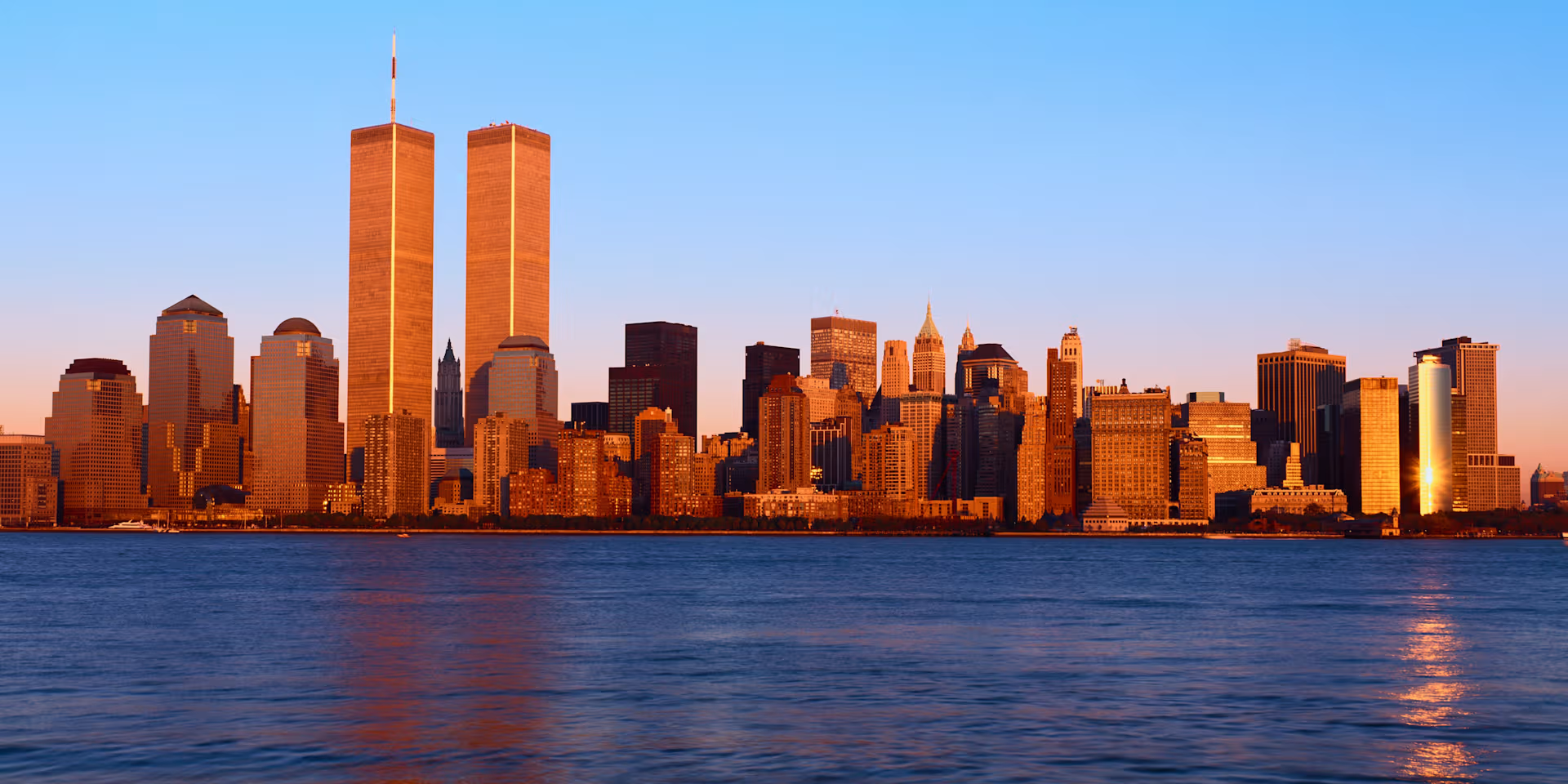
(Joe Sohm/Visions of America/Universal Images Group/Getty Images)
When the 10-year anniversary of the 9/11 attacks approached in 2009, the Port Authority of New York and New Jersey assembled an Archive Committee to collect, catalog and disseminate material recovered from the World Trade Center site. The collection reflected the range of victims of the attacks: broken eyeglasses and office supplies from those who worked in the buildings, crushed fire and police vehicles from those who raced in to save them.
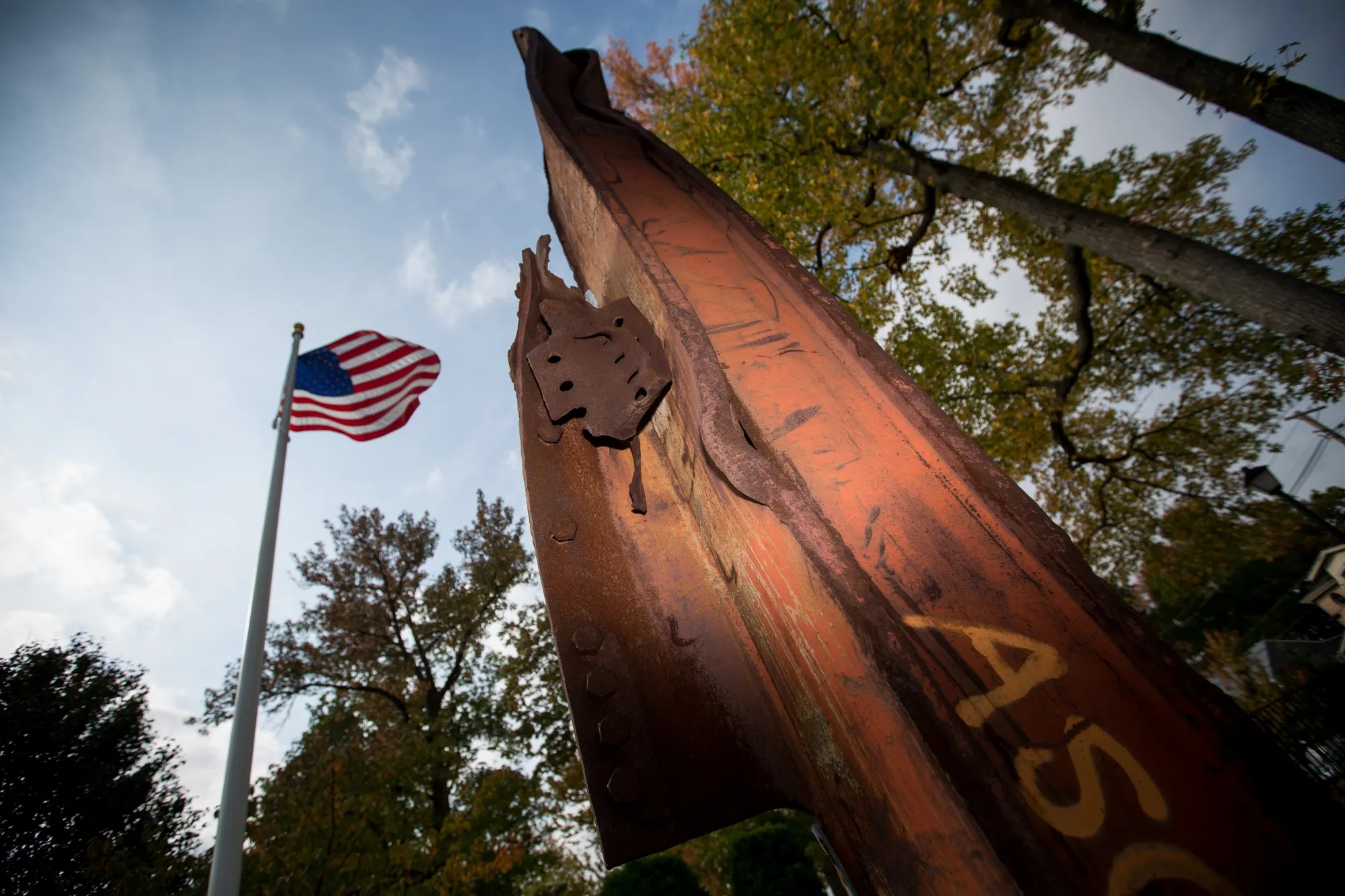
An American flag flies behind steel from the World Trade Center at Constitution Park in Fort Lee, New Jersey — one of many local memorials to the Sept. 11 attacks across the U.S. (Michael Nagle/Bloomberg)
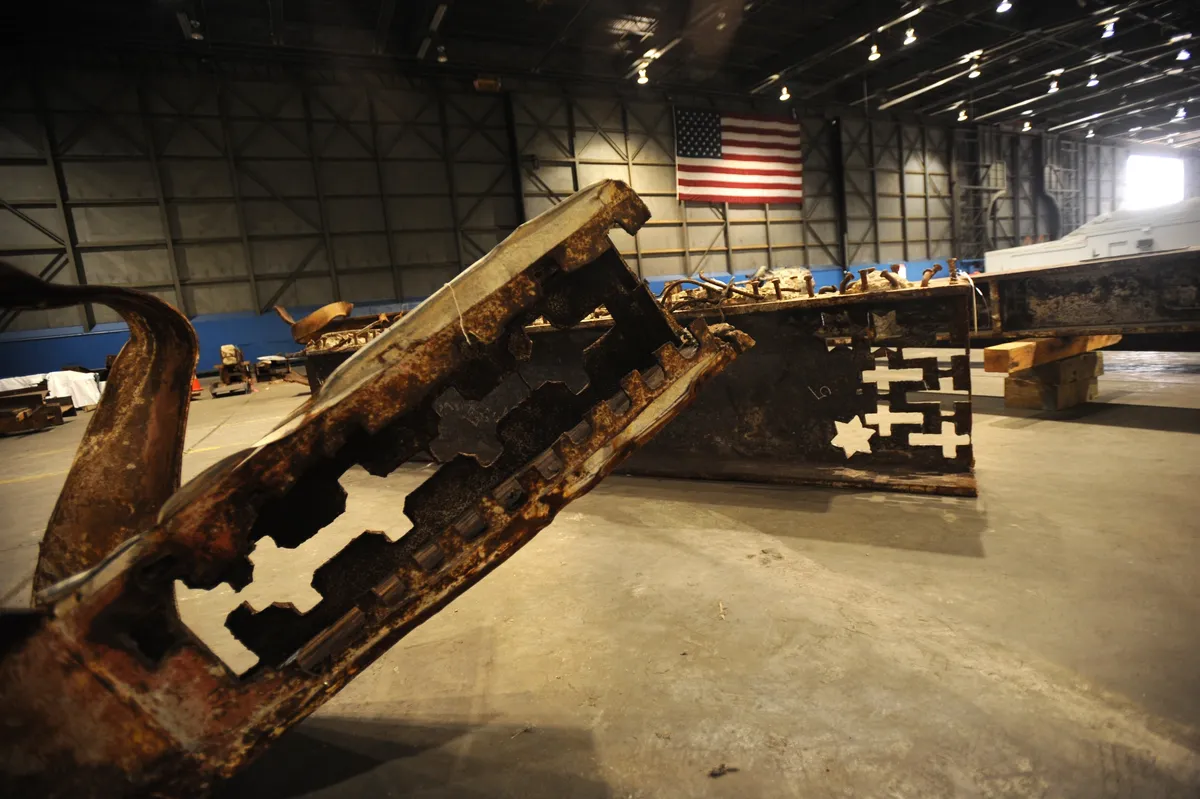
But most of the collection was metal: 7,000 tons of steel from the Twin Towers themselves, stored in a hangar at JFK airport in Queens, New York. This trove became the raw material for a campaign of memorial-making. In a program that lasted until 2016, the Port Authority solicited requests for World Trade Center artifacts from fire and police departments, libraries, small-town museums, military and veteran organizations, and local governments, along with other interested groups.
Artifacts from the World Trade Center site are stored in Hangar 17 at John F. Kennedy Airport in Queens in 2011. (Jennifer S. Altman /The Washington Post via Getty Images)
“The process of this steel’s salvage and distribution across the United States speaks to the persistent social and political power of relics — parts of bodies or objects imbued with auras from another realm,” write Samuel Holleran and Max Holleran in Places Journal. The Melbourne-based brothers — a visual artist and urban sociologist at the University of Melbourne, respectively — sifted through newspaper clips and official documents to track down the fate of about 1,800 steel fragments that were distributed by the Port Authority during the life of the archive program, to chronicle the World Trade Center’s second life.
“The attack was so televisual, and the image of the towers became so painful and charged, we were curious as to how communities could honor the buildings without showing them,” Samuel Holleran told CityLab in an email.
A World Trade Center memorial by artist Heath Satow in Rosemead, California. The sculpture contains 2,976 stainless-steel doves, representing victims of the 2001 attacks, welded together to create a pair of giant hands lifting a twisted steel beam from the towers. (Frederick J. Brown/AFP via Getty Images)
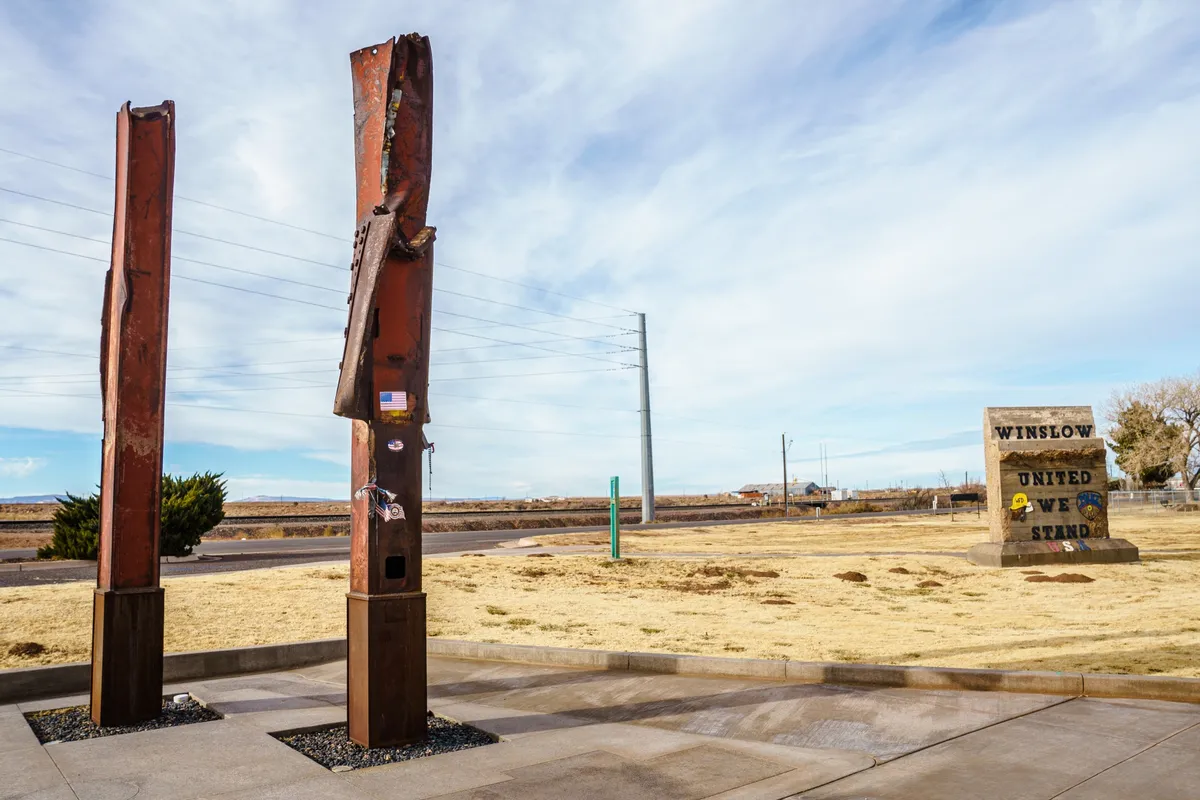
Most of these chunks of I-beams and scraps of scorched steel were used to create small 9/11 memorials scattered around the country. “Only a few of the American memorials are in major cities,” they write. “Most have been erected in liminal spaces between suburban office parks and parking lots, at the centers of traffic circles, outside public buildings in small towns.”
The geography of World Trade Center remnants, they discovered, is surprisingly broad. New York City and the immediate region received the largest share of artifacts, unsurprisingly, but fragments were distributed to all 50 states. There are also memorials built around WTC steel in Canada, Germany, Italy, England and Israel. U.S. military bases in South Korea and Afghanistan received 9/11 steel, too.
Most memorials, they note, pay tribute to firefighters and police departments rather than those who worked and died in the towers. The authors speculate that 9/11-relic-based monuments emerged in the wake of the attacks in part because so few human bodies, alive or dead, were pulled from the wreckage; the steel itself served as stand-ins for everything that families and loved ones could not recover: “Even in our globalized digital age, the demands of memory remain stubbornly tactile, and alternative death rites were needed.”
A 9/11 memorial in Winslow, Arizona. (Josh Brasted/Getty Images North America)
But the spread of WTC artifacts and their incorporation into public spaces nationwide also reflects the sheer significance and scale of the event. “For Americans who couldn’t make it to Manhattan, the dispersal of steel around the country helped to turn the loss of a distinctly New York icon into a ‘national sorrow’ akin to the assassination of a president,” the Hollerans write.
This dispersal was far wider than the physical footprint of the memorials themselves. Only a tiny portion of the World Trade Center’s massive steel skeleton ended up in the Port Authority’s archive: More than a million tons of debris ended up in a landfill in Staten Island, and the city sold 200,000 tons of structural steel in the international scrap metal market. “By the first anniversary of the attack,” the Hollerans write, “most of the WTC’s metal frame was beginning a new life in Asia, recast as cladding, rebar, even cookware.”
In a sense, that process of creation and change continues two decades later; in various forms, the towers endure.
Cookie Consent
We use cookies to improve your experience on our site. By using our site, you consent to cookies.
Contains information related to marketing campaigns of the user. These are shared with Google AdWords / Google Ads when the Google Ads and Google Analytics accounts are linked together.
90 days
__utma
ID used to identify users and sessions
2 years after last activity
__utmt
Used to monitor number of Google Analytics server requests
10 minutes
__utmb
Used to distinguish new sessions and visits. This cookie is set when the GA.js javascript library is loaded and there is no existing __utmb cookie. The cookie is updated every time data is sent to the Google Analytics server.
30 minutes after last activity
__utmc
Used only with old Urchin versions of Google Analytics and not with GA.js. Was used to distinguish between new sessions and visits at the end of a session.
End of session (browser)
__utmz
Contains information about the traffic source or campaign that directed user to the website. The cookie is set when the GA.js javascript is loaded and updated when data is sent to the Google Anaytics server
6 months after last activity
__utmv
Contains custom information set by the web developer via the _setCustomVar method in Google Analytics. This cookie is updated every time new data is sent to the Google Analytics server.
2 years after last activity
__utmx
Used to determine whether a user is included in an A / B or Multivariate test.
18 months
_ga
ID used to identify users
2 years
_gali
Used by Google Analytics to determine which links on a page are being clicked
30 seconds
_ga_
ID used to identify users
2 years
_gid
ID used to identify users for 24 hours after last activity
24 hours
_gat
Used to monitor number of Google Analytics server requests when using Google Tag Manager