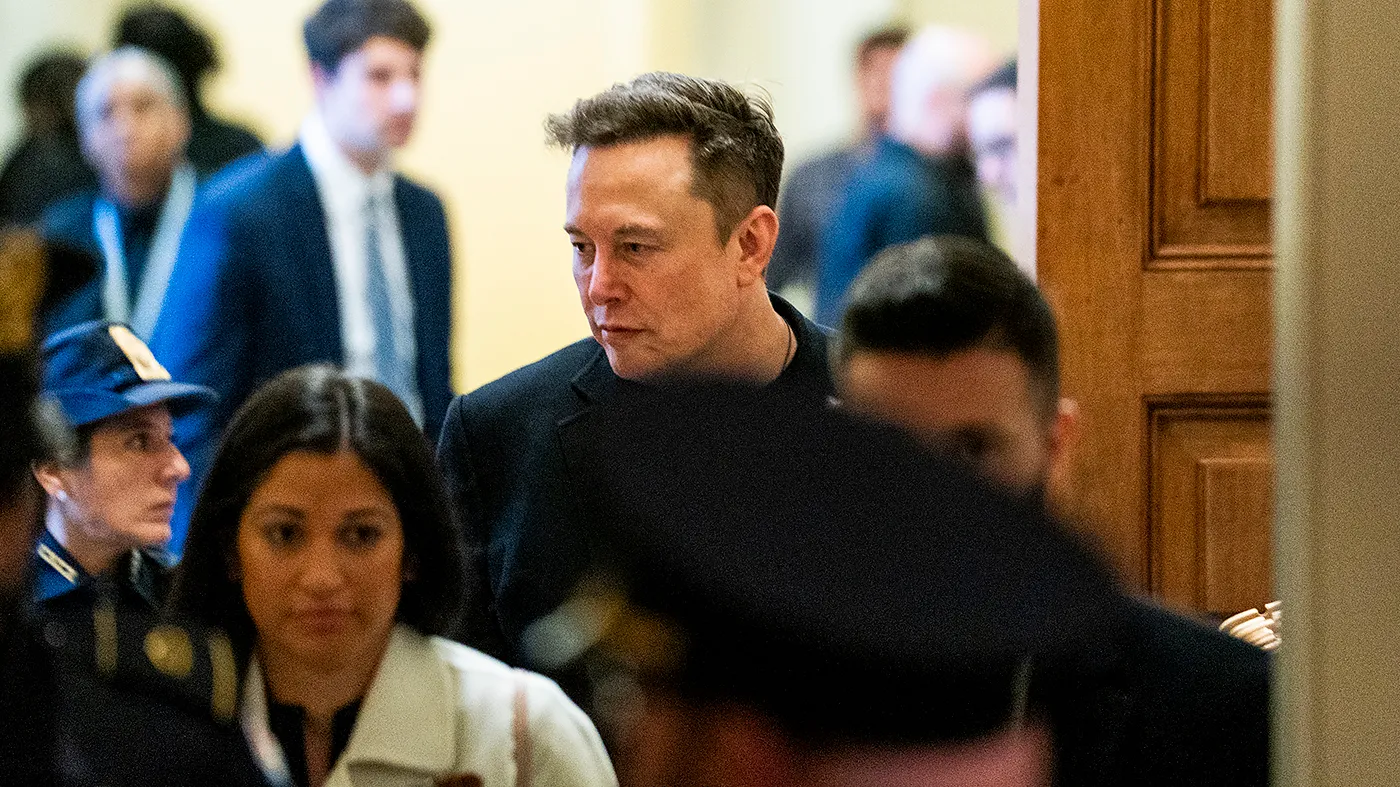
Last week, Elon Musk indicated for the first time that his Department of Government Efficiency was falling short of its goal.
He previously said his powerful budget-cutting team could reduce the next fiscal year’s federal budget by $1 trillion, and do it by Sept. 30, the end of the current fiscal year. Instead, in a cabinet meeting on Thursday, Mr. Musk said that he anticipated the group would save about $150 billion, 85 percent less than its objective.
Even that figure may be too high, according to a New York Times analysis of DOGE’s claims.
That’s because, when Mr. Musk’s group tallies up its savings so far, it inflates its progress by including billion-dollar errors, by counting spending that will not happen in the next fiscal year — and by making guesses about spending that might not happen at all.
One of the group’s largest claims, in fact, involves canceling a contract that did not exist. Although the government says it had merely asked for proposals in that case, and had not settled on a vendor or a price, Mr. Musk’s group ignored that uncertainty and assigned itself a large and very specific amount of credit for canceling it.
It said it had saved exactly $318,310,328.30.
Mr. Musk’s group has now triggered mass firings across the government, and sharp cutbacks in humanitarian aid around the world. Mr. Musk has justified those disruptions with two promises: that the group would be transparent, and that it would achieve budget cuts that others called impossible.
Now, watching the group pare back its aims and puff up its progress, some of its allies have grown doubtful about both.
“They’re just spinning their wheels, citing in many cases overstated or fake savings,” said Romina Boccia, the director of budget and entitlement policy at the libertarian Cato Institute. “What’s most frustrating is that we agree with their goals. But we’re watching them flail at achieving them.”
Mr. Musk’s group did not respond to questions about its claims sent via X, his social-media platform. Mr. Musk previously acknowledged the group might make errors but said they would be corrected.
The White House press office defended the team, saying it had compiled “massive accomplishments,” but declined to address specific instances where the group seemed to have inflated its progress.
Mr. Musk actually promised an even larger reduction last year. When he was Mr. Trump’s most prominent supporter on the campaign trail, he said he could cut $2 trillion from a federal budget of about $7 trillion. After Mr. Trump was elected and Mr. Musk’s group began its work, Mr. Musk lowered that goal to $1 trillion.
Even after Mr. Musk’s comments in Thursday’s cabinet meeting, a White House official indicated that this target had not changed.
Budget analysts had been deeply skeptical of these claims, saying it would be difficult to cut that much without disrupting government services even further, or drastically altering popular benefit programs like Medicare and Social Security.
Mr. Musk’s group has provided an online ledger of its budget cuts, which it calls the “Wall of Receipts.” The site was last updated on Tuesday, to show an “estimated savings” of $150 billion.
The ledger is riddled with omissions and flaws.
While Mr. Musk said on Thursday that his group would save $150 billion in fiscal 2026 alone, the website does not say explicitly when its savings would be realized. The site also gives no identifying details about $92 billion of its claimed savings, which is more than 60 percent of the total.
The rest of the savings are itemized, attributed to cancellations of specific federal grants, contracts or office leases. But these detailed listings have been plagued with data errors, which have inflated the group’s savings by billions.
Mr. Musk’s group has deleted some of its original errors, like entries that triple-counted the same savings, a claim that confused “billion” with “million,” and items that claimed credit for canceling contracts that ended when George W. Bush was president.
Still, some expensive mistakes remain.
The second-largest savings that the group lists on its site comes from a canceled I.R.S. contract that DOGE says saved $1.9 billion. But the contract it cites was actually canceled when Joseph R. Biden Jr. was president. The third-largest savings that the group claims comes from a canceled grant to a vaccine nonprofit. Mr. Musk’s group says that saved $1.75 billion. But the nonprofit said it had actually been paid in full, so the savings was $0.
In other cases, the itemized claims include “savings” that would not happen in fiscal 2026 — or might not happen at all.
They start with the largest single savings on the group’s website. Mr. Musk’s team says it saved $2.9 billion by canceling a contract for a huge shelter in West Texas to house migrant children who crossed the border alone.
That figure is pumped up by assuming things that might never happen, according to a New York Times analysis of federal contracting data and interviews with people familiar with that contract who spoke on condition of anonymity because they were not permitted to discuss it with members of the media.
One assumption was that the government was going to renew the contract every year for three more years. Another was that the shelter was going to hold hundreds of children every day from 2023 to 2028, triggering a higher payment rate.
Both of those assumptions seem less than guaranteed, given that the number of unaccompanied child migrants began falling last year. Around the country, shelters like this had emptied out even before Mr. Trump took office.
The Texas shelter had been empty since March 2024. The government paid a lower rate of $18 million per month to keep it on standby, compared to $55 million per month if the facility had been full, people familiar with the contract said.
By canceling the contract, the government did save the cost of keeping the facility ready until it expired later this year. But only a fraction of that money — about $27 million — would count as savings in fiscal 2026. That was about 1 percent of the savings that Mr. Musk’s group had claimed.
Nat Malkus, a senior fellow at the conservative American Enterprise Institute, said this approach — casting uncertain events as certain — was common in the data published by Mr. Musk’s group.
“It’s like if your kid drops out of college, and you tell your wife, ‘Whoa, we saved money on medical school!’ Well, that doesn’t make any sense, but that’s the same idea,” Mr. Malkus said. “How do you call it savings?”
In another example, Mr. Musk’s group said it had saved $285 million by canceling a contract with a South Dakota company, Project Solutions Inc., to perform safety inspections in federally subsidized apartment buildings.
But that presumed the government would spend money it had not promised to spend.
Robin Miller, a Project Solutions manager, said that the higher figure was calculated using a “ceiling value” — the maximum amount that the government could pay. In reality, she said, the government had agreed to pay only $29 million, of which $1.8 million had been disbursed, and another $3 million was owed for completed work.
Ms. Miller said her company supported Mr. Musk’s mission, but his group had its facts wrong in this case.
“If it’s not going to be used, it wasn’t truly money saved,” she said. In any event, she said, there would not have been much savings in the period Mr. Musk was focused on: The contract would end on Oct. 3, 2025, just three days into the next fiscal year.
Mr. Musk’s group also claimed credit for canceling a contract that was not a contract at all.
It involved a request for proposal that the Office of Personnel Management had published, seeking bids for help with human-resources work.
When announcing these requests, government agencies describe the work they want done. Contractors submit proposals, with both a plan and a price. The government can choose one vendor, or several. Even after that, it often negotiates with them to push the price below their original bids.
Details about this particular request were scarce: Mr. Musk’s group provided a tracking number for the request, 47QFEA24K0008. But The New York Times was not able to find that number in databases of previous government solicitations. The Office of Personnel Management declined to release the request, or say what it had planned to spend on the contract, nor would the office say when it planned to choose a contractor.
Despite that uncertainty, Mr. Musk’s calculated the savings involved in that cancellation down to the cent. (It later rounded the claim to an even dollar: $318,310,328.)
“Garbage,” said Steven L. Schooner, a professor who studies federal contracting at George Washington University.
He said it was far too early to know for sure what the government was going to spend — especially in the year that Mr. Musk had targeted. What if the bidders competed to drive the price lower? What if a losing bidder protested, and then the whole thing got canceled?
“You don’t know what’s going to happen,” Mr. Schooner said. “It’s silly.”
Leave a Reply