

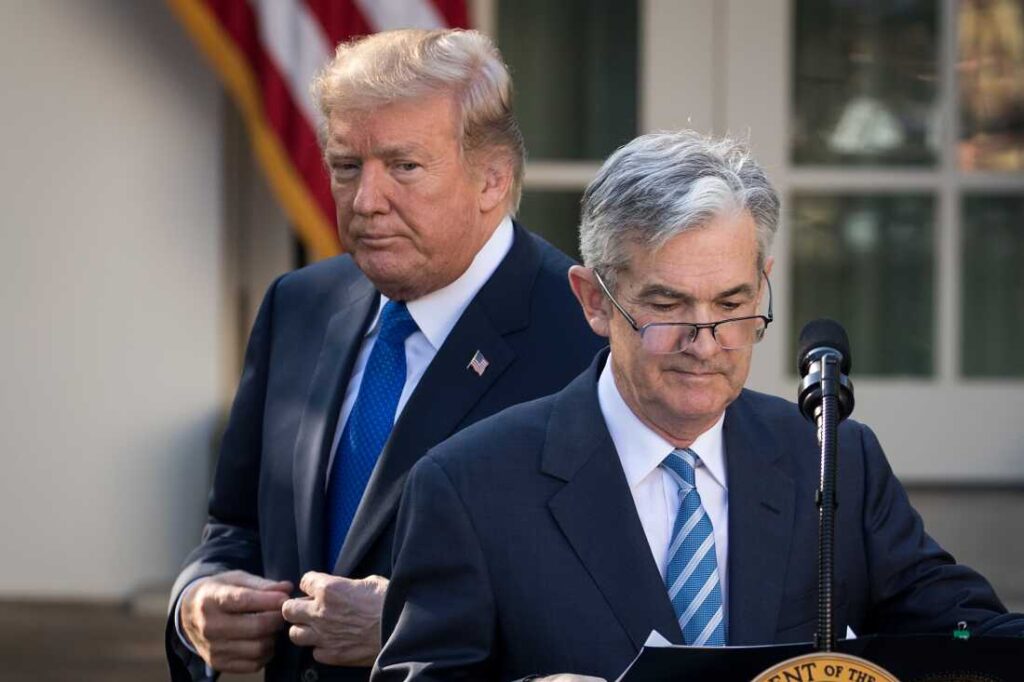
WASHINGTON, D.C. — The Federal Reserve held interest rates steady Wednesday for the fifth consecutive meeting, but signs of growing division within the central bank emerged as two officials dissented in favor of a rate cut, underscoring increasing uncertainty over the path forward amid rising geopolitical tensions and trade policy concerns.
The Federal Open Market Committee (FOMC) maintained its benchmark federal funds rate at a range of 5.25% to 5.50%, the highest level in over two decades. But for the first time in over a year, the vote was not unanimous: Dallas Fed President Lori Logan and Chicago Fed President Austan Goolsbee broke ranks, citing growing risks from weakening consumer demand and escalating tariffs on Chinese and European imports.
“The labor market remains strong and inflation has eased notably,” the Fed said in its statement. “However, the Committee remains highly attentive to inflation risks.” Yet the statement notably softened language about future tightening, opening the door to potential rate cuts if economic conditions deteriorate.
The dual dissents highlight what analysts are calling a “fraying consensus” inside the Fed, as policymakers weigh competing risks: on one hand, stubborn core inflation that has remained above the Fed’s 2% target, and on the other, a slowing economy compounded by new import tariffs that could dampen spending and business investment.
“These are not just marginal disagreements,” said Dana Peterson, chief economist at The Conference Board. “This is a fundamental debate over how much tariffs will drive inflation versus how much they will hurt growth. The balance is tricky.”
In recent weeks, the Biden administration has rolled out a fresh wave of trade penalties on strategic imports from China—particularly in EVs, solar panels, and critical minerals—and hinted at potential levies on select European goods. While designed to bolster domestic industry, the tariffs are expected to raise input costs for manufacturers and consumers.
Data released earlier this month showed that second-quarter GDP grew at a modest annualized rate of 1.2%, a deceleration from the 1.9% seen in Q1. Meanwhile, the Fed’s preferred inflation measure—the core personal consumption expenditures (PCE) index—was flat in June, holding at 2.8% year-over-year.
Although inflation has cooled significantly from its 2022 peak, officials remain divided over whether it has moderated enough to justify rate reductions. “The Fed is walking a tightrope,” said Sarah House, a senior economist at Wells Fargo. “They want to support growth, but they don’t want to repeat the mistakes of the 1970s by cutting too soon.”
Chair Jerome Powell, speaking at a press conference following the decision, emphasized that the Fed remains data-dependent but acknowledged that the case for rate cuts is growing stronger.
“If we see more evidence that inflation is moving sustainably toward 2%, and if labor market conditions continue to evolve gradually, then a policy adjustment would be appropriate,” Powell said. “But we are not there yet.”
Markets React with Caution
Financial markets responded cautiously to the decision. The S&P 500 closed flat, while the yield on the 10-year Treasury note dipped slightly to 4.21%. Futures markets now see a 52% chance of a rate cut at the Fed’s September meeting, up from 38% last week, according to CME FedWatch data.
Investors remain on edge over the policy outlook, with many anticipating at least one rate cut before the end of the year. But the Fed’s internal disagreements signal a more complex road ahead.
“The Fed is no longer speaking with one voice,” said Julia Coronado, a former Fed economist now at MacroPolicy Perspectives. “This is the beginning of a broader debate—not just on rates, but on how the Fed should respond to trade-driven inflation and a more fractured global economy.”
All eyes now turn to the Fed’s Jackson Hole symposium in late August, where Powell is expected to outline the central bank’s evolving approach. Analysts expect the Chair to strike a balanced tone, reaffirming inflation vigilance while acknowledging the shifting economic landscape.
“Powell will try to bring the committee back toward a unified message,” said Coronado. “But that’s harder to do when growth is slowing, inflation is sticky, and trade tensions are rising.”
As the Fed grapples with its next steps, one thing is clear: The era of near-lockstep policymaking may be giving way to a period of internal debate—and a less predictable path ahead for rates, markets, and the U.S. economy.


1 Comment
Pingback: Trump Has a New Opportunity to Influence the Federal Reserve – The NewYorkBudgets