With all due respect to the acrimony of Yankees vs. Red Sox, the heritage of Ohio State vs. Michigan, or the titanic struggle of Joey Chestnut vs. a hot dog, the distinction of greatest rivalry in sports belongs to a showdown that isn’t such a regular fixture on the calendar.
It’s a long-running feud that has included decades of chicanery, unconditional hatred, and a 74-day war fought on the high seas. And on Wednesday, it will come to a head once again, for just the fifth time in over 150 years, and with more on the line than ever before: England vs. Argentina for a place in the final of the World Cup.
Though other grudge matches have enormous stakes, high intensity and histories that transcend anything that happens on the field, what elevates this one above any other is its combination of scarcity, the clash of cultures, and the immediacy of real-world, geopolitical beef.
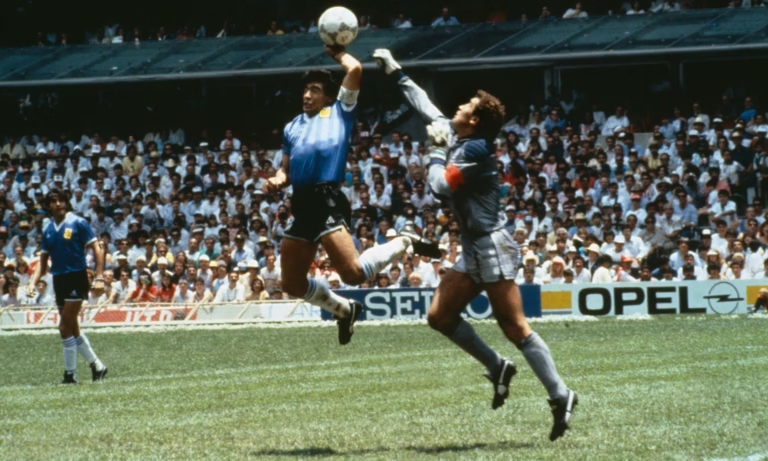
The brief history of those five games includes: a match so violent that it prompted the introduction of red cards, a goal so controversial it became known as the “Hand of God,” a goal so sublime it became known as the “Goal of the Century,” allegations of vile racism, endless chants about the Falkland Islands, the ejection of soccer icon David Beckham, and an effigy of a player hanged outside a London pub.
“We know what the game against England means for our country,” Argentina midfielder Leandro Paredes said.
Never mind that Argentina learned the game from English sailors, or that the two countries haven’t met in competition in 24 years. For 46 million Argentines, this means much more than giving the team a chance to lift the trophy for a fourth time—or an opportunity to defend the title they won with Lionel Messi four years ago in Qatar.
Each installment on the pitch has come to define an entire era of the rivalry. In total, the two nations have shared a pitch 14 times, but nine of those were exhibitions. The other five all came at the World Cup. And in a world where sports rivalries are now commoditized, sanitized, and milked for every last ounce of monetizable content, the rarity of Argentina vs. England has transformed it into a generational event.

“From the four lines of the pitch to the outside, it is a clash that has a lot of history, that has a lot of pain and a lot of things behind it,” said Argentina forward Jose Manuel Lopez. “We are going to play it as we play all the games, until the last second, leaving everything on the pitch.”
That is, if all the players can stay on it. When the two sides met at London’s Wembley Stadium in 1966, tempers frayed so quickly that Argentina captain Antonio Rattin was sent off after a string of vicious fouls. He refused to leave the pitch for eight minutes before ultimately taking a seat on the red carpet that had been exclusively reserved for Queen Elizabeth II.
“Tackling is fine,” former England defender George Cohen once said. “But it was some of the snidey things, the spitting and pulling the short hairs on your neck, pulling your ear. They were trying to intimidate us.”
England manager Alf Ramsey was so scandalized, that he told his players to refuse to swap jerseys after the game, calling the Argentine players “animals.”

Twenty years later, the insult was still on Argentina’s mind when the two sides crossed paths again at the 1986 World Cup in Mexico. By then, however, even more bad blood had boiled over between the two countries following the 1982 Falklands War. And after Diego Maradona lifted his country to a 2-1 win over Three Lions in the quarterfinal, he didn’t shy away from bringing up the islands known in Argentina as Las Malvinas.
Maradona scored two goals that day: one with his fist, an infraction that was missed by the referee, and another by dancing past five English defenders. The Three Lions never quite recovered from either.
Then came the Beckham arc. In 1998, he received a red card for kicking out at Argentina’s Diego Simeone in a game so tense that it had to be decided by a penalty shootout. When England lost, one tabloid led with the headline: “Ten Brave Lions, One Stupid Boy.” Beckham was even hanged in effigy outside a pub.
Which made it all the more dramatic four years later when England’s group-stage meeting with Argentina was decided by a single goal: a redemptive Beckham penalty.

That remains their most recent confrontation in a major tournament. There was an exhibition, in 2005, staged at the most neutral territory imaginable—Switzerland. Otherwise, the two nations have tacitly agreed not to arrange friendly matches against each other.
That’s not to say that these two enemies have stopped obsessing over each other.
“We will give our souls against England,” Cristian Romero said. “We will leave our lives on the pitch.”
England’s players have tried to be a little more measured—at least in public.
“We don’t get wrapped up in things like that,” England goalkeeper Jordan Pickford said.
The fans won’t make it easy. All of the reminders will be right there in Argentina’s song of the summer. At every game, they have belted out in Spanish: For the Falklands, for Diego, for the last World Cup of Leo.
“It’s a football match that brings back many memories,” midfielder Rodrigo De Paul said. “The songs also remind us of the Falklands and its heroes. But we have to understand that the Falklands should be discussed elsewhere.”