Apollo Global Management (NYSE: APO) says it is directing over $100 billion of capital into industries reshaped by trade friction. In a Q2 2024 investor briefing, the firm highlighted a multibillion-dollar allocation across private equity, credit and infrastructure to capitalize on reshoring trends, supply-chain reorientation and commodity arbitrage amid U.S.–China decoupling and new green levies. Apollo executives note that “private assets” can “offer a measure of stability during times of turbulence, such as the current stretch driven by U.S. President Donald Trump’s tariffs”. In effect, Apollo treats tariffs not merely as costs but as catalysts for value – redeploying capital from affected sectors to advantaged ones.
Investment breakdown: Apollo says roughly $28 billion is earmarked for North American reshoring infrastructure. This includes semiconductor fabs and EV battery plants supported by the U.S. CHIPS and Science Act, and new duties (e.g. U.S. tariffs on Chinese steel) that improve domestic project economics. Another $19 billion goes to energy and metals logistics – for example, warehouse and transport assets that can arbitrage carbon-border taxes and critical-mineral import curbs. A further $14 billion is set aside for supply-chain finance: credit lines and working-capital support for companies moving manufacturing out of China into Southeast Asia or Mexico (reducing tariff exposure to roughly 4% vs. 19% on Chinese imports).
Apollo co-President Scott Kleinman puts it bluntly: “Tariffs are creating the most significant capital reallocation since the 2008 financial crisis.” His team views this shift as a once-in-a-decade rebalancing where firms must rebuild shorter, more secure supply chains.
Market Context: Rising Tariffs and Supply Shifts
Global tariff barriers are indeed on the rise. The U.S. now keeps duties on hundreds of billions of dollars of imports that average well above historical lows. For example, the Trump-era tariffs still cover over $300 billion of Chinese goods at rates from 7.5% up to 25%. And in 2024 the Biden administration approved further hikes: Chinese electric vehicles now face a 100% U.S. tariff, and solar panels 50%. New 25% duties also apply to certain medical supplies, lithium batteries and even China-made ship-to-shore cranes. (The U.S. now flatly bans EVs and advanced batteries from China, while quadrupling EV tariffs.) In short, import-tax burdens on high-value and strategic goods have jumped sharply (about double the 2016 level), reshaping sourcing economics.
The policy backdrop has spurred a massive supply-chain overhaul. Industry surveys suggest a large majority of leading companies have shifted production since 2022. For instance, a recent McKinsey survey found roughly 78% of Fortune-500 firms have at least partially diversified their supply bases away from China. Apollo itself has banked on this trend: it now controls a growing real estate footprint south of the U.S. border (reports note Apollo’s platform includes some 12 industrial parks in Mexico) to serve nearshoring. European green trade rules add to the mix – with planned carbon border tariffs reaching about $95 per ton of embedded CO₂ by 2030 – which further tilts advantage toward low-carbon supply hubs. Notably, Apollo’s commodity and resource portfolio returned 34% in 2023, underscoring the payoff from such policy-driven gaps.
Semiconductors: Apollo is plowing roughly $12 billion into chip manufacturing. This includes equity stakes in established players (GlobalFoundries) and emerging firms (e.g. “VoltChip” start-ups). In June 2024 Apollo announced a near-$11 billion investment to take a 49% stake in Intel’s new fab in Ireland – effectively subsidizing part of Intel’s $18.4 billion buildout. Such deals are aimed at capturing government incentives (like CHIPS Act subsidies) and the U.S. drive to onshore cutting-edge chip capacity.
EV Materials: Apollo has allocated about $8 billion to critical battery raw materials. That includes projects in Chile and Canada to secure lithium and other inputs for North American EV supply chains. With tariffs and subsidies skewing autos’ geometry (e.g. U.S. duties on Chinese EVs, and local content bonuses under the Inflation Reduction Act), owning the upstream supply means higher margins.
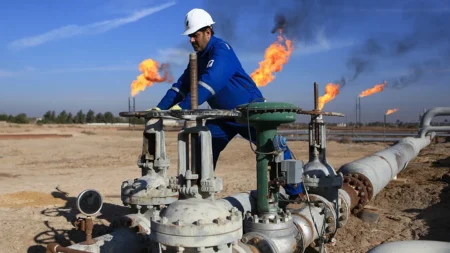
Logistics and Industrial Real Estate: Some $6 billion is targeted at U.S.–Mexico warehousing and transport hubs. The thinking is that sprawling cross-border logistics parks will benefit from the southward shift of manufacturing. Apollo (through funds like its ACORE vehicle) has bulked up on industrial REITs and logistics portfolios. These assets serve goods coming in from Asia via alternative routes or from nearshore factories, and thus can charge rents that fully factor in tariff and friction premiums.
No strategy is without headwinds. Numerous policy and market risks could blunt the playbook. For example, U.S. Section 301 tariffs on China have already been challenged at the WTO (China’s case DS543), and Congress or a future administration might roll back some measures. Similarly, some U.S. “green” levies could be softened or delayed following domestic political pressures (e.g. EU election outcomes may force renegotiation of carbon rules). Even where plants are built, capacity might overshoot demand: Goldman Sachs warns that up to 40% of U.S. battery cell capacitycould lie idle by 2026 absent stronger end-market growth. On Apollo’s own books, the $45 billion credit portfolio is exposed to 9% coupon lending and an estimated 5.2% default probability in a slowing economy – a reminder that higher rates and tariffs could strain borrowers.
Some industry veterans counsel caution. As RBC Capital Markets strategist Gerard Cassidy tersely observes, “Betting on tariffs is betting on politics.” In other words, asset prices tied to trade policy must factor in the risk of political change, not just economic logic.
Apollo is not alone in chasing trade-tailwinds. Other large asset managers have also announced bold commitments. Blackstone has cited roughly $50 billion of investment plans in Europe and emerging markets (notably data centers and Indian renewables) that ride parallel decoupling trends. KKR recently unveiled a $30 billion logistics fund targeting U.S. fulfillment centers (leveraging the e-commerce surge and re-shored inventory). Brookfield has dedicated about $20 billion to critical minerals and renewable energy worldwide, anticipating commodity supply strains. The competition underscores that supply-chain resilience – whether through warehouses, fiber routes or power plants – is increasingly prized. As Apollo’s chief economist Torsten Slok puts it, “In a multipolar world, supply chain resilience is the new prime real estate.”
Apollo’s strategy treats tariffs not as mere externalities but as alpha-generating catalysts. By deliberately allocating capital to the beneficiaries of trade fragmentation – domestic fabs, alternative routes, and non-Chinese suppliers – Apollo aims to earn outsized returns so long as U.S.–China tensions and green trade frictions persist. The firm’s success hinges on the assumption that global supply chains will remain balkanized for years, rather than reverting quickly to pre-trade-war norms. If tariffs and subsidies indeed endure or deepen, Apollo’s repositioning could pay off handsomely. If not, or if demand falters, the strategy faces a stark test.
By the Numbers: Key metrics and targets mentioned above include 100% (new U.S. tariff on Chinese EVs); 50% (tariff on Chinese solar panels); 25% (tariff on ship-to-shore cranes); 17% (year-over-year AUM growth in Q1 2025); $785 billion (Apollo’s assets under management, Mar. 2025); $43 billion (new capital raised by Apollo in Q1 2025); 21% (year-on-year jump in Apollo’s fee revenue for Q1); $11 billion (Apollo’s announced investment in the Intel Ireland fab JV); and $300+ billion (approximate value of Chinese imports still under U.S. tariffsreuters.com).