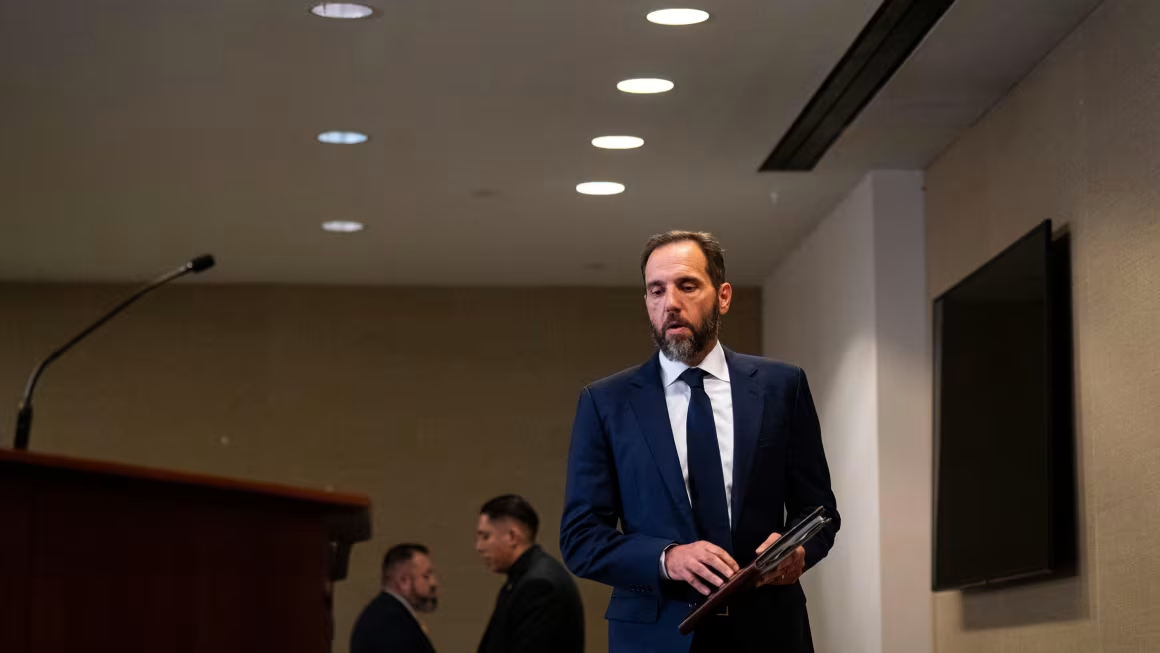
In a stunning development with far-reaching political implications, the U.S. Office of Special Counsel (OSC) has officially launched an investigation into Jack Smith, the former special counsel who led the federal prosecutions of former President Donald J. Trump. The inquiry, announced over the weekend, centers on allegations that Smith may have violated the Hatch Act, a federal law that prohibits government officials from engaging in partisan political activity while performing their official duties.
The OSC, an independent federal investigative and prosecutorial agency responsible for enforcing the Hatch Act, confirmed to several news outlets—including The Hill, Fox News, and Reuters—that it is now examining complaints lodged by Republican lawmakers about Smith’s conduct during his tenure leading high-profile investigations into the 45th president. These investigations began shortly after Attorney General Merrick Garland appointed Smith in November 2022—just three days before Trump formally declared his candidacy for the 2024 presidential election.
While the OSC declined to provide specific details regarding the scope of the probe, a spokesperson stated that “appropriate steps are being taken to evaluate potential violations of the Hatch Act or other misconduct involving Mr. Smith.”
The timing of the announcement has reignited fierce partisan debate over the integrity and neutrality of the Justice Department and the role of special prosecutors in politically sensitive cases.
The Allegations and GOP Response
Leading the charge is Senator Tom Cotton (R-AR), who has openly accused Smith of wielding his prosecutorial power for political ends. In a strongly worded post on X (formerly Twitter), Cotton alleged, “Jack Smith’s legal actions were nothing more than a tool for the Biden and Harris campaigns. This isn’t just unethical—it is very likely illegal campaign activity from a public office.”
Cotton further pointed to Smith’s push for an “unprecedented and rushed” trial schedule—seeking jury selection just two weeks before the Iowa GOP caucuses—as evidence of politically motivated intent. “No other case of this magnitude and complexity would come to trial this quickly,” he said.
Other conservative lawmakers, including Sen. J.D. Vance (R-OH) and Rep. Elise Stefanik (R-NY), have echoed Cotton’s sentiments, calling for sweeping reviews of the Justice Department’s prosecutorial discretion and accusing it of being “weaponized” against political opponents.
Smith, a veteran prosecutor and former head of the DOJ’s Public Integrity Section, has firmly denied any improper conduct. In a final report issued in January 2025 before his resignation, Smith maintained that “the ultimate decision to bring charges against Mr. Trump was mine alone.”
“To all who know me well, the claim from Mr. Trump that my decisions as a prosecutor were influenced or directed by the Biden administration or other political actors is, in a word, laughable,” Smith wrote in the report.
His report detailed what he called a “throughline of deceit,” accusing Trump of knowingly spreading false claims about election fraud and obstructing a constitutionally mandated process. “Until Mr. Trump obstructed it, this democratic process had operated in a peaceful and orderly manner for more than 130 years,” he wrote.
After Trump’s victory in the 2024 presidential election, Smith stepped down from his role and ultimately dismissed charges against the president-elect, citing political and logistical barriers to achieving a conviction.
Pam Bondi Cleans House
Adding more intrigue to the already politically charged case, newly appointed Attorney General Pam Bondi fired 20 Justice Department employees who were reportedly tied to Smith’s investigations just weeks before the OSC announced its inquiry. While the DOJ has not publicly commented on the dismissals, sources told Politico and Axios that Bondi’s team is reviewing all DOJ prosecutions initiated during the Biden administration.
Bondi, a close Trump ally and former Florida attorney general, has previously criticized what she described as “a two-tiered justice system” and vowed to restore impartiality at the Department of Justice.
The Hatch Act of 1939 prohibits executive branch employees from using their official authority to influence elections or engage in partisan political activity. Violations can result in disciplinary actions including suspension, removal from federal service, or referral for criminal prosecution if warranted.
While the OSC does not have direct prosecutorial power, it can submit its findings to the DOJ’s Office of the Inspector General or Office of Professional Responsibility, or recommend sanctions to federal agencies.
Legal experts say proving a Hatch Act violation in Smith’s case may be difficult. “You’d have to show not just political impact, but political intent,” said Paul Rosenzweig, a former DHS official and senior fellow at the R Street Institute, speaking to NPR. “The threshold is very high.”
A Broader Political Battle
The investigation into Jack Smith is yet another chapter in the intensifying legal-political drama engulfing Washington, where partisanship increasingly clouds public perception of the justice system. While Democrats accuse Republicans of undermining the rule of law, the GOP sees a pattern of political targeting that must be rooted out.
On the campaign trail, Trump has repeatedly referred to Smith as “deranged” and painted his prosecution as part of a “deep state conspiracy.” Meanwhile, Democrats have accused the former president of trying to evade accountability for actions that culminated in the January 6, 2021, Capitol riot.
The OSC’s investigation is expected to unfold over the coming months, though no specific timeline has been set. Depending on the outcome, the case could either vindicate Smith—or add fuel to Republican arguments of DOJ corruption and abuse.
As 2026 approaches, and with President Trump now back in office, the results of this inquiry could reshape the public’s understanding of the relationship between law enforcement and electoral politics for years to come.