What should have been a peaceful drive down a scenic California mountain road turned into a harrowing life-or-death struggle for 69-year-old retired radiologist Dr. Peter Rothschild, whose Volvo XC90 plug-in hybrid suddenly lost its ability to brake. With dashcam footage capturing every moment of the escalating crisis, the terrifying incident is now at the center of a nationwide recall affecting nearly 12,000 Volvo vehicles — and raising serious questions about the automaker’s safety practices and software deployment. Volvo VOLV -4.10% ▼
On a steep descent along Corona Road in Carmel Highlands, Rothschild’s Volvo — equipped with Volvo’s latest software version 3.5.14 — began to accelerate uncontrollably, defying the driver’s repeated attempts to brake. As his vehicle gained speed, Rothschild made a split-second decision that likely saved his life: he steered into an embankment, intentionally crashing the vehicle to avoid flying off the mountainside.
“The last thing you want to do is panic, but this was a scary road and without brakes it’s very scary,” Rothschild told The Wall Street Journal. “This wasn’t my fault. This was Volvo’s fault.”
A Preventable Catastrophe


Unbeknownst to Rothschild — or the dealership that recently serviced his vehicle — his XC90 had been affected by a serious software flaw introduced in a prior update. The issue, tied to regenerative braking systems and use of “B-mode” or “One Pedal Drive,” could cause a complete loss of braking function after coasting downhill for over 90 seconds.
According to Volvo Cars USA, the problem arose when a recall for a rearview camera defect was bundled with other system updates — updates which inadvertently introduced a new critical braking bug.
Volvo now admits that around 11,500 vehicles out of more than 400,000 updated units may have been affected by the glitch.
“We are treating this issue very seriously and doing everything we can to update all impacted vehicles as soon as possible,” the company said in a statement.

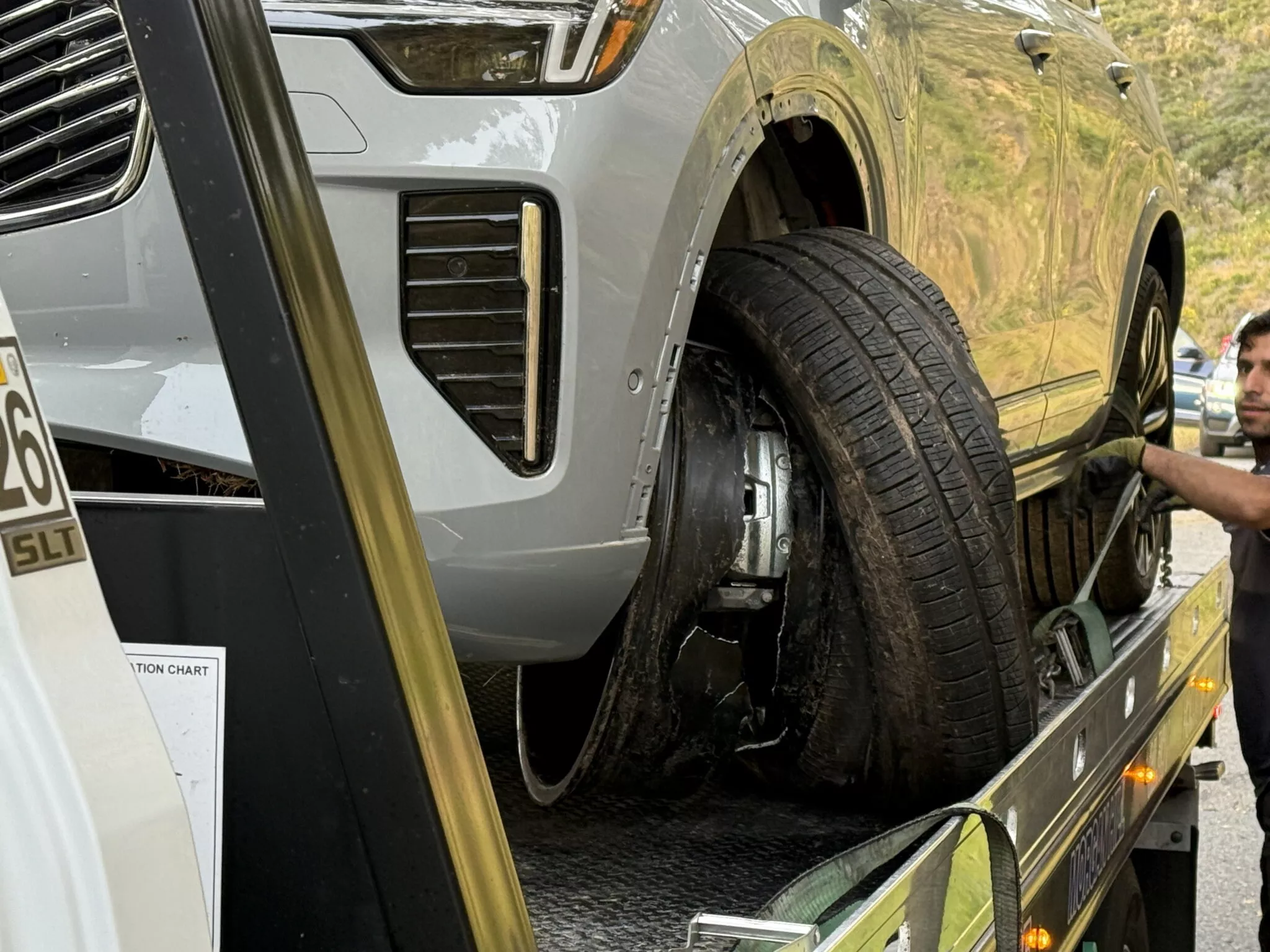
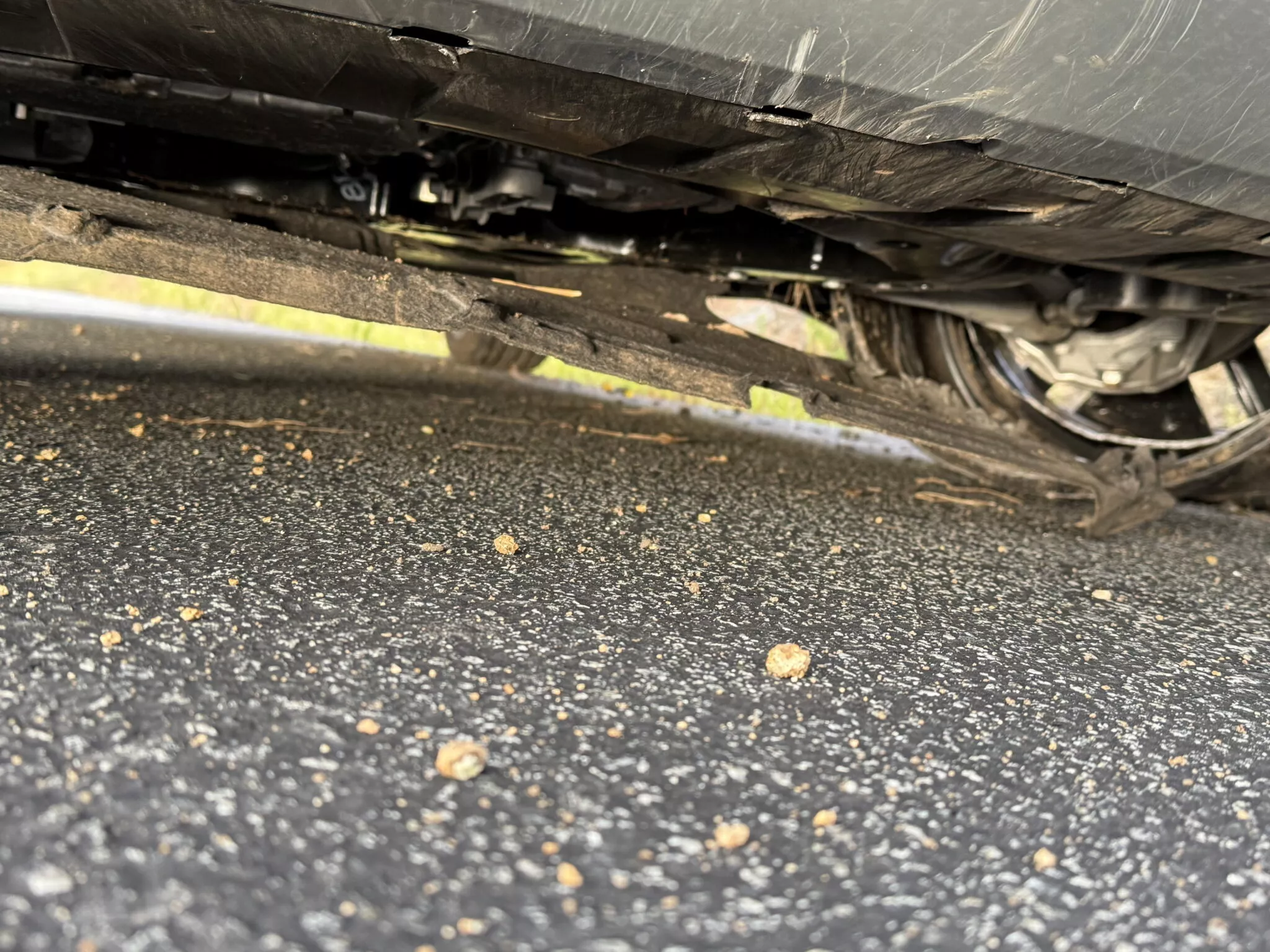

Photos and video provided to © Carscoops by the owner.
The Horror Caught on Camera
Dashcam footage reviewed by Carscoops shows Rothschild’s Volvo XC90 speeding uncontrollably down a narrow road. Despite visible brake pedal application — confirmed later through vehicle data logs — the SUV accelerates, passing the one-minute-and-forty-second mark without slowing down.
Data from the vehicle’s onboard recorder shows that brake input was consistent, and no throttle was applied. However, the vehicle did not respond. Faced with a fatal drop just ahead, Rothschild drove the SUV into a dirt embankment. The side airbags deployed, and the front suspension and wheel were shattered on impact. The wheel itself split into pieces, according to post-crash photos.
Fortunately, no one was injured, but the psychological toll was real.
“I don’t think I would’ve made the next curve and would’ve gone off the side,” Rothschild said. “I’ve driven Volvos since the 1980s, spent close to a million dollars on them over the years. But I’m done.”
More Than Just One Incident
Rothschild’s terrifying ride isn’t the only one. Carscoops confirmed at least three similar reports of brake loss under similar conditions, all tied to software version 3.5.14 — the same update Rothschild received just hours before his crash. In another case, a California driver (referred to as “Max”) experienced nearly identical circumstances in his two-month-old XC90 Recharge.
“I was forced to steer off the road into the side of a hill to avoid going over a cliff,” Max said.
After inspecting Max’s vehicle, a forensic crash reconstruction engineer found “no throttle input, full brake input, increasing speed — the brakes were clearly not functioning.” The post-crash analysis left little room for doubt: the failure was systemic.
In June, Volvo initially warned owners of nine different models not to use B-mode or One Pedal Driving — driving modes typically associated with enhanced regenerative braking and energy efficiency.
Affected models (2020–2026): XC90, XC60, XC40, S60, V60, S90, EX40, EC40, C40
By July, the automaker escalated its warning, urging all affected vehicle owners to visit a dealer immediately to receive the fixed software — or risk losing braking altogether.
As of this week, Volvo said roughly 600 vehicles still haven’t been updated. Owners are being told not to use certain driving modes until the patch is installed.
Yet critics argue Volvo’s handling of the issue has been slow and opaque. Despite Carscoops’ repeated inquiries, Volvo has not provided a full incident chronology, nor explained why the software was distributed without more rigorous testing.
Brand Reputation at Risk
Volvo has built its legacy on safety innovation — from pioneering the three-point safety belt to its much-lauded commitment to zero fatalities in new Volvo cars. But this latest software snafu could tarnish that brand trust, especially among loyalists like Rothschild.
“We almost died and they don’t even say they’re sorry,” Max said. “It’s a lame response from a company that built its name on protecting people.”
Rothschild echoed the sentiment. “This isn’t just about fixing a car. This is about trust. You expect a Volvo to protect you, not betray you.”
Volvo says that a software fix is already available and urges customers to update immediately. The fix can be installed over-the-air or at authorized dealerships.
Until those answers are provided — and all affected cars are fixed — Volvo’s crisis may continue to deepen.
Rothschild, who once proudly passed his love of Volvo on to his children, says he’s now shopping for a Tesla instead.
“Safety shouldn’t be a gamble,” he said. “This isn’t a minor bug. This was nearly a death sentence.”
What to Do If You Own an Affected Volvo
If you own a 2020–2026 Volvo plug-in hybrid or EV, check whether your vehicle is part of the recall using the NHTSA Recall Lookup Tool or contact your local dealer. If your car is running software version 3.5.14, avoid B-mode and One Pedal Drive until the fix is installed.