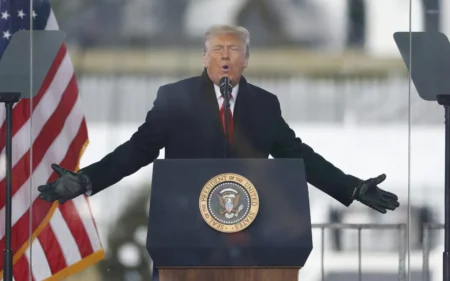

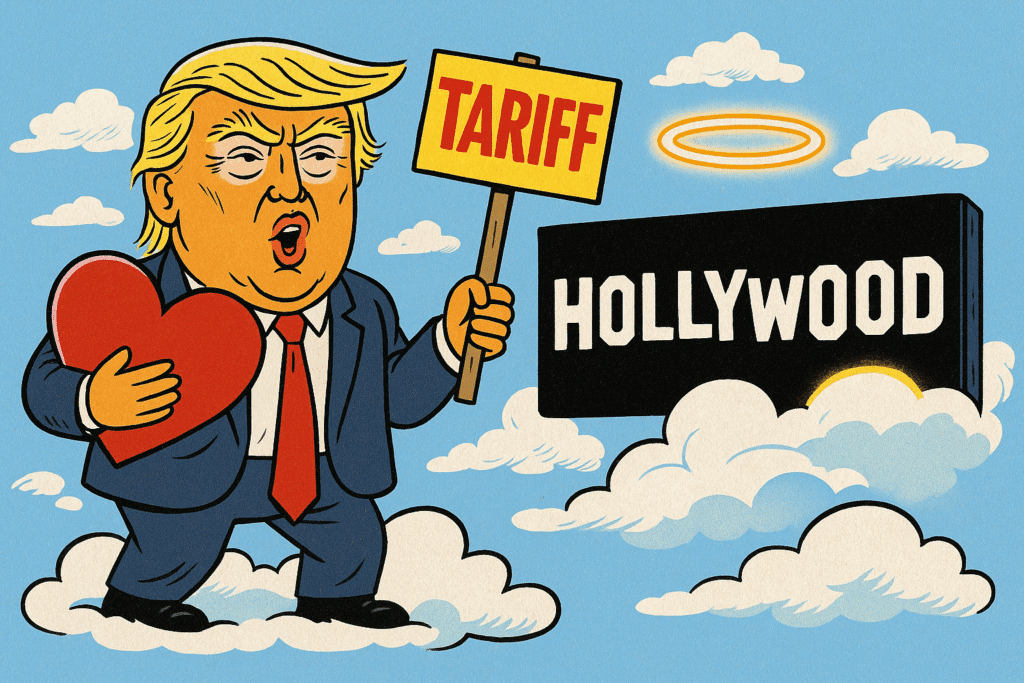
President Donald Trump called for a 100 percent tariff on movies produced overseas in a Truth Social post Sunday night, confounding studio executives and critics about what this could mean for the heavily globalized film industry.
“The Movie Industry in America is DYING a very fast death,” the president wrote Sunday night. “This is a concerted effort by other Nations and, therefore, a National Security threat. It is, in addition to everything else, messaging and propaganda!” he wrote. “Therefore, I am authorizing the Department of Commerce, and the United States Trade Representative, to immediately begin the process of instituting a 100% Tariff on any and all Movies coming into our Country that are produced in Foreign Lands. WE WANT MOVIES MADE IN AMERICA, AGAIN!”
“We’re on it,” U.S. Commerce Secretary Howard Lutnick wrote in an X post Sunday night.
On Monday, White House spokesman Kush Desai said via email: “Although no final decisions on foreign film tariffs have been made, the Administration is exploring all options to deliver on President Trump’s directive to safeguard our country’s national and economic security while Making Hollywood Great Again.”
The president’s claim that foreign movies represent a national security threat suggests that he may rely on a provision of a 1962 trade law that he has used in the past to impose tariffs on goods such as steel and aluminum. Under Section 232 of that law, the Commerce Department would have up to 270 days to complete an investigation of the alleged danger to national security caused by importing foreign films. At the conclusion of that probe, the president could impose tariffs.
Trump expanded his comments while speaking to reporters on Sunday. “Other nations have been stealing the movies — the moviemaking capabilities from the United States,” he said, according to video footage from C-SPAN.
“I’ve done some very strong research over the last week, and we’re making very few movies now,” the president said.
“Hollywood is being destroyed,” he added. “Other nations have stolen our movie industry. If they’re not willing to make a movie inside the United States, we should have a tariff on movies that come in.”
Trump cited governments that are “giving big money” to fund foreign-made films as a “sort of a threat to our country in a sense.”
Trump did not offer any specifics about which type of films this would impact. It remains unclear if these tariffs would apply to just foreign films, American-made films shot on location abroad, blockbusters involving postproduction overseas or other examples of cross-border production. It’s also unclear if any tariff would apply to television shows.
American-made films are often shot overseas in places like Canada, the United Kingdom and Australia, which offer incentives for productions to film there. Recent and upcoming tentpole movies, such as “A Minecraft Movie,” “Mission Impossible — The Final Reckoning” and “Jurassic World Rebirth,” were mostly or entirely filmed overseas. London has become a central locale for American-made films. Marvel’s next “Avengers” sequels are in production there.
It’s unclear how the Trump administration would apply a tariff on foreign-produced films, since movies can be considered a service, not physical goods. It’s also unclear what the value of movies are and what the criteria would be to identify films as an import.
The 2025 superhero film “Thunderbolts*,” for example, “was mostly shot in Georgia, Utah, and New York, but also had a scene shot in Malaysia,” raising questions about how big a tariff would be in such a case, according to an analyst report from Roth Capital Partners.
The uncertainty over how one would apply tariffs to the contemporary film industry is further complicated by the rise of streaming and global distribution in media, said Jennifer Porst, a professor of film and media at Emory University who studies the industry. A platform like Netflix “is not like a theatrical model where you could tax the box office,” she said. “You have subscriptions and advertising revenue … how does that directly correlate to any one movie or TV show?”
Expanding Trump’s second-term trade war to include services opens the United States to potentially punishing foreign retaliation. While the U.S. has long run a deficit in merchandise trade with the rest of the world, Americans routinely sell foreign customers more services than they buy.
Last year, the U.S. enjoyed a nearly $300 billion surplus in services trade. If the president persists with his plans to tax foreign-produced services such as films, U.S. trading partners could retaliate by erecting new barriers to U.S. films or other services related to travel, finance or insurance.
The American movie industry had $22.6 billion in exports and a $15.3 billion trade surplus in 2023 — including positive surpluses in every major foreign market — according to the Motion Picture Association’s latest economic impact report. The MPA declined to comment.
Shares in major media and entertainment companies fell shortly after markets opened Monday but recovered. Paramount, Netflix and Warner Bros. Discovery were down less than 2 percent by early afternoon, and Comcast and Disney were up slightly.
Leaders from hubs of film production — both domestically and abroad — reacted strongly to Trump’s announcement.
“We believe he has no authority to impose tariffs under the International Economic Emergency Powers Act, since tariffs are not listed as a remedy under that law,” Bob Salladay, senior adviser for communications to California Gov. Gavin Newsom (D), told Deadline on Sunday night.
“Nobody should be under any doubt that we will be standing up unequivocally for the rights of the Australian screen industry,” Australia’s home affairs minister, Tony Burke, said, according to Reuters.
“We’ll have to see the detail of what actually ultimately emerges. But we’ll be obviously a great advocate, great champion of that sector and that industry,” New Zealand Prime Minister Christopher Luxon told reporters.
Studio executives were left confused Sunday night by Trump’s announcement, according to the Wall Street Journal. Producers and industry veterans sounded off with fiery reactions, while critics suggested Trump doesn’t have the authority to impose tariffs on informational material related to films and artwork.
“A big part of this is what constitutes U.S. film. Is it where the money comes from, the script, the director, the talent, where it was shot?” Tim Richards, CEO and founder of the U.K.-based movie theater chain Vue Entertainment, told BBC Radio 4’s “Today” program on Monday.
Producer Randy Greenberg wrote in a LinkedIn post Sunday that tariffs would hurt Hollywood. “Putting a tariff on Movies shot outside the US will increase the cost of shooting and the studios will lobby the Exhibitors to raise ticket prices and then the audience will skip the theatre and then … well you see where this is going,” he wrote.


Some analysts said tariffs could damage Hollywood at a time when it’s only beginning to collectively bounce back after covid-19 and 2023 labor strikes led to work stoppages.
Annual television production shot in Los Angeles declined 58.4 percent between 2021 and 2024, according to FilmLA, a not-for-profit that promotes on-location filmmaking in the region. Feature film production was up about 20 percent in 2024 but still down 27.6 percent from its five-year average, FilmLA found. While spending on U.S. film production has declined since 2022, it has increased in Canada, the United Kingdom, Australia and New Zealand, according to ProdPro, a research firm that tracks production data.
Tariffs would make many blockbuster movies shot abroad “financially unfeasible,” the Roth Capital Partners’ note said.
Large studios and distributors currently carry significant risk, according to a Wedbush analyst note. About 75 percent of Netflix’s content is produced internationally, the note estimated.
Trump has tapped several well-known film industry conservatives since taking back the White House, naming Jon Voight, Mel Gibson and Sylvester Stallone his “special ambassadors” to Hollywood. (Voight and Stallone did not respond to requests for comment.)
According to Deadline, Voight has been spending time with unions and moviemakers to see what problems they face in domestic production. Voight has reportedly been pushing a plan to revive Hollywood that included a foreign tax incentive, per Deadline.
Trump’s ambassadors might face a film production tariff themselves — Gibson’s upcoming “Passion of the Christ” sequel is expected to start shooting in Italy this summer. Gibson’s team declined to comment.
The announcement from Trump comes amid his administration’s attempt to reshape America’s arts and culture landscape. He now leads the Kennedy Center as its chairman after ousting many of its board members. Meanwhile, the National Endowment for the Arts, the National Endowment for the Humanities, the Institute of Museum and Library Services and the Corporation for Public Broadcasting have all faced changes as Trump has sought to redirect their funds or cut their budgets entirely.
Filming abroad is not new but has increased in recent years, due in part to labor strikes in the U.S. that led to work stoppages in 2023, and the increasingly global nature of production companies like Netflix, Porst said. There are also contract provisions in the U.S. that can make production more expensive than filming abroad, she said.