
Close Menu
The New York BudgetsThe New York Budgets
  • Latest
  • Politics
    • World & Politics
    • US Politics
      • U.S. Administration
      • Donald Trump
    • UK
    • Middle East
      • Middle East Tensions
    • Russia-Ukraine War
  • Business
  • Economy
  • Opinion
  • AI & Tech
  • New York
  • US NEWS
  • Climate
  • Health
  • Entertainment
  • Tech
  • Media
  • Tariffs
  • US NEWS
  • Economic Policy
  • Trade
  • New York
  • Investment
  • Social Media
  • Hollywood
  • Real Estate
  • Health
  • Asia
  • Automotive
  • Food
  • Crime
  • Movies
  • Bankruptcy
  • Cryptocurrency
  • Education
  • National
  • Airlines
  • Religion And Culture
  • Internet
  • UK News
  • Private Equity
  • Financial
  • Retail
  • Markets
  • Store
  • Climate
  • India-Pakistan Tensions
  • Medical
  • Commodities
  • Aviation
  • e-commerce
  • e-commerce
  • Streaming
  • Investing
  • Sports
  • Style & Art
  • Ukraine Conflict
  • Stock Market
  • Oil and Gas
  • International
  • Europe
  • Language
  • Asia
  • Video
  • Podcast
  • Magazine
The New York BudgetsThe New York Budgets
SUBSCRIBE
  • Latest Headlines
  • Politics
  • Economy
  • Opinion
  • Tech
  • Style & Art
  • Sports
  • Climate
  • Investigative Journalism
The New York BudgetsThe New York Budgets
  • Latest Headlines
  • Politics
  • Economy
  • Opinion
  • Tech
  • Style & Art
  • Sports
  • Climate
  • Investigative Journalism
Media US Politics

The President’s Office Wants Congress to Take Away Funding From NPR and PBS

Jeniffar WhightBy Jeniffar WhightApril 15, 20250
Facebook Twitter LinkedIn WhatsApp Bluesky Telegram Email Copy Link
Calls to defund public media have grown louder in part because of Elon Musk. | Anna Moneymaker/Getty Images
WASHINGTON, DC - FEBRUARY 18: A view of the National Public Radio (NPR) headquarters on North Capitol Street on February 18, 2025 in Washington, DC. The U.S. House of Representatives panel working with the Department of Government Efficiency (DOGE) recently sent a letter to the heads of both NPR and Public Broadcasting Service (PBS) demanding that they appear to testify on Capitol Hill regarding alleged improper use of government funding. (Photo by Anna Moneymaker/Getty Images)

The White House is planning to ask Congress to claw back more than $1 billion slated for public broadcasting in the United States, according to two people briefed on the plan, a move that could ultimately eliminate almost all federal support for NPR and PBS.

The plan is to request that Congress rescind $1.1 billion in federal funding for the Corporation for Public Broadcasting, the taxpayer-backed company that funds public media organizations across the United States, one of the people said. If Congress agrees, that will amount to about two years of the organization’s funding, nearly all of which goes to public broadcasters including NPR, PBS and their local member stations. The Trump administration isn’t planning to ask Congress to claw back about $100 million allocated for emergency communications.

Government money accounts for a small part of the budgets at NPR and PBS, which also generate revenue through sponsorships and donations. Most of the government funding goes to local stations, which rely on it to finance their newsrooms and pay for programming.

The proposal would be part of a broader rescission package, a formal request to Congress to rescind previously approved funds, that would also eliminate billions allocated to foreign aid, the two people said. The process is established under law, which gives the House and Senate 45 days to vote to approve the request after it is submitted. The White House plans to submit this rescission request in the coming weeks, the people said. If Congress does not approve the rescission request, the money must be spent as originally intended.

The Trump administration’s proposal to defund public broadcasting comes amid sustained pressure on NPR and PBS from Republicans in Congress, who have intensified long-running attacks on the broadcasters. The chief executives of both organizations testified before Congress last month in a fiery hearing that played out along mostly partisan lines: Republicans assailed the executives for what they saw as liberal bias, and Democrats argued that the proceeding was a waste of time.

The ask would also be the latest move by the Trump administration to exert pressure on media organizations. The administration is waging a legal battle with The Associated Press over its decision to exclude the wire service from the presidential press pool, breaking decades of precedent. Mr. Trump is also personally suing CBS News and The Des Moines Register, and the Federal Communications Commission has launched investigations into Comcast, PBS and NPR.

Spokespeople for the Corporation for Public Broadcasting, PBS and NPR declined to comment.

The Corporation for Public Broadcasting is “forward-funded” two years to insulate it from political maneuvering, and a sizable chunk of the money for 2025 has already been paid out to public broadcasters in the United States, according to a person familiar with the matter.

Public media executives have been planning for the possibility of having public funding clawed back for months. According to a document prepared by station directors this past fall, the immediate elimination of funding, while unlikely, would be “akin to an asteroid striking without warning.”

“It is the highest risk scenario especially in a time in which the media ecosystem is rapidly changing,” the document said.

Public media defenders say rural audiences would be hit the hardest if funding was cut from NPR and PBS stations. In very remote areas without broadband access, public radio and TV are among the few sources of news and entertainment.

But those in favor of defunding say advances in technology have made those services obsolete. In an interview last month, Representative Marjorie Taylor Greene, Republican of Georgia, said residents in rural parts of her district had enough access to cellphone and internet services to keep them informed.

“The bottom line here: NPR and PBS only have themselves to blame,” said Mike Gonzalez, a fellow at the Heritage Foundation who has argued publicly for defunding public media. “For the last 50 years, every Republican president has tried to defund them or reform them.”

In 2011, NPR executives produced a secret report that explored what would happen if government funding was eliminated. According to the report, up to 18 percent of roughly 1,000 member stations across the United States would close, and $240 million would vanish from public radio. Stations in the Midwest, the South and the West would be most affected, and roughly 30 percent of listeners would lose access to NPR programming.

One potential upside, according to the document: Cutting off federal funding would galvanize public radio supporters, leading to a sudden surge in donations to stations across the United States.

NPR PBS Politics Trump Presidency United States
Jeniffar Whight
Jeniffar Whight

    Jeniffar Whight is a seasoned market news writer, author, and financial columnist who has been covering the financial world since 2009. Her work spans a wide range of topics including the stock market, shares, banking, finance, personal finance, and real estate. Known for her clear, insightful reporting, Jeniffar also dives deep into company market trends, the history of the automotive and food industries, and the evolving landscape of corporate finance. With a sharp analytical approach and a strong storytelling voice, she helps readers make sense of complex financial systems and market dynamics. Whether writing about Wall Street, Main Street, or the global real estate scene, Jeniffar brings knowledge, perspective, and reliability to every story.

    What to Read Next

    A sign for The Washington Post is seen at the company's offices Jan. 26, 2026, in Washington. (Mark Schiefelbein/AP)

    Washington Post Publisher Will Lewis Steps Down After Major Layoffs

    February 8, 2026
    Iran's Foreign Minister Abbas Araghchi speaks during the Al Jazeera Forum in Doha on February 7, 2026. (Karim JAAFAR / AFP)

    Iran Rejects U.S. Pressure, Vows to Continue Uranium Enrichment

    February 8, 2026
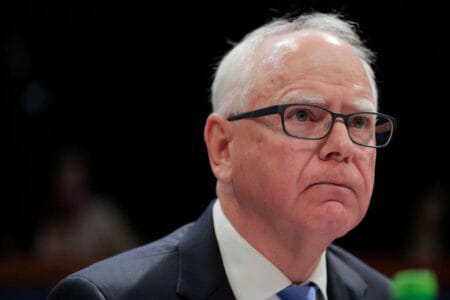
    Minnesota Gov. Tim Walz listens during a hearing with the House Oversight and Accountability Committee at the U.S. Capitol on June 12, 2025, in Washington, D.C. (Anna Moneymaker / Getty Images)

    Lawmakers Warn $30 Billion Welfare Program Is Vulnerable to Abuse

    February 8, 2026
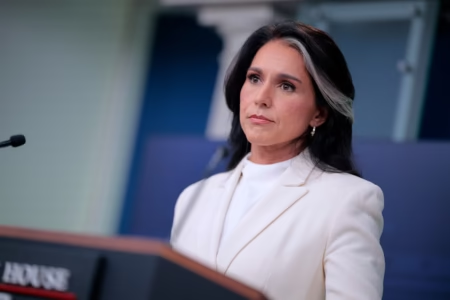
    Director of National Intelligence Tulsi Gabbard talks to reporters in the Brady Press Briefing Room at the White House on July 23, 2025 in Washington, DC. (Chip Somodevilla/Getty Images)

    Whistleblower Complaint Against Gabbard Tied to Intercepted Foreign Call

    February 7, 2026
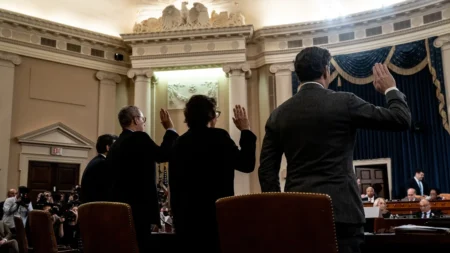
    Three law experts called by Democrats on the House Judiciary Committee and one called by Republicans provided contrasting judgments of the case for impeachment against President Trump. (The New York Times)

    How a $30 Billion Welfare Program Turned Into a ‘Slush Fund’ for States

    February 7, 2026
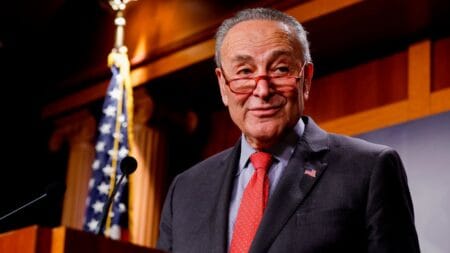
    Senate Majority Leader Chuck Schumer speaks at a news conference on the Senate Democrats expanded majority for the next 118th Congress at the U.S. Capitol Building on December 07, 2022. (Anna Moneymaker/Getty Images)

    Democrats Lay Out Conditions for Approving ICE and DHS Funding

    February 6, 2026
    Add A Comment
    Leave A Reply Cancel Reply

    Facebook X (Twitter) Instagram Pinterest
    © 2026 ThemeSphere. Designed by ThemeSphere.

    Type above and press Enter to search. Press Esc to cancel.

    Go to mobile version