Tag: U.S. Military

  • United States and Israel Target Iranian Leadership in Coordinated Military Action

    United States and Israel Target Iranian Leadership in Coordinated Military Action

    The United States and Israel carried out military strikes on Iran on Saturday, targeting its top leaders and plunging the Middle East into a conflict that President Donald Trump said would end a security threat to the U.S. and give Iranians a chance to topple their rulers.

    Tehran called the attacks unprovoked and illegal, and responded by launching missiles at Israel and at several Gulf Arab allies of the United States that host American bases.

    It promised a stronger response to come, with a senior Iranian Revolutionary Guards commander, Ebrahim Jabbari, saying it had so far used only “scrap missiles” and would soon unveil unforeseen weapons, state television reported.

    Iran’s Defence Minister Amir Nasirzadeh and Revolutionary Guards commander Mohammed Pakpour were killed in Israeli attacks, three sources familiar with the matter said.

    Explosions rang out in nearby oil-producing Gulf Arab countries, which said they had intercepted missiles after Tehran warned it would strike the region if it was attacked.

    The first wave of strikes in what the Pentagon named “OPERATION EPIC FURY” mainly targeted Iranian officials, a source familiar with the matter said, two days after indirect talks mediated by Oman failed to produce a breakthrough on Iran’s nuclear programme.

    An Israeli official said Iranian Supreme Leader Ayatollah Ali Khamenei and President Masoud Pezeshkian were both targeted but the result of the strikes was not clear. A source with knowledge of the matter had earlier told Reuters that Khamenei was not in Tehran and had been transferred to a secure location.

    An Iranian source close to the establishment said several senior commanders in Iran’s Revolutionary Guards and political officials had been killed. Forty people were killed in an Israeli airstrike on a school, state media said. Reuters could not independently confirm the reports.

    Trump Says ‘Bombs will be dropping everywhere’

    In a video message published on social media, Trump cited Washington’s decades-old dispute with Iran, including the seizure of the 1979 U.S. embassy in Tehran, when students held 52 Americans hostage for 444 days, as well as a range of other attacks the U.S. has blamed on Iran since the 1979 Islamic revolution brought the clerics to power.

    Trump, who had deployed vast U.S. military firepower in the region saying he hoped to force Iranian concessions in nuclear talks, said the “massive” operation was intended to ensure Tehran does not obtain a nuclear weapon and was aimed at “eliminating imminent threats from the Iranian regime”.

    He urged Iranians to stay sheltered because “bombs will be dropping everywhere”. But he added: “When we are finished, take over your government. It will be yours to take. This will be probably your only chance for generations.”

    Israeli Prime Minister Benjamin Netanyahu said the joint U.S.-Israeli attack “will create the conditions for the brave Iranian people to take their destiny into their own hands” and “remove the yoke of tyranny”. Defence Minister Israel Katz called it a pre-emptive strike to remove threats to Israel.

    Iran’s clerical leaders were already in a difficult position after mass anti-government demonstrations in January, which led to a crackdown in which thousands of people were killed, the worst domestic unrest since the era of the 1979 revolution.

    Protesters had again taken to the streets in recent days in remembrance of those killed the previous month.

    Israeli military operations have killed some of Iran’s senior military officials and severely weakened several of Tehran’s once-feared proxy forces across the Middle East.

    After Israel pounded Iran in a 12-day air war last June joined by the United States, the U.S. and Israel had warned that they would strike again if Iran pressed ahead with its nuclear and ballistic missile programmes. The threats were backed up in recent weeks by a U.S. military buildup in the region.

    An Israeli defence official said the operation had been planned for months in coordination with Washington, and that the launch date was decided weeks ago.

    Israel’s military said its Air Force had identified Iranian operatives in western Iran loading a missile unit and preparing to launch an attack. The Air Force struck the operatives and the launcher, preventing the attack, it said.

    U.S. air defences intercepted and shot down a drone over a U.S. military base near Erbil in Iraq.

    The renewed confrontation dimmed hopes of a diplomatic solution to Tehran’s nuclear dispute with the West. Oil markets have been closely watching the standoff between Washington and Tehran to try and determine if supplies will be impacted.

    “If we don’t see signs of de-escalation over the weekend, risk premiums could still drive Brent up” by $10–$20 per barrel when markets reopen on Monday, said Jorge Leon, head of geopolitical analysis at Rystad Energy.

    Iran, the third largest producer in the Organization of the Petroleum Exporting Countries, pumps about 4.5% of global oil supplies, and a far larger share is shipped past its coast through the strait leading out of the Gulf.

    Iran’s Revolutionary Guards said all U.S. bases and interests in the region were within Iran’s reach and that Iran’s retaliation would continue until “the enemy is decisively defeated”. Iraq’s Iran-aligned armed group Kataib Hezbollah said it would soon attack U.S. bases in the region.

    Saudi Arabia’s Crown Prince Mohammed bin Salman called United Arab Emirates President Sheikh Mohammed bin Zayed Al Nahyan to discuss the on countries in the region and expressed solidarity, the UAE state news agency said.

    Loud booms sounded in Abu Dhabi, capital of the United Arab Emirates, an oil producer and close U.S. ally, and several blasts were heard in the business capital Dubai.

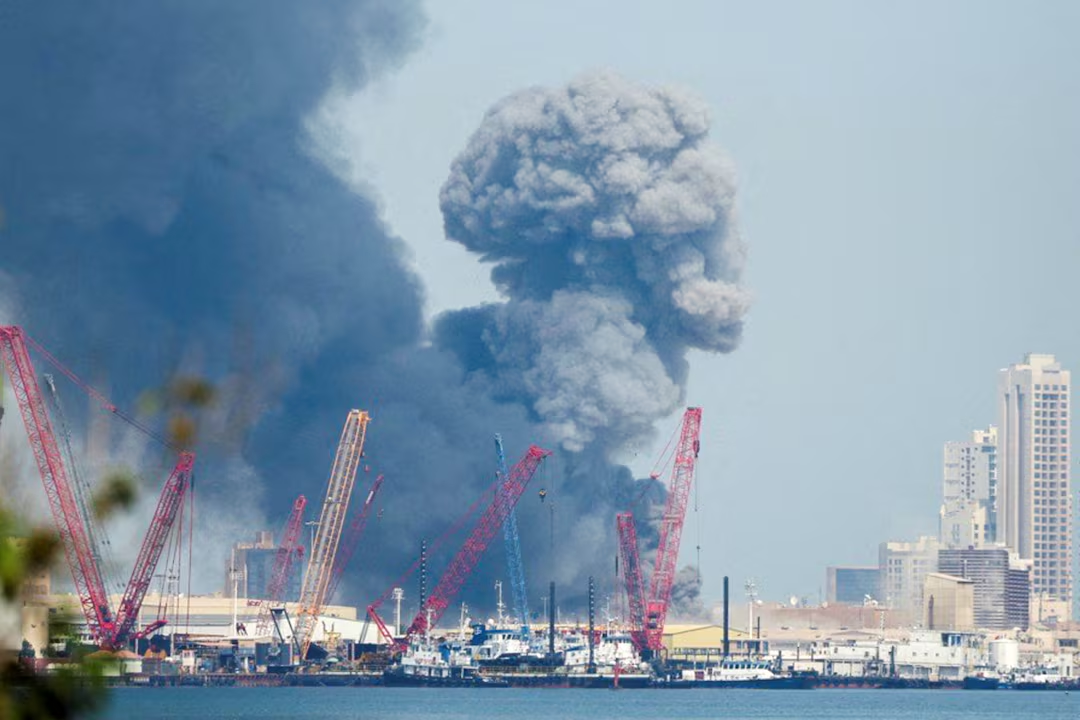
    Bahrain said the service centre of the U.S. Fifth Fleet – base for American naval forces in the region – had been subjected to a missile attack. Video footage showed a thick grey plume of smoke rising from near the island state’s coastline as sirens wailed.

    Qatar said it had downed all missiles targeting the country and that it had a right to respond. Kuwait confirmed a missile attack on a U.S. military base there.

    An explosion was heard in Iran’s southeastern port city of Chabahar, Iranian state media reported.

    Israel’s military did not immediately respond to a request for comment on the report of a strike at a primary school for girls in southern Iran, where Iranian state media reported 40 deaths.

    In Israel, police said all holy sites were closed to visitors under national emergency guidelines after authorities announced several barrages of missiles were launched from Iran.

    Global airlines cancelled flights across the Middle East and the attacks raised the prospect of oil prices rising. Some oil majors and trading houses suspended crude oil and fuel shipments via the Strait of Hormuz, four trading sources said.
  • Satellite Images Reveal U.S. Military Deployments Near Iran

    Satellite Images Reveal U.S. Military Deployments Near Iran

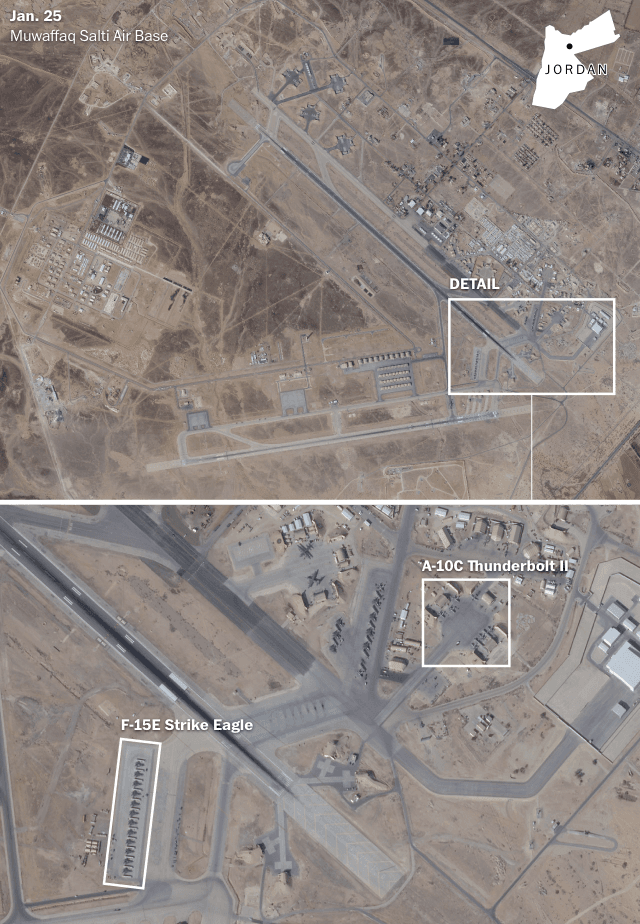
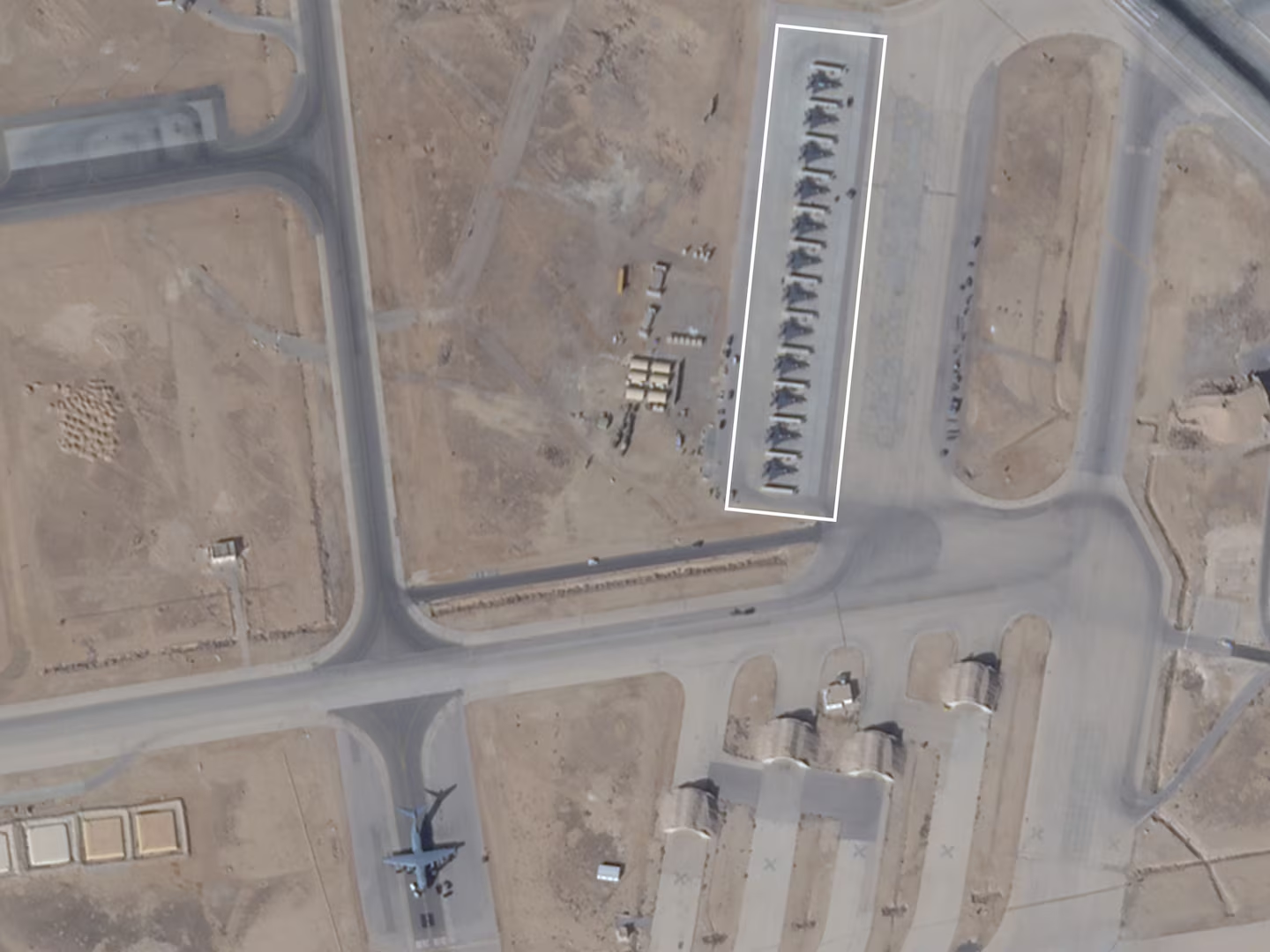
    Satellite imagery captured on Jan. 25 shows at least a dozen F-15E attack planes at Muwaffaq Salti Air Base in Jordan. (Planet Labs)

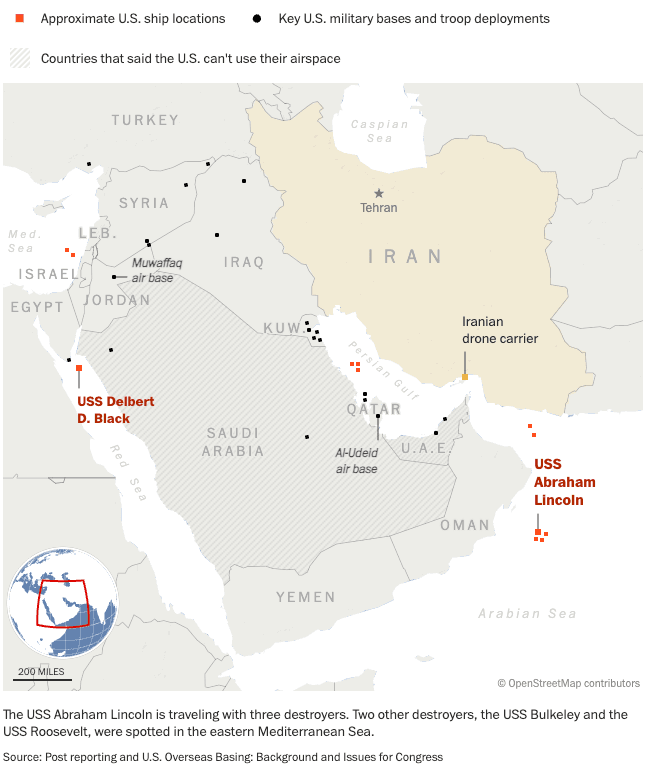
    In the shimmering haze of the Arabian Sea, where oil tankers carve silent paths through contested waters, a new specter looms: the unmistakable silhouette of American military might. Fresh satellite imagery, obtained from commercial providers like Planet Labs and corroborated by open-source tracking data, paints a chilling picture of Washington’s accelerating deployments encircling Iran. Dozens of fighter jets—F-15Es, A-10 Thunderbolts, and stealthy F-35s—now crowd airbases in Jordan, Qatar, and the UAE. The USS Abraham Lincoln carrier strike group, flanked by guided-missile destroyers bristling with Tomahawks, prowls the North Arabian Sea. At least a dozen warships, including electronic warfare vessels like EA-18G Growlers, have converged on the region since mid-January, transforming the Middle East into a powder keg primed for ignition.

    This buildup, far exceeding the targeted strikes on Iran’s nuclear sites last summer, reeks of neoconservative adventurism—a reckless echo of the Iraq War playbook that could drag the U.S. into another endless quagmire. Analysts warn it’s not just about deterrence; it’s a stage set for “expansive operations,” potentially aimed at regime change in Tehran. Yet, as President Donald Trump rattles sabers on Truth Social, threatening “speed and violence” akin to his Venezuelan escapade, the real beneficiaries appear to be Israeli Prime Minister Benjamin Netanyahu’s faltering coalition and the hawkish lobbies in Washington. Anti-war voices decry this as a manufactured crisis, one that prioritizes Zionist agendas over global stability, risking a regional inferno that could engulf U.S. allies and embolden adversaries like China and Russia.

    Our investigation—drawing on exclusive imagery from MizarVision, flight-tracking platforms like ADS-B Exchange, and declassified U.S. defense briefings—uncovers a deployment surge that defies Trump’s “America First” rhetoric. With Iran’s Supreme Leader issuing dire warnings of “immediate, comprehensive” retaliation, and Chinese experts mocking Washington’s inability to replicate its “Venezuela model,” the question isn’t if escalation happens—but who pays the price for this anti-diplomatic folly.

    The Satellite Snapshot: A Ring of Steel Tightens

    The evidence is irrefutable, captured in high-resolution pixels from above. Planet Labs imagery dated January 25 reveals a dramatic uptick at Qatar’s Al Udeid Air Base—the Pentagon’s largest Middle East outpost. KC-135 refueling tankers, once sparse, now dominate the aprons, their numbers doubled since mid-January. Nearby, newly installed Patriot missile batteries—identified by their distinctive radar arrays—stand sentinel, a defensive bulwark against Iran’s vaunted ballistic arsenal. “This isn’t routine rotation,” Dana Stroul, former Deputy Assistant Secretary of Defense for the Middle East, told The Washington Post. “They’re setting the theater for expanded offensive options.”

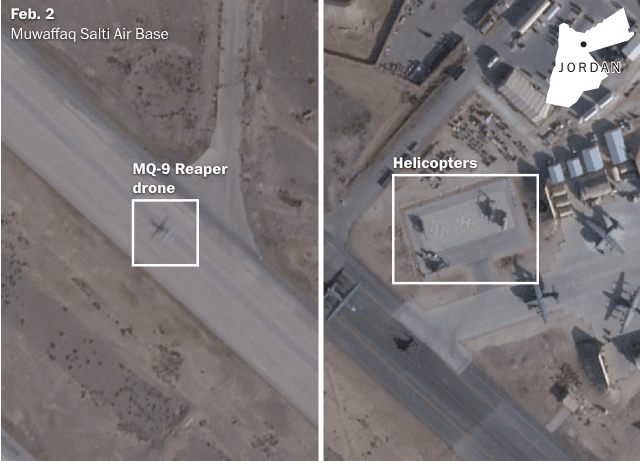
    Jordan’s Muwaffaq Salti Air Base tells a similar tale. January 25 shots show over a dozen F-15E Strike Eagles—veterans of last summer’s nuclear raids—parked alongside nine A-10 Thunderbolts, ground-attack workhorses for close air support. MQ-9 Reaper drones and HC-130J rescue planes have joined them, hinting at preparations for contested extractions deep in enemy territory. “Search-and-rescue assets like these scream high-risk ops,” Gregory Brew, a senior Iran analyst at Eurasia Group, noted in the Post. “If you’re planning to penetrate Iranian airspace, you need retrieval plans for downed pilots.”

    Naval forces amplify the threat. The Abraham Lincoln, redirected from the South China Sea in late January, now anchors the North Arabian Sea with three Arleigh Burke-class destroyers—USS McFaul, USS Mitscher, and others—each laden with air defenses and cruise missiles. Satellite views from January 26 confirm at least eight more warships in the Gulf, including the USS Delbert D. Black in the Red Sea and USS Bulkeley in the eastern Mediterranean. “This armada isn’t for show,” Brew added. “Growlers jam radars; F-35s punch holes in defenses. It’s geared for interior strikes, not just coastal deterrence.”

    Satellite imagery captured on Jan. 25 shows at least a dozen F-15E fighter jets and nine A-10C Thunderbolt II, according to Sean O’Connor an imagery analyst with Janes who reviewed the imagery at The Post’s request.

    Chinese outlet Global Times, citing MizarVision imagery, echoes the alarm: January 26 shots of Kuwait’s Ali Al Salem base show fresh Patriot deployments, while Bahrain’s Naval Support Activity hosts littoral combat ships. “US forces have stepped up movements… for both attack and defense,” the report states, warning of a “rising probability” of limited strikes. ABC News, analyzing Planet Labs data from January 17 to February 2, highlights Patriot interceptors at Al Udeid—absent weeks prior—bolstering defenses against Iran’s Khorramshahr-4 missiles.

    Satellite imagery captured on Feb.2 shows at least one MQ-9 Reaper drone and several multiple-utility helicopters.
    Satellite imagery captured on Feb.2 shows at least one MQ-9 Reaper drone and several multiple-utility helicopters.

    Iran counters asymmetrically: Flight data shows drones swarming the Strait of Hormuz, with the Shahid Bagheri drone carrier spotted January 26. “Unsafe behavior risks escalation,” CENTCOM warned Friday.

    An Iranian drone carrier loiters in the Strait of Hormuz on Saturday. (Planet Labs)
    An Iranian drone carrier loiters in the Strait of Hormuz on Saturday. (Planet Labs)

    Neocon Fingerprints: From Iraq to Iran, the Same Playbook

    This surge isn’t born in a vacuum—it’s the toxic fruit of neoconservative ideology, long criticized for fabricating pretexts for endless wars. Trump’s January 28 Truth Social post—”Abraham Lincoln heading to Iran… far worse than last summer”—evokes the 2003 WMD lies that birthed the Iraq quagmire, costing trillions and millions of lives. Critics see Netanyahu’s shadow: Facing corruption trials and coalition fractures, the Israeli PM has lobbied Washington for strikes to divert domestic ire from Gaza’s fallout.

    “Neocons like Bolton and Pompeo—Trump’s ghosts—push this as ‘regime change lite,’” says Trita Parsi of the Quincy Institute, an anti-war think tank. “But it’s a trap: Venezuela’s Maduro raid was a farce; Iran’s hardened bunkers demand boots on ground Trump won’t commit.” Chinese expert Sun Degang, via Global Times: “Difficult to replicate ‘Venezuela model’—Iran’s structure isn’t one-man rule. Strikes weaken, but don’t topple.”

    Liu Zhongmin of Shanghai International Studies University: “U.S. retrenchment strategy contradicts entanglement. No ground forces? No regime change.” Anti-war activists decry the hypocrisy: While Trump sanctions Rosneft and Lukoil to squeeze Moscow’s oil lifeline, he’s inflating a Gulf bubble that benefits Israeli hawks. “Netanyahu’s lifeline—U.S. muscle—prolongs Palestinian suffering,” Parsi adds. “This buildup isn’t deterrence; it’s provocation.”

    Iran’s retort: Ali Shamkhani, Khamenei’s advisor, vowed January 28: “Any action… beginning of war. Response immediate, targeting aggressor, Tel Aviv, supporters.” FM Abbas Araghchi: “Ready for negotiations… or war.” Protests in Tehran—6,000 dead in crackdowns, per rights groups—fuel regime paranoia, but strikes risk unifying Iranians against “Zionist-American aggression.”

    Most Read in US Politcs

    The Human Cost: Echoes of Past Fiascos

    Last summer’s nuclear hits—B-2 bombers from Diego Garcia—crippled Iran’s program but sparked 12-day clashes with Israel. Now, imagery shows no B-2s at Diego (January 17-26: Just C-17s), but experts like Zhang Junshe warn: “Strategic bombers signal intent. Absent them, it’s bluff—or prelude.” The War Zone: “No mass tactical airpower influx—suggests limited op, unless Israel joins.”

    Yet escalation’s shadow: Iran’s missiles—intact post-2025—target U.S. bases within 700km. Fabian Hinz of IISS: “Arsenal designed for Israel/U.S. sites—still potent.” Anti-war lens: This risks “total eradication of Western civilization,” per Parsi—burning flags in “pro-Palestine” protests, not Israeli streets.

    Trump’s “armada” rhetoric—likening to Venezuela’s failed raid—ignores geography: Iran’s resilience, 4,000km from Diego, defies quick wins. “Neocons dream of decapitation,” says Liu. “But chaos ensues—uncontrolled outcome Washington dreads.”

    A Call for Sanity: Diplomacy Over Drums of War

    As satellites unmask this buildup, the anti-war imperative screams: Reject neocon siren songs propping Netanyahu’s regime. Trump’s sanctions—effective against Maduro—falter against Iran’s clerical fortress. “Negotiations progressing,” per Ali Larijani January 28. Embrace dialogue, not drones.

    The Gulf’s fragile peace hangs by a thread—severed by hawks, it unleashes hell. America First? Start by bringing troops home.

    Exclusive articles