Tag: Tech

  • Reddit’s AI Answers Are About to Get Faster and More Accurate

    Reddit’s AI Answers Are About to Get Faster and More Accurate

    Reddit has expanded a partnership with Google to use the tech giant’s Gemini tool and tap artificial intelligence for Reddit Answers. Google is helping Reddit manage information from 100,000 online communities and more than 400 million weekly active users, making their online conversations more searchable for Reddit Answers, Google said on Wednesday. 

    It could mean faster and more accurate search in addition to summaries, follow-up questions and the ability to have an AI conversation about the content, not unlike what users of AI chatbot services such as ChatGPT would expect.

    Reddit unveiled Answers in late 2024, telling its users that it would be easier to search for content from Reddit — more often than not, answers to questions — without the need to go to Google and use its search function. Reddit already had a $60 million deal with Google to help train generative AI models on its content.

    The company has also been expanding its translation services across its communities with the help of AI.

    Reddit’s unique position in tech and AI

    Although Reddit’s AI efforts may be much more visible to people lately, the company has been positioning itself with the technology for a while, said Rowan Curran, a senior analyst at Forrester Research.

    “Reddit’s AI efforts have been ongoing for a number of years across a number of fronts,” Curran said. “For example, they were one of the early companies to develop their own model for code generation and assistance to support Reddit’s developers.”

    While the company is getting some outside assistance with AI, it’s also attractive to companies such as Google and OpenAI because of how much content it owns and generates. 

    “Reddit’s position as both a provider as well as a well of information puts them in a somewhat unique position to attempt to capitalize heavily both on the ingestion and preparation of data for AI use cases, as well as the serving of answers and information created from that data,” he said.

    Reddit’s position as an ongoing generator of deeply human discussion is something that shouldn’t be lost in the rush to implement AI, says author Christine Lagorio, who wrote about the company in her book We Are the Nerds: The Birth and Tumultuous Life of Reddit, the Internet’s Culture Laboratory.

    “I certainly hope it doesn’t diminish Reddit’s strength, which is increasingly its ecosystem of real human answers to real human questions, a welcome contrast from the rest of the increasingly artificial (and artificial-sounding, and artificial-looking) web,” Lagorio said.

  • OpenAI has filed a lawsuit against Elon Musk, saying he’s not acting in good faith.

    OpenAI has filed a lawsuit against Elon Musk, saying he’s not acting in good faith.

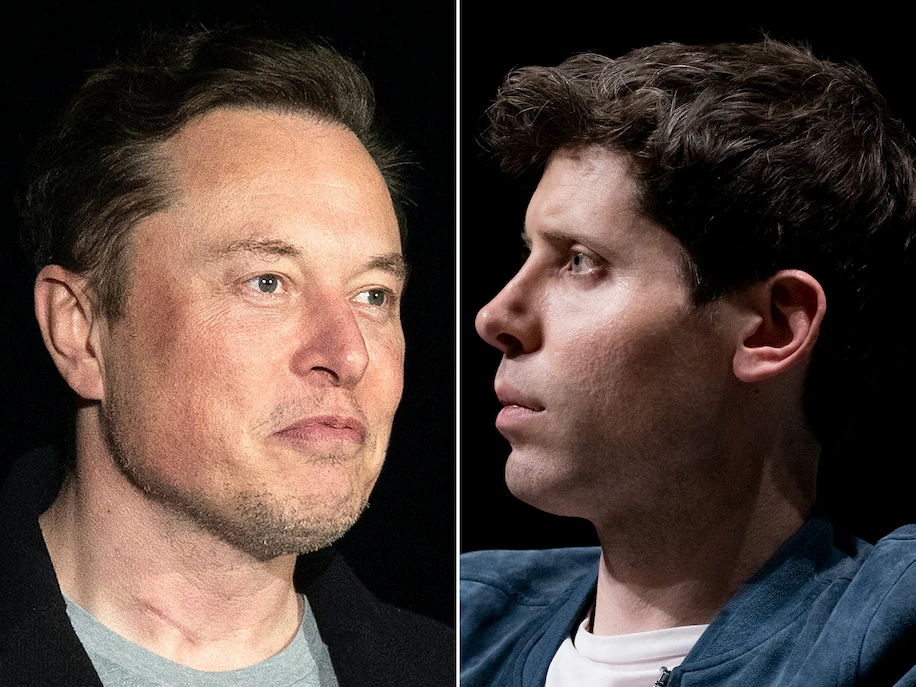
    OpenAI is suing Elon Musk over claims he has tried “nonstop” to slow down its business for his own benefit.

    The company accuses the Tesla boss of using “bad-faith tactics” against OpenAI to help him control cutting-edge AI technology.

    Mr Musk sued OpenAI chief executive Sam Altman last year in a bid to stop him from changing its corporate structure. He co-founded OpenAI with Mr Altman but left several years ago. 

    The countersuit opens up a new front in the high-stakes – and long-running – battle between two Silicon Valley heavyweights, who both say they are acting in the best interests of OpenAI and the public.

    “Elon’s nonstop actions against us are just bad-faith tactics to slow down OpenAI and seize control of the leading AI innovations for his personal benefit,” OpenAI said in a statement on Wednesday. “Today, we countersued to stop him.”

    Last week, a federal judge in Oakland, California, set a March 2026 trial date in Mr Musk’s suit in a bid to fast-track the legal fight.

    US District Judge Yvonne Gonzalez Rogers previously declined to grant Mr Musk an injunction that would temporarily halt OpenAI’s conversion from a non-profit to a for-profit company.

    She also said that she expected Mr Musk to give evidence in the case.

    Mr Musk alleges that OpenAI strayed from its founding mission as a non-profit to develop AI for the benefit of humanity and is therefore in breach of contract.

    He left the company in 2018.

    “This is about control. This is about revenue. It’s basically about one person saying, ‘I want control of that start-up’,” said Ari Lightman, professor of digital media and marketing at Carnegie Mellon University.

    Lightman said it has been a distraction from making AI safe and equitable.

    “That takes a backseat with all this rigmarole over control and monetization,” Lightman said.

    OpenAI claims Mr Musk has “been spreading false information about us,” in a X post on Wednesday, adding “Elon’s never been about the mission. He’s always been about his own agenda.”

    Musk’s xAI is a competitor to OpenAI, but has so far lagged behind. Last month, xAI acquired Musk’s social media platform X – formerly Twitter.

    Mr Musk claims the combined company, XAI Holdings, is valued at more than $100 billion.

    In February, Mr Musk made an unsolicited bid for OpenAI, offering to buy it for $97.4 billion, which Mr Altman rejected by posting: “no thank you but we will buy twitter for $9.74 billion if you want.”

    In a statement to the BBC, Mr Musk’s lawyer Marc Toberoff said: “Had OpenAI’s Board genuinely considered the bid, as they were obligated to do, they would have seen just how serious it was.”

    “It’s apparent they prefer to negotiate with themselves on both sides of the table than engage in a bona fide transaction in the best interests of the charity and the public,” Mr Toberoff added.

  • Meta appoints Dina Powell McCormick and Patrick Collison as new board directors amid a refresh.

    Meta appoints Dina Powell McCormick and Patrick Collison as new board directors amid a refresh.

    The tech giant Meta Platforms Inc. continues to refresh its board of directors, naming Dina Powell McCormick and Patrick Collison as board members, effective April 15.

    Collison is the co-founder and CEO of the payments platform Stripe, while Powell McCormick is vice chair, president and head of global client services at the merchant bank BDT & MSD Partners. 

    Powell McCormick also has strong connections in Republican politics, serving as deputy National Security Advisor to President Trump, and as an assistant Secretary of State for Condoleezza Rice. She is also married to Republican Senator Dave McCormick of Pennsylvania.

    The additions of Collison and Powell McCormick to Meta’s board comes just a few months after Meta CEO Mark Zuckerberg announced three new board members, including UFC CEO Dana White. The company has now added five new board members in just four months.

    “Patrick and Dina bring a lot of experience supporting businesses and entrepreneurs to our board,” Zuckerberg said in a statement. “Patrick is deeply committed to expanding economic opportunity, and Dina has a long career advocating for economic development and supporting entrepreneurs. Their perspective will be extremely valuable to businesses that rely on our services to grow.”

    “Between WhatsApp, Instagram and Facebook, Meta is one of the internet’s most important platforms for businesses. I look forward to helping them navigate the abundant opportunities of the coming years,” said Collison.

    “I’m excited to bring my experience in finance, government and economic development to support the people and entrepreneurs who use Meta’s services,” added Powell McCormick.

  • What Is Open-Source Artificial Intelligence (AI)?

    What Is Open-Source Artificial Intelligence (AI)?

    Illustration of data, update about Open-Source Artificial Intelligence (AI). © Hedy Larson/NYB
    Illustration of data, update about Open-Source Artificial Intelligence (AI). © Hedy Larson/NYB

    Open-source artificial intelligence (AI) refers to AI software, tools, models, and datasets that are publicly available for anyone to use, modify, and distribute—usually under an open-source license. Unlike proprietary AI systems, which are controlled and distributed by a single company, open-source AI encourages transparency, collaboration, and innovation by allowing developers, researchers, and organizations to access the technology’s inner workings.

    Key Characteristics of Open-Source AI

    Publicly Accessible Code
    The source code for an open-source AI system is openly available, allowing anyone to review how it works, make modifications, or build upon it.

    Collaborative Development
    Contributions can come from a global community of developers, researchers, and companies, leading to rapid improvements and diverse perspectives in problem-solving.

    Open Licensing
    Open-source AI is distributed under licenses such as MIT, Apache 2.0, or GNU General Public License (GPL), which define how the software can be used, modified, and redistributed.

    Transparency and Trust
    By allowing public access to algorithms and training methods, open-source AI makes it easier to detect bias, improve accuracy, and ensure ethical use.

    Examples of Open-Source AI Projects

    TensorFlow – An open-source machine learning framework developed by Google.

    PyTorch – A deep learning framework originally created by Facebook’s AI Research lab.

    Hugging Face Transformers – A library for natural language processing (NLP) models like BERT and GPT.

    Stable Diffusion – An open-source image generation model that allows users to create AI-generated art.

    Scikit-learn – A popular machine learning library for data analysis and predictive modeling.

    Benefits of Open-Source AI

    Cost-Effective – Reduces the cost barrier for startups, researchers, and students.

    Faster Innovation – Global collaboration accelerates development.

    Customizability – Users can adapt the AI to their unique needs.

    Ethical Oversight – Transparency allows communities to identify and fix harmful or biased behavior in AI systems.

    Challenges of Open-Source AI

    Security Risks – Open code can be exploited for malicious purposes.

    Misuse Potential – Powerful AI models can be repurposed for harmful applications.

    Lack of Centralized Support – Users may rely on community help instead of official customer service.

    The Future of Open-Source AI

    Open-source AI is likely to play a major role in democratizing AI technology. As major companies like Meta, Google, and Microsoft experiment with partially open models, and as communities like Hugging Face expand, we can expect open-source AI to become even more influential in research, business, and creative industries.

    However, debates around regulation, safety, and intellectual property will shape how freely AI models can be shared in the coming years. Balancing innovation with responsibility will be the key challenge.

    Open-source AI is transforming the AI landscape by making powerful technology accessible to everyone. It promotes transparency, innovation, and collaboration—while also requiring careful oversight to prevent misuse. In the right hands, it can be one of the most powerful forces driving technological progress in the 21st century.