Thirty years ago on April 19, 168 people were killed and hundreds more suffered injuries in the Oklahoma City bombing — still the deadliest homegrown terrorist attack in the history of the United States.
Their stories are preserved and honored by the Oklahoma City National Memorial and Museum, which pays homage to the victims by commemorating their lives and legacies while centering its mission around educational initiatives against violence.
“The memorial museum was created to remember and teach the brutality of the attack and the tenderness of the response. It’s about teaching the story of the senselessness of violence,” said Kari Watkins, the CEO of the museum. “We average about half a million visitors a year, and we work to teach those people to meet the people who were impacted, those who were killed, those who survived and those changed forever. It helps us keep this story relevant and alive.”
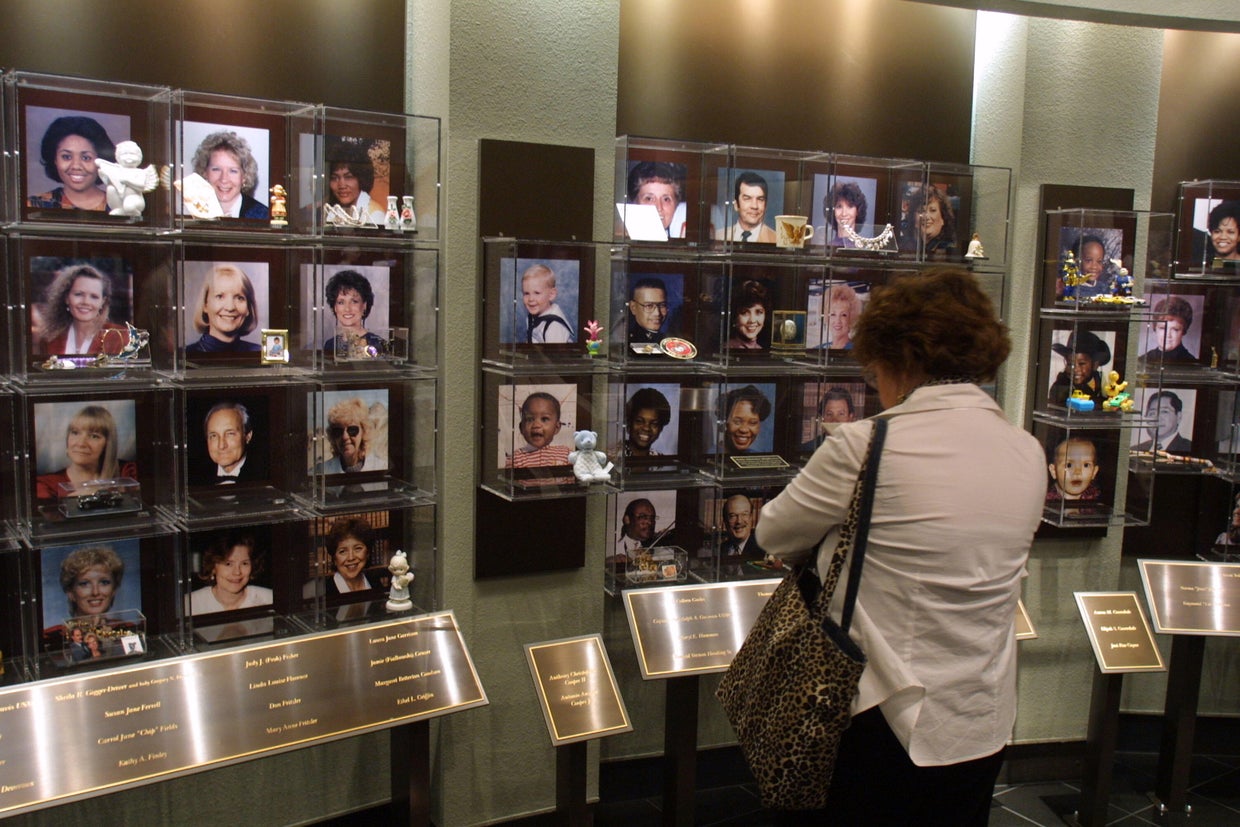
The 1995 attack targeted a federal building, and most of the people killed worked for the U.S. government. Lucio Aleman, Jr., a safety engineer with the Federal Highway Administration and father of two, was 33 when he died in the bombing. His biography appears on the memorial museum’s website alongside the other victims.
Beside Aleman’s photograph is one of Teresa Alexander, also 33, who had three children and worked multiple full-time jobs, including as a nurse’s assistant, a role in which those who knew her said she “enjoyed doing the little extras for patients.” Alexander was visiting the building to pick up her son’s Social Security card when it was bombed, according to the museum.
Scrolling farther down the webpage reveals a sea of names and faces, some belonging to toddlers and infants. At just 3 months old, Gabreon DeShawn Lee Bruce was the youngest victim. His sister, 3-year-old Peachlyn Bradley, and his grandmother, Cheryl E. Hammon, were both killed in the bombing, too.
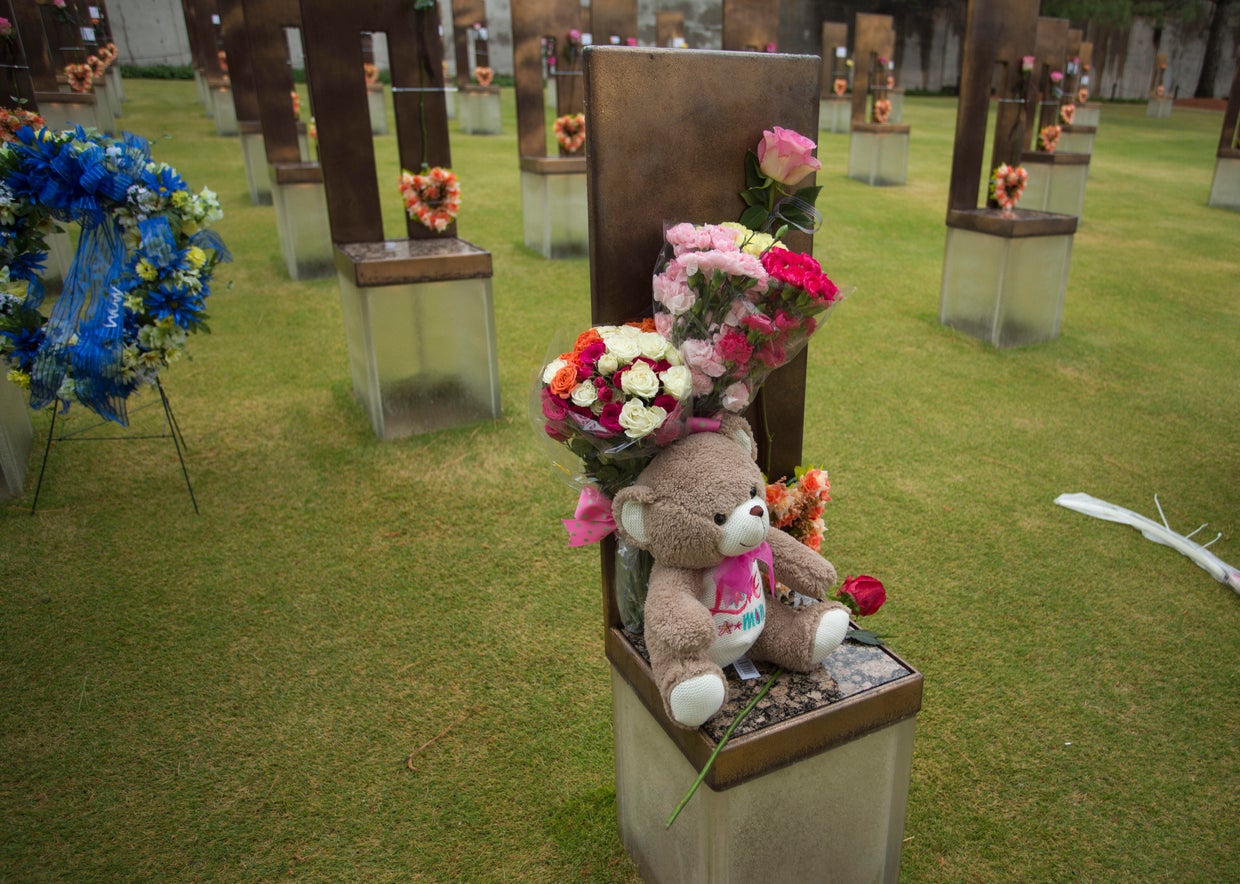
As survivors and families who lost loved ones look back on what the memorial museum refers to as “a day of darkness” three decades on, here’s what to know about the attack.
When was the Oklahoma City bombing and what happened?
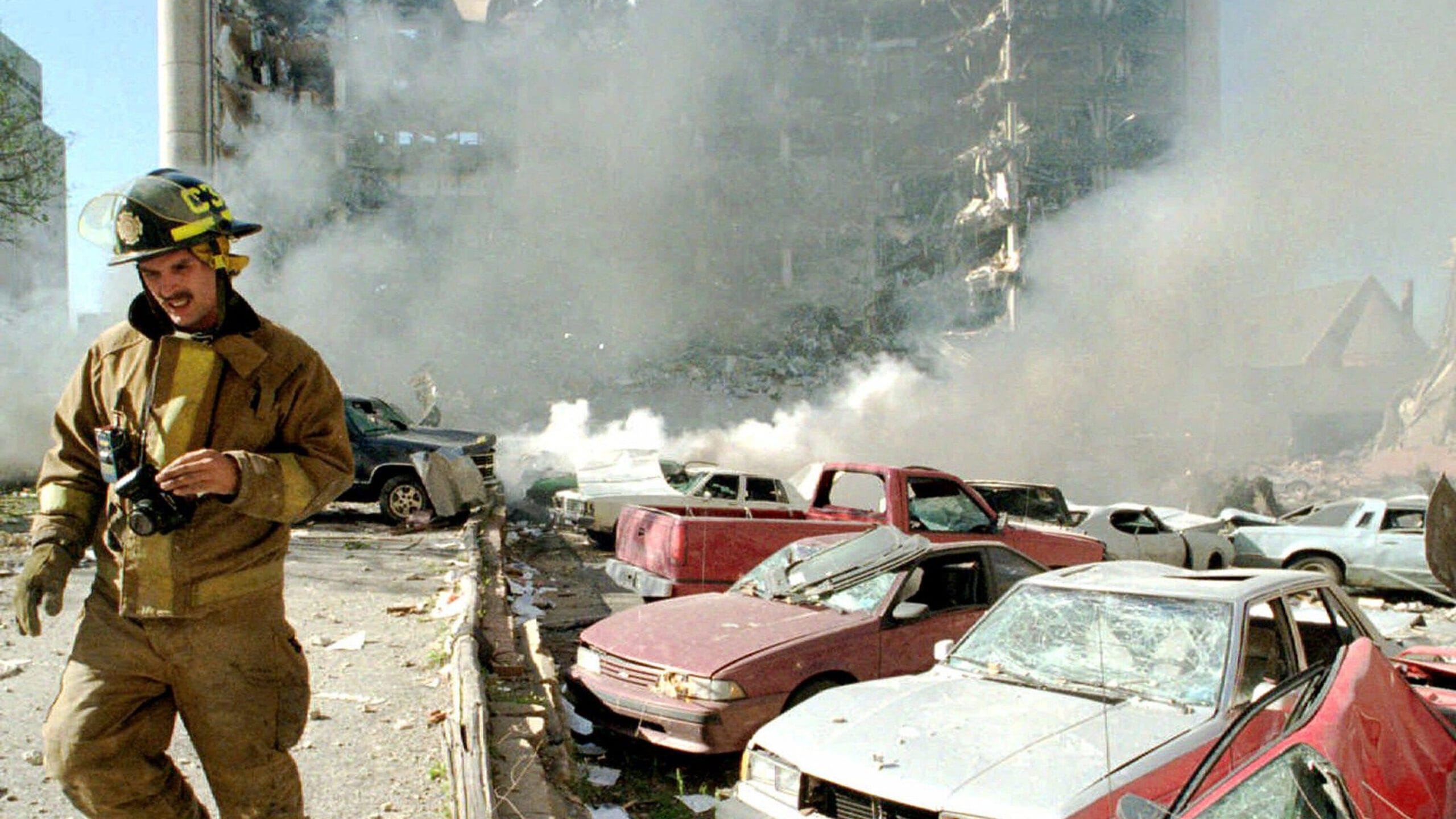
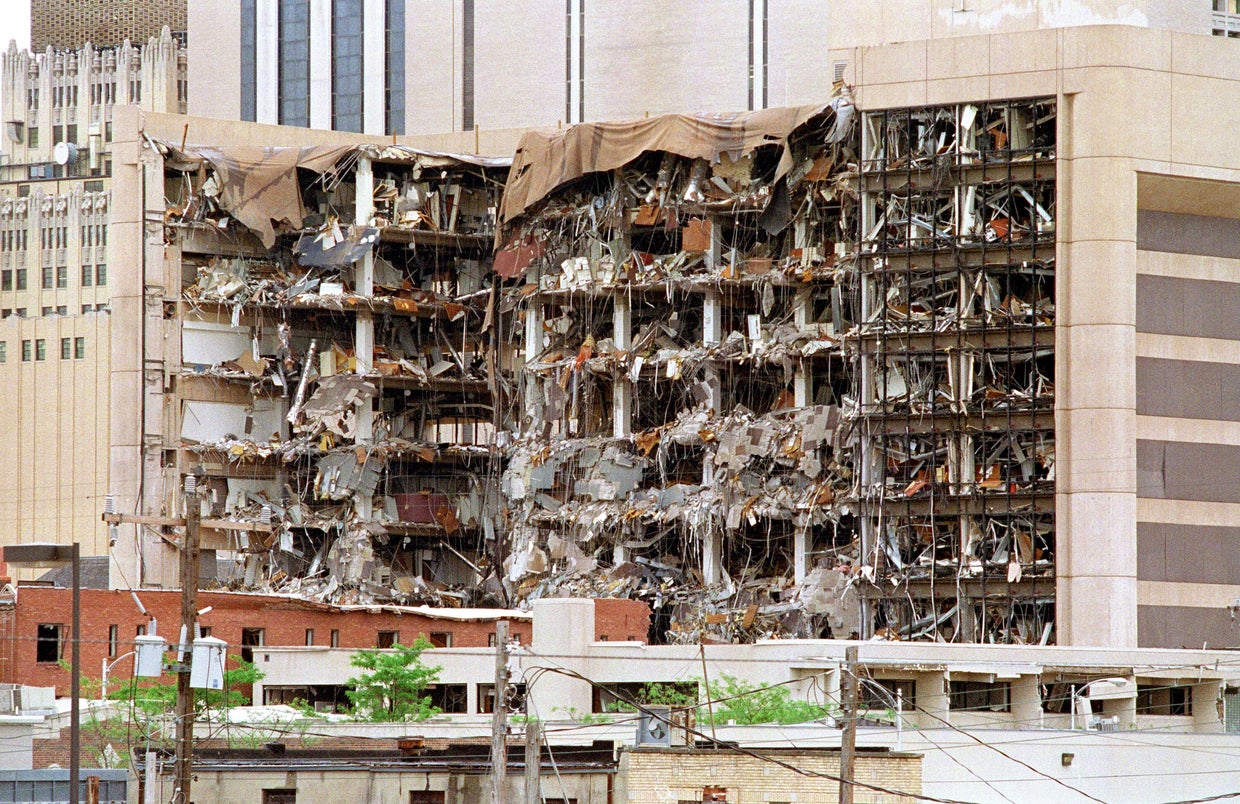
The bombing happened on April 19, 1995, at the Alfred P. Murrah Federal Building in Oklahoma City. Nineteen children, most of whom were at a day care center in the building, were among the 168 people killed in the attack. More than 600 people suffered injuries that included severe burns and other physical traumas caused by the explosion itself or the structure’s subsequent collapse. Search and rescue operations continued for more than a week after the blast, as crews located and retrieved survivors trapped beneath the debris.
A former Army soldier, Timothy McVeigh, detonated the bomb. Federal agents who investigated the tragedy determined that McVeigh acted alone on the day of the explosion, but a friend of his, Terry Nichols, helped build the bomb and another man, Michael Fortier, knew of the plot before it was carried out. Nichols and Fortier were ultimately convicted as co-conspirators in the crime.
At 9:02 a.m. local time on the morning of the bombing, McVeigh parked a rented Ryder truck in front of the federal building in downtown Oklahoma City. At the time, the building housed regional government offices for 17 federal agencies, like the Social Security Administration, the Department of Housing and Urban Development, and the Drug Enforcement Administration, in addition to the America’s Kids Child Development Center, a snack bar and a Federal Employees Credit Union, according to the memorial museum.
On the day of the attack, 361 workers and visitors were inside, including 21 children in the America’s Kids day care center. Ninety-eight of the victims were federal government workers, and another three were employed by the state of Oklahoma.
Inside McVeigh’s rental truck was a powerful homemade bomb, made using a mix of fertilizer, diesel fuel and other chemicals, the Federal Bureau of Investigation said. He exited the vehicle that morning, locked the doors and, while heading toward a getaway car, ignited two timed fuses that set off the explosion.
About one-third of the Alfred Murrah building was reduced to rubble within moments, and authorities say 300 nearby buildings were either damaged or destroyed in the blast.
McVeigh was arrested roughly 90 minutes after fleeing the scene, during a traffic stop about 80 miles north of Oklahoma City. A state trooper initially flagged his car’s missing license plate and, later, the concealed weapon inside his vehicle. Agents went on to discover traces of the chemicals used to create the bomb on McVeigh’s clothing and some other items in his possession.
Who was Timothy McVeigh?
A U.S. Army veteran and security guard prior to the Oklahoma City attack, McVeigh was 27 at the time of the bombing. He was convicted in 1997 on numerous federal charges for his role, including conspiracy, using a weapon of mass destruction and multiple counts of first-degree murder. McVeigh was executed by lethal injection in 2001, becoming the first federal inmate to receive the death penalty in almost 40 years.
Authorities found McVeigh was motivated by strong anti-government sentiment, mainly rooted in the U.S. involvement in the Gulf War, where he previously had been stationed as a soldier, along with then-recent standoffs between federal agents and civilians during clashes in Ruby Ridge, Idaho, and Waco, Texas.
McVeigh’s radicalization ultimately pushed him to the extreme: discovered inside his getaway car on April 19, 1995, was a copy of “The Turner Diaries,” a white supremacist novel authored by neo-Nazi leader William Luther Pierce, which has been called “the bible of the racist right” and considered an inspiration for the Oklahoma City bombing and other acts of domestic terror.
What is the connection to the Waco siege?
McVeigh’s hostility toward the government intensified after the 1992 Ruby Ridge killings and the Waco siege eight months later, where civilians died in standoffs with officers. In Waco, the 51-day siege ended April 19, 1993, exactly two years before the Oklahoma City bombing, with dozens of members of the Branch Davidian religious sect perishing in a fire. Some blamed federal authorities for their deaths, and the outcome of that standoff became a call to arms for far-right extremist and anti-government groups.
According to the FBI, McVeigh had visited Waco during the clash at the Texas compound, and, citing the incident as motivation for the bombing, later said he believed the government had declared war on the American people. He saw himself as a revolutionary and considered the Oklahoma City bombing part of that misguided revolution.
“If government is the teacher, violence would be an acceptable option,” he told CBS News correspondent Ed Bradley in a “60 Minutes” interview in 2000, when asked whether using violence against the government was acceptable or not.
Is there a connection to the Columbine shooting?
On April 20, 1999, teenagers Dylan Klebold and Eric Harris killed 12 of their fellow students and one teacher in a shooting at Columbine High School in Littleton, Colorado.
The massacre, which marked the beginning of a rise in mass shootings at U.S. schools, also involved an attempted bombing. According to investigators, the two teenage gunmen, both of whom died by suicide, had constructed and planted homemade explosives that failed to detonate.
Harris referenced the Oklahoma City bombing in his personal writings while planning the attack. In one passage, which the Jefferson County Sheriff’s Office in Colorado released years after the shooting, the teenager wrote that the event would “be like the LA riots, the oklahoma bombing (sic), WWII, vietnam (sic), duke and doom all mixed together,” with “duke and doom” apparently referring to graphic video games in the mid-90s.
Harris’ writings suggested he intended the Columbine attack to be much larger than it was, according to Dave Cullen, journalist and author of “Columbine” who spent years researching the shooters. He “would brag about topping McVeigh,” Cullen wrote.